

Buying another truck won't fix your profit problem. In fact, it might just accelerate your bankruptcy. You see the numbers every Friday. Your fuel overhead is climbing. Your labor margins are disappearing into the asphalt. Most contractors think the answer is more equipment and more debt. They are wrong. The real bottleneck is your windshield time. Every minute your crew spends in traffic is a minute you aren't getting paid. It is a leak in your bucket that no amount of new business can plug.
You know the frustration of a scattered route map. It is exhausting. You are likely tired of managing a fleet that costs more to maintain than it earns in the field. This guide provides the master plan for lawn care logistics management in a high-cost economy. You will learn how to eliminate non-billable hours and optimize route density until your profit per mile spikes. We are moving away from the heavy-debt trap. Instead, we will show you how to scale using an asset-light model. This involves strategic account trading and leveraging rental networks to grow without the weight of massive monthly payments. It is time to stop driving and start earning.
Key Takeaways
- Stop treating travel as an unavoidable cost and start mastering lawn care logistics management to eliminate the profit-killing drain of windshield time.
- Transition from a scattered service map to geographic asset clustering, reducing the fuel and labor waste inherent in traditional "hub and spoke" operations.
- Scale your seasonal capacity using a rental-first model to avoid high-interest equipment loans and the hidden costs of maintenance downtime.
- Leverage account trading and swaps to perform logistical arbitrage, trading distant high-revenue jobs for high-density clusters that maximize profit per mile.
- Conduct a systematic "Windshield Audit" to identify your most expensive miles and build a leaner, more profitable route framework for 2026.
Lawn Care Logistics Management: Defining the Efficiency Gap
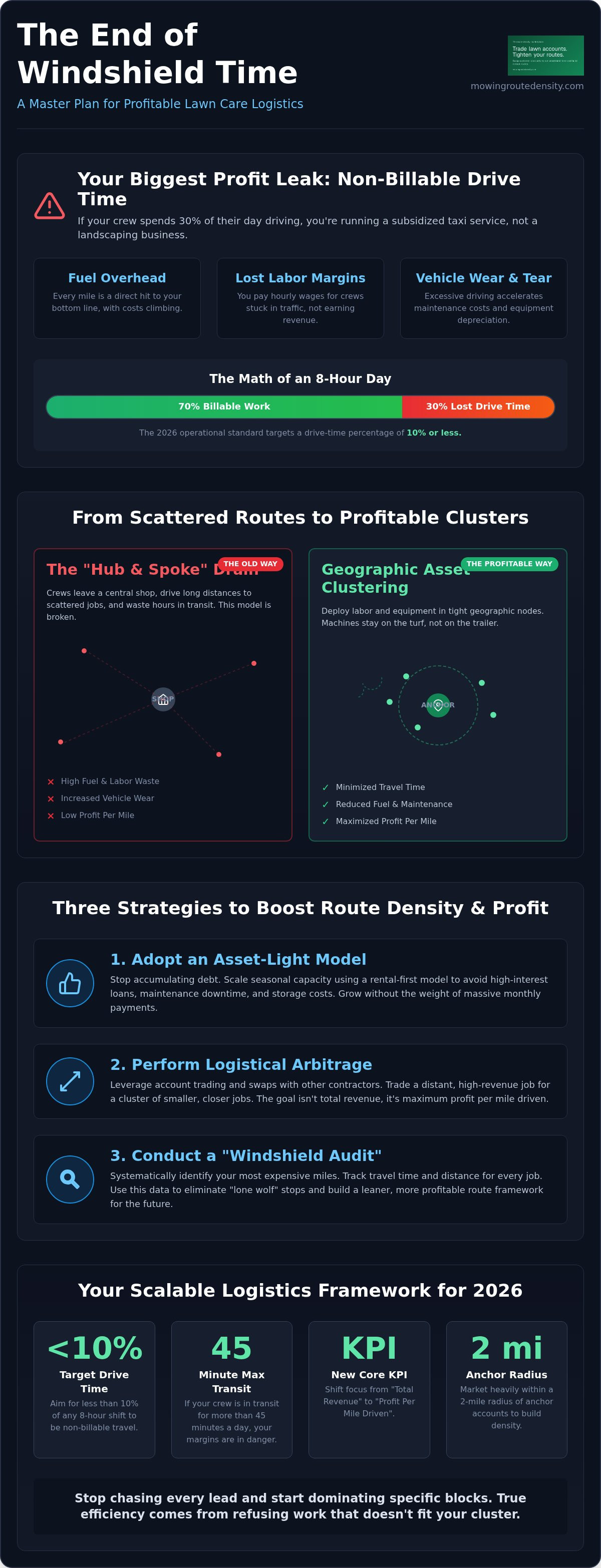
Most owners think they have a labor problem. They don't. They have a geography problem. Logistics is the strategic coordination of your labor, your equipment, and the ground you cover. In 2026, fuel prices and labor shortages have turned loose routing into a terminal business mistake. If your crews spend 30% of their day behind a steering wheel, you aren't running a landscaping company. You are running an expensive, subsidized taxi service for mowers. The shift from "growth at any cost" to "margin-first logistics" is no longer optional; it is a requirement for survival.
The Math of Non-Billable Hours
Every mile driven is a direct hit to your bottom line. You pay for the fuel. You pay for the truck's wear. Most importantly, you pay the hourly rate for a crew that isn't producing revenue. Calculate the true cost: take your total crew hourly rate plus your vehicle operating cost per mile. If you're driving 15 miles between jobs, that's 20 minutes of lost production. Over a week, that’s dozens of hours gone. We define "logistics leakage" as the gap between your potential revenue if every hour was billable and the actual revenue you collect after accounting for travel. It's the silent leak that sinks otherwise healthy firms.
Why Traditional Routing Software Often Fails
Software is a tool, not a strategy. Standard apps are great at finding the "shortest distance" between two points. They are terrible at telling you that those two points shouldn't both be on your schedule. Effective lawn care logistics management requires density, not just directions. A "perfect" route that spans three zip codes is still a failure. You need manual oversight to ensure you aren't just optimizing a broken map. True efficiency comes from refusing work that doesn't fit your cluster, no matter how high the contract value seems.
The 2026 Operational Standard
The industry is changing. Successful firms now target a drive-time percentage of 10% or less. If your team is in transit for more than 45 minutes in an 8-hour shift, your margins are in danger. You must set logistics KPIs for your crew leaders. Track "profit per mile driven" instead of just total revenue. Use real-time data to adjust daily operations. If a crew hits a delay, don't just push the schedule back. Re-route based on the nearest cluster. In a $184.1 billion industry, the winners are those who stop chasing every lead and start dominating specific blocks.
Maximizing Efficiency Through Asset Clustering
Stop driving across the county. Most owners operate a "hub and spoke" model. Crews leave the shop, hit a job, drive 20 minutes, and hit another. This model is dead. It kills your trucks. It kills your labor budget. Asset clustering is the only logical replacement. You deploy your labor and equipment in tight geographic nodes. By focusing on lawn care route density, you ensure your machines stay off the trailer and on the turf. This reduces wear on your transport vehicles and saves thousands in fuel. Modern Data-Driven Fleet Management proves that the most profitable miles are the ones you never drive. Effective lawn care logistics management isn't about moving faster; it's about moving less.
The "hub and spoke" drain is a silent killer. Every time a truck returns to the shop for a different piece of gear or a crew swap, you lose money. Clustering keeps your assets in the field. It minimizes the time spent loading and unloading trailers. This isn't just about saving fuel. It's about equipment longevity. Engines that stay at operating temperature all day while working are more efficient than those that sit idling in traffic or cooling down on a trailer. Tightening your geography is the first step toward an asset-light future.
The Anchor Account Strategy
Every cluster needs a center of gravity. We call this an anchor account. This is usually a high-margin commercial property or a large facility that provides four to six hours of billable work. Once you have an anchor, you can justify keeping a dedicated crew in that specific zone. You don't need to drive back to the shop. Look at your current client list. Where are you already profitable? Identify those properties and market heavily within a two-mile radius. You aren't just selling mowing; you're building a fortress of density that competitors can't touch.
Eliminating the "Lone Wolf" Stop
The "Lone Wolf" account is the client 15 miles away from your nearest stop. They might pay on time, but they are a logistical cancer. When you factor in drive time, fuel, and the opportunity cost of not being in your cluster, that account is likely a net loss. Firing these clients is often the fastest way to increase your profit margin. If you aren't ready to drop them, use a lawn account trading platform to swap that outlier for a property inside your existing clusters. Effective lawn care logistics management requires you to be ruthless with your schedule. Don't be afraid to cut the dead weight.
Asset-Light Strategy: Equipment Rental vs. Ownership
Ownership is a trap many contractors fall into because they equate "stuff" with "success." It's a mistake. Every mower in your shop is a five-year commitment to maintenance, storage, and depreciation. This is where lawn care logistics management often fails. You take on a massive loan for a zero-turn that sits idle four months of the year. That isn't an asset; it's a capital anchor. Scaling your business shouldn't mean scaling your debt. In 2026, the most agile firms are those that own the accounts and rent the iron. This approach keeps your balance sheet clean and your fleet ready for any route.
Reducing Fleet Idling Costs
Equipment that doesn't move doesn't earn. Yet, you still pay for the warehouse space it occupies and the insurance it requires. Strategic professional lawn equipment rental allows you to bypass these "ghost" costs entirely. You pay only for the machines you are actually billing to a client. Fleet elasticity is the ability to scale equipment up or down based on current route demand. Why pay for a 72-inch deck in December when you only need it in May? Renting ensures you aren't subsidizing a fleet that spends half its life under a tarp.
Minimizing Maintenance Logistics
Maintenance is a logistical nightmare that kills your schedule. A blown hydraulic line on a Tuesday morning doesn't just stop one crew; it wrecks the entire week's production. When you own the fleet, that downtime is your financial burden. When you rent, it is the provider's problem. You outsource the logistics of oil changes, blade sharpening, and major repairs to your rental partner. Most reputable networks provide guaranteed replacements to ensure 100% uptime. This keeps your focus on the turf and your crews moving toward the next job.
Capital Preservation for Marketing
Every dollar tied up in a depreciating asset is a dollar not spent on acquiring new customers. Ownership limits your agility. If you want to test a new service zone, renting allows you to do so without a long-term financing commitment. Reinvest that "equipment cash" into account acquisition and route tightening. Buy density, not iron. Leveraging rentals allows you to prove a route's profitability before you ever sign a purchase agreement. It's the smarter, leaner way to scale a modern landscaping business.
Optimizing Logistics via Account Trading and Swaps
Growth is a trap if it isn't dense. Most contractors celebrate a new contract without looking at the map. That is a mistake. If that new account sits ten miles from your nearest stop, you just bought yourself a logistical headache. True lawn care logistics management requires a shift in perspective. You must view your accounts as tradable assets. Logistical arbitrage is the practice of trading a high-revenue scattered account for multiple lower-revenue clustered ones. The math is simple. Your profit per hour is significantly higher when your mower blades are spinning instead of sitting on a trailer. Density is the goal. Distance is the enemy.
Strategic swaps allow you to reduce your cost of acquisition (CAC). Traditional marketing is expensive and unpredictable. Swapping an outlier account for one inside your existing cluster is essentially a free lead. You are valuing an account based on its proximity to your current route. A property that is five minutes away is worth more to your bottom line than a larger property thirty minutes away. Use our lawn account trading platform to find these opportunities and tighten your operational footprint.
The Account Swap Workflow
Start by identifying your outliers. These are the stops that drain your labor margins. They are the "Lone Wolf" accounts mentioned earlier. Once you have a list, find partners in the contractor network who are already serving those specific areas. They likely have their own outliers near your clusters. Reach out. Structure a fair trade based on annual contract value and proximity. A successful swap benefits both businesses. It turns two inefficient routes into two high-density profit centers. It is a professional solution to a geographic problem.
Buying Density vs. Organic Growth
Organic growth is slow. It relies on door-to-door marketing or digital ads that may or may not land in the right neighborhood. Buying a clustered client list is a shortcut to profitability. When you purchase a route, perform strict due diligence on its logistical tightness. Don't just look at the total revenue. Look at the drive time between stops. If the route is already clustered, it is worth a premium. Integrating these accounts into your existing asset clusters is seamless. You don't need more trucks. You just need more work in the zones where your trucks already sit. This is how you scale without adding massive capital debt.
Building a Scalable Logistics Framework for 2026
Scalability isn't about how many trucks you own. It's about how many of those trucks are actually making money. In 2026, lawn care logistics management is the bridge between being a local operator and a national strategist. You need a framework that doesn't buckle under the weight of new equipment loans. Buying a bigger fleet is often just a vanity project that masks operational rot. This blueprint is your path to a leaner, more profitable operation that scales with logic, not just debt.
Follow these five steps to rebuild your logistics from the ground up:
- Step 1: Perform a "Windshield Audit" to identify your most expensive miles. If a mile doesn't lead to a cluster, it's a loss.
- Step 2: Consolidate accounts into geographic clusters. Use the asset-light tools we've discussed to focus your labor where it's most effective.
- Step 3: Offload non-dense accounts via our lawn account trading platform. Don't be emotional about "losing" a client; be clinical about gaining margin.
- Step 4: Use commercial mower rental to handle seasonal surges. This prevents the "idle fleet" problem during the off-season.
- Step 5: Continuously monitor route density KPIs. Logistics drift is a slow poison that returns the moment you stop paying attention.
Conducting a Logistics Audit
Data doesn't lie, but your gut often does. You need to identify the "Profit Per Mile" for every truck in your fleet. Start by mapping your current accounts. Look for natural clusters and the "Lone Wolf" outliers that sit outside them. Set a maximum allowable drive time between stops. If a property takes more than 10 minutes to reach from your last job, it's a candidate for a swap. This audit isn't a one-time event. It's a quarterly requirement to keep your lawn care logistics management tight and your margins protected.
The Role of the Service Provider Locator
You don't need to own the mower to own the margin. A specialized B2B lawn mowing service provider locator allows you to scale your brand nationally without buying a single trailer. Use these locators to find reliable subcontractors for accounts that sit too far from your primary clusters. This turns a logistical nightmare into a passive revenue stream. You manage the logistics and the customer relationship; they manage the turf. Building a network of partners allows you to handle overflow logistics during peak growth periods without the risk of heavy capital investment. Work smarter. Scale faster.
Dominate Your Market with Lean Logistics
The era of "growth at any cost" is over. High fuel prices and labor shortages have made inefficient routing a death sentence. You have the tools now. Cluster your accounts. Rent your iron. Trade your way to density. This isn't just a strategy; it's a survival plan for 2026. True lawn care logistics management is about protecting your labor margins. It's about ensuring your machines are on the turf, not the trailer. By eliminating windshield time and focusing on geographic nodes, you stop subsidizing waste. You can scale your brand nationally without the weight of heavy capital debt.
It's time to stop driving and start earning. Access a national network of commercial mower rentals and a secure marketplace for trading high-density routes. Use a proven asset-light scaling framework to grow your business on your terms. Optimize your logistics and trade your way to density with Mowing Route Density. Your most profitable season is within reach.
Frequently Asked Questions
How do I calculate my lawn care route density?
You calculate route density by dividing your total billable man-hours by the total hours your crew spent on the clock. If your team worked eight hours but only mowed for five, your density is 62.5%. You can also track revenue per mile. Take your daily revenue and divide it by the total miles driven by that truck. A higher number indicates a tighter cluster. Low density means you are paying for travel instead of turf.
What is a good target for drive time between stops?
Aim for a drive time of ten minutes or less between stops. In a high-performance lawn care logistics management framework, transit should consume no more than 10% of the total workday. If your crew spends more than 45 minutes of an eight-hour shift behind the wheel, your margins are in danger. Tightening these gaps is the fastest way to increase profit without raising prices on your existing customers.
Is it better to buy or rent commercial lawn mowers for a growing business?
Renting is the superior choice for contractors pursuing an asset-light growth model. Ownership forces you into five-year debt cycles and high maintenance overhead. When you utilize a lawn mower rental, you only pay for the equipment while it is generating revenue. This preserves your capital for marketing and account acquisition. It also eliminates the logistical burden of off-season storage and unexpected repair downtime. Scale your fleet based on current route needs, not a bank loan.
How does account trading help with logistics management?
Account trading allows you to perform logistical arbitrage by swapping distant outliers for properties within your existing clusters. Instead of wasting fuel on a scattered account, you trade it to a contractor who is already in that neighborhood. In return, you use a lawn account trading platform to acquire an account near your current stops. This process instantly increases your route density and profit per mile. It is a professional shortcut to a tighter service map.
What are the main causes of logistics waste in landscaping?
Logistics waste is primarily caused by scattered service areas and excessive windshield time. Every mile driven between jobs is a non-billable expense that eats your labor margin. Other major drains include the "hub and spoke" model, where crews return to a central shop too frequently. Using over-leveraged equipment that sits idle during the off-season also creates massive financial leakage. If your assets aren't moving and earning, they are costing you money.
Can I improve my logistics without buying expensive software?
You can improve your logistics by focusing on geography rather than just algorithms. Expensive software can optimize a path, but it cannot fix a fundamentally broken route. Start by performing a manual windshield audit to identify your most expensive miles. Use a lawn account trading platform to consolidate your work into tight clusters. Combine this with strategic equipment rental to keep your overhead low. Real efficiency comes from better territory management, not just a better app.
What is asset clustering in lawn care?
Asset clustering is the practice of deploying your labor and equipment in tight geographic nodes. Instead of your crews roaming across multiple zip codes, they stay within a two-mile radius for the entire day. This focus on lawn care logistics management ensures your machines spend more time on the grass and less time on a trailer. It reduces wear on your trucks and maximizes the billable output of every crew member you employ.


