

The value of a landscaping company isn't found in its client list. It's found in its route density and asset agility. If you're looking at a 5.5x EBITDA multiple without auditing the actual logistics, you're flying blind. Performing rigorous landscaping business due diligence is the only way to separate a profitable engine from a high-overhead disaster. You likely feel the weight of this decision. You're right to worry about inheriting aging equipment debt or finding out those stable commercial contracts are built on a handshake.
It's time to stop guessing and start measuring. This guide promises to help you master the pragmatic framework for evaluating a landscaping acquisition, from verifying revenue integrity to quantifying drive-time waste. We'll audit the 2026 operational checklist to identify red flags before they drain your bank account. You'll learn how to spot operational inefficiencies and build a plan to optimize the business immediately after the purchase. Let's look under the hood of your potential investment.
Key Takeaways
- Audit three years of tax returns to verify revenue integrity and spot dangerous client concentration.
- Measure the "Drive-to-Mow" ratio to quantify drive-time waste and visualize route density gaps.
- Execute a landscaping business due diligence audit on the fleet to identify aging assets and recurring repair costs.
- Verify pesticide licenses and OSHA safety records to ensure you aren't inheriting unresolved regulatory citations.
- Build a 90-day optimization plan that includes purging inefficient accounts and replacing high-maintenance equipment with flexible rental units.
Financial Due Diligence: Verifying Revenue Integrity and EBITDA
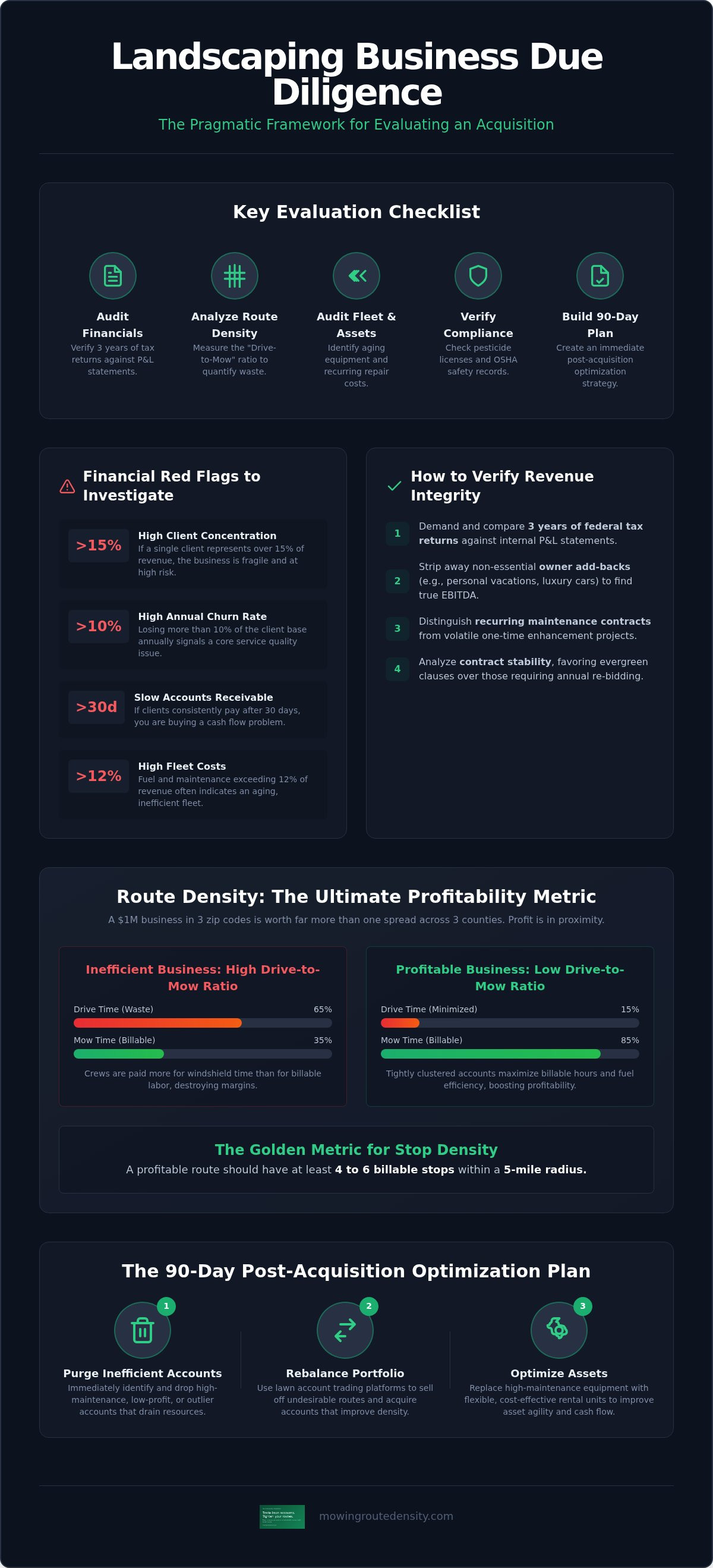
Numbers lie. Sellers lie. Your job during Due diligence is to find the truth buried in the ledger. Start by demanding three years of federal tax returns. Compare them against internal P&L statements with clinical precision. Any gap between what they told the IRS and what they're telling you is a red flag. If the numbers don't align, the seller is likely inflating performance. This is the foundation of landscaping business due diligence. Without verified revenue integrity, the rest of the audit is a waste of time.
Analyze revenue concentration immediately. If a single client accounts for more than 15% of total billings, the business is fragile. One bad relationship or one budget cut at that client's office can wipe out your margin. Check the accounts receivable aging reports next. Are clients paying within 30 days? A business that acts as a free bank for its customers has a cash flow problem, not a revenue success. You aren't just buying accounts; you're buying the reliability of those payments.
Scrutinize owner add-backs. Sellers often try to artificially inflate EBITDA by claiming personal vacations or luxury vehicles were essential business expenses. Strip these away. If an expense is necessary to run the shop, it stays on the P&L. Don't pay a premium for financial fiction. You need to see the raw, unvarnished cost of keeping the crews on the grass.
Revenue Quality and Contractual Stability
Distinguish between recurring maintenance and one-time enhancement projects. Maintenance is the floor. Enhancements are the ceiling. You can't build a stable business on a ceiling. Check for evergreen clauses versus contracts requiring annual re-bidding. Contracts that require constant re-bidding are high-stress and low-security. Audit the churn rate over the last 24 months. If they're losing more than 10% of their base annually, there's a service quality issue you'll have to fix on day one.
Expense Normalization and Margin Analysis
Compare labor costs against national benchmarks. In 2026, labor is your biggest drain. Is the seller overpaying or under-reporting hours? Audit fuel and maintenance spend as a percentage of total revenue. If these exceed 12%, the fleet is likely a collection of lemons. EBITDA normalization is the process of stripping out non-recurring costs to find true operational profit. This ensures you're paying for the engine, not the noise. Tighten the margins now or pay for the waste later.
Route Density Audit: The Ultimate Metric for Landscaping Profitability
Most buyers focus entirely on the P&L. They ignore the map. This is a fatal mistake in landscaping business due diligence. A business with $1M in revenue spread over three counties is worth far less than $1M concentrated in three ZIP codes. You need to map every service account to visualize geographic clustering. If the accounts look like scattered buckshot, you're buying a logistics nightmare. This spatial analysis is a critical addition to any due diligence checklist for buying a business. Visualizing the gaps reveals the truth about operational waste that tax returns won't show.
Calculate the 'Drive-to-Mow' ratio. This is the heartbeat of your future profitability. How many minutes do crews spend in the truck compared to minutes spent on the turf? If the ratio is skewed toward travel, you're paying for windshield time instead of billable labor. Identify outlier accounts that kill your margins. These are the high-maintenance clients located 20 miles from the nearest cluster. If you find a broken route, don't walk away immediately. You can use a lawn account trading platform to rebalance the portfolio and sell off the outliers after the deal closes.
Quantifying Drive-Time Waste
Labor is your biggest expense. Paying crews to sit in traffic is business suicide. Analyze GPS data or route logs to find the true cost of fuel and labor during transit. Look at stop density. A profitable route should ideally have at least 4 to 6 billable stops within a 5-mile radius. Higher lawn care route density directly increases the valuation multiple because it lowers the cost of goods sold. You aren't just buying grass; you're buying proximity. If the stop density is low, you are essentially buying a fleet of trucks that happens to cut grass occasionally.
Asset Clustering Opportunities
Look for anchor accounts. These are large commercial properties that can support additional growth in specific corridors. Determine if the current route structure allows for a 'hub and spoke' logistics model. Can you swap low-density residential accounts for higher-density commercial routes? Evaluate the feasibility of trading away the outliers to tighten the operation. Using a specialized route rebalancing tool during the audit phase allows you to see the business as it could be, not just as it is. Fix the map, and the profits will follow. This level of scrutiny ensures your landscaping business due diligence isn't just a financial check, but an operational deep-dive into the company's true efficiency.
Equipment and Asset Evaluation: Ownership vs. Agility
Ownership is often a liability disguised as an asset. Many buyers see a row of mowers and assume value. They're wrong. During your landscaping business due diligence, you must treat the fleet as a collection of potential repair bills. Audit the lifecycle of every machine. What percentage of the equipment is past its prime service life? Commercial zero-turn mowers often become money pits after 2,000 hours of operation. If the seller’s fleet is aging out, you aren't buying a business; you're buying a capital expenditure crisis. The SBA guide to buying a business stresses the importance of verifying physical assets to ensure they can actually generate the revenue promised in the P&L.
Review the maintenance logs with clinical suspicion. Identify "lemon" machines that show recurring repair costs for the same hydraulic or engine issues. If logs don't exist, assume the equipment has been neglected. Next, assess the debt load. Compare the outstanding loan balances against the current market value of the assets. If the seller is underwater on their equipment financing, you need to know before you sign. High-overhead debt on depreciating assets is a lead weight on your cash flow. You might find that the cost of maintaining an aging, owned fleet far exceeds the investment required for commercial lawn mower lease options that provide modern reliability without the long-term debt.
Fleet Durability and Maintenance Audit
Inspect the hour meters on every zero-turn and stand-on unit. Don't take the seller's word for it. Verify the existence of a formal preventative maintenance schedule (PMS). A business that lacks a schedule is a business that waits for things to break. Check for compliance with national safety standards. Missing ROPS (Roll-Over Protection Structures) or bypassed safety switches are liability landmines. If the equipment isn't safe, it isn't an asset. It's a lawsuit waiting to happen.
The Asset-Light Strategy for Scaling
Evaluate the benefits of offloading owned equipment to reduce balance sheet liabilities. Buying a business doesn't mean you have to keep every piece of iron the seller owned. Determine if a rental-based model for seasonal peaks is more efficient than owning specialized machines that sit idle for nine months. Asset agility in 2026 requires balancing owned core equipment with flexible rental options for growth. This approach keeps your landscaping business due diligence focused on profitability rather than just accumulating heavy machinery. Tighten your asset list to only what drives daily revenue.
Legal, Regulatory, and Compliance Risk Assessment
Compliance is not a "check the box" activity. It is a risk mitigation strategy. If you fail to perform thorough landscaping business due diligence on the legal front, you could inherit a business that is one inspection away from being shut down. Start by verifying all active pesticide and herbicide application licenses. These must be valid at both the national and state levels. If the primary license holder is the seller and they plan to exit, you have a service gap that must be filled immediately. Without these licenses, your chemical application revenue vanishes on day one.
Audit the OSHA safety records next. Look for unresolved citations or high Experience Modification Rate (EMR) ratings. A high EMR is a silent profit killer; it drives up your workers' compensation premiums and can disqualify you from bidding on high-value commercial contracts. Review all employment contracts for enforceable non-compete and non-solicitation agreements. If the current operations manager can walk across the street and take half the client list with them, the business has no defensive moat. Check for pending litigation from former employees, disgruntled customers, or unpaid vendors. Skeletons in the legal closet are expensive to bury.
Contractual Integrity and SLAs
Review the Service Level Agreements (SLAs) for every major commercial client. Sellers often promise the moon to close a deal, but can the crews actually deliver? If the SLAs are unachievable with current staffing levels, you're buying a breach of contract. Audit your subcontractor agreements too. Ensure they include proper insurance and indemnification clauses to protect your balance sheet. If the seller relies on outside help, you must learn how to find lawn care subcontractors that meet high compliance standards. Tight contracts prevent loose profits.
Environmental and Regulatory Compliance
The regulatory environment in 2026 is tightening. Check for compliance with local noise ordinances and emissions regulations, especially if the business operates in regions phasing out gas-powered equipment. Verify that chemical storage and disposal protocols meet EPA standards. Finally, audit the "Right to Work" and I-9 documentation for the entire workforce. With the H-2B visa filing window for the first half of FY 2027 closing in July 2026, you must ensure the labor force is stable and documented. A single audit can trigger massive fines and labor shortages. Before you sign the closing papers, verify your compliance strategy to ensure the foundation is solid.
Post-Acquisition Optimization: The 90-Day Efficiency Plan
The ink is dry. The keys are in your hand. But if you don't act in the first 90 days, you'll drown in the same inefficiencies that plagued the previous owner. Your landscaping business due diligence revealed the rot. Now you have to cut it out. Execute a 'Route Purge' immediately. Identify every account that sits outside your core density zones and sell them off. Keeping a distant client for the sake of top-line revenue is a vanity move that kills your bottom line. Windshield time is a silent thief. Stop letting it rob you. Every mile driven without a mower on the ground is a direct hit to your EBITDA.
Modernize the fleet by replacing the high-maintenance units you identified during the audit. Don't waste capital on new debt for specialized machines. Use professional rental equipment to handle seasonal surges. This keeps your balance sheet lean and your crews on the turf. Integrate your operations with a lawn mowing service provider locator to fill geographic gaps in your network. By connecting with other B2B partners, you can trade away your headache accounts for ones that fit your route like a glove. Implement lawn care profit margin optimization strategies on day one. If a process doesn't directly increase billable hours, kill it.
Route Rebalancing and Liquidity
Use a marketplace to trade outlier accounts. This isn't just about cleaning up the map; it's about generating immediate operational liquidity. When you trade away a low-density account for a high-density one, your profit per stop jumps instantly. Communicate this transition to your customers clearly. Focus on how a tighter route means more reliable service and faster response times. Your 90-day target is simple: reduce fuel and labor overhead by 10%. If you aren't hitting that number, you aren't optimizing. You're just coasting.
Expanding Market Share via B2B Networks
Leverage national contractor networks. These platforms provide supplemental commercial leads that fit your existing density profile. You don't need more trucks. You need more stops on the streets you already drive. If your long-term goal is a roll-up, evaluate the potential for an asset-light model. This makes the business significantly more attractive to future buyers. Plan for your own lawn care business exit strategy from the moment you take over. A business built on density and low overhead is easy to sell. A business built on scattered accounts and heavy debt is a life sentence. Tighten the operation now so you can cash out later.
Secure Your Operational Future
Buying a landscaping company is a high-stakes bet on operational efficiency. If you've followed this framework, you know exactly where the waste is hidden. You've verified the EBITDA. You've mapped the routes. Now it's time to execute. Successful landscaping business due diligence isn't about finding a perfect company; it's about finding a fixable one. You've identified the gaps, and you have the data to bridge them.
Focus on the transition. Use your 90-day plan to purge the outliers. Stop paying for windshield time. Move away from capital-heavy equipment debt by utilizing flexible rental networks. The difference between a profitable owner and a struggling one is the courage to cut the fat early. You have the tools to turn a mediocre operation into a high-density profit engine. Tighten the routes, clean the ledger, and protect your cash flow.
You don't have to build these systems from scratch. Optimize your acquisition strategy with Mowing Route Density tools to access our transaction-ready route trading platform, commercial-grade equipment rental network, and national B2B contractor locator. Take control of your margins today. You have the map; now go out and own the turf.
Frequently Asked Questions
What is the most common 'red flag' in landscaping business due diligence?
High revenue concentration is the most dangerous red flag in landscaping business due diligence. If one client generates more than 15% of total billings, the business is fragile. You are one bad relationship or one budget cut away from a cash flow crisis. Always verify the owner add-backs too. If the seller is claiming personal vacations as business expenses, they are likely inflating the EBITDA to get a higher multiple.
How long does the due diligence process typically take for a landscaping acquisition?
A thorough landscaping business due diligence process typically takes 30 to 60 days. You need this window to verify three years of tax returns and audit every equipment maintenance log. Rushing the process leads to expensive surprises. If a seller pressures you to close in under 30 days, they are probably hiding operational waste or pending litigation. Take the time to map the routes properly before signing.
Should I buy the equipment or lease it when acquiring a landscaping business?
Agility beats ownership every time. Avoid taking on capital-heavy debt for a fleet of aging mowers. Utilizing commercial rental solutions allows you to scale for seasonal peaks without the long-term liability of a depreciating asset. Successful owners in 2026 focus on asset-light growth. Use your capital to buy more high-density routes. Don't sink it into iron that will eventually break down in your shop.
How do I calculate the true value of a landscaping route?
True route value is measured in billable hours per square mile. Total revenue means nothing if your crews are spending half their shift in the truck. Calculate the value by subtracting the cost of drive-time labor and fuel from the gross billing of a geographic cluster. A high-density route with lower gross revenue is often more profitable than a scattered route with higher billings. Focus on the stop density.
Is it better to buy a business with residential or commercial contracts?
Commercial contracts are the gold standard for valuation. They provide the recurring revenue and contractual stability that banks and investors look for. Residential work is often too fragmented and suffers from higher churn rates. If you want a business that scales, focus on commercial accounts with evergreen clauses. These contracts allow for better route density and more predictable labor scheduling throughout the season.
Can I perform due diligence myself, or do I need a broker?
Use a broker to source the deal, but perform the operational audit yourself. Brokers are focused on the transaction, not the day-to-day logistics. You need to get in the shop and on the turf to see the true condition of the assets. Verify the licenses and safety records personally. No one cares about your future profit margin as much as you do. Trust your own data over a sales pitch.
What happens if I find environmental compliance issues during the audit?
Environmental compliance issues are a deal-breaker. If the audit reveals unresolved pesticide citations or improper chemical storage, you must demand full remediation before closing. Inheriting an EPA violation or a state regulatory fine can wipe out your first year of profit. Don't sign until you have proof that all hazardous material protocols meet current national and state standards. Protect your balance sheet from regulatory sinkholes.
How do I ensure the crew stays with the business after the acquisition?
Retention starts with transparency and incentives. Meet the crew on day one to explain your vision for a more efficient operation. Link their performance to route density bonuses. If the team sees that working smarter leads to better pay and less frustration, they won't leave. Most crews quit because of poor equipment and bad management. Fix those two things, and you'll build a loyal, high-performing workforce.


