

Winning a commercial contract is a logistics calculation, not a sales pitch. If you're still spending 40 minutes in traffic to mow a quarter-acre lot, you're running a hobby, not a business. Most contractors fail at how to get commercial mowing contracts because they focus on the wrong metrics. They worry about the size of their crew while their profit margins vanish into fuel tanks and idling engines. You know the frustration of losing a bid to a larger firm just because they had more mowers on the ground or better paperwork. It's time to stop guessing and start optimizing.
You want predictable monthly revenue and a professional B2B reputation that keeps your phone ringing. This article provides a pragmatic blueprint to identify, bid, and win high-margin commercial work while maintaining peak operational density. We'll break down the 2026 government RFP updates; explain how to scale your fleet using tactical mower rentals; and reveal the route-trading secrets that turn scattered accounts into a tight, profitable grid. From managing 2026 OSHA hazard standards to hitting a 25% net profit margin, this guide covers the path to a leaner, more dominant operation.
Key Takeaways
- Secure your business future by transitioning from "on-call" residential work to stable, recurring B2B agreements.
- Learn exactly how to get commercial mowing contracts by identifying anchor properties and building high-density routes that protect your margins.
- Meet professional bidding standards by mastering specific liability insurance requirements and 2026 safety compliance protocols.
- Locate high-value opportunities through government RFP clearinghouses and strategic networking with property management firms.
- Scale your operations using account trading and tactical equipment rentals to dominate geographic clusters without the burden of debt.
What Are Commercial Mowing Contracts and Why Do They Matter?
Commercial mowing contracts are the backbone of a scalable landscaping business. They aren't just "more grass" to cut. These are formal B2B service agreements with fixed terms, legal obligations, and defined service levels. Residential work is a gamble. It relies on the weather, the homeowner's mood, and seasonal whims. Commercial contracts change the math. They provide predictable, recurring cash flow that allows you to plan your labor and equipment needs months in advance. If you want to stop chasing individual checks and start building an enterprise, you must master how to get commercial mowing contracts.
The scope of these agreements usually extends beyond a simple trim. You're responsible for the full duties of a groundskeeper, including precision mowing, edging, debris removal, and comprehensive turf management. In the 2026 market, we're seeing a massive shift toward multi-year, density-focused agreements. Clients no longer want a new vendor every spring. They want long-term partners who understand their site's specific logistics. They want reliability. You want the margin that comes with staying on a site for three years instead of one.
Private vs. Public Sector Contracts
Private sector contracts cover retail centers, HOAs, and industrial complexes. These deals often move faster. They rely on your professional reputation and your ability to solve a property manager's headaches. Public sector work is different. This involves municipal parks, school districts, and highway medians. The key difference here is transparency and paperwork. Public bids are governed by strict government RFP rules. They require more documentation, but they offer unparalleled stability. Private is about relationships; public is about compliance.
The Concept of Route Density in Commercial Work
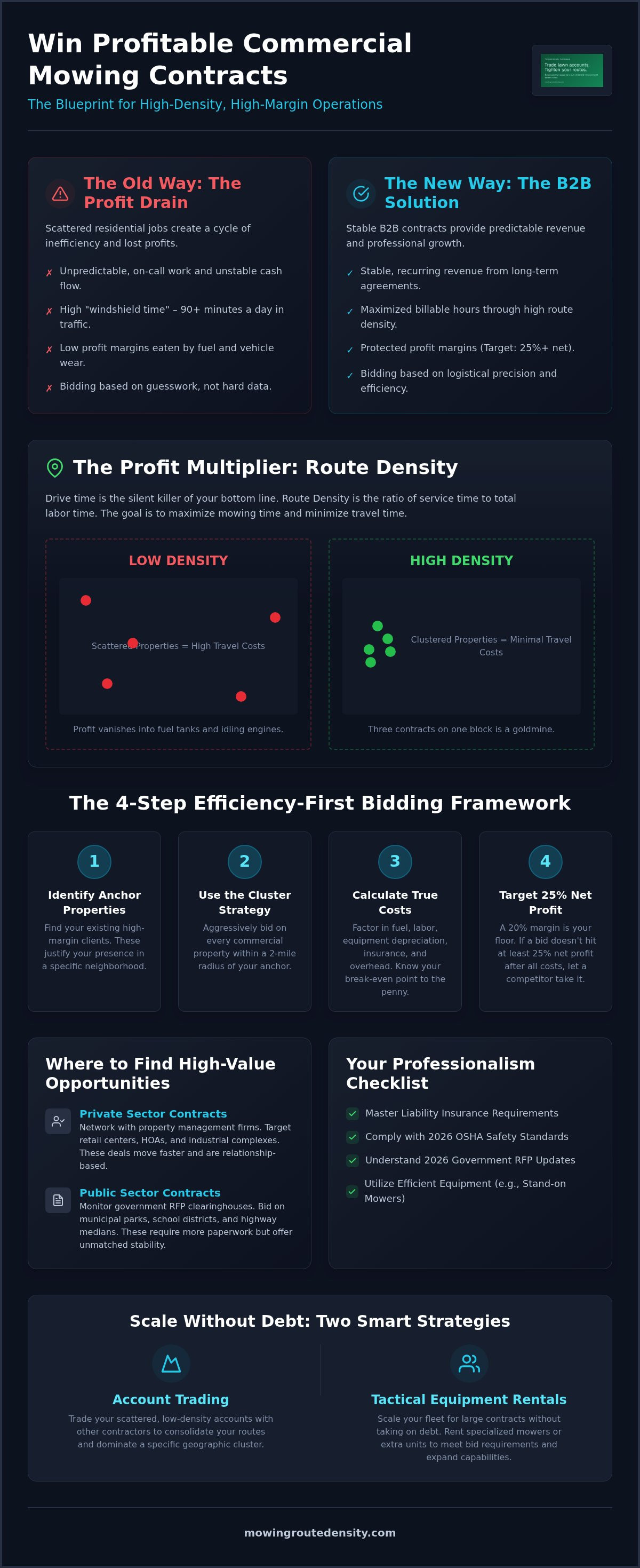
Drive time is the silent killer of your bottom line. If your crew spends 90 minutes a day sitting in traffic, you've already lost the profit on that day's first two jobs. Profitable density means maximizing your billable hours within the smallest possible geographic footprint. We define Route Density as the ratio of service time to total labor time. Every minute spent behind a steering wheel is a minute you aren't getting paid. Understanding how to get commercial mowing contracts requires a "cluster" mindset. One contract in a new zip code is a burden. Three contracts on the same block is a goldmine. Stop looking for the biggest properties. Start looking for the closest ones.
The Efficiency-First Framework for Winning Bids
Profit is a choice. Most contractors lose money because they treat bidding like a guessing game. They look at a lot, guess the time, and hope there's money left over. That's a recipe for bankruptcy. Understanding how to get commercial mowing contracts starts with an audit of your existing route. Identify your anchor properties. These are the high-margin clients that justify your presence in a specific neighborhood. Once you have an anchor, you use the Cluster Strategy. You bid on every commercial property within a two-mile radius. Why? Because your travel cost for those adjacent properties is virtually zero. You can bid lower than the competition and still keep more profit. You aren't just selling a service; you're selling geographic dominance.
Winning a bid isn't a victory if the job drains your bank account. You need a framework that prioritizes efficiency before you ever open a spreadsheet. If you don't know your break-even point to the penny, stay home. You must calculate the cost of fuel, labor, and equipment depreciation for every hour the crew is in the field. This logistical precision allows you to identify which contracts are worth the effort and which ones are just "busy work" that kills your equipment longevity.
Calculating Your Commercial Bid Price
Your biggest expense isn't grass; it's the road. Windshield time is the cost of your truck moving while your mowers are idle. If you aren't billing for that time, you're paying for it out of your own pocket. You must also factor in equipment depreciation and overhead. This includes your shop rent, your office software, and your insurance. A 20% net profit margin is your floor. If a contract doesn't hit that mark after all expenses, let your competitor have it. Let them go broke while you stay lean. Focus your energy on achieving optimized route density instead of just chasing higher revenue numbers.
The Role of Equipment in Bid Competitiveness
Speed equals margin. Stand-on mowers often provide better visibility and faster mount/dismount times than traditional zero-turns. This saves seconds on every turn and minutes on every acre. You must also match your mower deck size to the property. Using a small deck on a wide-open campus is a waste of labor. Conversely, using commercial lawn mower rental gives you the flexibility to deploy the right machine for the right job without a massive capital outlay. It allows for asset-light scaling. You can win a massive new contract today and have the extra equipment on-site tomorrow. This approach keeps your debt low and your bid prices competitive.
Where to Find Commercial Mowing Opportunities
Finding where the money hides is the first hurdle in mastering how to get commercial mowing contracts. You can't wait for the phone to ring. You need a multi-channel approach that targets both the public sector's transparency and the private sector's speed. Most contractors waste years trying to grow organically. They bid on one property at a time and hope for the best. Smart operators use the "Account Trading" shortcut. They buy existing routes from retiring peers or competitors exiting a specific zip code. This provides instant density. It eliminates the slow burn of traditional marketing and puts you in the black on day one. If you want to scale, stop hunting and start acquiring.
Visibility is your second priority. In the B2B world, property managers don't scroll through social media to find vendors. They use professional databases. Utilizing service provider locators is a non-negotiable step for increasing your inbound B2B visibility. It puts your brand in front of facility directors who are actively looking to replace underperforming contractors. It's about being the obvious choice when a high-value contract goes back out to bid.
Government Portals and RFP Systems
Government work is a paperwork game. Start by registering on SAM.gov for federal opportunities and your state's specific procurement sites for local work. You must learn the lexicon of the public sector. A "Solicitation" is the invitation to play. A "Quote" is your price for simple, recurring services. A "Proposal" is a detailed strategy for complex projects. Miss a deadline by five minutes? You're out. Compliance is 100% or nothing. There is no middle ground in municipal work. It's rigid, but the checks are guaranteed.
Private Sector Outreach Strategies
Private contracts move on relationships and proactive solutions. You need to reach regional property managers and facility directors before their current contract expires. Leveraging a lawn mowing service provider locator ensures your business appears in the right professional searches. This tool bridges the gap between your crew and the decision-makers who control multi-site portfolios.
Don't ignore the "Cold-Walk" method for private sites. If you see a retail center with overgrown edges or neglected beds, that property manager is already frustrated. Walk in. Offer a specific solution to their visible problem. Don't sell "mowing." Sell the removal of their current headache. This proactive approach is a core part of how to get commercial mowing contracts in the private sector. It bypasses the bidding war and positions you as a strategic partner rather than just another vendor.
Professional Requirements: Liability, Equipment, and Proof
Commercial property managers don't care about your "passion for landscaping." They care about risk mitigation. If you're wondering how to get commercial mowing contracts without a stack of compliance documents, the answer is simple: you don't. You need to prove you can handle the scale and the liability before you ever step onto the property. This isn't residential work where a handshake suffices. You're entering a world of legal scrutiny and professional expectations. If you can't provide proof of stability, you're invisible to the people who sign the checks.
Commercial General Liability (CGL) insurance is your ticket to the table. A policy with $1M per occurrence and $2M aggregate limits is the 2026 baseline. Anything less makes you a liability in the eyes of a facility director. You also need Workers' Compensation. It's non-negotiable. Property managers won't even look at your bid if they think an injured worker could sue the property owner. Finally, build a portfolio of high-acreage work. Show them you've managed sites similar to theirs. Proof of performance is the only currency that matters in B2B. Equipment reliability is your lifeline. One broken mower can derail an entire week's schedule. You must implement a strict fleet management program that prioritizes preventative maintenance to guarantee zero downtime.
Insurance and Compliance Checklist
Managing your Certificate of Insurance (COI) is a daily task, not a yearly one. Large industrial contracts often require Umbrella policies that extend your coverage into the $5M range. Don't let the cost scare you. It's a barrier to entry that keeps the low-ball "weekend warriors" out of your market. You must also stay current with OSHA safety protocols. In 2026, compliance with updated Hazard Communication rules is mandatory for all landscaping crews. If your safety record is spotty, your bid is dead on arrival.
Scaling Equipment via Rental and Leasing
You don't need a massive bank loan to scale your fleet. In fact, debt is often the heaviest anchor in this industry. Exploring commercial lawn mower lease options allows for asset-light growth without the burden of long-term interest. It keeps your balance sheet clean and your cash flow liquid. Rental mowers allow for rapid contract absorption by providing the exact machines you need the moment a bid is awarded. This "Reserve Fleet" strategy ensures you never breach a contract due to equipment failure. If a mower breaks, you swap it out immediately. The job stays on schedule. Your reputation stays intact.
Ready to scale without the debt? You can rent commercial equipment today to meet your new contract obligations without the upfront capital risk.
Scaling Your Commercial Portfolio via Route Density
Geographic dominance isn't a suggestion; it's a requirement for survival. Once you've secured an anchor property, your next move is aggressive expansion within that specific zip code. You don't look for the next biggest lot across town. You look for the lot next door. This is the "Anchor and Expand" method. It turns a single win into a cluster of high-margin sites. If you're still wondering how to get commercial mowing contracts that actually build wealth, stop looking at the map and start looking at the street. One crew. One street. Zero drive time. That's the only formula for a profitable business.
Most owners collect accounts like baseball cards. They want a big stack, but they don't care if the locations are scattered. That's a mistake. A scattered route is a leaky bucket. You're losing fuel. You're losing labor hours. You're losing equipment life. You need continuous lawn care profit margin optimization through monthly logistical audits. If an account is an outlier, it's a liability. Cut it or trade it.
The Account Swap Strategy
Outlier accounts are profit killers. If you have a lone commercial site 20 miles away, you're subsidizing that client's grass with your own retirement fund. Stop doing it. Use a lawn account trading platform to swap that outlier for something in your home cluster. Find a local partner who has the opposite problem. You trade your distance for their density. It's a win-win that tightens your route overnight. Just ensure your contracts allow for assignment or transfer before you sign the deal. Logistics dictate your paycheck.
Long-Term Growth and Exit Strategy
High-density routes do more than increase monthly cash flow; they increase the valuation of your entire company. A potential buyer doesn't want a list of names. They want a turnkey machine. They want a dense, defensible territory where one truck can generate maximum revenue with minimum mileage. This is how you build a "sellable" portfolio. You aren't just mowing; you're creating an asset for future liquidity. For a deeper look at your five-year plan, refer to the lawn care business exit strategy. Density is your legacy.
Mastering how to get commercial mowing contracts is about more than the initial handshake. It's about the relentless pursuit of efficiency. Every site you add should make the previous sites more profitable. If it doesn't, don't bid. Stay disciplined. Stay dense. Stay profitable. That's the only way to win in 2026.
Build Your High-Density Commercial Empire
Success in the 2026 commercial market is a math problem. You've seen that how to get commercial mowing contracts requires more than a clean truck and a handshake. It requires a relentless focus on route density and risk mitigation. Stop chasing every lead. Start building clusters of accounts that minimize your fuel consumption and maximize your billable hours. High-acreage work is only profitable when your windshield time is near zero. Every mile driven without a mower on the ground is a direct hit to your bottom line.
Professional compliance is your moat. Use your insurance limits and safety protocols to lock out the low-ball competition. Then, scale without the burden of heavy debt. Use tactical rentals to meet sudden demand and trade your outlier accounts for properties that fit your existing grid. This is how you build a business that is both profitable today and sellable tomorrow. You're no longer just cutting grass; you're managing a high-yield logistical asset.
Ready to stop guessing and start growing? Optimize your route density and scale your commercial portfolio with Mowing Route Density. Leverage our national mower rental network, secure lawn account trading marketplace, and no-nonsense B2B locator tool to dominate your local market. The era of the "mow and go" hobbyist is over. It's time to run a real operation. Build your empire.
Frequently Asked Questions
How do I find commercial mowing bids near me?
Find public bids by registering on SAM.gov for federal work or your state's procurement portal for local municipal contracts. Understanding how to get commercial mowing contracts in the private sector requires a different approach. You should list your business in a B2B service provider locator to ensure property managers find you during their vendor search. Private leads often come from direct outreach to regional facility directors before their current agreements expire.
What is the average profit margin for commercial mowing contracts?
The average net profit margin for a lawn care business is 10% to 15%, but highly optimized routes can reach 20% to 25%. Profit is a function of logistics, not just your hourly rate. If your crew spends too much time in transit, your margin vanishes. Mastering how to get commercial mowing contracts with high route density is the only way to hit those upper-tier profitability numbers and protect your bottom line.
Do I need a special license for commercial lawn care?
You need a Commercial Pesticide Applicator certificate if you apply or supervise the application of restricted-use pesticides. This is a federal requirement under FIFRA, though state-level testing varies. You must also stay current on local equipment regulations. For instance, the sale of new gas-powered mowers manufactured after 2023 is banned in California, and San Francisco prohibits their use entirely as of January 1, 2026.
How do I write a professional bid for a commercial property?
Lead with a clear, itemized scope of work that defines service frequency and specific tasks like edging and debris removal. Use professional bidding software to present a clean proposal that includes your Certificate of Insurance (COI) and references. Property managers aren't looking for the lowest price; they're looking for the lowest risk. Prove you have the equipment and labor capacity to handle their acreage without delays.
What insurance do I need for commercial landscaping?
General liability insurance is the baseline, typically costing between $400 and $1,500 annually for $1M/$2M coverage limits. You also need commercial auto insurance, which averages $1,200 to $3,000 per year. Workers' compensation is non-negotiable if you have employees, with costs ranging from $800 to $4,000. Large industrial clients may also require an Umbrella policy to meet their specific risk mitigation standards. Always provide an up-to-date COI with your bid.
Can I rent a commercial mower for a specific contract?
Yes, you can use a national mower rental network to scale your fleet without taking on high-interest bank debt. This is a tactical move for winning bids that require specialized equipment or more machines than you currently own. Rental mowers serve as a "Reserve Fleet," ensuring you never breach a contract due to equipment downtime. It's an asset-light strategy that allows for rapid growth while keeping your cash flow liquid.
How do I calculate drive time into my mowing bid?
Calculate your "windshield time" as a direct labor cost and add it to your total bid price. If your crew costs $60 per hour and they drive 30 minutes to a site, you've lost $30 in billable time before the first mower drops. This is why you must prioritize geographic clusters. Use route-trading platforms to swap outlier accounts for properties that fit your existing grid. Lower drive time equals higher profit.
What is the best way to contact property managers?
Direct outreach to facility directors and regional property managers is the most effective B2B strategy. Don't wait for an RFP to appear; build the relationship early. Use a service provider locator tool to increase your inbound visibility so managers find you when they're frustrated with their current vendor. When you reach out, focus on solving their specific headaches, such as poor communication or inconsistent service, rather than just selling a price per cut.


