

What if the "turnkey" operation you're eyeing is actually a logistical liability designed to bleed your bank account dry? Most buyers look at top-line revenue and assume they're purchasing a gold mine. They don't realize they're actually buying a scattered route that wastes $4.09 per gallon on fuel while the crew sits in traffic. Understanding the critical mistakes to avoid when buying a lawn care business is the only way to ensure you're acquiring a profitable asset rather than inheriting a previous owner's expensive failures.
You want a clean transition with high client retention and a route dense enough to eliminate wasted windshield time. It's a smart objective, but it's impossible to reach if you're blinded by inflated revenue numbers or a fleet of mowers held together by zip ties. This guide identifies the financial traps and operational blind spots that turn acquisitions into disasters. We will break down 12 essential red flags, from verifying route density to auditing equipment longevity, so you can buy with clinical precision and strategic foresight.
Key Takeaways
- Audit tax returns against P&L statements to expose inflated revenue and ensure the business is actually profitable.
- Calculate your revenue-per-mile to identify the logistical mistakes to avoid when buying a lawn care business.
- Verify account validity by checking payment history and assignability clauses to ensure "ghost clients" don't vanish post-sale.
- Conduct a mechanical audit on all mowers to avoid inheriting a fleet of expensive, patched-up liabilities.
- Prune low-density accounts immediately to maximize route density and slash unnecessary windshield time.
Financial Due Diligence: Avoiding the "Inflated Revenue" Trap
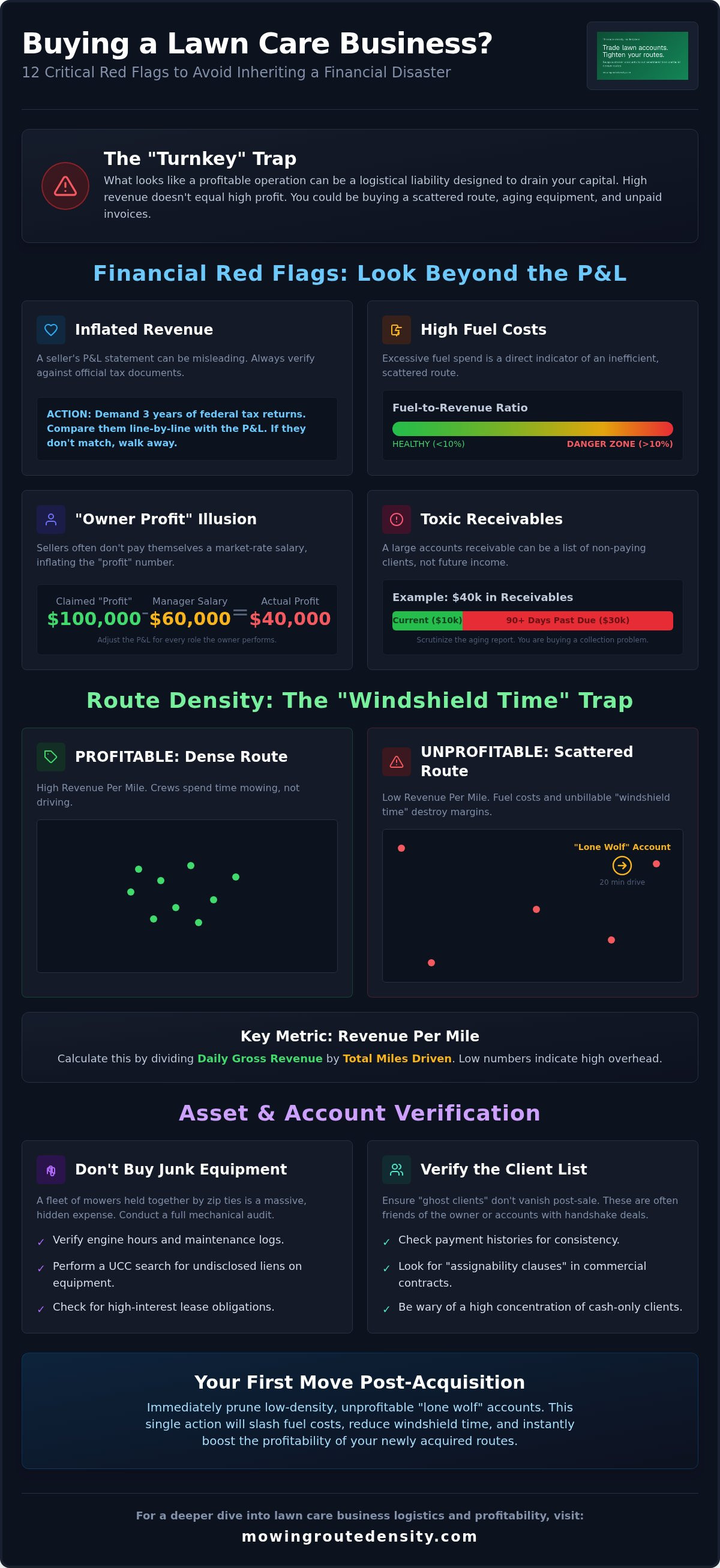
Revenue on paper isn't cash in the bank. Sellers love to showcase "record-breaking" years, but you need to see the proof. Demand the last three years of federal tax returns. Compare them directly against the Profit and Loss (P&L) statements provided in the sales deck. If the numbers don't match, walk away immediately. Discrepancies here usually mean the seller is inflating revenue or hiding expenses to juice the valuation. This level of scrutiny is the bedrock of proper due diligence. Don't take a spreadsheet at face value.
Analyze the fuel-to-revenue ratio to spot logistical rot. With national regular gasoline averaging $4.09 per gallon in July 2026, fuel is a major overhead drain. If the business spends more than 10% of its gross revenue at the pump, the route is likely a scattered mess. You're buying a logistics problem, not a profitable enterprise. High fuel spend relative to billable hours indicates excessive "windshield time" and poor density. This is one of the most expensive mistakes to avoid when buying a lawn care business.
Identify "owner-operator" bias before you sign. Many sellers don't draw a fair market salary. They take what’s left over at the end of the month and call it profit. If you plan to be an absentee owner, you'll have to hire a manager. That $100k "profit" disappears quickly when you factor in a $60k salary for a supervisor. Always adjust the P&L to include a market-rate salary for every role the owner currently performs. If the math doesn't work after that adjustment, the business isn't viable.
Scrutinize the accounts receivable aging report. A business with $40k in receivables might look healthy until you see that $30k of it is over 90 days past due. You aren't buying revenue; you're buying a list of people who refuse to pay. Chronically late-paying clients are a liability. They drain your administrative time and kill your cash flow. To ensure long-term success, you need a lawn care profit margin optimization strategy that prioritizes high-quality, auto-pay accounts over "ghost" revenue.
Analyzing the True Cost of Labor
Check for "under-the-table" payments. Cash-only labor hides the true cost of operations and creates massive legal exposure. Verify workers' compensation insurance rates. A high E-Mod rating suggests a history of workplace injuries, which will spike your insurance premiums. High crew turnover is another red flag. If the team leaves every six months, you'll spend your first year constantly hiring and training instead of growing. This is a common hurdle among mistakes to avoid when buying a lawn care business.
Debt and Lien Verification
Perform a UCC search on the business entity. This ensures that the zero-turn mowers and trailers you're paying for don't have outstanding undisclosed liens. Check for lease obligations on specialized commercial gear. You don't want to find out a month later that the "owned" fleet is actually a stack of high-interest equipment leases. Finally, confirm all GPS tracking and software subscriptions are current. Inheriting a mountain of unpaid vendor debt is a fast way to tank your first quarter.
Auditing Route Density: The "Windshield Time" Checklist
Windshield time is where profits go to die. When you buy an existing business, you aren't just purchasing a client list. You're purchasing a logistical network. If that network is spread across three counties, you're paying your crew to sit in traffic while burning $4.09 per gallon in fuel. Calculate the "Revenue Per Mile" by dividing daily gross revenue by the total miles driven. If that number is low, your overhead will eat your margins. This is one of the most common mistakes to avoid when buying a lawn care business. You need a dense cluster, not a scenic tour of the suburbs. Your crew isn't paid to sightsee.
Map every account. Look for outliers that sit 20 minutes away from the core route. These "lone wolf" accounts are often legacy clients the seller kept out of loyalty. They are logistical anchors. They drain labor hours and increase wear and tear on your trucks. Identify "cluster gaps" where the business has a presence in two neighborhoods but nothing in between. This gap represents wasted potential. If you can't fill that gap, the route will never reach peak efficiency. A balanced mix of commercial and residential accounts is ideal, but only if they are logistically compatible. Don't send a 72-inch zero-turn to a neighborhood with 36-inch gates.
The 2026 Standard for Route Efficiency
In 2026, the national average for man-hour rates ranges from $45 to $85. To remain profitable, your revenue per drive hour must exceed your operational costs by at least 20%. Use the seller's GPS data to verify actual time spent on-site versus time spent behind the wheel. If the data shows more than 20% of the day is spent driving, you have a density problem. You can fix a scattered acquisition by using a lawn account trading platform to swap distant accounts for ones closer to your core route.
Identifying Logistical Liabilities
Flag accounts that require specialized equipment. If one commercial property requires a specific slope mower that isn't used anywhere else, that account is a liability. Analyze traffic patterns. A route that looks good on a map might be a nightmare during the morning rush. Review the lawn care route density to ensure every stop adds marginal utility. Understanding these logistical hurdles is key to identifying mistakes to avoid when buying a lawn care business. If an account doesn't fit, cut it. You can always optimize your route by trading accounts for better density to tighten your operations.
Asset Assessment: Don’t Buy the Seller’s Junk
Assets are only valuable if they generate billable hours. If the equipment is sitting in the shop, it's a liability. One of the primary mistakes to avoid when buying a lawn care business is accepting the seller's valuation of their fleet at face value. Most owners stop investing in preventative maintenance the moment they decide to sell. You're likely looking at a fleet held together by "quick fixes" and deferred repairs. Use a comprehensive due diligence checklist to guide your inspection, but don't stop at the paperwork. You need a mechanical audit. If you don't know how to check a hydraulic pump or test engine compression, bring a lead mechanic with you. Their fee is a cheap insurance policy against a $10,000 engine failure in your first month.
Calculate the remaining life expectancy of every major asset. A commercial riding mower averages $3,940, while walk-behinds sit around $405. If the fleet is pushing 2,000 hours per unit, those machines are nearing the end of their profitable life. You aren't just buying the equipment; you're buying the upcoming replacement costs. Auditing the fleet's physical condition is critical to identifying mistakes to avoid when buying a lawn care business. Compare the cost of repairing inherited junk versus the efficiency of professional lawn equipment rental. Sometimes, it's cheaper to let the seller keep their scrap metal while you start fresh with reliable, rented assets.
The Equipment Audit Process
- Check hour meters: Look for signs of tampering or disconnected wires. High hours without documented engine overhauls signal an impending collapse.
- Inspect the decks: Look for thin spots or weld patches on mower decks. A warped deck ruins the quality of cut and frustrates clients.
- Verify trailer safety: Check tire date codes and brake lights. Trailers must be DOT-compliant to avoid heavy fines and liability during transport.
Asset-Light Scaling Strategies
You don't have to own every piece of steel on day one. Consider excluding high-mileage or specialized equipment from the purchase price to lower your initial capital outlay. This keeps your entry costs lean and your cash reserves high. You can then leverage commercial lawn mower lease options to upgrade the fleet with modern, fuel-efficient technology. This approach shifts the burden of maintenance and depreciation away from your balance sheet. Utilizing rentals during the transition period also ensures your crews stay productive if the inherited equipment fails. Focus on the service, not the hardware.
Account Validity: Verifying the "Ghost Client" List
Revenue isn't real until it's collected. A common trap in this industry is the "ghost client" list. Sellers often present a roster of hundreds of accounts to justify a higher valuation. You must verify that every "active" account has paid a bill within the last 30 days. If an account hasn't been serviced or billed in two months, it's a dead lead, not a business asset. Buying a list of inactive names is one of the costliest mistakes to avoid when buying a lawn care business. You are paying for a predictable cash flow; don't settle for a phone book.
Customer concentration risk can sink your acquisition before the first mow. Analyze the revenue split across the entire portfolio. If a single commercial client represents more than 15% of total revenue, you're in a high-risk position. If that one client leaves, your route density collapses and your profit margins evaporate. You need a diversified base where no single cancellation can cripple your operations. Handshake deals are another major liability. Old-school owners rely on personal relationships rather than paper. Those deals usually disappear the moment a new face shows up in the truck. Demand written contracts for every commercial account.
The Client Retention Audit
Interview the top 10 clients before closing the deal. You need to know if they stay for the brand or the person. If their loyalty is tied strictly to the seller, expect a high churn rate post-sale. Review the history of price increases. If the seller hasn't raised rates since 2023, the route is likely underpriced for 2026 operational costs. You'll be forced to raise prices immediately, which triggers even more churn. Check for seasonal patterns. Some "annual" revenue totals hide the fact that half the clients only pay for six months of service.
Contractual Red Flags
Audit every service agreement for "assignability" clauses. If the contract doesn't explicitly allow for the transfer of the account to a new owner, the client can walk away without penalty. Look for "out clauses" that allow 30-day cancellations without cause. These are common but dangerous during a transition. Finally, verify that the seller has the legal right to sell landscaping route accounts. Without clear legal standing, you're buying air. If the current list is full of low-margin or distant accounts, you can use a route trading platform to swap them for more profitable, dense accounts immediately after the purchase.
Post-Acquisition: Tightening Operations for Profit
The deal is closed. The keys are in your hand. Now the real work begins. One of the biggest mistakes to avoid when buying a lawn care business is maintaining the status quo for too long. You've inherited another person's inefficiencies. Every day you wait to optimize is a day you lose money to fuel waste and labor bloat. You need to implement a lawn care profit margin optimization plan within the first week. Start by pruning the route. If an account is low-margin or sits outside your core cluster, cut it. Your goal is a dense, high-yield territory, not a collection of vanity metrics. High revenue means nothing if your overhead is higher.
Introduce yourself to your new clients immediately. A professional, brand-aligned communication sets the tone. It tells them the era of "handshake deals" is over. A professional operation has arrived. This is your chance to transition them to auto-pay and standardized service agreements. If you inherited a fleet of junk as discussed in our previous asset audit, don't let it slow you down. Swap out failing mowers for professional-grade rentals to keep your crews moving at peak speed. Reliability is the foundation of retention. Downtime is a luxury you cannot afford during a transition.
Route Optimization Tactics
Stop driving past your competitors to reach a single yard. Use a lawn mowing service provider locator to find local partners for accounts that don't fit your density map. You can swap outlier accounts with other contractors to increase your cluster density and slash that $4.09 per gallon fuel expense. Re-route every service day. Minimize left-hand turns. Eliminate deadheading time. Every minute saved in transit is a minute earned on a mower deck. If a route isn't generating at least $60 per man-hour, it needs a total overhaul to remain viable in 2026.
Maximizing Field Efficiency
Your inherited staff might be used to the previous owner's lazy habits. Retrain them on your specific efficiency standards. Show them exactly how you expect a property to be staged and mowed. Install GPS tracking on every truck and trailer. Monitor idle time and unauthorized stops with clinical precision. Standardize your fleet immediately. If every crew uses the same deck size and engine type, you reduce your spare part inventory and simplify field repairs. This proactive approach ensures you bypass the common mistakes to avoid when buying a lawn care business and start generating real profit from day one. Tighten the screws on your operations now, or watch your acquisition capital bleed out in the field.
Secure Your Acquisition and Scale for Profit
You've audited the financials, mapped the routes, and inspected the fleet. Now it's time to execute. Buying a business is an exercise in logistics. If you don't tighten the operations immediately, the overhead will crush your margins. Mastering the mistakes to avoid when buying a lawn care business ensures you enter the market with a lean, efficient model rather than a collection of someone else's failures. You have the data. Use it to cut the waste and prioritize billable hours over windshield time.
Don't let a scattered route or failing equipment tank your first season. You can fix a broken acquisition by optimizing your fleet and density from day one. Access high-performance commercial mower rentals and a secure marketplace for trading low-density accounts through our platform. Leverage our B2B network of professional landscaping partners to ensure every stop on your route is a profitable one. Optimize your new route with Mowing Route Density. You have the blueprint. Go build a route that pays.
Frequently Asked Questions
What is the most common mistake when buying a lawn care business?
The most common error is ignoring "windshield time" in favor of top-line revenue. A business with high gross revenue spread across 50 miles is often less profitable than a smaller business on five streets. You're buying a logistical problem if the density is low. This is one of the top mistakes to avoid when buying a lawn care business because fuel and labor costs for transit are fixed drains on your bottom line.
How do I value a lawn care route for acquisition in 2026?
Valuation in 2026 depends on EBITDA and route density. Most small businesses trade for 2x to 3x their annual earnings. However, you must subtract the cost of replacing outdated equipment and adjust for the current prime rate of 6.75%. A dense route with modern assets commands a higher multiple than a scattered route with failing mowers. Don't pay a premium for a business that requires an immediate capital injection.
Should I buy the equipment or just the client list?
Buy the client list and the brand, but treat the equipment as a secondary line item. If the fleet is nearing the end of its life expectancy, exclude it from the purchase price. You can utilize commercial mower rentals to stay operational without the heavy debt load of new purchases. Paying for the seller's junk is a liability. Focus your capital on the accounts that generate recurring revenue and logistical stability.
How do I prevent clients from leaving after I buy the business?
Retention requires immediate, professional communication. Introduce yourself through a brand-aligned letter before the first service. Maintaining the same crew also helps, as clients value familiarity. Ensure the quality of cut stays consistent. If you raise prices immediately to cover 2026 fuel costs, expect some churn. Transitioning clients to auto-pay and written contracts provides the stability you need during the first 90 days of ownership.
What is a good route density ratio for a profitable business?
A profitable business should maintain a billable hour ratio of at least 80%. This means your crews spend 48 minutes of every hour on a mower deck, not behind a steering wheel. If your windshield time exceeds 20%, your density is too low. Calculate your revenue per mile to see the true cost of your logistics. High density allows you to maximize billable hours while minimizing fuel consumption and equipment wear.
Is it better to buy a commercial or residential lawn care business?
Commercial accounts offer multi-year contracts and higher volume, but residential accounts often provide better margins per property. Commercial work is a game of scale and efficiency. Residential work is a game of customer service and density. Most successful buyers look for a balance. A commercial-heavy route provides stability, while a dense residential cluster provides the high-margin revenue that boosts your overall net profit.
How do I check for hidden debt in a landscaping business sale?
Perform a UCC search to identify undisclosed liens on equipment. This is a critical step in identifying mistakes to avoid when buying a lawn care business. You should also verify that all payroll taxes and workers' compensation premiums are current. Compare the seller's P&L statements against their actual tax returns. If the numbers don't match, the seller might be hiding debt or inflating their profitability to juice the sale price.
What legal documents do I need to transfer lawn care accounts?
You need an Asset Purchase Agreement (APA) and a Bill of Sale to legally transfer the business. Ensure every commercial contract includes an "assignability" clause. This allows you to take over the account without renegotiating terms. You also need non-compete agreements for the seller and key staff. Without these documents, the seller could open a new shop across the street and take half your clients within a month.


