

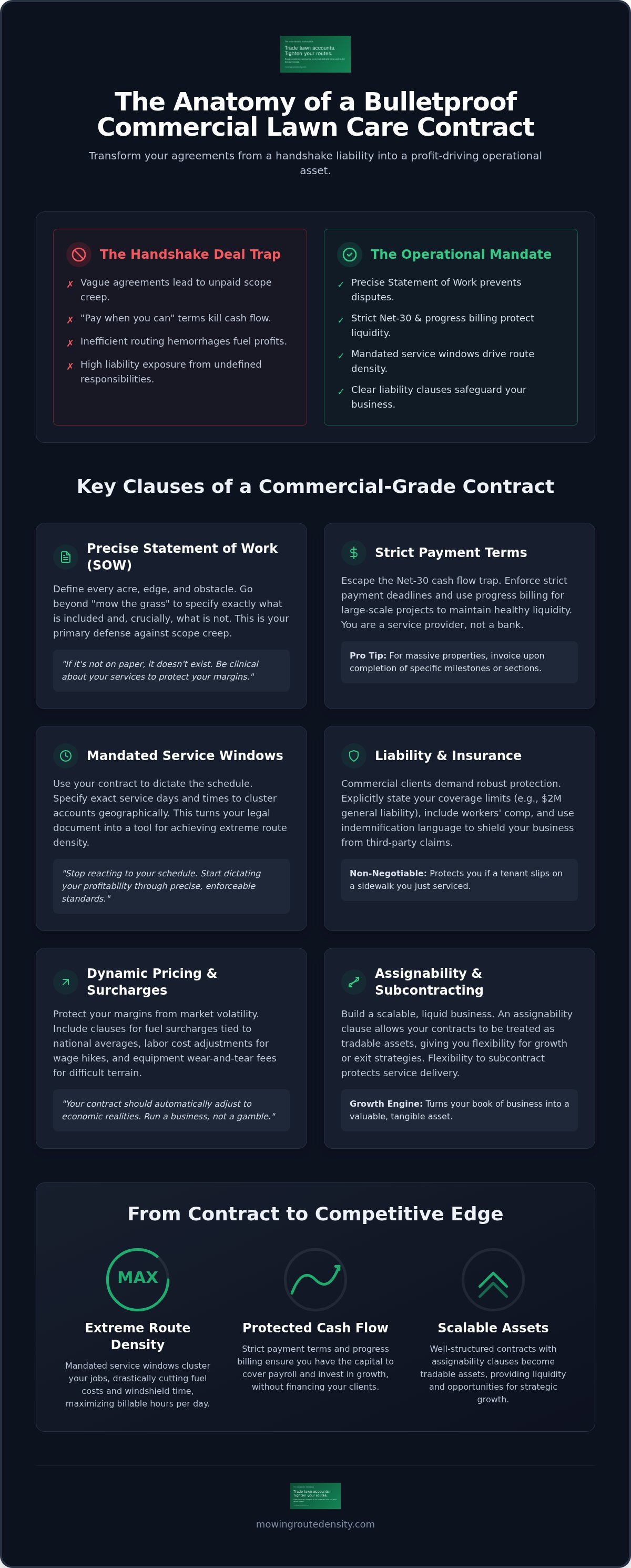
A handshake deal isn't a sign of trust; it's a financial liability waiting to explode. You might think keeping things casual builds rapport with commercial clients, but on a 15-acre property, "casual" quickly turns into unpaid scope creep and hemorrhaging margins. Every minute your crew spends performing "favors" is a minute you aren't hitting your next stop. Late payments and inefficient routes are killing your cash flow before the season even peaks. To fix this, you need a commercial lawn care contract template that functions as an operational mandate rather than just a legal shield.
This guide will show you how to build a bulletproof legal document that protects your equipment, enforces strict payment terms, and drives extreme route density. We'll strip away the fluff and focus on the clauses that actually matter for your bottom line. You're running a business, not a charity, and your paperwork should reflect that reality. It is about protecting your billable hours and your sanity.
We'll break down the essential language that stops profit leaks, explain how to use these contracts as currency on account trading platforms, and show you how to scale your B2B growth without drowning in fuel overhead. It's time to stop reacting to your schedule and start dictating your profitability through precise, enforceable standards.
Key Takeaways
- Stop profit leaks by replacing vague verbal agreements with a precise Statement of Work that defines every acre and edge.
- Protect your cash flow on large-scale accounts. Move away from "pay when you can" toward strict Net-30 or progress billing terms.
- Use a commercial lawn care contract template to mandate specific service windows. Turn your legal paperwork into a tool for extreme route density.
- Ensure your business remains scalable and liquid. Include assignability clauses that treat your contracts as tradable assets.
- Safeguard your equipment and margins. Use liability protections that hold clients accountable for site conditions and allow for flexible subcontracting.
Why Residential Templates Fail in Commercial Lawn Care
Residential templates are a trap. They focus on "cutting grass." In the commercial world, that is a hobbyist mindset. A professional Groundskeeping operation requires a commercial lawn care contract template built on operational logistics, not just aesthetics. Residential agreements are often vague. They rely on "curb appeal." Commercial contracts are different. They are driven by liability and risk mitigation. If your paperwork doesn't reflect that shift, you're leaving your business exposed.
If a crew misses a patch of debris on a walkway, that's a lawsuit; it isn't just a grumpy neighbor. A weak contract ignores these risks. It leads to scope creep. It creates unbillable hours. You end up doing "favors" for facility managers that kill your margins. Your contract should be an operational mandate. It should define exactly what's included and, more importantly, what's not. Every minute of unbilled labor is a direct drain on your bottom line. You aren't just selling a service; you're selling a slot on a high-efficiency route. If that slot isn't protected by clear language, your overhead will eat your profits.
The Definition of a Commercial-Grade Agreement
A commercial agreement isn't a handshake. It's a B2B legal framework. It defines the service window with clinical precision. Can your crew be on-site at 2:00 PM on a Tuesday? Or does the facility manager require service before 7:00 AM to avoid blocking traffic? Residential templates don't ask these questions. They ignore the logistical weight of high-density routes. Your contract must mandate specific service days. This allows you to cluster accounts. It allows you to maximize billable hours per gallon of fuel. If your contract doesn't enforce your schedule, your route density will suffer.
Liability and Insurance: The B2B Reality
Corporate property managers care about risk exposure. You need specific insurance clauses. In many markets, commercial clients demand at least $2 million in general liability coverage. Your commercial lawn care contract template must explicitly state these limits and include workers' compensation clauses. You also need indemnification language. This protects your business from third-party claims. If a tenant slips on a sidewalk you just cleared, your contract determines who pays. Don't leave your assets exposed to someone else's negligence. A professional contract turns a service into a protected asset.
The Anatomy of a Bulletproof Commercial Contract
A commercial lawn care contract template isn't a suggestion. It's a set of rules. You must define the Scope of Services down to the square foot. Don't just say "mow the grass." Specify every acre, edge, and obstacle. A well-written contract prevents disputes before they start. If it's not on paper, it doesn't exist. Scope creep is a silent killer. It starts with one "extra" flower bed. It ends with lost margins and frustrated crews. Be clinical about what you do and what you don't do.
Payment terms are your lifeline. Residential clients often pay on the spot. Commercial clients play the Net-30 game. This delay can kill your cash flow if you aren't prepared. For massive properties, use progress billing. Charge for specific milestones. Don't let a property manager hold your entire check because one small area wasn't blown off. It's about protecting your liquidity. You're a service provider, not a bank. Don't finance your client's operations with your own payroll.
Dynamic Pricing and Surcharges
Energy volatility in 2026 is a constant threat to your margins. You can't predict gas prices six months out. Use fuel surcharge triggers. Tie your pricing to national averages. If fuel jumps above a set threshold, your bill reflects the cost. It's an automatic adjustment. Do the same for labor. If minimum wage hikes hit, your multi-year contract should adjust. You're running a business, not a gamble. Add equipment wear-and-tear fees for specialized terrain. If a site has steep hills that eat through belts and blades, the client pays for that overhead. If your current contracts are weighing you down, consider trading your accounts for better-aligned opportunities.
Performance Standards and KPIs
Facility managers need data, not excuses. Define "professional standard" in technical terms. Mention grass height, weed thresholds, and debris removal. Set response times for non-emergency requests. If a client wants a bush trimmed, tell them exactly how many days it takes to respond. This manages expectations. It protects your crew's schedule. Reporting requirements are also vital. Use digital logs to prove your team was on-site and completed the task. It builds trust through transparency.
Finally, include a clear termination clause. You need the right to fire a client. If a property becomes a logistical nightmare, you must be able to walk away without losing the rest of your route. A 30-day out clause is standard. It keeps you in control. Your commercial lawn care contract template should ensure that you only keep accounts that serve your bottom line. Don't let one bad contract sink your entire season.
Aligning Contract Terms with Route Density Goals
Route density isn't a happy accident. It's an operational choice. Your commercial lawn care contract template must reflect this reality. If you let a client dictate a Tuesday service when your crew is three zip codes away, you're losing money. Drive time is the enemy of profit. Every minute your truck is in motion is an unbillable expense. Use your contracts to mandate service days that align with your existing cluster. If you don't control the schedule, the schedule will control your bank account. High-density routes are built on enforceable terms that prioritize efficiency over client whims.
The "Density Discount" is your most powerful sales tool. It sounds like you're losing money by offering lower rates for adjacent properties, but you're actually protecting it. This is a core part of lawn care profit margin optimization. When two commercial properties sit side-by-side, your profit on the second site is massive. No extra fuel. No extra drive time. Just billable labor. You can afford a slightly lower top-line price because your bottom-line retention is higher. It's about total route value, not individual account ego.
The Logistics of Service Windows
Corporate clients often demand "Wednesday by noon." This is a luxury you can't always afford. Negotiate flexible service windows instead. A "week-specific" scheduling clause gives your dispatchers the room they need to optimize. If weather hits or a mower breaks, that flexibility saves your margins. Day-specific scheduling is a bottleneck. Week-specific scheduling is a strategy. Balance their need for a clean site with your need for a lean route. Don't sign away your ability to be efficient just to land a logo.
Account Clustering Strategies
Target properties within a tight radius. Five miles is a common benchmark, but closer is always better. Use a lawn mowing service provider locator to identify potential clusters or partners in your area. This isn't about random growth. It's about surgical expansion. If you have accounts that are outliers, use a trading platform to swap them for contracts that fit your cluster. Your commercial lawn care contract template should include assignability clauses to make these trades seamless. The math is simple. If you can add two more commercial accounts on the same block, your fuel overhead per site plummets. You're building a fortress of profitability one zip code at a time.
Managing Risk: From Equipment to Subcontractors
Commercial properties are obstacle courses for your equipment. A hidden piece of rebar or an improperly marked irrigation head can destroy a $500 set of blades in seconds. Your commercial lawn care contract template must explicitly state that the property owner is responsible for site hazards that aren't clearly marked. If they don't flag it, you don't pay for the repair. This isn't just about fairness; it's about protecting your machine uptime. Every hour a mower is in the shop is an hour it isn't generating revenue.
Risk management also means preparing for the unpredictable. Force Majeure clauses are often ignored until a 500-year flood or a global supply chain collapse hits. Your contract should allow for service delays during extreme weather or when parts for specialized equipment aren't available. You can't be held in breach for things you can't control. It's about maintaining a pragmatic relationship with your clients. Don't let a "fixed" schedule turn into a legal liability when the weather turns.
Equipment and Asset Logic
Scale requires assets, but it doesn't always require debt. When you land a high-acreage account, look into commercial lawn mower lease options to fulfill the contract requirements. This asset-light approach keeps your balance sheet clean while you grow. Your contract should also define maintenance uptime. If a machine goes down on-site, how long do you have to replace it? Commercial facility managers expect results, not excuses. Define these windows clearly to avoid liquidated damages and lost trust.
The Subcontractor Framework
Scalability is impossible if you're the only one doing the work. You need the right to subcontract. This clause is a non-negotiable part of a commercial lawn care contract template. It allows you to maintain capacity when your internal crews are at their limit. However, your subcontractors must be bound by the same standards you are. You're responsible for their output, so your paperwork must reflect that hierarchy.
You'll need to know how to find lawn care subcontractors who can actually meet B2B quality standards. Include clauses for liability pass-through, ensuring that if a sub causes damage, their insurance is the first line of defense. Use quality control and brand consistency clauses to ensure the client never sees a drop in service levels. Payment flow-through terms are also vital; you should only be obligated to pay your subcontractors after the client has cleared your invoice.
Protecting your business means planning for the worst while executing for the best. If you need to scale quickly without the heavy overhead of new equipment, rent the commercial mowers you need to dominate your next high-density route.
Trading Contracts: Using Your Agreements as Growth Assets
Stop looking at your filing cabinet as a graveyard of past negotiations. Your contracts are the inventory of your business. In the B2B world, a well-structured agreement is a liquid asset. It's the currency you use to scale, pivot, or exit. If your commercial lawn care contract template doesn't allow for easy transfer, you don't own a business. You own a job that ends when you stop working. To build real wealth, you must treat every signature as a building block for a future sale. Your agreements should be as standardized and tradable as any other commodity.
The Assignability Clause
Assignability is the most important clause for a lawn care business exit strategy. It gives you the legal right to transfer the service obligation to another provider without the client's constant veto. Without it, your accounts have zero market value. Buyers want certainty. They want to know that the revenue they're purchasing won't vanish the moment the ownership changes. Standard B2B language states that the contract is "assignable to any successor or affiliate." This simple sentence can increase your business valuation significantly. It turns a service relationship into a tradable asset that lives beyond your personal involvement.
Preparing for the Marketplace
Standardization is the prerequisite for speed. If you want to use a lawn account trading platform, your paperwork must be clean. Potential buyers don't have time to decode 50 different versions of a "handshake" agreement. They want to see a consistent commercial lawn care contract template across your entire portfolio. This makes due diligence fast and painless. It proves your operations are organized and your revenue is predictable. If your contracts are a mess of different terms and dates, you're signaling that your business is a liability, not an opportunity.
Use the marketplace to fix your logistical mistakes. We all have that one outlier account that sits 20 minutes away from the rest of the route. It's a profit drain. Trade it. Swap that low-density account for a contract that sits inside your existing cluster. You aren't just moving revenue; you're optimizing your margins. Valuation in the marketplace is driven by density. A contract that adds five billable hours to an existing stop is worth more than a standalone site. Tighten your clusters. Standardize your terms. Turn your agreements into the growth engine your business deserves.
Turning Contracts into Operational Momentum
Handshake deals are for hobbyists. In the commercial sector, your paperwork is your profit. We've covered why a commercial lawn care contract template must be more than a legal shield. It's a tool to mandate service windows, protect your equipment, and ensure your business remains liquid. If your current contracts aren't assignable, they aren't assets; they're just obligations. You've learned how to enforce route density through strict scheduling and how to protect your margins from fuel and labor volatility. These aren't just clauses; they're the difference between a thriving enterprise and a struggling crew.
You now have the blueprint to stop hemorrhaging billable hours and start clustering accounts with surgical precision. It's time to stop reacting to the market and start dictating your growth. You can optimize your route density on our trading platform today to maximize your billable hours. Access high-quality commercial mower rentals to scale without debt and join a national network of professional contractors who prioritize efficiency. Lean operations aren't a luxury; they're a requirement for survival in 2026. Build a business that works for you by setting the right terms from the first signature.
Frequently Asked Questions
Is a verbal agreement legally binding for commercial landscaping?
Verbal agreements are technically binding in some jurisdictions but are practically worthless in a professional setting. Without a written document, you have no leverage when a property manager demands extra work. Handshake deals invite scope creep and payment delays. Professional contractors use a written commercial lawn care contract template to ensure every billable hour is protected and every expectation is clearly defined before the first crew arrives on-site.
How do I handle fuel price spikes in a long-term contract?
You must include a fuel surcharge clause that triggers based on national price averages. If fuel costs exceed a pre-determined threshold, your rates should adjust automatically to protect your margins. This prevents energy volatility from eating your profits during multi-year agreements. Don't gamble on fuel stability; build an automatic mechanism into your contract that shifts the risk away from your bottom line and onto the market reality.
What is the standard payment term for B2B lawn care accounts?
Net-30 is the industry standard for B2B accounts, though some large-scale facilities may push for longer windows. You should resist Net-60 or Net-90 terms because they turn your business into a bank for the client. For high-acreage properties, progress billing is a safer alternative. This ensures you receive payments at specific milestones throughout the season, maintaining the cash flow necessary to cover payroll and fuel without taking on debt.
Can I use a residential contract for a small commercial property?
You shouldn't use residential templates for commercial properties, regardless of the site's size. Commercial contracts require specific language regarding liability, indemnification, and professional performance standards that residential agreements ignore. A small business site still carries the same legal risks as a large corporate campus. Using a professional commercial lawn care contract template ensures you are protected against third-party claims and that your service windows are clearly enforceable for better route density.
What insurance coverage is typically required for commercial contracts?
Most commercial clients require a minimum of $1 million in general liability insurance, though many corporate facility managers now demand $2 million per occurrence. You also need workers' compensation coverage for every member of your field team. Your contract must state that you will provide an insurance certificate upon request. This builds trust and proves you have the financial backing to handle on-site accidents without exposing the client to unnecessary risk.
How do I write an assignability clause for route trading?
An assignability clause should state that your business has the right to transfer the contract to a successor or affiliate without the client's written consent. This language is vital for anyone using a lawn account trading platform to optimize their route density. By making the contract assignable, you turn a simple service agreement into a liquid asset. This flexibility allows you to swap low-density accounts for more profitable clusters as your business scales.
What happens if a client cancels a seasonal contract early?
Your contract should include a termination clause that requires a 30-day written notice and a cancellation fee for early exit. This protects you from losing a significant portion of your seasonal revenue without warning. Ensure you are paid for all services rendered up to the termination date. Without these protections, an early cancellation can leave you with empty slots on your route that are impossible to fill mid-season, killing your annual profitability.
How should I define the "Scope of Work" to avoid scope creep?
To stop scope creep, you must define the Scope of Work with clinical precision. List every task, from the number of mows per season to the specific feet of edging required. Don't use vague terms like "general maintenance." Instead, use a detailed commercial lawn care contract template to specify acreage and debris removal limits. If a task isn't listed in the SOW, it's an extra charge. This clarity protects your margins and your crew's time.


