

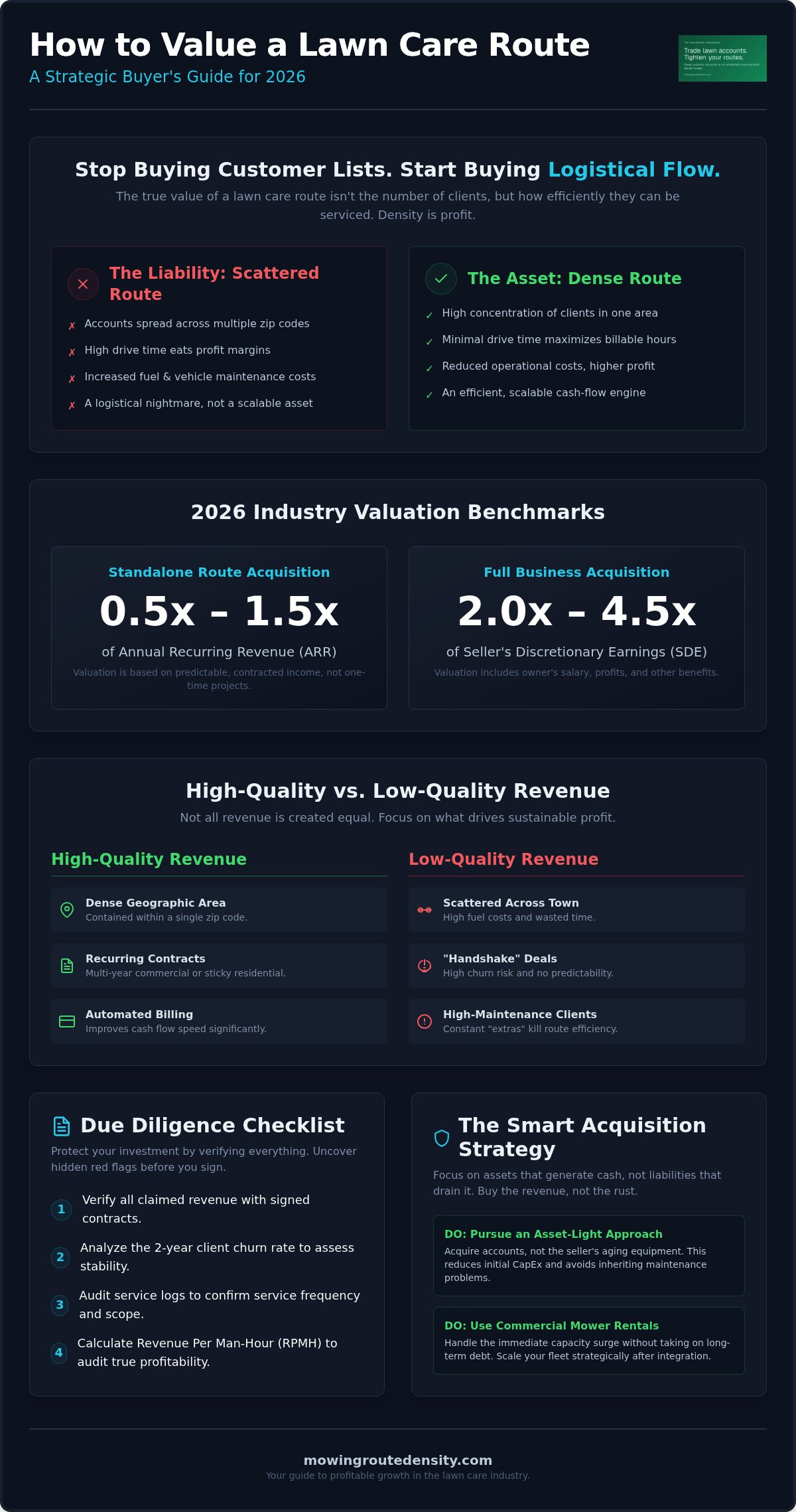
Buying a lawn care route isn't about acquiring a customer list. It's about purchasing logistical liquidity. If those accounts are scattered across three zip codes with diesel sitting at $6.00 a gallon, you aren't buying an asset; you're buying a liability. You likely understand the frustration of watching drive time eat your margins while you struggle to verify if a seller’s revenue claims are actually backed by signed contracts. It's a high-stakes gamble where high churn and poor route density can sink your ROI before the first mow of the season.
This guide cuts through the fluff to show you exactly how to value lawn care routes for purchase using 2026 metrics that account for record fuel costs and shifting environmental regulations. We will break down the precise valuation multiples for Seller's Discretionary Earnings, provide a rigorous due diligence checklist, and outline a strategy to integrate new accounts into your existing operations without missing a beat. You will learn to identify profitable density and spot operational waste before you ever sign a check.
Key Takeaways
- Stop buying contact lists and start buying logistical flow. Learn why recurring contract revenue is the only metric that matters for a sustainable 2026 valuation.
- Master how to value lawn care routes for purchase by applying current industry multiples of 0.5x to 1.5x of annual recurring revenue to ensure you don't overpay.
- Use the Revenue per Man-Hour (RPMH) calculation to audit route density. This metric exposes how drive time and fuel costs are actually impacting the bottom line.
- Protect your investment by verifying service logs and analyzing two-year churn rates to identify hidden operational waste before signing any contracts.
- Streamline the acquisition process by using secure account trading platforms and leveraging commercial mower rentals to handle the immediate capacity surge of a new route.
Beyond the Client List: Defining What You Are Actually Buying
Buying a business isn't a vanity project. It's an efficiency play. If you're looking at how to value lawn care routes for purchase, stop looking at the top line revenue number. That's a rookie mistake. A client list is just a pile of contact info. A route, however, is a sequence of logistical flow. If those clients are 15 minutes apart, you're buying a fuel bill, not a business. You need to understand standard business valuation methods to see that value lives in the density, not the headcount.
Commercial-heavy accounts usually command a premium. Why? Because they're anchored by multi-year contracts. Residential accounts are often "handshake" deals. In 2026, a handshake isn't worth the paper it isn't written on. You also need to look at crew stability. If the laborers walk out the day the previous owner hands over the keys, your "acquisition" just became a massive hiring headache. Brand reputation matters, but it’s the systems and the schedule that actually generate the cash.
Recurring Revenue vs. One-Time Gigs
Contracts are worth twice as much as verbal agreements in this market. They provide the predictability lenders and buyers demand. One-off landscape projects look great on a spreadsheet but do nothing for your weekly route density. You want "sticky" customers who have been with the company for three seasons or more. Logistical Liquidity is the profit remaining after drive time and overhead are stripped away.
The Value of Asset-Light Acquisitions
Don't get emotional about the seller's fleet. Most used equipment is a ticking time bomb of repair costs and downtime. Smart buyers often acquire the accounts and leave the aging mowers behind. This asset-light approach reduces your initial capital expenditure and simplifies the transition. To handle the immediate capacity surge, many pros use commercial lawn mower rental. It’s a tactical way to bridge the gap until you can optimize your own fleet. You get the revenue without the immediate burden of equipment debt.
When you focus on the accounts rather than the iron, you're buying the ability to scale. This is especially critical when diesel prices are hovering near $6.00 per gallon. You don't want to drag heavy, inefficient trailers across town for low-margin residential jobs. Focus on the density. Buy the accounts that fit your existing footprint. Let the seller keep their headaches; you keep the profit.
Calculating the Multiple: Industry Benchmarks and Revenue Quality
Valuation isn't a guessing game. It's math. In 2026, most standalone lawn care routes sell between 0.5x and 1.5x of their Annual Recurring Revenue (ARR). If a seller asks for 3x revenue for a route without assets, they're dreaming. You're buying the cash flow, not their ego. For a full business acquisition, the market looks at Seller’s Discretionary Earnings (SDE), usually landing between 2.0x and 4.5x. Knowing how to value lawn care routes for purchase requires you to look at what's left after the bills are paid. If the SDE is low because of bloated overhead, the multiple drops. It's that simple.
Growth potential also dictates the price. A route in a saturated market with no room for expansion is worth less than one in a developing commercial district. You aren't just paying for what the route did last year. You're paying for what it can do under your management. If you can't see a path to increasing the margin, you're overpaying at any multiple.
High-Quality vs. Low-Quality Revenue
A $100k route contained within a single zip code is gold. A $150k route spread across three counties is a slow death by fuel consumption. With diesel prices hovering near $6.00 a gallon, drive time isn't just an inconvenience; it's a margin killer. You must identify "bad" revenue early. This includes high-maintenance clients who demand "extras" for free and low-margin work that ties up your best crews. Payment terms also matter. A route where clients pay net-30 is worth less than one with automated credit card billing. Cash flow speed is a valuation driver that many buyers overlook until the first payroll cycle hits.
The 2026 Valuation Matrix
The price changes based on who is doing the work. An owner-operated route often sells at a lower multiple because the "business" is really just a job for the owner. If that owner leaves, the value might walk out the door with them. Crew-run routes are more scalable and command higher prices. You should also weigh the service mix. Specialized services like fertilization and weed control typically have higher margins and better retention than standard mowing. For a deeper dive into protecting your bottom line, see our guide on lawn care profit margin optimization. Before you pull the trigger on a deal, run the numbers through a secure account trading platform to see how the price stacks up against current market data.
The Route Density Audit: Measuring Logistical Liquidity
Route density is the primary multiplier for business value. Period. When you investigate how to value lawn care routes for purchase, you aren't just looking at a map of dots. You're looking for clusters. If those dots are scattered across multiple zip codes, your profit is evaporating through the tailpipe. You must calculate the Revenue per Man-Hour (RPMH) by including every minute of drive time. If a crew spends two hours of an eight-hour shift in traffic, your labor efficiency is already capped at 75%. That is a failing grade in a high-overhead industry. You are buying a schedule, not just a list of names.
Assess the proximity of these stops to your existing service hubs. A high-density route that sits 45 minutes away from your shop is still a logistical nightmare. You want routes that feed into your existing flow. Logistical liquidity is the ability to turn labor into cash with minimal friction. If you can't get from stop A to stop B in under five minutes, the route's value drops. You don't want to buy a commute; you want to buy a profit engine.
Quantifying Drive Time Waste
In 2026, with diesel prices hitting $6.06 per gallon, drive time is a literal tax on your revenue. Every mile adds labor costs, fuel burn, and depreciation to your fleet. A route with superior lawn care route density justifies a 20% premium because it eliminates this waste. By clustering assets in a tight radius, you reduce the "deadhead" time that kills your bottom line. You are buying billable hours, not a scenic tour of the county. If the "Windshield Time" exceeds 15% of the total shift, the route requires a heavy valuation discount.
Synergy and Overlap Analysis
The most valuable acquisition is the one that fills the gaps in your current schedule. This is the "Neighbor Effect." Buying an account adjacent to a current client adds zero drive time to your day. It is pure profit. When you analyze a potential purchase, overlay their route map with yours. Look for the overlap. Strategic clustering allows you to eliminate redundant overhead like extra trucks or secondary supervisors. If the new route lets you add a fourth stop to a three-stop street, you have just optimized your way to an immediate margin increase. This synergy is why a route can be worth more to you than it was to the previous owner.
Due Diligence: Identifying Operational Red Flags
Don't trust a spreadsheet provided by a seller. It is a marketing document, not a financial audit. To truly understand how to value lawn care routes for purchase, you must dig into the raw service logs. GPS timestamps from 2025 and 2026 provide the only objective proof that work was actually performed. If the logs are missing or "lost," assume the revenue is inflated. You are looking for a history of performance, not a list of promises.
Analyze the churn rate over the last 24 months. If the business loses more than 20% of its clients annually, you are buying a leaky bucket. High turnover usually points to poor service quality or unsustainable pricing. You should also inspect the true age and maintenance history of any included equipment. Don't pay premium prices for mowers that have deferred maintenance or are nearing the end of their commercial lifespan. If the equipment is junk, strip it from the deal and adjust the price accordingly.
Check for "Concentration Risk" immediately. If a single commercial client represents more than 20% of the route's total revenue, you are in a vulnerable position. If that one property manager leaves or the contract goes out to bid, your acquisition could fail overnight. You want a diversified portfolio of accounts where no single loss can sink your cash flow.
The "Ghost Client" Audit
Inactive accounts are a common tactic used to pad a sale price. These "zombies" look active on paper but haven't seen a crew in months. You must also verify pricing consistency across the route. If one client is paying half the market rate because they are the seller's friend, that revenue is worthless to you. Every account must be profitable on its own merits under your overhead structure. I always advise on a 30-day "proof of service" period before the final payment is released to ensure the client list is legitimate.
Contract and Legal Scrutiny
Verify that every contract is legally transferable to a new owner. Without a transferability clause, you are buying a list of leads, not a business. You also need a non-compete agreement that prevents the seller from opening a new shop in your service area next season. Finally, evaluate the risk of crew members leaving post-acquisition. If the laborers have no loyalty to the new brand, you might lose the hands needed to do the work. Protect your capital by using a secure lawn account trading platform to handle the verification and escrow process.
Executing the Acquisition: From Valuation to Handoff
Execution is where most acquisitions fail. You have crunched the numbers and applied the right multiples, but the handoff is where the value actually transfers, or evaporates. If you don't have a structured process for moving these accounts into your system, you're inviting churn. The first 90 days are a test of your operational discipline. You must monitor margins with clinical precision to ensure the logistical liquidity you paid for actually shows up in your bank account. Even if you have mastered how to value lawn care routes for purchase, a botched handoff will destroy your internal rate of return.
Draft a transition plan that introduces your crew to the clients before the first service date. This isn't just about PR. It's about verifying that the service expectations match the contract terms. If a client was getting "extra" trimming for free, you need to know that before your crew arrives and blows the man-hour budget. Tighten the schedule from day one. If the new route doesn't fit your existing flow, you are just buying more windshield time.
The Secure Handoff Process
Leveraging a lawn account trading platform is the only way to handle this securely in 2026. Handing over a bag of cash for a spreadsheet is a fool's errand. You need secure escrow and a verified transfer of client data. This protects you from the ghost clients and concentration risks identified during due diligence. A professional bill of sale and a non-disclosure agreement are the bare minimum. If a seller resists using a marketplace, walk away. Finding these deals shouldn't be a matter of luck. Smart operators use lawn mowing service provider locators to identify B2B targets in specific high-density zones that fit their existing logistics.
Scaling Post-Acquisition
Scaling capacity doesn't mean buying a new $20,000 mower on a high-interest loan. You can scale instantly and preserve your cash using commercial mower lease options or rentals. This asset-light approach keeps your capital free for future acquisitions. Once the accounts are integrated, look for ways to swap accounts with other contractors. If you bought a route with a few outliers, trade them for stops that sit adjacent to your existing clients. Tightening your footprint is the fastest way to increase your ROI. Do not settle for the route as it was sold to you; optimize it until every stop is profitable. Trade or acquire your next route on the marketplace today.
Stop Buying Waste and Start Buying Density
Acquiring a route is the fastest way to scale your business. It is also the fastest way to bleed cash if you ignore the underlying logistics. You now have the framework for how to value lawn care routes for purchase by focusing on high-density clusters and verified recurring revenue. Don't pay for a seller's potential. Pay for the logistical liquidity that remains after record-high fuel costs and labor are paid.
Success in 2026 requires more than a handshake agreement. You need hard data from service logs and a clinical understanding of your Revenue per Man-Hour. Use our platform to find routes that actually fit your current footprint. Protect your capital with secure escrow trading, a national contractor network, and 2026 market data. The right acquisition doesn't just add accounts; it tightens your entire operation and eliminates waste.
Browse current lawn care accounts for sale on our marketplace and take control of your growth strategy today. You have the metrics to buy smart. Now go execute.
Frequently Asked Questions
How much is a lawn care customer list worth?
Understanding how to value lawn care routes for purchase starts with realizing a list is worth less than a dense route. In 2026, most lists sell between 0.5x and 1.5x of annual recurring revenue. However, a list without contracts or logistical density is a liability. You're paying for the predictability of the cash flow. If the accounts are scattered or have high churn, the value drops quickly toward the lower end of the multiple.
What is the standard profit margin for a lawn care route in 2026?
Net profit margins for a well-run route typically sit between 15% and 25% after accounting for labor, fuel, and equipment. Diesel prices at $6.06 per gallon in September 2026 have tightened these margins for many operators. To maintain profitability, you must focus on route density. If your margin is below 15%, you are likely overpaying for drive time or using inefficient equipment that needs replacement and better management.
Should I buy the equipment when purchasing a lawn care route?
You should often leave the old equipment behind. Most used mowers are nearing the end of their lifecycle and carry high repair costs. It is more efficient to acquire the accounts and use commercial lawn mower rental to handle the immediate capacity. This asset-light strategy keeps your capital free. Only buy equipment if it is under three years old with verifiable maintenance logs and a clear path to continued operational longevity.
How do I verify the revenue of a lawn care business for sale?
Never rely on a seller's spreadsheet. You must verify revenue through bank statements, tax returns, and digital service logs. GPS timestamps from 2025 and 2026 are the gold standard for proving work was performed. When learning how to value lawn care routes for purchase, you should also check for ghost clients by calling a random sample of the list to confirm active service and consistent pricing across the entire customer base.
What is a good route density for a landscaping business?
High density means spending less than 10% of your shift in the truck. A strong route has stops within a five-minute drive of each other. If your crews are crossing county lines for single accounts, you are losing money. Strategic clustering allows you to service more properties per man-hour. This logistical efficiency is the primary driver of the route's purchase price and its long-term profitability under your management structure.
Can I buy just a portion of a lawn care route?
Yes, buying a slice of a route is common for contractors looking to tighten their footprint. You can use a lawn account trading platform to acquire specific accounts that sit adjacent to your existing clients. This is often more profitable than buying a whole business. It allows you to add revenue without adding a new truck or crew, maximizing your existing overhead and significantly increasing your revenue per man-hour.
How do I finance the purchase of a lawn care route?
Most buyers use a mix of seller financing and SBA 7(a) loans. In 2026, SBA variable rates range from 9.75% to 13.25%. Seller financing is often better because it keeps the seller active during the transition. They are more likely to ensure a smooth handoff if their final payment depends on client retention. Always ensure the debt service doesn't choke your monthly cash flow or prevent you from investing in equipment. If unexpected personal expenses arise during the purchase process and you need quick bridge liquidity, platforms like QuickCashDirect provide access to short-term funding solutions and cash advances.
Churn is a natural part of the transition. You should include a retention clause in the bill of sale that holds a portion of the purchase price in escrow for 60 to 90 days. If more than 10% of clients leave during this period, the final payout is adjusted downward. This protects you from buying ghost accounts or clients who were only loyal to the previous owner rather than the service itself.


