

What if your most valuable asset walked out the door because of a handshake deal? You’ve spent years tightening your route and cutting waste to build a profitable operation. Handing those accounts over without a rigid lawn care client transfer agreement is business suicide. It’s common for sellers to fear buyers poaching their list before the check clears. It’s even more common to see route density collapse during a messy, uncoordinated handoff. You don't need a bloated legal bill to fix this. You need a pragmatic framework that treats your accounts like the logistical assets they are.
We understand the frustration of watching billable hours vanish during a transition. This guide provides a blunt, peer-to-peer strategy for securing your exit. You'll learn how to draft a document that protects your assets, prevents client churn, and keeps your route density optimized post-transfer. We will break down the specific mechanics of a secure handoff so you can walk away with your profit intact. It's time to stop leaving your payout to chance. You must treat your exit with the same clinical precision you used to build your route. Let’s look at how to lock in your legacy and your liquidity.
Key Takeaways
- Stop relying on handshakes. A formal lawn care client transfer agreement is the only way to prevent revenue leakage and ensure you actually get paid for the route you built.
- Detail every account with clinical precision. A professional asset schedule listing service frequency and pricing eliminates buyer confusion and protects your route density.
- Structure the deal for maximum profit. Compare asset purchases against list transfers to manage your tax burden and avoid inheriting unnecessary liabilities.
- Execute a joint introduction to stop churn. Timing your announcement and introducing the new contractor personally keeps clients from looking elsewhere during the transition.
- Use a specialized platform to find vetted partners. Standardizing the account trading process ensures you are handing off to a professional who will maintain your operational standards.
Why Handshake Deals Kill Lawn Care Profit Margins
Handshake deals are a financial drain. They feel honorable, but they're professionally lazy. In an industry where profit margins are squeezed by labor costs reaching $50 to $90 per hour, you cannot afford a messy exit. A verbal handoff isn't just risky; it's an operational failure. It invites client churn. It causes revenue leakage. Without a written lawn care client transfer agreement, you are essentially handing over your hard-earned route density and hoping for the best. Hope is not a strategy. It is a recipe for a failed payout and a damaged reputation.
The Hidden Risks of Informal Handoffs
Informal deals create a legal vacuum. Consider the logistics of a transition period. Who is liable for property damage during the first week of the new crew? Who handles the collection headache if a client refuses to pay the new guy? Without a contract creating legally enforceable rights and obligations, you have zero recourse. You also face the poaching problem. A buyer might evaluate your list, decline the deal, and then approach your high-margin accounts directly. A formal agreement locks the door. It defines payment schedules. It establishes non-solicitation terms. It protects your liquidity against bad actors who want your route without paying for the work you've put into it.
Establishing Operational Authority
A professional B2B transaction requires a clean break. You aren't just selling a list of names. You're selling a logistical asset. An agreement defines the boundaries of the relationship versus the account data. It sets the stage for a smooth handover that maintains high route density. This level of documentation is the gold standard on any reputable lawn account trading platform. It builds immediate trust with the buyer. It proves your operation is lean and organized. Using a formal lawn care client transfer agreement ensures that the buyer inherits the route, not your past liabilities. Don't let a gentleman's agreement erode your exit value. Secure the transfer with clinical precision. Every billable hour you've spent building this route deserves a legal shield.
Core Components of a Professional Client Transfer Agreement
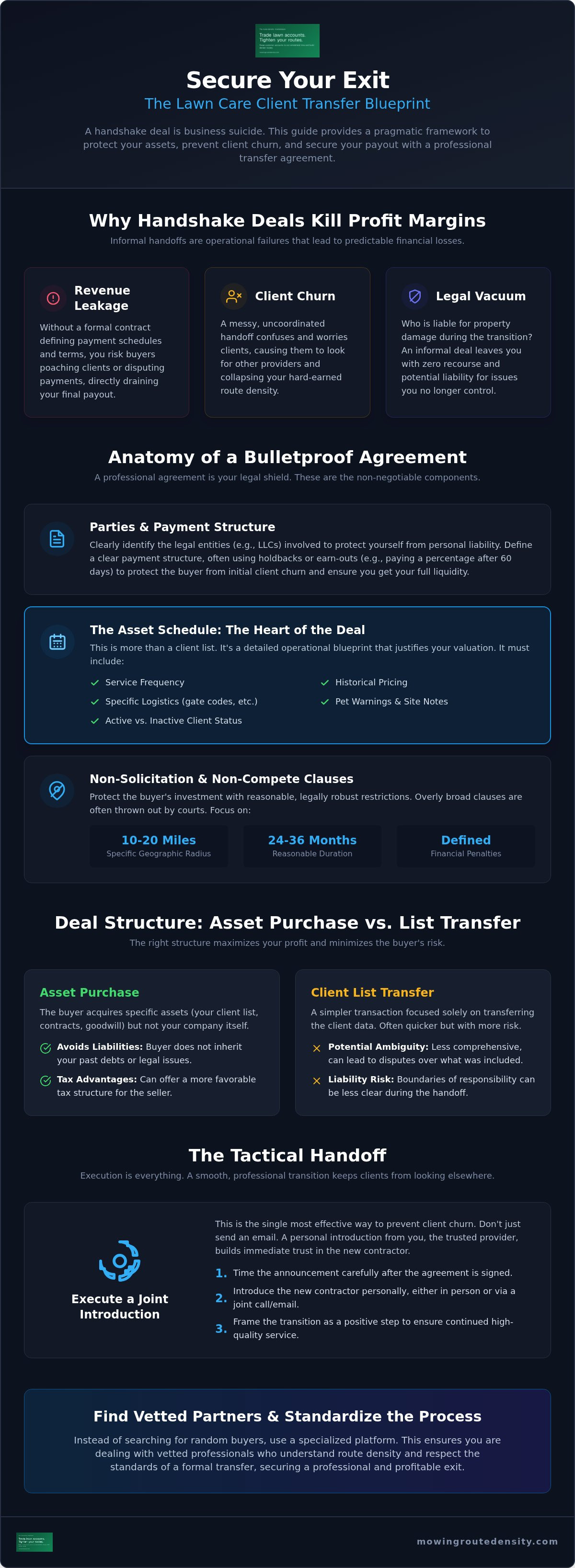
A generic template is a liability. It ignores the boots-on-the-ground reality of your operation. A professional lawn care client transfer agreement must be a surgical document. It identifies the legal entities involved to ensure you aren't personally on the hook for future equipment failures or service disputes. It defines the payment structure, often utilizing holdbacks or earn-outs. If 20% of your clients churn within the first 60 days, the buyer needs protection. If they stay, you get your full liquidity. This isn't just about a list; it's about the legal components of a client list, which include data, contracts, and the goodwill you've built.
The Asset Schedule: More Than Just a List
Your asset schedule is the heartbeat of the deal. It shouldn't just list names and addresses. It needs to detail service frequency, historical pricing, and specific logistics like gate codes or pet warnings. This data justifies your valuation because high-margin buyers pay for predictability. You must define active versus inactive clients to prevent post-sale disputes over "ghost" accounts. Most importantly, this schedule must align with your lawn care route density. If the accounts aren't clustered, the buyer's fuel consumption and windshield time will eat the profit. If you're ready to exit, you can trade your accounts on a secure marketplace designed for these specific logistics.
Non-Solicitation Clauses That Actually Hold Up
A buyer won't cut a check if they think you'll open a new shop across the street next week. You need non-solicitation and non-compete clauses that are legally robust but reasonable. In 2026, courts frequently throw out "infinite" or overly broad restrictions. Focus on a specific geographic radius, perhaps 10 to 20 miles from your existing route. Set a duration that makes sense, typically 24 to 36 months. Define specific financial penalties for poaching. If a seller steals back a high-value account, the penalty should be immediate and painful. This clarity deters bad actors and gives the buyer the confidence to invest in your territory without fear of asset theft.
Asset Purchase vs. Client List Transfer: Which is Smarter?
In a lawn care exit, clean lines save money. You have two main paths: buying the whole business entity or just the assets. For most contractors, a stock purchase is a liability trap. You don't want the seller’s past tax audits or worker’s comp claims. A clean asset purchase focuses solely on the client list and equipment. This structure allows the buyer to step into a lawn care client transfer agreement without inheriting the seller’s legal baggage. It’s about surgical precision. The buyer gets the revenue stream; the seller gets the liquidity.
Tax implications favor the asset route. Buyers can often amortize the cost of the client list over 15 years. This reduces taxable income while they scale the new route. Sellers often see this as a win for capital gains treatment. It’s a professional exchange that prioritizes bottom-line profitability. If you’re transferring accounts, make sure the agreement specifies that no liabilities are being transferred. You’re buying the future cash flow, not the past mistakes.
The Asset-Light Growth Strategy
Don't buy the seller's headache. Many contractors try to bundle aged mowers into the deal to inflate the price. This is a mistake. Buyers should look at commercial lawn mower lease options instead of taking on old junk. Inherited equipment leads to maintenance traps. It causes downtime. Renting or leasing allows a buyer to focus capital on the route acquisition itself. Use your cash to buy the customers; use a lease to get the tools. This asset-light approach ensures your crew stays in the field, not in the shop.
Valuation Tactics for 2026
The old 12-month revenue multiplier is dying. It’s too blunt. In 2026, smart contractors price in route density. A route with ten houses on one block is worth more than twenty houses spread across the county. Your lawn care client transfer agreement should justify a premium for clustered accounts. Focus on fuel savings. Highlight equipment longevity. If you can prove that a route minimizes windshield time, you can demand a higher multiple. Clustered accounts are the only way to fight rising labor costs. Don't settle for a generic valuation. Price the efficiency.
The Tactical Handoff: Executing the Transfer Agreement
Execution is where the profit lives or dies. You can have a perfect lawn care client transfer agreement, but a sloppy handoff will kill your valuation. Timing is everything. Don't announce the sale until the ink is dry and the initial payment has cleared. Announcing too early triggers client panic. It invites your competitors to start price shopping your best accounts. You want a controlled narrative. Use the "Joint Introduction" method. The seller must personally vouch for the buyer's professionalism. This transfer of trust is the only way to minimize churn and protect the route density you've built.
Managing the first 30 days requires clinical focus. Your contract should include a "Trial Period" or holdback clause. This ensures the buyer doesn't pay full price for "ghost" accounts that cancel the moment a new truck pulls up. It forces both parties to stay engaged during the transition. If the seller wants their full payout, they must ensure the clients stay on the schedule. This isn't about being nice. It's about protecting the logistical integrity of the route.
The 30-Day Transition Blueprint
Ride-alongs are mandatory during the first two weeks. You need to verify the route efficiency you're paying for. Don't just trust the GPS data. See the gate codes. Verify the pet warnings. Understand the specific property quirks that don't show up in a CRM. If a stop takes 45 minutes instead of the promised 20, your labor costs will spike. Frame the transition as a service upgrade. Introduce the new crew as a specialized team brought in to maintain high standards. If you encounter churn-outs, use your pre-negotiated credit terms to adjust the final payout. This keeps the transaction fair and grounded in reality.
Data and Logistics Migration
A clean data handoff is non-negotiable. You need more than just names. You need historical service dates, specific chemical application logs, and recurring payment authorizations. Moving these authorizations legally requires precision. Ensure the buyer has their professional lawn equipment rental ready for day one. Scaling into a new route with unreliable gear is a recipe for immediate service failures. Don't let equipment downtime destroy your new acquisition before you've even sent the first invoice. Ready to find a vetted partner for your next trade? You can list your accounts or find new routes on our secure marketplace.
Securing Your Exit with Mowing Route Density
Efficiency is your only defense against rising overhead. You've spent years optimizing fuel consumption and tightening your schedule. Don't throw that value away with a disorganized exit. Mowing Route Density standardizes the account trading process to ensure your hard work translates into maximum liquidity. We provide the infrastructure for professional contractors to swap routes and trade accounts without the typical logistical friction. By using a standardized lawn care client transfer agreement on our platform, you eliminate the guesswork. You protect your route density. You secure your payout.
The lawn care market in 2026 is projected to grow at a compound annual rate of up to 5.20%. With EBITDA multiples for maintenance-heavy businesses ranging from 3x to 6x, the stakes are too high for amateur mistakes. Our platform connects you with a national network of vetted contractors who understand the value of a clustered route. You aren't just selling a list; you're selling a high-performance logistical machine. We help you prove that performance to buyers who prioritize bottom-line profitability over raw revenue numbers.
The Marketplace Advantage
Skeptics look for holes in your data. They want to see proof of route density and equipment longevity. Our tools allow you to leverage your operational data to justify a premium price. Moving from a mower operator to a business strategist means treating your accounts as tradable assets. On a national B2B platform, you gain access to qualified buyers who have the capital and the professional crews to execute a clean handoff. This isn't about finding a "guy with a truck." It's about finding a partner who respects the billable hours you've invested in your territory.
Finalizing the Deal
A standardized agreement protects both sides of the transaction. It ensures the buyer isn't inheriting hidden liabilities and the seller isn't left chasing a check. You need a clear path toward a lawn care business exit strategy that pays out in full. Stop guessing at your valuation. Start auditing your route for the specific metrics that buyers actually pay for. If your accounts aren't clustered, fix them now. If your documentation is thin, thicken it. Your exit value depends entirely on the clarity of your data and the strength of your legal framework. You can start your route audit today on Mowing Route Density to see exactly where your operation stands.
Secure Your Payout and Protect Your Route
You’ve built your route with sweat and logistical strategy. Don't let a sloppy exit erode years of hard work. A professional lawn care client transfer agreement is the final tool in your arsenal to ensure your liquidity is protected and your clients remain loyal during the transition. Handshake deals are for amateurs who don't understand overhead. You need a legally binding framework that treats your accounts as the high-performance assets they are. Focus on route density as your primary valuation lever. Execute the handoff with clinical precision. By prioritizing a clean asset purchase and a tactical joint introduction, you eliminate the "ghost" account problem and secure your bottom line.
Success in this industry belongs to those who tighten their operations and cut out waste. Access our professional B2B marketplace and national contractor network to find your next opportunity or find a vetted buyer for your route. Optimize your route and secure your trade on Mowing Route Density. It’s time to stop leaving your business value to chance. Start treating your route with the strategic foresight it deserves and walk away with the profit you've earned.
Frequently Asked Questions
What is a lawn care client transfer agreement?
A lawn care client transfer agreement is a legally binding contract that moves ownership of service accounts from one contractor to another. It defines the specific assets being traded, including customer data, service history, and pricing structures. This document ensures the seller receives fair value for their route density while protecting the buyer from inheriting the seller's past legal liabilities or hidden business debts.
Do I need a lawyer for a client list transfer?
Consulting a lawyer is a smart move to ensure your state's specific regulations are met. However, you don't need to pay for a custom contract from scratch. Utilizing a specialized lawn account trading platform provides a pragmatic framework for these B2B transactions. A lawyer is most effective when used to review the final document—or by consulting a full-service firm such as Botelho Law Group—to ensure it protects your bottom line and remains legally enforceable.
How do I value my lawn care client list for a transfer?
Valuation goes beyond a simple revenue multiplier. In 2026, smart contractors value lists based on route density and EBITDA, which typically ranges from 3x to 6x for maintenance revenue. Clustered accounts that minimize fuel consumption and windshield time command a higher premium. You must audit your route to prove that your billable hours are optimized. Buyers pay for predictability and profit margins, not just names.
What is a non-solicitation clause in a landscaping contract?
A non-solicitation clause is a protective provision that prevents a seller from poaching clients back after the deal is finalized. It creates a legal barrier that stops you from contacting transferred accounts for a specific duration, usually 24 to 36 months. Without this clause, the buyer’s investment is at risk. It ensures the buyer has the time to build their own relationship with the route without unfair competition.
Can I sell my lawn care accounts if I don't have written contracts with them?
You can sell accounts based on verbal agreements, but expect a lower valuation. Buyers view handshake deals as high-risk assets because client churn is more likely. To mitigate this risk, your lawn care client transfer agreement should include a joint introduction period. Personally vouching for the new contractor helps stabilize the transition. Moving forward, always secure written service agreements to maximize the eventual liquidity of your business.
How long should a non-compete last in the lawn care industry?
A non-compete typically lasts between two and three years. Courts in 2026 often find "permanent" or overly broad restrictions unenforceable. The duration must be reasonable and tied to a specific geographic radius, such as 10 to 20 miles. This timeframe gives the buyer enough seasons to lock in client loyalty. Setting a clear, limited duration protects the buyer's new territory while keeping the agreement legally robust and enforceable.
What happens if a client cancels right after the transfer?
Your agreement should include a holdback or clawback clause to handle immediate churn. This typically involves keeping 10% to 20% of the purchase price in escrow for 60 to 90 days. If a client cancels during this window, the final payout is adjusted downward. This mechanism protects the buyer from paying for ghost accounts. It also incentivizes the seller to ensure a professional and smooth handoff during the transition.
How do I handle the transfer of equipment along with the clients?
Treat equipment as a separate line item or exclude it entirely. Selling aged mowers often complicates the deal and adds maintenance liability for the buyer. It is often more efficient for the buyer to utilize commercial lawn mower rental options to scale into the new route with reliable gear. If you do include equipment, ensure the agreement specifies that it is sold as is to prevent future disputes over equipment longevity.


