

Most lawn care owners are addicted to top-line revenue while their profit leaks out of a gas tank. If your crews spend forty minutes driving for every twenty minutes of mowing, you aren't running a landscaping business. You're running a poorly funded logistics company. You've likely felt the sting of rising fuel costs and labor rates eating your margins while your equipment debt climbs. It's a common trap. You scale for the sake of size and end up with a calendar full of windshield time and low-quality residential churn.
Success in 2026 requires a shift in perspective. Proper due diligence for buying lawn care routes must move beyond checking a P&L statement. It requires a clinical audit of route density. This guide shows you how to acquire accounts that slash overhead and maximize billable hours. We'll examine how to identify high-density clusters that minimize travel, secure predictable B2B revenue, and leverage asset-light scaling through strategic equipment rentals. Stop buying headaches. Start buying density.
Key Takeaways
- Stop chasing top-line revenue and prioritize the ratio of billable hours to total labor hours. Route density is the only metric that protects your margins against rising fuel costs.
- Perform rigorous logistical due diligence for buying lawn care routes. You must audit the physical footprint and travel paths of a route before you ever sign a purchase agreement.
- Apply the "Density Premium" to your valuations. Paying a higher multiple for accounts adjacent to your current territory often yields a better ROI than buying cheap, scattered routes.
- Consolidate schedules within the first 30 days to eliminate overlapping travel. Quick integration of new accounts is critical to preventing margin bleed and securing customer trust.
- Use account trading platforms to swap inefficient outliers for high-density clusters. Combine this with commercial mower rentals to scale your fleet without the burden of high-interest capital expenditure.
The Strategic Shift: Buying Density Over Revenue
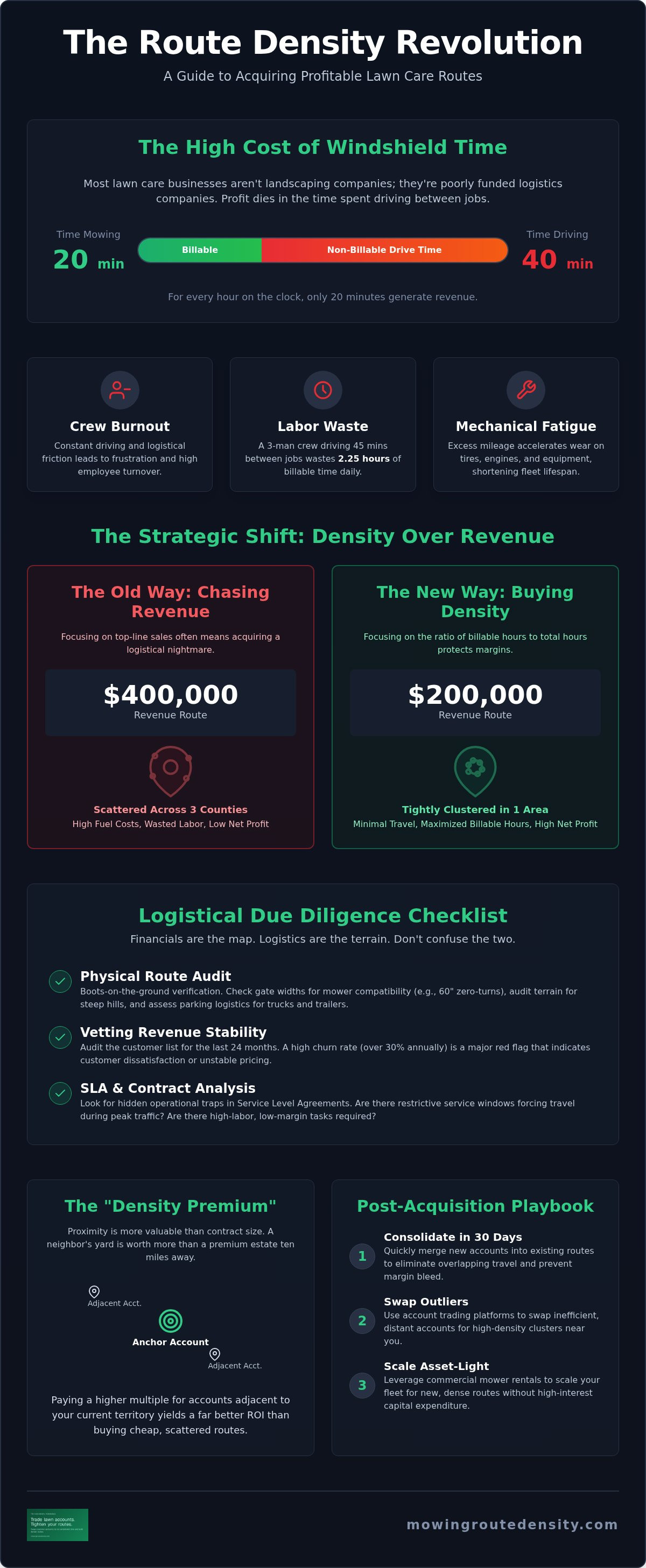
Stop chasing top-line revenue. It's a vanity metric that hides operational rot. If you buy a route based on gross sales alone, you're likely inheriting a logistical nightmare. In 2026, profit isn't found in the number of accounts you service; it's found in the gaps between them. You need to focus on lawn care route density. This is the ratio of billable hours to total on-clock hours. A smaller, tighter route with $200,000 in revenue often yields a higher net profit than a $400,000 route spread across three counties. Why? Because you aren't paying your crews to sit in traffic.
Effective due diligence for buying lawn care routes requires a clinical look at the map. You aren't just buying customers; you're buying a schedule. If that schedule is inefficient, your margins will evaporate into fuel tanks and non-billable labor hours. High density isn't just a bonus. It's the only way to survive rising overhead. You must prioritize routes where the travel time between stops is measured in minutes, not miles.
The High Cost of Windshield Time
Windshield time is where profit goes to die. Every minute your crew spends in transit is a minute you pay for labor, fuel, and vehicle depreciation without generating a cent of revenue. This is a classic vehicle routing problem that many owners ignore until their bank account is empty. Consider the hidden costs of logistical waste:
- Labor Waste: Paying a three-man crew for 45 minutes of driving between jobs adds up to 2.25 hours of lost billable time every single day.
- Mechanical Fatigue: Excessive mileage accelerates tire wear, oil changes, and engine fatigue, shortening the lifespan of your fleet.
- Crew Burnout: Field staff hate being stuck in trucks. They want to work, finish their routes, and get home. Logistical waste breeds frustration and drives up turnover rates.
Acquiring for Strategic Asset Clustering
Your goal is to build clusters. When performing due diligence for buying lawn care routes, look for accounts within a 5-mile radius of your existing hubs or anchor accounts. This is the "Anchor Account" strategy. You find a large commercial contract and buy every smaller account around it. Proximity is now more valuable than contract length. In a high-inflation environment, a neighbor's yard is worth more than a premium estate ten miles away. Tighten your footprint. Cut the outliers. Focus on the cluster to keep your machines running and your trucks parked.
Logistical Due Diligence: Auditing the Route Footprint
Financial statements show you what already happened. Logistics show you what will happen next month. When you conduct due diligence on a potential acquisition, you must look past the EBITDA. You're buying a physical footprint. If the geography is broken, the profit is fake. Rigorous due diligence for buying lawn care routes means boots on the ground. You need to see the gates, the hills, and the curb space. Financials are the map. Logistics are the terrain. Don't confuse the two.
Vetting the seller’s Service Level Agreements (SLAs) is equally critical. Hidden operational traps often lurk in the fine print. Are there restrictive service windows that force your crews into peak traffic? Does the contract require specialized hand-weeding that eats up billable hours? You must assess the quality of the customer list with a cold eye. Commercial contracts offer stability, but high-maintenance residential accounts often demand more customer service than they are worth. If the route is a patchwork of demanding homeowners, your overhead will spike.
The Physical Route Audit Checklist
Don't assume your current fleet works for every new account. You need to verify equipment compatibility at the property level. Check the gate widths. If your 60-inch zero-turns can't reach the backyard, your labor costs just tripled. Audit the terrain for steep hills or obstacles that require specialized walk-behind mowers. Parking logistics are another hidden drain. If your crew spends ten minutes finding a safe spot for a 20-foot trailer at every stop, your density is an illusion. Every minute spent maneuvering a truck is a minute you aren't mowing.
Vetting Revenue Stability and Churn
High revenue often masks high churn. Audit the customer list for the last 24 months to find red flags. If the seller is replacing 30% of their base annually, you're buying a leaky bucket. Look for toxic accounts. These are the clients who require excessive office hours and constant callbacks. They destroy your administrative efficiency. Finally, verify contract transferability. You need to ensure customers can't cancel the moment the ink is dry. If you find outliers that don't fit your new density goals, you can always swap accounts on a trading platform to tighten your footprint.
Verify that the seller has documented proof of service for every billable event. Gaps in service history usually signal unhappy customers. You want a route that is a well-oiled machine, not a series of fires waiting to be put out. Focus on the logistics, and the financials will take care of themselves.
Valuation Framework: Calculating the Real Price of Density
Standard business valuation models are lazy. Most brokers will tell you to use a generic 2.5x or 3x EBITDA multiple. In the lawn care industry, that number is often meaningless. A route with high revenue but zero density is a liability, not an asset. You need to calculate the Density Premium. This is the additional value an account provides simply by being adjacent to your existing stops. When you perform due diligence for buying lawn care routes, you aren't just looking at what the seller earned. You're looking at what you will keep after merging their map with yours.
Calculating the marginal utility of a new account is simple math. If a crew is already on a street, the cost of adding the house next door is negligible. Your truck is already parked. Your mowers are already hot. Every dollar from that new stop goes almost directly to the bottom line. This is the foundation of lawn care profit margin optimization. You aren't just buying revenue. You're buying the elimination of waste.
The Synergy Multiple
Value a route based on how much it reduces your existing drive time. If an acquisition allows you to merge two inefficient routes into a single, dense loop, the labor savings alone might justify a higher purchase price. This is the Synergy Multiple. If you cut forty minutes of daily windshield time for a three-man crew, you've just reclaimed two hours of billable labor. That's pure profit. On the other hand, isolated accounts should be bought at a deep discount. If a stop requires a ten-minute drive away from your cluster, it's an outlier that bleeds your margin. Don't pay a premium for a headache.
Asset-Light Growth Strategies
Scaling too fast is a death sentence for cash flow. Many owners over-leverage themselves with high-interest equipment debt the moment they acquire new routes. This is a mistake. Use a "Rent-to-Scale" model instead. Test the actual profitability of a new route for 90 days before committing to permanent capital expenditure. You can utilize commercial lawn mower lease options to manage the initial workload without the burden of a long-term loan. Proper due diligence for buying lawn care routes includes protecting your balance sheet. Stay lean until the route proves its density. If the numbers don't work, you haven't tied yourself to a five-year equipment note.
Post-Acquisition Integration: Merging Routes Without Margin Bleed
The ink is dry. The keys are in your hand. Most owners think the hard part is over. They're wrong. Integration is where profit is either realized or lost. If you keep the seller's exact schedule, you've already failed. Your due diligence for buying lawn care routes should have identified the logistical overlaps. Now you must execute. The first 30 days are a sprint to secure customer trust and retain the seller's field staff. Without that staff, you lose the site-specific nuances that prevent callbacks.
Consolidate your schedules immediately. Overlapping travel paths are pure waste. If your existing crew is on the same street as your new acquisition, merge them into a single loop. This is also the time for standardizing equipment. Running a mixed fleet is a maintenance nightmare. Decide on a brand and stick to it. Carry one set of blades, one type of belt, and one set of filters. Tightening your parts inventory reduces downtime and simplifies training.
Be ruthless about pruning. If an account is an outlier that destroys your density, fire it. Sentimentality doesn't pay for fuel. If a stop is ten minutes away from your cluster, it's a drain on your net margin. Cut it loose and focus on the core. You're building a business, not a collection of addresses.
Re-Routing for Maximum Efficiency
Don't guess with your map. Use route optimization software to merge new accounts into your existing loops. We advocate for the Tight Loop philosophy. Your crews should spend their entire day in one specific zone. If a truck has to cross a highway more than once, your route is broken. Communicate these changes to customers as an "efficiency upgrade." Most won't care about a day change if the service quality remains high and consistent.
Staff and Operations Integration
Retain the tribal knowledge. The previous owner's crew knows which gates have broken latches and which yards have hidden irrigation heads. Losing that knowledge leads to property damage and lost time. Standardize your safety protocols across the combined teams on day one. If the transition creates a temporary overflow of work that your current staff can't handle, you can find lawn care subcontractors to handle the surge while you stabilize the new schedule.
Don't let a messy transition bleed your margins. If you find yourself with too many outliers after the merger, list your inefficient accounts on our trading platform to swap them for density that fits your new footprint.
The Account Marketplace: Scaling via Mowing Route Density
Traditional growth is slow and expensive. You've spent weeks performing due diligence for buying lawn care routes, and you've likely found a mix of high-value clusters and logistical outliers. Some accounts fit your core zone perfectly. Others are distractions that force your trucks across town. In the past, you either kept the waste or fired the client. Neither is ideal. The Mowing Route Density platform offers a third way. It serves as your tactical growth hub, allowing you to treat accounts as liquid assets rather than permanent obligations.
You don't have to accept a messy map. Use the marketplace to swap those outliers for high-density clusters. If an account doesn't contribute to your billable-hour ratio, it belongs to someone else. Trading accounts allows you to tighten your footprint without the friction of traditional sales cycles. It is a pragmatic solution to the systemic waste that plagues the service industry.
Trading for Geographic Dominance
The Account Swap is the most efficient way to tighten your footprint. Average customer acquisition costs (CAC) in 2026 range from $116 to $165 per lead. Why pay that when you can trade your way to growth? You find another contractor who is driving ten miles to a house that is right next to your shop. They have the same problem you do. You swap. Both businesses gain density without spending a dime on marketing. This is how you build geographic dominance in specific zip codes or business parks. It is faster, cheaper, and more logical than organic lead generation. Use our lawn mowing service provider locator to identify potential B2B partners in your target areas.
Asset-Light Fleet Management
Scaling doesn't have to mean drowning in debt. When you acquire a large route, the immediate instinct is to buy more mowers. Don't. High-interest loans on equipment you only use for eight months of the year will crush your cash flow. Adopt an asset-light model instead. You can leverage professional lawn equipment rental to handle the new workload. Rent the commercial-grade mowers you need for the peak season and return them when the grass stops growing. This keeps your balance sheet lean while you double your account count. You get access to professional-grade equipment without the long-term maintenance headache or the depreciation risk. Logistical efficiency is the only hedge against rising labor and fuel costs. Secure the dense accounts. Swap the waste. Rent the tools. That is how you build a profitable, scalable landscaping business in 2026.
Dominate Your Market Through Logistical Precision
Scaling a landscaping business in 2026 isn't about owning the most trucks. It's about owning the most efficient map. You've learned that revenue is a vanity metric if it's spread across three counties. True profitability lives in the clusters. Successful acquisition requires rigorous due diligence for buying lawn care routes that focuses on gate widths, parking logistics, and the "Density Premium." Stop paying for windshield time. Start buying the house next door.
Merging routes is a tactical maneuver. You must be willing to prune the outliers and consolidate your fleet. This isn't just theory; it's the only way to protect your margins against rising labor and fuel costs. Use the right tools to stay lean and asset-light during your growth phase. You're building a machine, not a collection of addresses.
Ready to tighten your footprint? Start optimizing your logistics on the Mowing Route Density marketplace. We provide no-nonsense B2B account trading, commercial-grade mower rentals, and pragmatic operational support. Build a business that works for you, not the other way around. You have the strategy. Now go execute.
Frequently Asked Questions
How much does it typically cost to buy a lawn care route in 2026?
Most routes in 2026 trade between 2.0x and 4.0x of Seller's Discretionary Earnings (SDE). The median deal settles between 2.4x and 2.8x SDE. If the route has over 60% recurring maintenance revenue, expect to pay a premium of 3.2x to 4.0x. Smaller owner-operated setups under $500,000 in revenue usually stay on the lower end of that range. Focus on the earnings, not just the gross revenue, to ensure you aren't overpaying.
Is it better to buy residential or commercial lawn care routes for density?
Commercial routes offer predictable B2B revenue and better contract stability, but residential clusters often provide superior density. A single subdivision with thirty accounts is a goldmine for billable hours. Commercial sites often require more travel between large, spread-out properties. Your goal is to minimize travel time regardless of the customer type. Look for where the properties are closest together to maximize your crew's output and reduce fuel consumption.
What is the single most important metric to check when buying a route?
The single most important metric is the ratio of billable hours to total on-clock hours. This defines your route density. Financials show past performance, but this ratio predicts future profit. If your crew spends 30% of their day in a truck, your margin is already gone. Proper due diligence for buying lawn care routes requires auditing GPS logs to see exactly how much time is spent actually mowing versus driving between jobs.
How do I prevent customers from leaving after I buy the route?
Retain the seller's field staff to maintain the familiar face of the business for the customers. Customers leave when they feel the service quality or the personal connection has vanished. Introduce yourself through a formal letter or visit, but keep the existing crew on the properties. Avoid drastic price hikes in the first 90 days. Focus on proving that the transition will be seamless and that their service will remain uninterrupted.
Can I buy a lawn care route with no money down?
Buying a route with no money down is possible through seller financing or earn-out structures. You pay the seller a percentage of the revenue over time rather than a lump sum upfront. This aligns the seller's interests with yours, as they only get paid if the customers stay. Most traditional lenders will still require some skin in the game. Use an earn-out structure to protect yourself against immediate post-sale customer churn and revenue loss.
Should I buy the equipment along with the lawn care route or rent?
Renting is the more pragmatic choice during the initial acquisition phase. It allows you to scale your fleet on-demand without the burden of high-interest equipment debt. Use a Rent-to-Scale model to test the route's actual profitability for 90 days. If the density doesn't hold up, you aren't stuck with a five-year loan on a mower you don't need. Buying used equipment from the seller is often a trap for hidden maintenance costs.
How do I calculate the route density of a potential acquisition?
Divide the total hours spent on properties by the total hours your crew is on the clock. If a crew works an 8-hour shift and spends 6 hours mowing, your density is 75%. You want this number as high as possible to ensure profitability. Map out every stop and calculate the drive time between them using a routing tool. If the travel segments are longer than ten minutes, your density is failing and your overhead will spike.
What are the risks of buying existing lawn care contracts?
The primary risks include high customer churn and non-transferable contract clauses. Some customers only stayed because of a personal relationship with the previous owner. Perform thorough due diligence for buying lawn care routes by checking for toxic accounts that demand excessive service time. Verify that the contracts legally allow for a change in ownership. If the paperwork is messy, the revenue is at risk the moment you take over the business operations.


