

What if the biggest drain on your 2026 profit margins isn't your labor cost, but the $15,000 mower sitting in your shop waiting for parts? You know the reality of the service industry. Equipment breaks, schedules collapse, and route density suffers. Every hour a machine stays idle is revenue lost to overhead and depreciation. It's a cycle that keeps many landscaping businesses stuck in a loop of high-interest debt and stagnant growth.
We agree that owning your core fleet is standard, but relying solely on ownership creates a ceiling for your expansion. This guide explains how to leverage zero turn mower rental for contractors as a tactical tool to protect your billable hours and scale your operations without tying up your capital in depreciating assets. You'll learn how to maintain 100 percent route uptime, even when your primary machines fail or your route volume spikes.
We're going to dive into the mechanics of asset-light scaling. We'll cover how to test high-performance commercial models before you commit to a purchase, how to fill equipment gaps during peak season, and how to use strategic rentals to maximize your crew's efficiency on every route you service.
Key Takeaways
- Stop ignoring the "ownership trap" where idle assets kill your margins. Learn to calculate Total Cost of Ownership (TCO) to identify exactly where renting beats buying.
- Protect your route density by using zero turn mower rental for contractors to service new accounts immediately. Never turn down a profitable cluster because of equipment gaps.
- Shift from reactive repairs to proactive scaling. Ensure 100% route uptime by swapping broken machines for reliable rental units in hours, not weeks.
- Evaluate rental partners on B2B support structures and maintenance logs rather than just price. Reliability and contractor-specific timelines are the only metrics that matter.
- Build an asset-light business model by integrating on-demand rentals with account trading platforms. Scale your fleet capacity without the burden of high-interest equipment debt.
Beyond the Machine: Why Contractors Rent Zero Turn Mowers
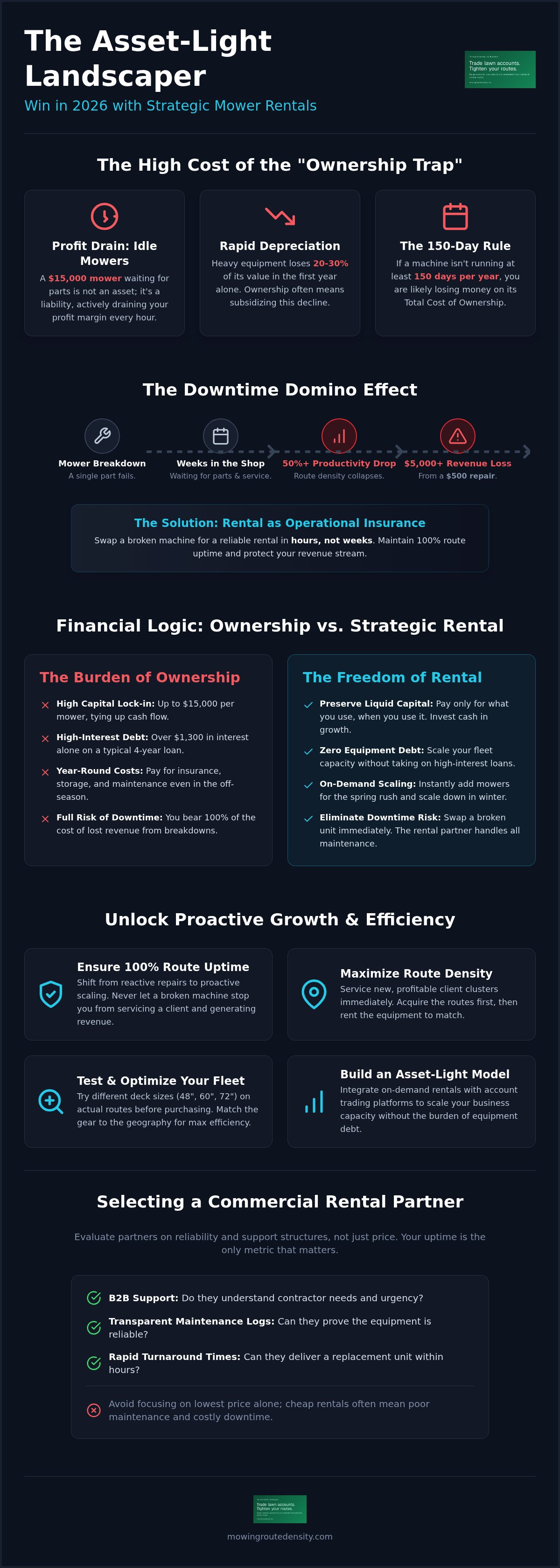
Most contractors view rental as a "break glass in case of emergency" option. That's a fundamental mistake. In 2026, the most profitable operators treat zero turn mower rental for contractors as a tactical offensive move. Ownership feels like building an empire, but it's often just building a graveyard of depreciating assets. Heavy equipment typically loses 20 to 30 percent of its value in the first year alone. If a machine isn't running at least 150 days a year, you're subsidizing its decline with your hard-earned profit. Tactical rental shifts your mindset from reactive repairs to proactive scaling.
Professional-grade zero-turns aren't the same as the units you see at big-box retailers. They're built for 8-hour shifts and high-speed cutting. When you rent commercial-duty equipment, you're accessing durability and speed that retail units can't match. This is a critical hedge against 2026 market volatility. With the U.S. equipment rental market projected to reach $83.5 billion this year, smart contractors are joining the 60 percent of professionals who now favor renting over total ownership to stay agile.
The High Cost of Equipment Downtime
A broken spindle or a blown hydraulic line doesn't just cost you the price of the part. It costs you billable hours. If your primary unit sits in the shop for a week, your crew's productivity drops by 50 percent or more. This creates a domino effect. One broken mower destroys your route density for the entire month. You're forced to pay labor for windshield time while your remaining machines struggle to keep up. Think of rental as operational insurance. It keeps your crews moving and your clients happy while your core fleet undergoes maintenance. Don't let a $500 repair turn into a $5,000 revenue loss.
Asset-Light Growth Strategies for 2026
Scaling for peak season shouldn't require taking on high-interest debt. Financing a $15,000 mower can add over $1,300 in interest alone over four years. Why carry that weight in January when the grass isn't growing? Renting allows you to scale your fleet capacity for the spring rush without the burden of year-round storage and insurance costs. This preserves your liquid capital for high-ROI activities like lawn account trading. Instead of buying a machine and hoping for work, acquire the routes first and rent the equipment to service them. You can also test different deck sizes, like a 60" versus a 72", on your actual routes before committing to a purchase. It's about working smarter, not harder.
Maximizing Route Density with On-Demand Equipment
Route density isn't just a map of pins. It's a logistical puzzle. If you lack the hardware to service a cluster, those pins are worthless. Most contractors wait until they've "earned" a new mower to buy it. This is backward logic. By the time you save the cash, the customer has already hired your competitor. Using a zero turn mower rental for contractors allows you to service newly acquired mowing routes the moment they hit your books. You capture the revenue now. You build the density now.
Strategic asset clustering is the secret to lean operations. Stop hauling a 72-inch deck across the city for one commercial lot. Instead, place a rental unit in the center of a high-density cluster. You reduce drive-time waste. You maximize billable hours per crew. If your equipment doesn't match the route requirements, you're burning fuel and labor on inefficiency. Smart operators don't let gear dictate their growth. They dictate their gear based on the work available.
Synchronizing Gear with Route Geography
A 60-inch zero turn is a liability in a tight residential neighborhood. It won't clear gates. It scalps uneven turf. It forces your crew to use walk-behinds on areas that should be mowed in minutes. Matching your deck width to specific route geography is non-negotiable for profitability. Renting allows you to swap a wide-deck machine for a compact 48-inch unit when your route shifts from open parks to gated backyards. This reduces trailer weight. It cuts fuel consumption. It keeps your crews moving at peak speed regardless of terrain. Efficiency is about precision, not just power.
Protecting the Schedule During Peak Growth
The "Spring Rush" kills businesses that can't scale. When demand spikes, your permanent fleet hits its ceiling. One delay leads to a week of angry calls and client churn. Utilizing professional lawn equipment rental provides the surge capacity you need to stay on schedule. It's a safety valve for your reputation. By integrating zero turn mower rental for contractors into your seasonal planning, you avoid the trap of turning away profitable work. If your internal capacity is still maxed out, use a national contractor locator to find vetted partners to handle the overflow. Don't let a lack of steel in the field cost you a long-term contract.
Financial Logic: Rental vs. Ownership in 2026
Ownership is often an emotional decision disguised as a financial one. Contractors love the feeling of a full equipment yard. However, your bottom line doesn't care about your feelings. It cares about the Total Cost of Ownership (TCO). When you buy a $15,000 zero-turn, you aren't just paying the sticker price. You're committing to "hidden" costs that typically add 20 to 30 percent to your total expense. This includes specialized mechanic labor, insurance premiums, and secure off-season storage. A zero turn mower rental for contractors replaces these unpredictable variables with a fixed, 100 percent deductible business expense.
Depreciation is the silent killer of landscaping margins. A new commercial mower loses roughly 20 to 30 percent of its value the moment it leaves the dealer. By the end of year two, you've lost nearly half your initial investment to wear and tear. Every hour that machine sits idle in your shop, it's hemorrhaging value. Rental flips this script. You only pay for the machine when it's generating revenue. If the grass isn't growing, you aren't paying for a depreciating asset to collect dust and rust.
The Opportunity Cost of Capital
Cash is your most valuable tool. Tying up a $15,000 down payment in a single machine limits your ability to pivot. What else could that capital buy? It could fund a marketing blitz or secure high-density clusters through lawn care profit margin optimization. Maintaining liquidity allows you to pounce on growth opportunities your debt-heavy competitors can't touch. For those seeking long-term fleet stability without the massive upfront hit, exploring commercial lawn mower lease options provides a middle ground that keeps your balance sheet lean and agile.
Maintenance and Replacement Cycles
The "Second Life" myth bankrupts contractors. You think you're saving money by keeping a five-year-old mower on the trailer. In reality, that "toxic" asset is costing you more in emergency repairs and downtime than a new unit would in payments. Rental ensures you always have a machine with under 500 hours on the clock. You get the latest fuel-efficient engines and sharpest cutting decks without the headache of major component failures. Audit your fleet today. If a machine spends more than 10 percent of its billable hours in the shop, it's time to swap it for a reliable zero turn mower rental for contractors. Stop paying for your equipment's retirement and start paying for its performance.
Selecting a Commercial Rental Partner: Beyond Deck Size
Choosing a partner for zero turn mower rental for contractors is about more than deck size. It's about uptime. A low daily rate means nothing if the machine dies at 10:00 AM on a Tuesday. You must prioritize reliability over brand loyalty. Demand maintenance logs. Check the unit age. If a machine has over 1,000 hours, it's a liability, not an asset. You're renting performance, not a logo. If the rental yard can't prove the machine is serviced, walk away. Your reputation is on the line.
B2B support structures are the backbone of a successful scaling strategy. Retail centers don't understand contractor timelines. They close early. They don't offer delivery. Your crews shouldn't spend two hours in traffic to pick up a unit. That’s dead time. It’s wasted labor. Seek partners who offer delivery and flexible contracts. Whether you need a unit for a day or a month, the terms must adapt to your route volume. Flexibility is the only way to protect your margins during the peak season.
Verifying Equipment Grade
Don't get fooled by a fresh coat of paint. Standard residential mowers use light-duty transmissions and consumer engines. They can't handle the heat of a professional shift. 'Big Box' rentals fail on commercial routes because they aren't built for the stress. You need high-capacity hydraulic systems and engines designed for constant use. Sharp blades and clean decks aren't optional. They are mandatory for customer retention. A ragged cut leads to a canceled contract and a damaged brand. Always verify the transmission and engine grade before signing the agreement.
Service Level Agreements (SLAs) for Contractors
Breakdowns happen. The response time is what determines your profit. A professional SLA must include a swap-out guarantee. If a machine fails on the job site, you need a replacement in hours, not days. You can't afford to wait for a part to ship while your crew sits idle. Read the fine print on damage waivers. Avoid predatory fees that punish you for normal wear and tear. Your rental partner should be an operational strategist, not a vendor looking for a surcharge. To ensure your fleet stays in the field, find vetted commercial rental partners through our specialized B2B platform.
Scaling Your Fleet with Mowing Route Density
Mowing Route Density is not just a vendor. We are a strategic partner for contractors who refuse to let equipment bottlenecks dictate their growth. Our platform provides a centralized hub for zero turn mower rental for contractors, ensuring you have access to high-performance assets without the traditional procurement lag. We understand that in the service industry, timing is everything. Our 100 percent B2B focus means we prioritize your operational efficiency above all else. We don't waste your time with residential-grade gear or consumer-level service. We provide the tools you need to dominate your market.
The real power of our ecosystem lies in integration. By combining equipment rental with our lawn account trading platform, you can execute a "buy and build" strategy with zero capital risk. You acquire a high-density route cluster and immediately deploy the necessary machinery to service it. This is asset-light scaling in its purest form. If you need to expand your network further or find vetted partners for overflow work, our lawn mowing service provider locator connects you with a national network of professionals. You aren't just renting a mower. You're accessing a logistical framework designed for profit.
A Holistic Approach to Landscaping Logistics
Equipment is only one piece of the route density puzzle. You can have the fastest mower in the world, but if your route is scattered across three counties, you're still losing money. We help you leverage data to decide when to rent and when to trade. Sometimes the most profitable move isn't adding a machine. It's trading away an inefficient outlier account to double down on a core neighborhood. Building a resilient business in 2026 requires this level of strategic foresight. You thrive on efficiency, not just hard labor. Stop chasing every lead and start building clusters that actually pay.
Next Steps for Your 2026 Growth
Growth doesn't happen by adding more work. It happens by removing more waste. Start by auditing your current fleet. Identify the underperforming units that cost more in maintenance than they earn in billable hours. Look for route gaps where a zero turn mower rental for contractors could unlock new revenue immediately. Don't wait for the next equipment failure to rethink your strategy. Contact Mowing Route Density today for a strategic equipment and route audit. We'll help you tighten your operations and maximize your crew's capacity before the next peak season begins. Work smarter. Scale faster. Keep your capital.
Take Command of Your 2026 Profit Margins
Scaling a landscaping business requires more than just sweat; it requires a lean, asset-light strategy. Stop letting depreciating equipment and high-interest debt dictate your growth ceiling. By integrating zero turn mower rental for contractors into your operational model, you protect your route density and ensure 100 percent uptime. You've learned that matching deck size to route geography isn't a luxury. It's a fundamental requirement for maximizing billable hours and reducing windshield time. Every hour a crew spends with the wrong machine is profit you'll never recover.
We provide the infrastructure you need to shift from reactive repairs to proactive scaling. Our specialized B2B equipment network, data-driven route optimization, and national contractor marketplace are built for professionals who value efficiency over ownership. It's time to stop subsidizing your equipment's retirement and start focusing on your company's expansion. Optimize your fleet today with Mowing Route Density. The most profitable year of your business starts when you stop paying for idle iron and start paying for performance. Go build your operation, one dense route at a time.
Frequently Asked Questions
Is it better for a landscaping contractor to rent or buy a zero-turn mower?
Renting is superior when your equipment utilization is below 40 percent or approximately 100 days per year. Ownership makes sense for core fleet units that run more than 150 days annually. However, you must factor in the hidden costs like insurance, storage, and specialized mechanic labor. If your capital is better spent on acquiring new routes, a zero turn mower rental for contractors provides the agility to scale without high-interest debt.
What is the average daily cost of a commercial zero-turn mower rental?
In 2026, daily rates for commercial units typically range from $150 to $215 depending on deck size and horsepower. For example, a Gravely Pro-Turn 160 might run $195 per day, while a Toro commercial unit can reach $215. Weekly and monthly rates offer significant discounts, often dropping the daily average by 30 to 50 percent. This predictable cost structure helps you maintain tight control over your billable hours and overhead expenses.
Do rental mowers include insurance and maintenance coverage?
Most professional B2B rental agreements include routine maintenance and wear-and-tear coverage in the base rate. You aren't responsible for oil changes or hydraulic fluid services. However, you must clarify the terms of the damage waiver. These waivers protect you against major component failures but may not cover negligence. Always ensure your rental partner provides a clear Service Level Agreement to avoid hidden fees that bleed your margins and damage your cash flow.
Can I rent a zero-turn mower for an entire mowing season?
Yes, many commercial providers offer monthly or full-season rental agreements tailored to landscaping cycles. This is a strategic move for handling the "Spring Rush" without committing to a 48-month finance plan. Renting for the season eliminates the burden of off-season storage and winterization. It allows you to return the machine when the grass stops growing, keeping your capital liquid for other business investments or route acquisitions during the winter months.
What deck size is best for commercial zero-turn rentals?
The best deck size depends entirely on your route geography rather than a "bigger is better" philosophy. Use a 48-inch deck for high-density residential clusters with tight gate access to maximize efficiency. Switch to a 60-inch or 72-inch deck for wide-open commercial properties where speed is the primary driver of profit. Renting gives you the flexibility to match the specific machine to the job site requirements, reducing wasted labor hours and fuel consumption.
What happens if a rented zero-turn mower breaks down during a job?
A professional B2B rental partner should provide a swap-out guarantee that gets you back in the field within hours. Downtime is the silent killer of route density. If a machine fails, your provider should replace the unit immediately rather than making you wait for repairs. This is why checking maintenance logs and unit age is critical before signing. Don't settle for retail centers that treat your commercial emergency like a casual weekend project.
Are there tax benefits to renting equipment instead of owning it?
Rental payments are typically 100 percent deductible as business operating expenses in the year they are paid. This simplifies your accounting and provides an immediate tax shield for your revenue. While Section 179 allows for depreciation deductions on purchased equipment, it often requires a larger upfront investment or debt commitment. Renting keeps your balance sheet clean and your cash flow predictable, which is essential for maintaining lean operations and protecting your bottom line.
How does renting a mower help improve my route density?
Utilizing a zero turn mower rental for contractors allows you to service new account clusters immediately instead of waiting months to save for a down payment. You can place rental units strategically within high-density zones to minimize drive time and maximize billable hours per crew. This asset-light approach ensures you never turn down a profitable route because of equipment gaps. It turns your fleet into a scalable tool for strategic growth.


