

Winning a massive commercial portfolio is the fastest way to bankrupt your lawn care business. If you're chasing every lead across three counties, you aren't growing. You're hemorrhaging cash on fuel and windshield time. Successfully finding property management companies for lawn contracts isn't just about a low bid. It's a high-stakes game of logistics and route density. You need clusters, not just customers.
We know the frustration. You spend hours cold-calling gatekeepers only to get ghosted. When you finally land a job, the profit disappears into inefficient travel and poorly estimated labor costs. It's a cycle of working harder for less. This guide changes that. You'll learn the exact framework for identifying, pitching, and securing high-volume property management contracts while maintaining maximum route density.
We're stripping away the fluff to focus on what matters. We will cover how to reach actual decision-makers, bid with clinical precision, and use strategic tools to optimize your portfolio for predictable, recurring revenue. It's time to stop driving and start earning.
Key Takeaways
- Transition from volatile residential one-offs to stable commercial B2B agreements that provide predictable recurring revenue.
- Stop wasting time on cold calls. Learn the tactical process for finding property management companies for lawn contracts using LinkedIn and national directories.
- Audit properties for safety risks and curb appeal to build bids that solve a manager's specific pain points.
- Scale your operations through an asset-light strategy. Use commercial mower rentals to handle large acreage without the burden of high-interest equipment loans.
- Maximize your bottom line by trading outlier accounts for high-density clusters. Use route density to out-bid competitors with bloated overhead.
The Commercial Shift: Why Property Management Contracts Matter
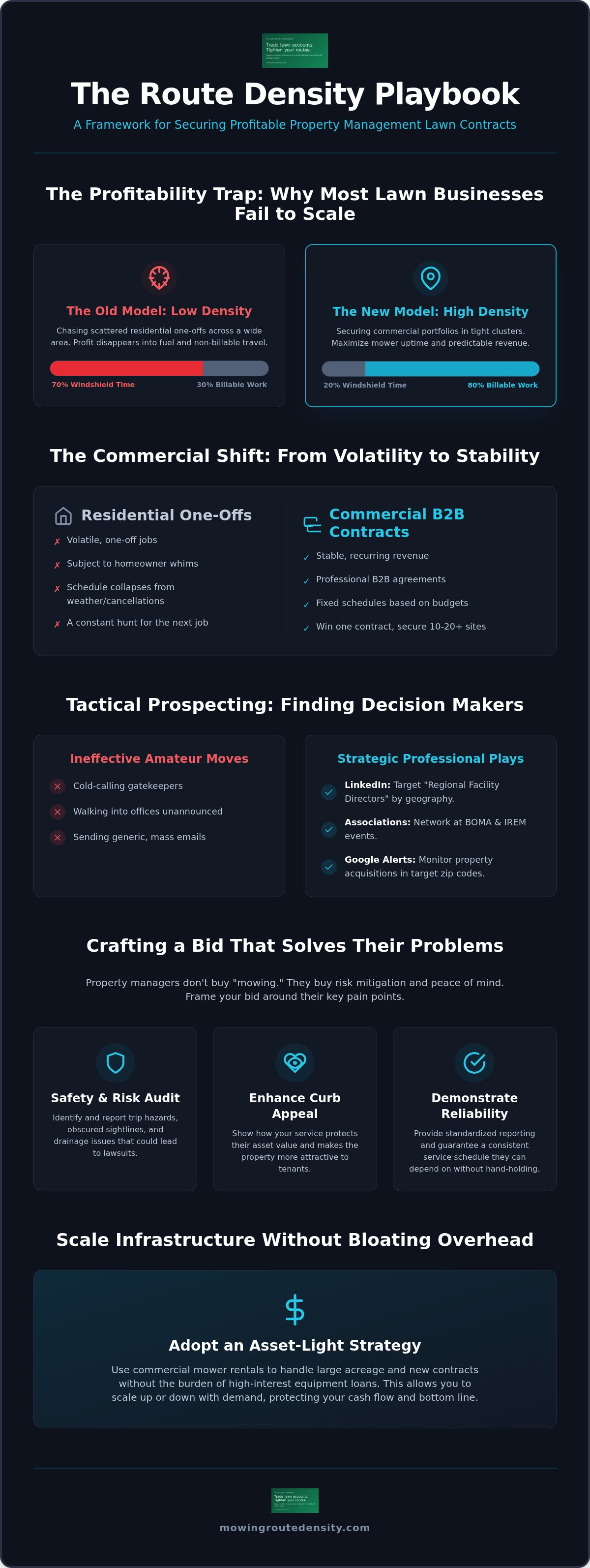
Residential lawn care is a treadmill. You chase one-off jobs, fight homeowner whims, and pray for good weather to keep your schedule from collapsing. It's a volatile way to run a business. Scaling requires a fundamental shift toward the commercial sector. A property management lawn contract is a professional B2B agreement that secures recurring maintenance across multiple assets, from retail centers to multi-family housing. It's the difference between hunting for your next meal and owning the farm.
The stability of these contracts is unmatched. While residential customers might cancel because of a vacation or a rainy week, a professional property management company operates on a fixed budget and a strict schedule. They need reliability. In 2026, market dynamics have shifted. Labor costs and fuel prices haven't softened. This means your success depends on operational efficiency. You can't afford to be a "jack of all trades" driving across three towns for five yards. You need the "portfolio effect." Winning one manager often means securing ten or twenty sites instantly. This is the most efficient way to achieve the route density required for real profitability.
The Reality of Commercial Profit Margins
Stop chasing volume. Start chasing density. Many contractors think a massive commercial contract is a win regardless of the location. They're wrong. If those sites are scattered, your profit disappears into windshield time. Property managers don't view landscaping as a luxury. They view it as a line item for risk mitigation. They want to ensure there are no trip hazards, no obscured sightlines, and no drainage issues that lead to lawsuits. Your job is to solve these problems while keeping your trucks moving less and your mowers running more. High-density clusters are the only way to protect your bottom line against rising overhead.
Decision Makers: Who Actually Signs the Check?
Finding property management companies for lawn contracts requires knowing who to talk to. You'll encounter two main players: regional managers and on-site facility leads. Regional managers care about the big picture, like total portfolio ROI and standardized reporting. On-site leads care about the daily headaches. You must pitch to both. In 2026, many national accounts use third-party procurement platforms to manage bids. Your proposal can't just be a price. It needs to speak the language of reliability. Show them you have the infrastructure to handle the load without constant hand-holding. They aren't just buying a mow; they're buying the peace of mind that the job is done right every Tuesday, without fail.
Tactical Prospecting: Where to Find Property Managers
Walking into a front office and asking for the manager is a waste of time. It's an amateur move that yields high rejection and zero respect. Professional contractors use data and targeted scouting to build their pipeline. When you're finding property management companies for lawn contracts, you need to focus on where the decision-makers live: professional associations and national directories. Organizations like BOMA (Building Owners and Managers Association) or IREM (Institute of Real Estate Management) are gold mines for networking with regional directors who control dozens of sites. It's about working the top of the food chain, not the bottom.
Digital scouting is your next weapon. LinkedIn allows you to filter by job title and geography to find regional facility directors. Don't pitch immediately. Connect, provide value, and watch for their posts to understand their current pain points. You can also use a lawn mowing service provider locator to identify areas where current vendors are failing or where market coverage is thin. This data tells you exactly where to aim your sales efforts. If you want to scale, you have to understand how to bid on an RFP before the opportunity even hits your inbox. Preparation prevents the panic of a last-minute, low-margin bid.
Digital Prospecting in the B2B Space
Set up Google Alerts for property acquisitions in your target zip codes. When a new firm buys a retail center, they're often looking to cut costs or improve service. That's your entry point. LinkedIn is your most potent tool for finding property management companies for lawn contracts on a regional scale. Your cold outreach should be lean. Nobody's got time for a three-paragraph life story. State who you are, the specific problem you solve for their type of property, and ask for a five-minute discovery call. Use social proof. Mention other commercial assets you maintain to bypass the gatekeeper and establish immediate authority.
Physical Scouting for Route Density
The 'Reverse Drive' method is simple but effective. Drive through industrial parks and HOAs within a five-mile radius of your current hub. Look for neglected properties. Weeds in the sidewalk or overgrown beds are signs of a property manager who's fed up with their current crew. Identify the owner through tax records or on-site signage. Don't just look for any contract; look for the one that fits your existing route. Clustering accounts is more important than the individual contract value. Three small properties on the same block are more profitable than one large property twenty miles away. If you need to fill gaps in your schedule to hit peak efficiency, consider using a lawn account trading platform to swap your outliers for local clusters.
The Bidding Framework: From RFP to Signed Contract
Once the audit is done, perform a cold-blooded overhead analysis. Calculate your labor burden, which typically sits 20% to 35% above the base wage when you factor in taxes and insurance. Factor in the fuel consumption of high-capacity zero-turns and the accelerated wear of running equipment for eight-hour shifts. Your proposal should focus on reliability and insurance compliance. In 2026, property managers have zero patience for "chuck in a truck" operations. They need proof of coverage and a professional cadence. Follow up 48 hours after submitting your bid. Be the contractor who respects their schedule, not the one who begs for the job.
Calculating the Real Cost of Commercial Work
Don't guess on your margins. Use lawn care profit margin optimization to price your services for actual growth. Commercial sites have hidden time-killers like complex irrigation clocks and perimeter fencing that requires manual string trimming. Account for every minute. However, you should also understand the "Density Discount." If a property is adjacent to an existing account, you can lower your bid to secure the cluster. You aren't cutting your throat; you're cutting your travel time. That's how you out-compete the big national firms with bloated overhead.
Professionalism as a Differentiator
Property managers value "self-performance." They want to know your crew is doing the work, not a third-tier subcontractor they've never met. Use this as your leverage. Implement GPS tracking and digital reporting so the manager gets a notification the moment the gates are locked. Uniformed crews and branded trucks aren't just for show. They signal to the manager that you take their B2B reputation as seriously as your own. Your value proposition should be a single, punchy sentence: "We provide 100% self-performed maintenance with zero-gap digital reporting." It solves their biggest headache—uncertainty—before they even ask.
Scaling Infrastructure Without Bloating Overhead
Winning the bid is only half the battle. If you've been successful in finding property management companies for lawn contracts, you're now facing the "growth trap." Most contractors celebrate a new portfolio by signing high-interest loans for a fleet of new mowers. This is a mistake. Debt is a weight that kills your agility. In 2026, the smartest operators use an "Asset-Light" strategy. They scale their fleet to match the contract, not their ego. Using lawn mower rental allows you to take on massive acreage without the long-term capital risk. If the contract ends, your overhead disappears with it. That's how you stay lean.
Leasing and buying both have their place, but they often lack the flexibility required for rapid scaling. Buying locks you into a five-year depreciation cycle. Leasing often comes with rigid hour limits. Professional-grade rentals provide a middle ground where you maintain equipment longevity without the maintenance headache. You get late-model, high-efficiency machines that reduce downtime and keep your crews on the job. Efficiency is the only metric that matters when you're managing commercial margins. Every hour a mower sits in the shop is an hour of lost billable revenue.
Equipment Tactics for New Contracts
Match the machine to the dirt. A 60-inch zero-turn is great for wide-open fields, but a stand-on unit might be faster for tight commercial islands and complex landscaping. Don't force a square peg into a round hole. You can utilize commercial lawn mower lease options to bring in specialized equipment for specific seasonal demands. Redundancy is also critical. Property managers have zero tolerance for "my mower broke" excuses. You must have a backup plan to meet strict contract deadlines. Having a rental partner on standby ensures that a mechanical failure doesn't turn into a breach of contract.
Labor and Capacity Management
Estimating man-hours for a 20-acre retail complex is different than a suburban cul-de-sac. You need to account for the "Commercial Standard." This requires a balance of speed and surgical detail. If you find your crew is stretched too thin, you may need to find lawn care subcontractors to handle overflow or specialized tasks like chemical applications. Train your team to look for the "big wins"—clean edges, clear sightlines, and debris-free walkways. These are the things property managers notice first. If you're ready to scale your fleet without the debt, explore our commercial equipment solutions to keep your operations asset-light.
Strategic Route Swapping and Network Leveraging
A full schedule is a vanity metric. If your trucks are crisscrossing the city to reach scattered commercial sites, you aren't growing; you're dying. The work of finding property management companies for lawn contracts doesn't end with a signature. It ends with a "Density Audit." You must look at your GPS logs and compare travel time to billable hours. With labor accounting for 25% to 40% of total revenue in 2026, every extra minute spent in transit is a direct hit to your net profit. You need clusters. If a contract sits twenty miles from your nearest hub, it's a parasite on your operations.
This is where strategic route swapping comes in. Most contractors are too proud to let go of an account, even if it's losing them money. Don't be that guy. Use the lawn account trading platform to trade your outliers for accounts that sit within your existing clusters. If you're still finding property management companies for lawn contracts that sit outside your core service area, you're building a house of cards. Trade the noise for signal. Focus on the properties that allow your mowers to spend more time on the turf and less time on the trailer.
Refining Your Portfolio for Maximum Density
Density is your most potent competitive weapon. A portfolio of 50 accounts in a single zip code is worth significantly more than 100 accounts scattered across the county. Why? Because your overhead is lower. You can use lawn care route density to out-bid national competitors who have massive fuel bills and bloated management structures. You don't need to be the biggest contractor in the state. You just need to be the most efficient one in your specific corridor. Trade away your residential "noise"—those high-maintenance, low-margin one-offs—for commercial "signal" that fits your route perfectly.
The Long-Term Growth Play
Consolidating your footprint does more than just save on fuel and maintenance. It builds a "Dominant Vendor" reputation. When a property manager sees your trucks on three different sites in one industrial park, they know you're the local expert. This makes the next sale easier. It also prepares your business for the ultimate payday. By proving route efficiency and high-density margins, you are building a lawn care business exit strategy that attracts serious buyers. Investors don't buy trucks and mowers. They buy predictable, dense, and profitable recurring revenue streams. Tighten your routes today so you can cash out tomorrow.
Dominating the 2026 Commercial Landscape
Stop chasing volume. Start chasing efficiency. The process of finding property management companies for lawn contracts is a long-term strategy, not a one-time event. You win by building clusters that minimize travel time and maximize billable hours. We've covered the transition from volatile residential work to the stability of B2B portfolios. You now have the framework to audit sites, analyze real overhead, and scale without the anchor of high-interest debt.
Your success depends on your ability to stay lean while meeting the professional standards of regional managers. Use route density as your primary weapon to out-bid bloated competitors. By leveraging specialized B2B account trading and a national contractor network, you can refine your portfolio until every stop is a profit center. It's time to stop driving across town for low-margin work and start owning your local corridor. You have the tools. Now execute the plan.
Optimize your commercial fleet with Mowing Route Density equipment rentals today.
Frequently Asked Questions
How do I find property management companies for lawn contracts without cold calling?
Finding property management companies for lawn contracts without cold calling requires a tactical digital approach. Use LinkedIn to identify regional facility directors and set up Google Alerts for local property acquisitions. Focus on professional associations like BOMA to build relationships before the RFP is even drafted. This bypasses the gatekeeper and positions you as an industry peer rather than a solicitor.
What is the typical profit margin for a commercial lawn care contract?
Commercial profit margins are a game of efficiency, typically landing between 10% and 20% net profit. Labor burden is your biggest drain. It usually accounts for 25% to 40% of your total revenue. You protect these margins through route density and high-capacity equipment. If your travel time exceeds your billable time, you've already lost the job.
Do property managers prefer multi-year or annual lawn maintenance contracts?
Property managers generally prefer multi-year contracts, often spanning two to three years. This provides them with budget stability and eliminates the administrative headache of an annual bidding cycle. For your business, these longer terms secure predictable recurring revenue. It allows you to invest in the specific equipment and density needed to service the portfolio profitably.
How do I bid on a commercial landscaping RFP as a small business?
Small businesses win RFPs by highlighting their self-performance and local responsiveness. National firms often struggle with quality control on the ground. Use your proposal to show a detailed site audit that identifies specific drainage or safety issues. Demonstrate that your crew is uniformed, GPS-tracked, and capable of meeting high-frequency reporting standards without hand-holding.
What insurance requirements do property management companies usually have?
Most commercial managers require $1 million to $2 million in General Liability coverage and full Workers' Comp. They will also demand an Umbrella policy and to be named as an "Additional Insured" on your certificate. Never bid on a contract until you've verified these costs with your agent. High premiums can quickly turn a profitable contract into a financial drain.
Is it better to buy or rent mowers when starting a large commercial contract?
Renting mowers is the superior strategy when starting a large commercial contract. It keeps your operation "asset-light" and prevents you from being locked into high-interest equipment loans. If the contract requirements change or the agreement ends, you can return the equipment without a capital loss. This flexibility is critical for maintaining healthy cash flow during a growth phase.
How can I improve my lawn care route density with commercial accounts?
Finding property management companies for lawn contracts that fit your existing clusters is the only way to scale profitably. Perform a "Density Audit" on your current routes. Use an account trading platform to swap outlier properties for those within your core corridor. If a site is more than five miles from your hub, it's likely a net loss after fuel and labor costs.
What should be included in a professional lawn care proposal for property managers?
A professional proposal must include a site-specific scope of work, proof of insurance, and a clear communication plan. Don't just list services. Address the manager's #1 headache: reliability. Include samples of your digital reporting and GPS logs to prove the work is getting done. A single, punchy value proposition focused on ROI and risk mitigation will beat a generic bid every time.


