

Every mile your crew spends on the highway is a leak in your bottom line. If your trucks are crisscrossing the county to hit three scattered accounts, you aren't growing. You're just burning fuel and wasting billable hours. To scale in 2026, you must find commercial landscaping partners who treat route density like a religion. It's the only way to survive in a market where labor costs continue to climb and margins are under constant pressure.
You already know that trying to own every piece of specialized gear or every square inch of a territory is a capital trap. It leads to equipment bloat and logistical waste that eats your profit before the season even peaks. You need a leaner way to operate. We'll show you how to identify and leverage strategic partnerships to eliminate that waste. You'll learn to vet reliable subcontractors, trade accounts for tighter routes, and access specialized commercial mowers without the heavy overhead. This framework is about tightening your operations, cutting the fluff, and protecting your bottom line.
Key Takeaways
- Stop treating partnerships as networking and start using them as tactical tools to handle high-volume commercial contracts.
- Use a dedicated locator tool to find commercial landscaping partners who possess the specific fleet capacity and crew expertise your contracts require.
- Maximize your bottom line by trading accounts with strategic partners to build route density and slash fuel costs.
- Execute rigorous operational and financial audits to ensure partners won't fold mid-season and leave your high-stakes accounts in jeopardy.
- Scale your territory without capital bloat by renting the commercial mowers you need only after you have secured partner-backed contracts.
The Strategic Necessity of Commercial Landscaping Partnerships
Scaling a landscaping business often feels like a race to the bottom of a debt pit. You win a big contract. You buy three more trucks. You hire ten more guys. By the time the first invoice is paid, your overhead has already strangled your profit. To grow without the capital bloat, you must find commercial landscaping partners who can absorb the logistical weight you haven't built yet. This isn't just networking. It's a tactical alliance designed to maximize every billable hour.
Commercial work operates on a low-margin, high-volume reality. It's a game of efficiency. Every minute your crew spends on the road is a financial leak. The breaking point is simple: when drive time exceeds billable hours, you're actually paying for the privilege of working. Partnerships allow you to trade accounts or share labor in specific territories, effectively killing the drive-time waste. It's the asset-light way to scale. Why take on six figures in equipment debt when you can leverage a partner’s existing fleet? You don't need more debt. You need better density.
Residential vs. Commercial: The Logistical Gap
A residential crew with a 60-inch zero-turn will drown on a 50-acre corporate campus. The workflows are different. The safety requirements are stricter. The Landscape contracting industry requires specific standards and specialized wide-area mowers that small residential firms simply don't own. Partnering fills this gap instantly. You get the specialized power without the monthly payment. It allows you to bid on Class A office parks and industrial sites that were previously out of reach due to equipment limitations. Stop trying to make residential gear do commercial work; it only leads to broken machines and missed deadlines.
Partnership as a Risk Mitigation Tool
High-stakes contracts have no room for equipment failure excuses. If your primary mower breaks, the grass keeps growing. Strategic partnerships provide built-in redundancy. You share the labor burden and the liability. It prevents the over-extension trap where one bad week of rain or one broken engine sends your firm into a tailspin. When you find commercial landscaping partners, you're building a safety net. You ensure 100% uptime through shared crew capacity and equipment backups. This level of reliability is what separates the professionals from the operators who eventually go bust from over-promising. Scale with logic, not just luck.
Where to Find Commercial Landscaping Partners Nationally
Finding a reliable partner isn't about scrolling through generic business directories. If you're looking for someone to handle a 20-acre retail complex, a residential mow-and-blow crew won't cut it. You need a specialized B2B approach. To effectively find commercial landscaping partners, you must look where the professionals hang out. This means moving away from broad search engines and toward industry-specific logistics platforms that prioritize operational efficiency.
Your best bet is a dedicated lawn mowing service provider locator. These tools filter for contractors who already understand commercial standards. They have the insurance, the equipment, and the crew size to actually perform. Beyond locators, look for account trading platforms. These are marketplaces where contractors swap accounts to fix their own logistical gaps. It's a win-win. You get the coverage you need. They get the density they want. It's about moving accounts to the person who can service them with the least amount of travel time.
Digital Locators vs. Traditional Networking
Relying on "who you know" is a bottleneck. Traditional networking is slow. It's limited by your personal circle. When you need to find commercial landscaping partners to fulfill a multi-state contract, you don't have months to build a rapport over coffee. You need capacity now. Digital locators provide immediate access to vetted pros across state lines. They combine local expertise with the speed of a national platform. This is how you fill gaps in 48 hours instead of 48 days. Don't let a slow search kill a fast-growing contract opportunity.
Evaluating Platform Credibility
Not all marketplaces are equal. Avoid generic lead-generation sites that prioritize quantity over quality. If a platform is filled with solo handymen, run. A credible B2B landscaping marketplace should focus on commercial-grade contractors. They should align with SBA subcontracting guidelines to ensure legal and operational compliance. Niche platforms are superior because they focus on lawn care profit margin optimization. They understand that a partner is only valuable if they help you keep more of your money. Red flags include a lack of insurance verification or a model that lets anyone join for a fee. A real B2B platform filters for the equipment longevity and crew capacity required for high-stakes work. If you're ready to stop the logistical bleeding, you can access our locator tool to find a vetted partner today.
Strategic Subcontracting: Leveraging Route Density
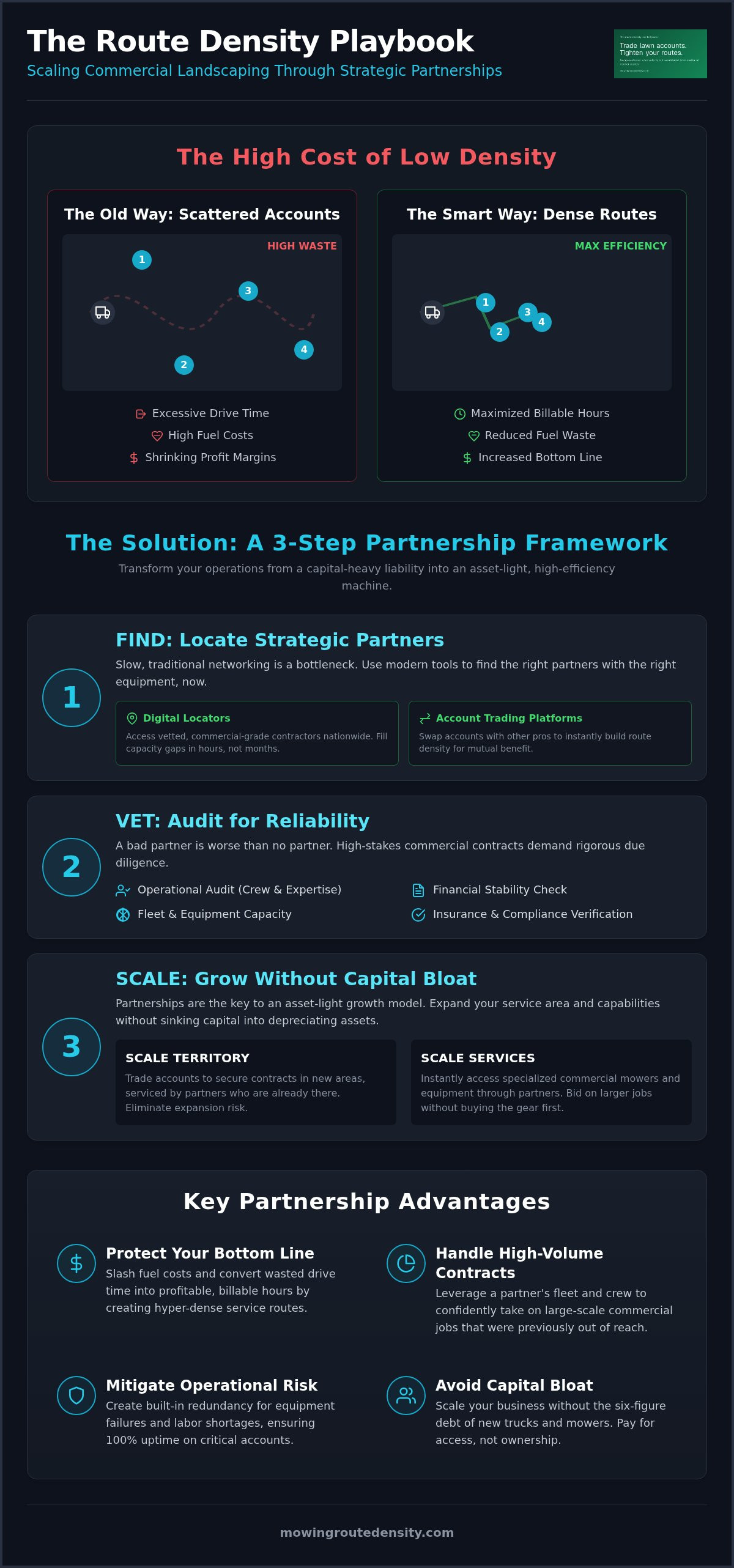
Drive time is the silent killer of the service industry. If your truck is on the road for forty minutes between jobs, you're losing money. You aren't just paying for gas. You're paying for the depreciation of the vehicle and the wages of a crew that isn't producing. This is why lawn care route density is the only metric that truly matters for scaling. By condensing your work into tight geographic clusters, you maximize billable hours and minimize "windshield time." It's a simple equation. More time on the grass equals more money in the bank.
To find commercial landscaping partners who understand this math is to unlock hidden revenue. Your goal shouldn't just be to offload work. It should be to optimize your map. If you have an isolated account twenty miles away, and a peer has one near your main cluster, swap them. It sounds like common sense because it is. Yet, many owners let their ego or "account ownership" pride get in the way of operational logic. Why are you still sending a $100k rig across three zip codes for one $300 mow? It's bad math and worse management.
The Mechanics of Account Swapping
Proposing a swap requires transparency. You aren't dumping a bad client; you're trading for logistical fit. Use a lawn account trading platform to identify peers who are already looking to tighten their routes. These platforms remove the friction of cold-calling competitors. When you find a match, ensure your contract integrity remains intact. The client rarely cares who mows the grass as long as the standards are met and the liability is covered. You're trading a logistical headache for a profitable asset.
Subcontracting for Geographic Efficiency
Adopt the "20-Minute Rule." If an account requires more than twenty minutes of drive time from your nearest job, it's a candidate for subcontracting. The marginal utility of managing that route yourself is negative once you factor in labor and fuel burn. Building a network of "Zone Partners" allows you to dominate a national market without a massive, debt-heavy fleet. You keep the high-density clusters for your internal crews. You let partners handle the outliers. This "Clustering" strategy ensures that every truck you put on the road is operating at peak efficiency. You aren't losing profit; you're buying back capacity. When you find commercial landscaping partners, you stop being a chauffeur and start being a strategist.
Vetting Partners for High-Stakes Commercial Contracts
Vetting is where most scaling efforts fall apart. You find a partner who talks a big game. You sign the contract. Then, the first rainy week hits and their crew disappears. When you find commercial landscaping partners, the vetting process is your only defense against contract failure. You need an audit, not an interview. Don't ask if they can handle the work. Ask to see the fleet maintenance logs. A partner with a graveyard of broken mowers in their shop will treat your accounts the same way.
Financial due diligence is non-negotiable. If a subcontractor is living invoice-to-invoice, they won't survive a 45-day commercial payment cycle. They'll fold mid-season. You'll be left holding the bag on a site that's two weeks behind. Demand proof of insurance and general liability coverage that matches the contract requirements. If they can't produce a COI within an hour, they aren't organized enough for high-stakes work. Start with a trial project. Give them one isolated site. Watch how they communicate. If they can't handle a single retail pad, they'll never survive a corporate campus.
Equipment and Crew Standards
Commercial sites have zero tolerance for residential mistakes. You need to verify that your partner has the specific wide-area mowers required for the job. If they have the talent but lack the iron, look into commercial lawn mower lease options to bridge the gap without taking on permanent debt. Crew training is equally critical. Are they certified for the chemicals they're spraying? Do they follow OSHA standards for PPE? If their crew looks like a ragtag group of day laborers, your reputation is at risk. High-stakes contracts require high-grade equipment and professional discipline.
The Partnership Agreement
A handshake is for friends; a contract is for business. Your agreement must include ironclad non-compete and non-solicitation clauses. You're giving them access to your client list. Protect it. Use Service Level Agreements (SLAs) to define exactly what "clean" means. If the edges aren't trimmed, the invoice doesn't get paid. Clear payment terms are the best way to ensure subcontractor loyalty. Pay them on time, and they'll prioritize your sites when the schedule gets tight. If you need to find commercial landscaping partners who meet these rigorous standards, search our vetted provider locator to find the right fit today.
Scaling with Mowing Route Density: The Complete Toolkit
Scaling a business isn't about owning more. It's about controlling more. Most owners think growth requires a massive fleet and a sprawling payroll. They're wrong. True scale comes from a system that integrates equipment, labor, and geography. Mowing Route Density provides that toolkit. Use our platform to find lawn care subcontractors who already have the boots on the ground in your target zones. Why build a new branch from scratch when you can plug into an existing one?
Strategic growth also means knowing when to walk away. If a route is dragging down your average profit per hour, it's a liability. You can use our marketplace to execute a lawn care business exit strategy for specific, inefficient territories. Sell those outliers to someone who already has density there. This turns a logistical drain into immediate liquidity. By refining your map, you position your firm as a National Tier 1 contractor. You become the strategist who manages the contracts while your network handles the execution. When you find commercial landscaping partners who align with this lean philosophy, you're no longer just mowing grass. You're managing a high-margin logistics engine.
Accessing Professional Equipment on Demand
Capital risk is the enemy of agility. Buying a $100,000 wide-area mower for a three-year contract is a gamble. What if the contract ends early? Renting professional lawn equipment is the smarter play. It allows you to match your gear to the specific needs of a new partner contract without the long-term debt. You maintain a lean fleet. You keep your balance sheet clean. You only pay for the iron when it's actively generating revenue. This asset-light approach is how you handle massive commercial workloads without the crushing weight of equipment payments.
The Future of National Landscaping Logistics
The 2026 market will be won by the logistics managers. The "work harder" mindset is a recipe for burnout and bankruptcy. To win, you must transition from being the guy on the mower to being the strategist behind the map. Route density is the only shield against rising fuel and labor costs. Audit your routes today. Identify your leaks. Then, find commercial landscaping partners to fill the gaps and tighten your clusters. The tools are here. The framework is clear. It's time to stop driving and start scaling.
Stop Driving and Start Dominating the Map
Every mile your trucks travel without a mower on the ground is a financial leak. You've seen the math. You know that route density isn't a luxury; it's a survival requirement. Scaling isn't about working more hours. It's about making every hour more billable. By swapping accounts and leveraging shared labor, you kill the drive-time waste that eats your profit. It's time to stop over-extending your fleet and start optimizing your territory.
When you find commercial landscaping partners through a vetted system, you unlock the ability to bid on massive contracts without the capital bloat. You get the specialized gear you need and the boots on the ground you want. It's about working smarter, not harder. Ready to tighten your operations? You can scale your commercial landscaping business with Mowing Route Density. Our national provider locator, secure route trading marketplace, and commercial equipment rental fleet give you the tools to dominate your market. Clean up your map. Protect your margins. Build the business you actually wanted.
Frequently Asked Questions
How do I find commercial landscaping partners without risking my current accounts?
Establish a legal framework with ironclad non-compete agreements before sharing any account details. When you find commercial landscaping partners through a professional B2B platform, you're working within a structured environment designed for pros. Start by outsourcing outlier accounts that are already costing you money in drive time. This allows you to test a partner's reliability without risking your high-density core clusters.
What is the best platform to find commercial landscaping subcontractors?
The best platforms are niche marketplaces like Mowing Route Density that prioritize logistics over generic lead generation. Generic sites are often flooded with residential crews who lack the specialized gear for massive commercial sites. You need a service provider locator that filters for commercial-grade capacity. A dedicated platform ensures you're connecting with peers who understand route density and commercial liability standards.
How do I vet a landscaping partner's equipment and reliability?
Conduct a physical operational audit and request fleet maintenance logs. Don't just take their word for it. A partner with a shop full of broken machines will eventually fail your clients. Verify they have the specific wide-area mowers required for your contract. Reliability is best tested with a trial project. Give them one isolated site and monitor their communication and uptime before scaling the relationship.
Is it better to hire employees or find a landscaping partner for new contracts?
Partners are usually the superior choice for rapid, asset-light scaling. Hiring employees requires immediate capital for trucks, equipment, and payroll taxes. If you lack route density in a new territory, a partner who is already there eliminates the fuel and labor waste. Use partners to capture new territory without the debt. Only hire internally once you have the volume to support a dedicated local crew.
How does route density affect my ability to find landscaping partners?
Route density is your primary currency when looking to find commercial landscaping partners. Other contractors want to trade for accounts that sit inside their existing clusters. If you have a high-density route, you're a valuable ally. If your accounts are scattered, you're a logistical burden. Focus on clustering your work to become the partner everyone else wants to work with. Efficiency attracts efficiency.
What should be included in a commercial landscaping partnership agreement?
Your agreement must include non-compete and non-solicitation clauses to protect your client list from being poached. Include clear Service Level Agreements (SLAs) that define specific quality standards and reporting frequency. Don't forget detailed payment terms. Subcontractors prioritize the partners who pay on time. A well-drafted contract ensures both parties understand the logistical expectations and the financial consequences of a service failure.
Can I rent commercial mowers for my partners to use on my contracts?
Yes, renting specialized equipment is a smart way to fill a partner's capacity gaps without long-term debt. You can utilize a commercial-grade mower rental fleet to provide the necessary iron for a specific high-stakes contract. This allows your partner to perform the work using professional machinery they might not own yet. It keeps your operations lean while ensuring the job meets the client's standards.
How do I trade landscaping routes with other contractors safely?
Safe route trading requires a secure account trading platform that verifies the value and location of accounts. Don't just swap on a handshake. Use a marketplace that facilitates the exchange and ensures both parties are getting a fair logistical deal. Be transparent with your clients about the change. Most commercial managers don't mind a new crew as long as the quality remains high and the liability is covered.


