

Why would you sign a personal guarantee on an 11.5% SBA loan just to inherit a fleet of junk mowers and a scattered route map? Most owners think expansion requires drowning in high-interest debt. It doesn't. You already know that interest rates are sitting at a 6.75% prime base; this makes traditional borrowing a heavy lift for any balance sheet. Learning how to finance a lawn care business acquisition in 2026 isn't about finding the biggest lender. It's about structuring a deal that keeps your operation lean and your cash flow protected.
You need growth, not a mountain of overhead that eats your ROI before the first trim. This guide provides a tactical, no-nonsense checklist to secure funding without over-leveraging your existing assets. We'll cover the mechanics of SBA 7(a) loans versus seller financing, how to spot hidden equipment liabilities, and why an asset-light rental strategy beats a high-interest equipment loan every time. It's time to stop buying headaches and start acquiring profit.
Key Takeaways
- Audit the target's P&L for owner add-backs and route density to ensure you aren't paying a premium for operational waste.
- Compare SBA 7(a) terms against seller-financed notes to understand how to finance a lawn care business acquisition without draining your cash reserves.
- Keep your balance sheet clean by excluding depreciated equipment from the deal and leveraging commercial mower rentals to scale safely.
- Prepare a lender-ready documentation package including three years of tax returns and interim financials no older than 60 days.
- Optimize your new territory immediately after closing by trading far-flung accounts for clustered routes that maximize your billable hours.
Audit the Target's Financial Vitals: The Pre-Financing Checklist
Before you approach a lender to discuss how to finance a lawn care business acquisition, you must strip away the seller’s optimistic narrative. Lenders don't fund dreams. They fund proven cash flow. If the Profit and Loss (P&L) statement is cluttered with personal expenses or non-recurring costs, your valuation is skewed. Start by verifying the "cleanliness" of the books. Look for owner-add-backs like personal vehicle leases, cell phone plans, or family travel. These are common in small operations. You must identify these to calculate the true Seller’s Discretionary Earnings (SDE). If you can't prove the profit, you can't justify the loan.
Route density is your most powerful financing lever. High-density routes guarantee higher margins because they minimize non-billable drive time. Lenders view tightly clustered accounts as lower-risk assets. If a crew spends three hours a day behind the windshield, they aren't making money; they're burning fuel. Check the client retention rates next. A business with 90% recurring revenue is a stable investment. A business with high churn is a "leaky bucket." Lenders will balk at funding an operation that loses a third of its customer base every season. It makes the debt coverage too unpredictable.
Finally, evaluate the equipment. An aged fleet is a looming liability, not an asset. If the mowers are nearing 2,000 hours, they are financial drains. Don't let a seller bundle junk equipment into the purchase price. In some specialized cases, such as Management Buyout (MBO) Financing, the internal team already knows where the mechanical bodies are buried. If you're an outsider, you must hunt for them. Inspect every deck, engine, and trailer before signing the note.
Revenue Quality vs. Quantity
Stop looking at the top line. It’s a vanity metric. You need to distinguish between recurring maintenance contracts and one-off project work. Projects like seasonal cleanups or sod installs are "lumpy" revenue. They don't pay the monthly debt. Calculate the Lifetime Value (LTV) of the client list. If the average client stays for five years, your revenue is predictable. Watch for concentration risk. If one commercial contract represents more than 10% of the total revenue, your entire acquisition is at the mercy of one facility manager's whim.
Operational Efficiency Audit
Audit the "dead air" in the schedule. Review the GPS logs or route sheets to identify excessive drive time. High fuel consumption patterns often signal engine inefficiency or poor logistics. Your goal is to maximize billable hours per crew. If the target company’s current crews are only billable for five hours of an eight-hour shift, you have an efficiency leak. Fixing this leak is how you find the margin to pay down your acquisition debt faster. Efficiency isn't a suggestion. It's a financial requirement when you're researching how to finance a lawn care business acquisition in a high-interest environment.
Compare Acquisition Funding Models: SBA 7(a) vs. Seller Financing
Choosing the right capital source is a math problem, not a personality contest. If you're figuring out how to finance a lawn care business acquisition in 2026, you're looking at a Prime Rate of 6.75%. This makes every percentage point of margin matter. You have three main paths: the government-backed route, the seller-backed route, or the traditional bank route. Each has a different impact on your debt-to-income ratio and your personal liability.
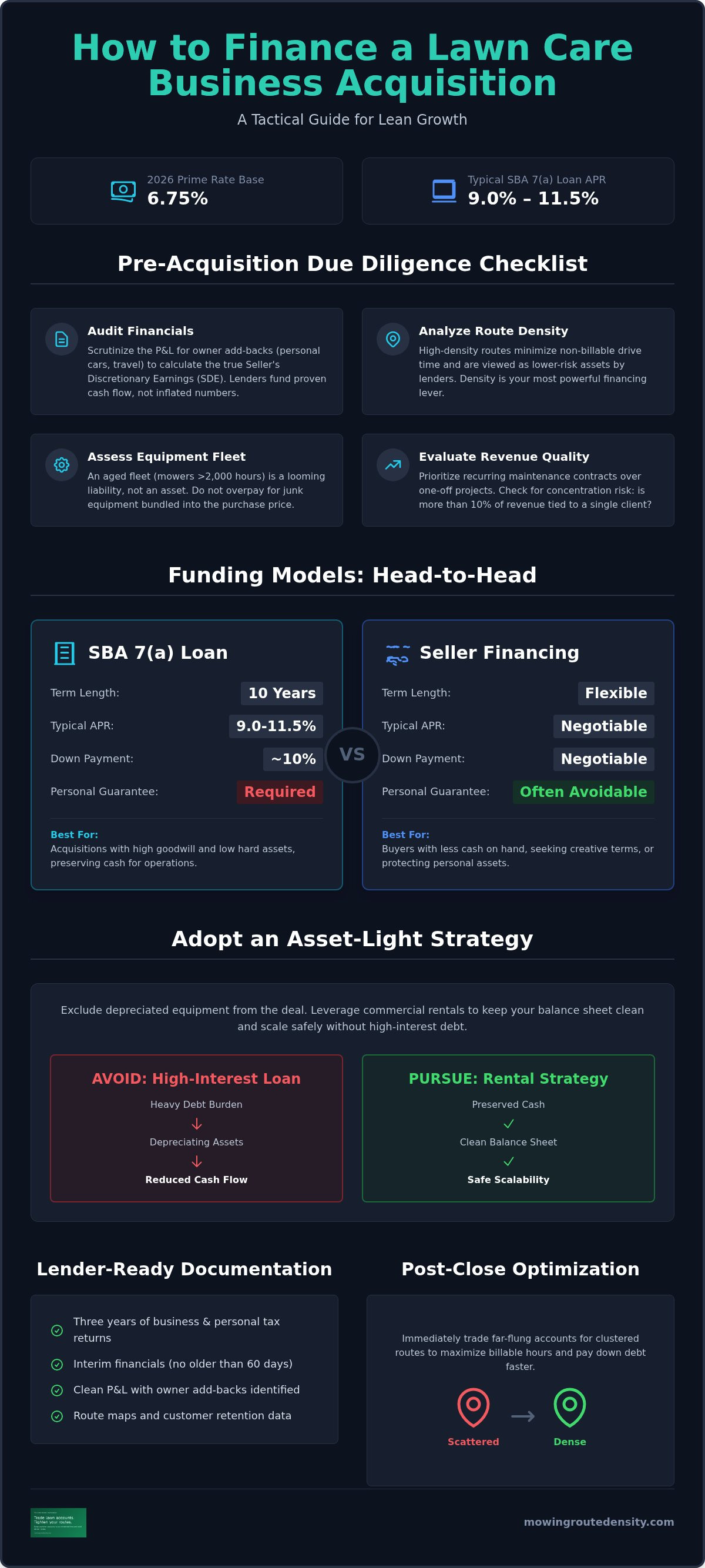
SBA 7(a) loans remain the industry standard. They offer 10-year terms which keep monthly payments manageable compared to 5-year conventional notes. However, they aren't "easy" money. Expect variable rates between 9.0% and 11.5% APR depending on the loan size. Conventional bank loans close faster but often demand 20% to 30% down and hard collateral like real estate. If you want to protect your personal assets, you might consider an earn-out structure. This ties part of the purchase price to the actual performance of the acquired routes over the first 12 months. If the clients churn, you don't pay. It’s the ultimate hedge against a "leaky bucket" business.
The SBA 7(a) Advantage for Contractors
The SBA 7(a) loan program is built for businesses with high goodwill and low hard assets. In 2026, a 10% equity injection is the typical entry point. This allows you to preserve your cash for operational scaling. Be warned: if you own 20% or more of the buying entity, you will sign a personal guarantee. Your house is on the line. The 10-year amortization period is the real win here. It provides the breathing room needed to optimize routes before the debt service eats your lunch.
Structuring Seller Financing Deals
Seller financing is often the smartest way to bridge a valuation gap. A seller note usually covers 10% to 25% of the total price. These rates typically hover between 5% and 7%; this significantly beats current SBA margins. It keeps the seller "in the game." If they lied about the account quality, you use a "Right of Offset" clause to deduct those losses from your future payments. It’s a self-correcting insurance policy. To maximize your immediate ROI, you can even look into trading underperforming accounts to pay down these notes faster. This strategy ensures you only keep the most profitable, high-density clusters.
Leverage Asset-Light Financing Strategies to Preserve Cash
Stop financing rust. One of the biggest mistakes when learning how to finance a lawn care business acquisition is rolling a depreciated fleet into a long-term loan. You end up paying 11.5% interest on a mower that will be in the scrap heap in eighteen months. That's not growth; that's financial sabotage. Instead, exclude the aged equipment from the purchase price. Focus your capital on the contracts and the route density. By keeping junk equipment off the loan, you lower your total debt service. This makes your acquisition more attractive to lenders and keeps your cash liquid for operational needs.
Renting equipment shifts your costs from Capital Expenditure (CapEx) to Operational Expense (OpEx). This is a massive tax advantage for 2026. You write off the rental fee immediately rather than waiting years to depreciate a failing asset. It keeps your balance sheet clean. This "asset-light" approach is the only way to scale safely in a volatile economy. You only pay for the equipment when it's out in the field earning a billable hour. If a route disappears, you return the machine. You aren't stuck with a monthly payment on a mower that's sitting idle in the shop.
Renting vs. Financing Equipment
A new mower loan locks you into a fixed payment for years, regardless of weather or client churn. When you look at commercial lawn mower lease options, you're buying uptime. Owned equipment comes with hidden drains: mechanic labor, parts inventory, and the crushing cost of downtime. Rented assets provide late-model reliability. If a machine breaks, you swap it. You keep cutting. You keep billing. This model eliminates the "depreciation trap" where your equipment loses value faster than you can pay down the principal on the loan.
Scaling Fleet Capacity Post-Acquisition
The first 90 days after a close are volatile. Clients might leave; routes might shift. Don't over-buy equipment before you have hard performance data. Use professional lawn equipment rental to bridge this integration period. It gives you the flexibility to scale up or down based on actual route volume. Once the dust settles and your route density is optimized, you'll know exactly how many units you need. This strategy ensures every machine in your yard is tied to a profitable, high-density cluster. Understanding how to finance a lawn care business acquisition means knowing which assets to own and which to rent to protect your margins.
Complete Your Lender-Ready Documentation Checklist
Lenders don't fund handshakes. They fund spreadsheets backed by verifiable data. If you want to know how to finance a lawn care business acquisition in a 6.75% prime rate environment, you must start with a clean paper trail. A disorganized application is a red flag for any loan officer. You need three years of federal tax returns for both your existing operation and the target company. This proves historical stability. Additionally, you must provide interim financial statements, including a P&L and Balance Sheet, that are no older than 60 days. Stale data kills deals during the 60 to 90-day underwriting window.
For SBA-backed deals, transparency is mandatory. You'll need to complete SBA Form 413, the Personal Financial Statement, for every owner with a 20% stake or more. This form tracks your personal assets and liabilities. Don't hide debt. Lenders will find it. Your goal is to show that you have the personal "skin in the game" to manage the risk of a new acquisition note.
The most critical part of your package is the business plan. This isn't a generic mission statement. It’s a tactical roadmap that explains exactly how the merger increases lawn care route density. If you can't prove that the combined entity will be more efficient than the two separate companies, the lender won't see the value. Show them the math on reduced fuel consumption and higher billable hours per crew.
Drafting a Pro-Forma Financial Statement
A pro-forma is your financial forecast for the first 12 to 24 months post-close. You must project revenue based on combined route efficiency, not just adding the two current revenue streams together. Detail exactly where you will cut overhead. Will you eliminate a redundant shop lease? Will you merge overlapping routes? Include a "worst-case scenario" cash flow forecast. If you lose 10% of the target's accounts during the transition, you must still prove you can service the debt. Lenders respect a borrower who acknowledges risk.
Legal and Compliance Paperwork
Ensure your legal foundation is solid before the final review. You need a signed Letter of Intent (LOI) and a comprehensive draft of the Purchase Agreement. Verify that all local operating licenses and permits are transferable to your entity. Perform a UCC search to confirm the target company has no outstanding tax liens or undisclosed equipment debt. You don't want to inherit a labor dispute or a lawsuit that could jeopardize your cash flow. To ensure your new routes are as profitable as possible before you finalize your pro-forma, use our lawn account trading platform to swap out far-flung accounts for high-density clusters.
Post-Close Optimization: Trading for Debt Coverage
The deal is closed. The ink is dry. The debt service starts now. Most owners make the mistake of waiting for organic growth to cover their new monthly loan payments. That is a slow path to insolvency. You need immediate liquidity. Treat your newly acquired client list as a liquid asset that requires aggressive rebalancing. If the acquisition brought in far-flung accounts that kill your crew's efficiency, sell them immediately. Use a lawn account trading platform to generate quick cash from these outliers. This isn't just about cleaning up the schedule; it’s about generating non-dilutive capital to pay down your high-interest acquisition note before the first season ends.
Maximizing marginal utility means every account must justify its place on the trailer. If an account doesn't fit your density model, it is a liability. By pruning these inefficient accounts, you reduce fuel consumption and wear on your rented fleet. You aren't just cutting costs; you're harvesting cash. Apply the proceeds from these sales directly to the principal of your SBA or seller note. This strategy is a core component of how to finance a lawn care business acquisition without choking your cash flow. You use the business's own logistical flaws to fund its purchase.
Generating Cash from Low-Density Routes
Identify your "island" accounts. If a property sits fifteen minutes away from your core cluster, it's a profit killer. These outliers cost more in non-billable drive time and labor than they generate in revenue. List these accounts for sale to contractors who already have density in those specific neighborhoods. What’s a logistical nightmare for you is a high-margin win for them. Take that "found money" and accelerate your loan repayment schedule. Reducing your debt early saves thousands in interest over the life of a 10-year SBA loan.
Sustainable Growth via Route Swapping
Stop trying to own the entire zip code. Own the neighborhood. Trade accounts with local competitors to eliminate overlapping service areas. This isn't "helping the competition"; it's a tactical move to protect your own bottom line. Focus on lawn care profit margin optimization by tightening your clusters until your windshield time is negligible. When you reduce drive time, you unlock billable hours without hiring more staff. Reinvest those saved hours into high-margin upsells like aeration or overseeding for your core clients. This is how to finance a lawn care business acquisition while building a machine that practically pays for itself.
Build a Lean Empire, Not a Debt Trap
Acquisition is the fastest way to scale. It's also the fastest way to go broke if you over-leverage. You've learned that auditing route density and revenue quality is non-negotiable. You know why an asset-light approach beats a high-interest equipment loan. Understanding how to finance a lawn care business acquisition means more than just signing a note. It means structuring a deal that prioritizes immediate cash flow and operational efficiency. Don't let a scattered route map or a fleet of aging mowers drain your ROI.
Success in 2026 requires a strategist's mindset. Prune the outliers. Tighten the clusters. Use your client list as a liquid asset to pay down debt faster. With our B2B Route Trading Marketplace, Commercial Mower Rental Network, and national contractor support, you have the tools to maintain scalability without the crushing overhead. It's time to stop working for your debt and start making your debt work for you. You have the checklist. Now go execute.
Optimize your routes and rent professional gear at Mowing Route Density
Frequently Asked Questions
What is the typical down payment for a lawn care business acquisition in 2026?
A 10% equity injection is the standard requirement for SBA 7(a) deals in 2026. If you're looking at how to finance a lawn care business acquisition through a conventional bank, expect to put down 20% to 30%. Banks view service businesses as high-risk because they lack hard collateral like real estate. Lowering your down payment requires a strong credit score and a proven track record of operational efficiency.
Can I use an SBA loan to buy just a client list without equipment?
Yes, you can use the SBA 7(a) program to acquire a client list, which the lender classifies as "goodwill." While banks prefer physical assets, the SBA is designed specifically to help contractors buy cash flow. You'll need to prove the recurring nature of the revenue through detailed contracts and historical retention data. Without equipment, your loan will be purely based on the strength of that recurring income stream.
Is seller financing safer than a bank loan for a landscaping business?
Seller financing is often safer for the buyer because it typically avoids the strict personal guarantee requirements of a bank. It also keeps the previous owner incentivized to ensure a smooth transition. If you're still weighing how to finance a lawn care business acquisition, a combination of 10% cash, 75% SBA, and 15% seller carry is a common structure. This limits your personal exposure while leveraging the seller’s confidence in the business.
How do I value a lawn care route for financing purposes?
Valuation is typically based on a multiple of Seller’s Discretionary Earnings (SDE) or EBITDA. For owner-operator businesses, expect a multiple of 2.5x to 3.5x SDE. Larger, multi-crew commercial operations often command 4x to 6x EBITDA. Lenders will adjust these multiples based on your route density and client concentration. If one client represents 20% of the revenue, the lender will likely devalue the route to account for that risk.
What is a 'Debt Service Coverage Ratio' and why do lenders care?
The Debt Service Coverage Ratio (DSCR) measures your ability to pay your loan with existing cash flow. Lenders want to see a ratio of 1.25 or higher, meaning you have $1.25 in profit for every $1.00 of debt payment. If your ratio is too low, you have no margin for error. Lenders care because a low DSCR means one bad rain month or a lost commercial contract could cause a loan default.
Should I keep the acquired company's old equipment or rent new mowers?
Don't pay interest on someone else's junk. If the target's fleet has over 1,500 hours, exclude it from the deal and rent professional-grade equipment instead. Renting shifts your costs from a fixed debt payment to a flexible operational expense. This keeps your balance sheet clean and ensures your crews aren't losing billable hours to mechanical downtime. Uptime is profit; old equipment is a liability that drains your cash flow.
How does route density affect my ability to get a loan?
Lenders view route density as a primary indicator of profit margin. A business with accounts clustered in three neighborhoods is far easier to finance than one spread across an entire county. High density reduces fuel consumption and labor waste, which increases the cash flow available to service your debt. If your routes are scattered, your "dead air" drive time will likely disqualify you from the most competitive interest rates.
What happens to my financing if clients leave after the acquisition?
Protect your financing by structuring a "right of offset" in your seller note. This allows you to deduct the value of lost accounts from your future payments to the seller. If you're using an SBA loan, the lender won't reduce your payment, so you must have a cash reserve. Use a route trading platform to quickly replace lost density with new accounts in your core clusters to maintain your debt coverage ratio.


