

Why are you still sinking five figures into a machine that loses value the moment it hits the turf? Owning a fleet is often a slow leak in your company bank account. Between the massive upfront capital and the inevitable maintenance downtime, the traditional ownership model is failing modern contractors. You need equipment that works as hard as your crew, not a graveyard of parts in the back of the shop. Keeping a close eye on commercial mower rental rates is the only way to ensure your overhead does not swallow your growth.
You already know that every hour a mower sits idle is a direct hit to your profit margin. With 79% of landscape contractors focused on revenue growth in 2026, you cannot afford to be sidelined by equipment failure. This guide will show you how to master the financial logic of equipment rentals to protect your business from seasonal volatility. We will benchmark the 2026 market standards and explain how to access the latest technology. We will also provide a roadmap for maximizing your billable hours with zero maintenance stress. It is time to stop overpaying for the privilege of owning a liability.
Key Takeaways
- Shift to an asset-light model to eliminate the financial burden of equipment depreciation and rising maintenance costs.
- Master the "1-3-10" rule to benchmark commercial mower rental rates and identify the most profitable contract length for your business.
- Match specific equipment specs like deck size and stand-on technology to your route requirements to maximize crew productivity.
- Identify and neutralize hidden costs, including delivery fees and fuel surcharges, that drain your project margins.
- Scale your fleet strategically by aligning equipment rentals with high-density mowing routes to eliminate wasted drive time.
The Financial Logic of Commercial Mower Rental Rates in 2026
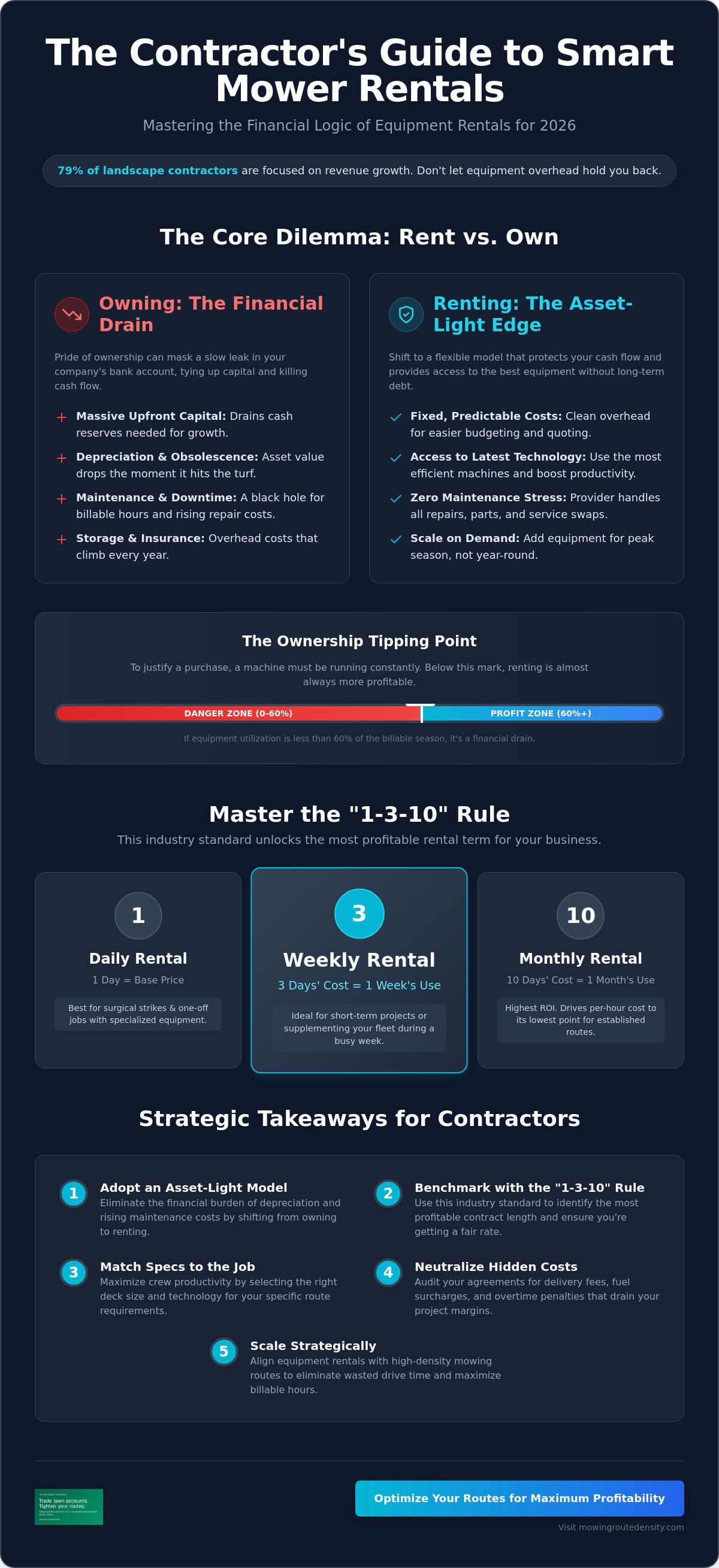
Owning a full fleet is a vanity project that kills cash flow. In 2026, the most profitable contractors are pivoting to an asset-light philosophy. This isn't about being unable to afford equipment; it's about refusing to carry the weight of depreciation. When you analyze commercial mower rental rates, you aren't just looking at a line item for a machine. You are looking at a hedge against maintenance inflation and the rapid obsolescence of high-tech gear. Fixed rental costs provide a clean, predictable overhead that ownership simply cannot match. It’s about tightening your operations and cutting the fat from your balance sheet.
Consider the variables you ignore when you buy. Storage space costs money. Insurance premiums climb every year. Repairs are a black hole for billable hours. By shifting to a rental model, you effectively outsource these headaches to the provider. You gain immediate access to the latest types of commercial mowers without the burden of long-term debt. The 2026 market shift toward higher-tech, more efficient machines means rental rates are slightly higher than in previous years, but the productivity gains of new tech more than cover the spread. Own the work. Rent the tools.
Rental vs. Ownership: The Tipping Point
Success in this industry is a numbers game. To justify purchasing a commercial mower, you need to hit a specific utilization rate. If a machine isn't running at least 60% of the billable season, it’s a financial drain. This 60% mark is the danger zone where the cost of storage, interest, and depreciation exceeds the cost of a monthly rental. Marginal utility in the context of seasonal rental spikes means that paying a premium for a machine only when the grass is growing is far more logical than paying for a machine to sit in a trailer during a drought. Don't let pride in ownership blind you to the math on your spreadsheet. Every hour an owned machine sits idle, it’s stealing from your profit margin.
The Impact of Inflation on 2026 Equipment Costs
Inflation hasn't just hit fuel; it has gutted the parts and labor market. Maintaining an older fleet in 2026 is a losing battle. Modern machines equipped with Tier 4 engines and complex electronics require specialized technicians and expensive components. These advancements have pushed commercial mower rental rates upward, but they've also made your costs more predictable. When a rental unit breaks, it’s the provider’s problem, not yours. Renting allows you to bypass the steep repair curve that hits machines after their first 500 hours of operation. You get the peak performance of a new machine with none of the long-term liability. It's a common-sense remedy for a major financial drain.
Deciphering Rental Rate Structures: Daily, Weekly, and Monthly Models
Stop guessing what you should pay. Rental pricing isn't arbitrary. It follows a mathematical structure designed to reward long-term commitment. When you benchmark commercial mower rental rates, you should look for the "1-3-10" rule. This is the industry standard. One day is the base price. Three days pay for an entire week. Ten days pay for a full month. If your provider’s math doesn't align with these ratios, you're leaving money on the table. Monthly rates offer the highest ROI for contractors with established routes because they drive the per-hour cost to its lowest possible point. It's about maximizing your billable window while minimizing the daily equipment hit.
A professional rental agreement isn't just for the iron. It's for the support. Your rate should include routine maintenance, wear parts like blades and belts, and immediate service swaps. The machine breaks. You call the shop. They drop off a replacement. Your crew keeps moving. That’s the value. However, you must watch out for the "overtime" trap. Most contracts are based on an 8-hour day or a 160-hour month. If you run a double shift without checking the meter, you'll face steep surcharges. Don't let a lack of oversight gut your margins. Understanding how rental rates are calculated allows you to negotiate from a position of strength.
Short-Term Tactical Rentals
Daily rentals are for surgical strikes. You have a one-off clearing job. You need a 72-inch deck for a wide-open commercial lot your standard fleet can't handle efficiently. In these scenarios, renting for a 48-hour surge is far more cost-effective than finding lawn care subcontractors and splitting the profit. You keep the control. You keep the revenue. Use daily rates to fill gaps, not to build a business.
Long-Term Fleet Scalability
Monthly rentals are essentially flexible leases without the credit risk or long-term debt. This is how you scale. As you add new accounts, you add rental units to match that specific growth. This keeps your fleet size perfectly aligned with your current route density. It prevents the "dead capital" problem of owning machines during the off-season. You can learn more about this in our guide on the commercial mower rental long term strategy. You can further protect your bottom line by using a platform to optimize your route density before committing to new equipment.
Rate Factors: How Equipment Type and Specs Influence Your Costs
Not all decks are created equal. A 72-inch deck might look impressive on paper, but it is a liability on a tight commercial property with narrow gates. Your commercial mower rental rates are tied directly to these dimensions. A 48-inch machine is often the entry-level price point. Jumping to a 60-inch or 72-inch unit usually adds a 15% to 25% premium to the daily rate. This isn't just about the metal. It is about the engine power required to spin those larger blades. You're paying for the speed of the cut. If your route doesn't have the wide-open acreage to justify a 72-inch deck, you're paying for capacity you can't use. That is operational waste.
Fuel choice is the next major lever in your overhead. Gas remains the baseline for most fleets. Diesel units command a higher rental fee because they offer the torque and longevity needed for massive wide-area mowing. However, 2026 has seen a surge in commercial electric mowers. These units often carry a "green premium" in their rental rates. You pay more upfront to the rental yard; you save on fuel and bypass noise ordinances that would otherwise limit your billable hours. Many contractors use data from the Associated Equipment Distributors to benchmark these shifting technology costs and ensure they aren't overpaying for outdated iron.
Don't ignore the tech premiums. GPS tracking is now standard in most 2026 rental fleets. It allows you to monitor crew location and machine health in real-time. Autonomous features are the new frontier. While renting a self-driving mower is expensive, it can slash your labor costs by 50% on large, repetitive properties. It's a strategic trade-off. You pay a higher rental rate to eliminate a paycheck. It’s about tightening your labor spend by leveraging better equipment.
Zero-Turn vs. Stand-On Rates
Stand-on mowers are the efficiency kings of 2026. They often command a higher rental rate than traditional zero-turns. They're compact. You can fit more units on a single trailer. This reduces your transport overhead. The higher rate is offset by the fact that operators can hop on and off faster to clear debris. This increases your billable hours per day. Check out our tactical comparison of stand on mower rental options to see which fits your specific trailer setup and crew workflow.
Walk-Behind Mowers for High-Density Routes
Lower commercial mower rental rates are the primary draw for wide-area walk-behinds. They are the workhorses of tight urban routes. While they have smaller decks, their ability to navigate steep hills and narrow passages makes them indispensable. Sometimes a 36-inch or 48-inch deck is the more profitable choice. If a larger machine can't fit, it doesn't matter how fast it cuts. Refer to our guide on walk behind mower rental commercial specs to find the most durable units for high-intensity work. Profit is found in the fit, not just the size.
Avoiding the "Rental Trap": Operational Audits for Contractors
You found a competitive rate. Your monthly overhead looks stable. Now, look at your trailer. If that rental machine spends four hours a day behind a truck instead of on the grass, you're failing. Commercial mower rental rates only make sense when the blades are spinning. Every minute spent in transit is a minute you're paying for a machine to do nothing. In an industry where maintenance services account for 83% of total revenue, equipment idle time is the quickest way to kill your growth. Stop burning cash on logistics and start focusing on the cut.
Look beyond the base price. The "Rental Trap" is built on hidden fees that gut your project margins. A delivery charge that looks small on a daily rental becomes a massive percentage of your weekly overhead. Cleaning fees are a common tax on laziness. If you return a machine caked in mud, you're handing the rental yard free money. Fuel surcharges are even worse. Most providers charge double the market rate for diesel or gas if you return the tank empty. Tighten your return process. Don't let $100 in preventable fees turn a profitable job into a break-even headache.
Insurance is another area where contractors bleed money. Many rental yards push expensive damage waivers. Before you sign, check your business policy. If your existing coverage handles hired or non-owned equipment, you're paying for protection you already have. In 2026, a "Smart Fleet" approach is mandatory. Ensure every rental unit includes active telematics. You need real-time data on machine location and hour-meter usage. If you can't track it, you can't optimize it. Demand transparency from your provider or find a new one.
The Cost of Low Route Density
A "cheap" rental rate is irrelevant if your crew is driving 45 minutes between stops. High drive time dilutes the value of your equipment spend. You should use lawn care profit margin optimization to justify higher equipment costs in areas where your accounts are clustered. Clustering accounts allows you to maximize "hours-on-turf" per rental day. If you can service five properties on one block, the rental cost per property drops significantly. Efficiency isn't just about how fast you mow. It is about how little you drive. You can optimize your route density to ensure your rental fleet is always earning, not just traveling.
Maintenance and Downtime Protection
Mechanical failure is inevitable, but downtime is a choice. Every contract you sign must include a "guaranteed uptime" clause that requires the provider to deliver a replacement machine within four hours of a reported failure. Don't waste your mechanics' time on rental units. That is the provider's job. A 4-hour delay on a high-density route can cascade into a missed day for ten different clients. This ripple effect destroys your credibility and your bottom line. Demand onsite service for minor issues and immediate swaps for major ones. Your business runs on uptime. Protect it.
Strategic Fleet Scaling with Mowing Route Density
Stop viewing rental as a temporary fix for a broken machine. That is a reactive mindset. In 2026, successful contractors view rental as a permanent lever for aggressive, low-risk expansion. Most business owners wait until they have the cash to buy a new unit before they bid on a large contract. They have it backward. The "Route First, Asset Second" approach flip the script. You secure the work first. You use commercial mower rental rates to calculate your exact margins. You deploy the equipment only when the revenue is guaranteed. This is how you grow without the anchor of a massive equipment loan.
The Mowing Route Density platform bridges the gap between equipment needs and account acquisition. By leveraging our lawn account trading platform, you can buy routes that specifically fit your current rental fleet. If you have a monthly rental on a 60-inch zero-turn, you need more acreage in a tight radius to justify the spend. Don't go looking for random jobs. Buy the density that makes your equipment profitable. Tighten your route. Optimize your fleet. Protect your cash flow.
The Asset-Light Growth Model
Use rental mowers to test new territories. Committing a permanent crew and an owned fleet to an unproven market is a gamble you don't need to take. Rent the gear for three months. If the route density doesn't materialize, you return the keys and walk away. No debt. No used equipment to sell at a loss. As you scale from one crew to ten, you can mix rentals with commercial mower lease options to keep your balance sheet lean. Here is the tough love: if you can't make a profit using rental equipment, your route density is the problem, not the equipment cost. Fix your logistics before you buy more iron.
Connecting with the Right Partners
Inventory shortages happen. When your local yard is tapped out, you need a backup. Use our lawn mowing service provider locator to find vetted partners when your primary rental options fall through. Building a national network allows for equipment swaps and account trading that keeps your crews moving. You aren't just a mower. You're a logistics manager. The most successful contractors in 2026 are those who own the fewest assets and control the most routes. Stop buying debt. Start renting growth. Benchmark your commercial mower rental rates today and start scaling with precision.
Own the Route, Not the Iron
Stop letting equipment debt dictate your business strategy. You now understand that 2026 success depends on an asset-light model that prioritizes route density over fleet ownership. By benchmarking commercial mower rental rates and mastering the 1-3-10 pricing rule, you've turned a standard expense into a tactical advantage. You have the framework to audit your operations, eliminate hidden fees, and ensure every machine on your trailer is earning its keep. Ownership is a 20th-century metric. Profitability is the only metric that matters now.
Growth isn't about how many mowers you own. It's about how many billable hours you can pack into a single square mile. Our national B2B marketplace provides the specialized route trading you need to minimize drive time and maximize margins. We provide an expert-led framework for asset-light business growth that keeps your overhead low and your profits high. Stop buying liabilities and start building a scalable empire. Optimize your fleet and trade routes today on Mowing Route Density. You've got the logic. Now go execute.
Frequently Asked Questions
How much does it typically cost to rent a commercial zero-turn mower per day in 2026?
Expect to pay between $135 and $175 per day for a high-performance zero-turn unit. These commercial mower rental rates vary based on deck size and engine horsepower. While a $175 daily hit seems steep, it is a predictable cost compared to the hidden expenses of ownership. Always benchmark your local rates against these standards to ensure you aren't overpaying for basic iron. Don't let a lack of research gut your project margins.
Is it cheaper to rent or lease a commercial lawn mower for a full season?
Leasing often carries lower monthly payments but locks you into long-term debt and credit risks. Renting for a full season provides the ultimate flexibility to scale your fleet down if a contract is canceled. If your route density fluctuates, the ability to return a machine without a buyout penalty makes renting the smarter tactical move. Don't trade your operational agility for a slightly lower monthly payment.
What is included in a standard commercial mower rental rate?
A professional rental rate should cover routine maintenance, wear parts like blades and belts, and immediate machine swaps. You are paying for uptime, not just a piece of equipment. If a machine fails, the provider should handle the repair or replacement at no extra cost to you. If your contract doesn't guarantee a swap within a few hours, you are leaving your billable hours to chance.
Do rental companies charge by the day or by the hour-meter reading?
Most providers charge a flat rate based on time, but they enforce strict hour-meter limits on every unit. A standard daily rental usually allows for 8 hours of run time, while a monthly contract might cap at 160 hours. Exceeding these limits triggers "overtime" surcharges that can quickly destroy your profit margins. Always check the meter before and after a shift to avoid these preventable financial drains.
Can I rent a commercial mower for a long-term contract (3-6 months)?
Yes, and this is the preferred strategy for contractors following an asset-light growth model. Long-term rentals often follow the "1-3-10" rule, where a monthly rate is roughly ten times the daily rate. This structure allows you to match your fleet size to your peak seasonal demand without the burden of off-season storage. It is a common-sense remedy for the seasonal cash flow volatility inherent in the industry.
What happens if a rented commercial mower breaks down on the job site?
You should demand a replacement unit immediately to keep your crew moving. A 4-hour delay on a high-density route can cost you thousands in lost revenue and damaged client relationships. Your contract must specify whether the provider performs onsite repairs or provides an immediate machine swap. Don't let your crew sit idle while a rental yard mechanic takes his time. Your business runs on the cut.
Do I need special insurance to rent professional landscaping equipment?
Most rental yards require proof of general liability insurance and will push a damage waiver to cover the machine itself. Before you pay for their waiver, audit your existing business policy. If your coverage already handles hired or non-owned equipment, the rental yard's waiver is a redundant expense. Stop paying twice for the same protection. Tighten your overhead by knowing exactly what your policy covers.
Are there discounts for renting multiple mowers for a fleet?
Volume discounts are standard for contractors managing multiple crews or high-density routes. When you rent three or more units, you have the leverage to negotiate lower monthly commercial mower rental rates. National rental chains often provide dedicated account managers for fleet-scale operations. Use your route density as a bargaining chip to tighten your overhead and secure better terms than a smaller competitor.


