
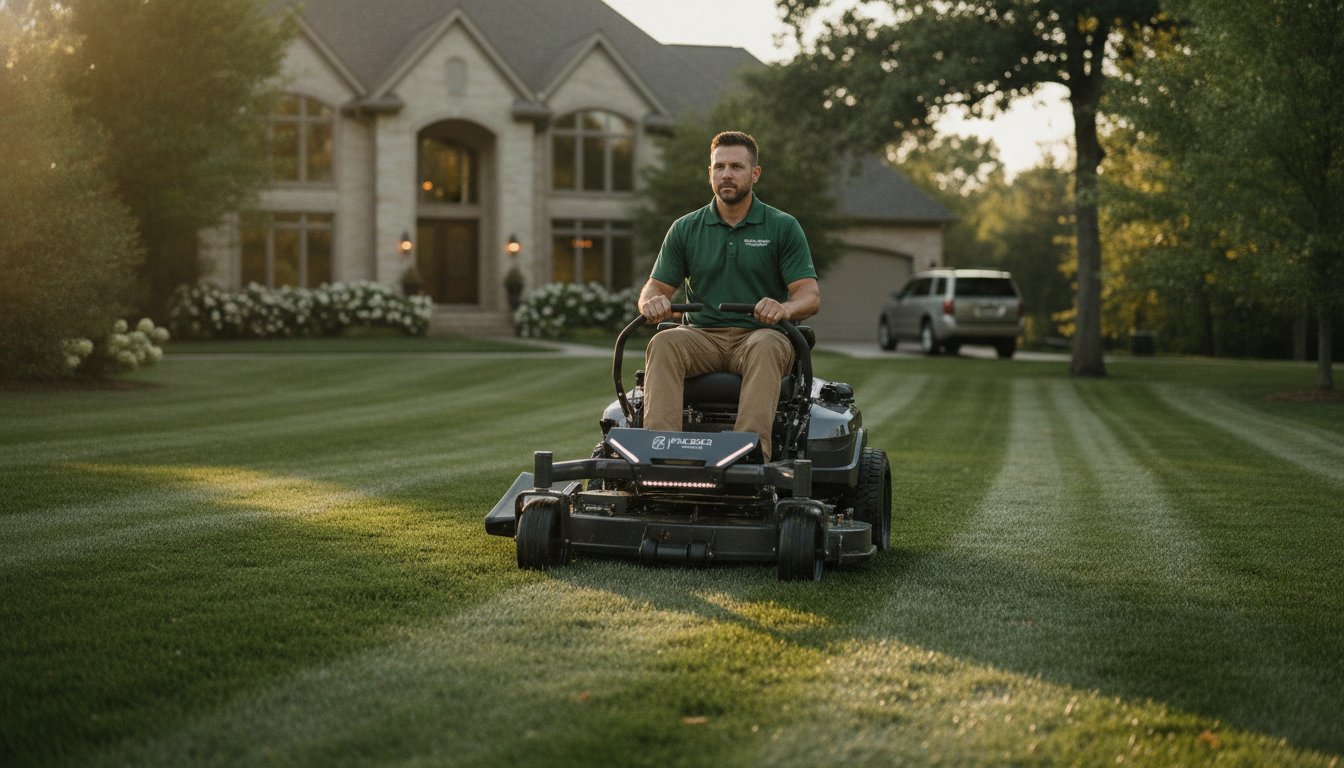
Owning equipment that loses value every time the hour meter clicks is a slow leak in your profit margin. You've felt the sting of high upfront costs and the sudden silence of a crew when a mower goes down for maintenance. It's a logistical nightmare that kills your route density and drains your cash reserves. You want to scale, but sinking capital into depreciating iron often feels like moving backward.
A strategic stand on mower rental isn't a temporary fix for a broken machine. It's a tactical lever to keep your business lean and your crews moving. Discover how leveraging rentals drives operational efficiency and increases billable hours per stop without the weight of long-term debt. We will break down the financial logic of the asset-light model and compare how these compact units outmaneuver traditional zero-turns in tight residential spaces. It's time to stop managing a graveyard of equipment and start optimizing your labor instead.
Key Takeaways
- Improve operator safety and reduce property damage by leveraging the superior visibility of a stand-on deck.
- Master the learning curve and maintain hillside stability with equipment designed for agility on steep residential slopes.
- Protect your cash flow with a stand on mower rental strategy that keeps your business asset-light and your credit lines open for growth.
- Audit your route's gate widths and terrain to select the exact deck size that eliminates time-wasting manual push-mowing.
- Maximize your ROI by using route trading platforms to align your rented equipment with your most profitable contracts.
The Strategic Case for Stand-On Mower Rental in 2026
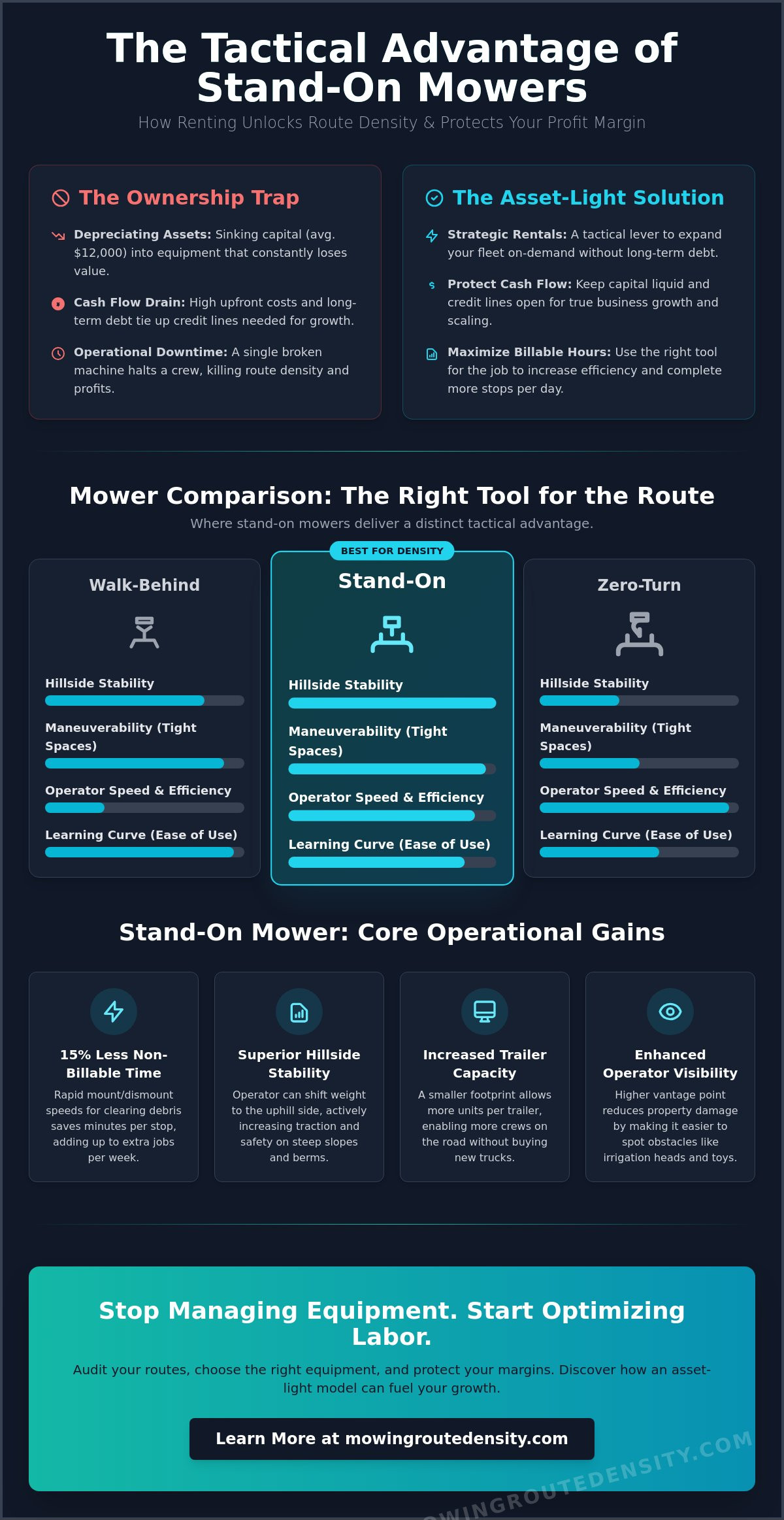
Scaling a landscaping business requires a lean approach to capital. Sinking $12,000 into a single piece of equipment is often a mistake for growing contractors. A stand on mower rental provides a flexible B2B solution that allows you to expand your fleet without the anchor of long term debt. It is a tactical move. It keeps your cash liquid while putting professional grade power on your trailers. Stop treating your equipment list like a collection of trophies and start treating it like a logistics puzzle.
The "visibility advantage" of these machines is a primary driver of operational safety. Operators standing on the platform have a higher vantage point than those in a seated position. They see obstacles faster. They spot irrigation heads, toys, and pet waste before the blades make contact. This reduces property damage claims and equipment downtime. When compared to other types of commercial mowers, the agility of a stand on unit is unmatched. You get the speed of a zero turn with the compact footprint of a walk behind. It is the best of both worlds for high volume routes.
Why Footprint Dictates Your Route Density
Trailer space is expensive real estate. Traditional zero turn mowers are bulky; they take up too much room and often limit you to two large units per trailer. Stand on models have a significantly smaller footprint. This allows you to fit more equipment on a single trailer, meaning more crews can hit the pavement without buying additional trucks. Smaller decks, such as 36 inch models, also provide immediate gate access. If your mower can't fit through a residential gate, your crew is stuck using a string trimmer or a push mower. That is a waste of labor. Optimizing your equipment size is a direct path to improving your lawn care route density and protecting your margins.
Operator Efficiency and Mount/Dismount Speed
In the service industry, you don't get paid for the time your crew spends sitting. You get paid for billable hours. Stand on mowers excel here because of their mount and dismount speed. If an operator needs to clear debris or move a garden hose, they simply step off the platform. There are no seatbelts to unbuckle and no awkward climbing out of a cockpit. This speed adds up over a ten hour shift. It keeps the momentum high and the fatigue low. A stand on mower rental ensures your team has the newest tech to maintain this pace. Stand-on mowers reduce non-billable time by 15% per stop. Those saved minutes turn into extra stops per day, which turns into pure profit.
Stand-On vs. Zero-Turn vs. Walk-Behind: The Comparison
Choosing the wrong machine for your crew is an expensive mistake. It isn't just about deck size. It's about how that deck moves and how your operator survives a ten-hour shift. If you are considering a stand on mower rental, you need to understand where these units sit in the hierarchy of commercial equipment. They aren't just a compromise between a walk-behind and a zero-turn. They are a distinct tactical advantage for specific environments.
The learning curve for new employees varies wildly across equipment types. Training a green hire on a massive zero-turn often leads to torn turf and damaged fences. The controls are sensitive and the bulk is intimidating. Walk-behinds are simpler but physically demanding and slow. Stand-ons offer an intuitive middle ground. The controls are accessible. The operator feels more in tune with the machine's center of gravity. This translates to faster training times and fewer "rookie" mistakes on high-end properties. Before you commit to long-term equipment financing options, testing these machines in the field is a mandatory step for any serious contractor.
Hillside stability is where stand-ons truly outperform sit-down models. On a zero-turn, your center of gravity is fixed. If the machine slides, you go with it. On a stand-on, the operator can shift their weight to the uphill side. This active participation keeps the tires biting into the slope. It turns a dangerous situation into a manageable task. If your route includes retention ponds or steep residential berms, the stand-on is the only logical choice for safety and speed.
Maneuverability in Tight Commercial Spaces
Zero-turn mowers are king in wide-open five-acre fields. However, they struggle in tight commercial "islands" and complex landscaping beds. A 48-inch stand-on has a much shorter chassis than a 48-inch zero-turn. This compact frame allows for tighter turns without the rear end swinging into a client's mulch bed or a parked car. You get the precision of a walk-behind with the ground speed of a rider. If you want to see how this agility impacts your bottom line, you can find local equipment rentals to test one on your tightest route.
Safety and Long-Term Operator Health
There is a persistent myth that standing all day is harder on the body than sitting. The opposite is true in the landscaping world. Sitting on a mower for eight hours over rough terrain causes significant spinal compression. Every bump goes straight to the lower back. On a stand-on unit, the operator's legs act as natural shock absorbers. They flex with the terrain. This reduces long-term fatigue and keeps your best workers from calling out with back pain. Additionally, the emergency exit speed is unmatched. You can step off the platform in a second. You don't have seatbelts or armrests pinning you down if the machine loses traction on a slope. It's a pragmatic approach to safety that protects your most valuable asset: your labor.
Renting vs. Buying: Protecting Your Margins
Owning a fleet is often a vanity project. It looks good in the parking lot but bleeds you dry in the off-season. For a scaling contractor, a stand on mower rental is a tactical shield for your margins. It shifts your business into an asset-light model. You don't need a graveyard of depreciating equipment to prove you are a professional. You need machines that run when the grass is growing and disappear when it isn't. Profit is the goal; ownership is just a method, and often a flawed one.
Hidden costs are the silent killers of landscaping businesses. Maintenance labor, specialized tools, and square footage for storage eat into your bottom line every month. Then there is depreciation. A new mower loses value the moment it leaves the dealership. By renting, you bypass these drains. You preserve your credit lines for high-impact moves like acquiring a competitor's route or launching a massive marketing campaign. Debt should not dictate your growth; strategy should. The break-even point for purchasing usually occurs only when a machine hits 80% utilization year-round. Until you reach that density, you are paying for idle iron.
Eliminating the Cost of Downtime
Every hour a mower spends in the shop is an hour of lost revenue. Using a professional lawn equipment rental ensures you always have a late-model, high-performance machine at your disposal. If a unit fails, it is the provider's problem to fix or replace it. You shift the maintenance burden to them and keep your crews on the grass. This strategy acts as a critical hedge against peak season surges when your owned equipment is most likely to fail under the heavy workload.
Scaling Fleet Capacity Without Debt
Testing a new service area is risky if you have to buy a new rig to do it. Rentals let you prove the market before you commit to a five-figure purchase. From a tax perspective, renting is an operating expense. It is a clean deduction that does not involve complex depreciation schedules or long-term liabilities. Rental costs scale linearly with revenue, unlike fixed loan payments that stay the same even when the rain stops and the mowers sit idle. This flexibility is the foundation of a truly lean operation.
Tactical Selection: Auditing Your Route Before You Rent
Walking into a rental yard without a plan is a rookie move. It leads to equipment that doesn't fit the job and margins that disappear into wasted labor. A successful stand on mower rental begins with a cold, hard look at your current route. You need to know your constraints before you commit to a machine. Stop guessing. Start measuring. If you aren't auditing your properties, you're leaving money on the table. Idle iron is a liability; the right tool is an asset.
Matching Deck Size to Property Type
Your deck size should be dictated by your narrowest point of entry. On residential routes, the 36-inch stand-on is the gate king. It eliminates the need for slow, manual push-mowing in fenced backyards. For commercial islands and medians, the 48-inch deck is the standard. It provides the right balance of speed and precision without the bulk of a full-sized rider. However, if you're dealing with wide-open acreage, a stand-on might be the wrong tool. In those cases, a high-speed zero-turn is still the efficiency leader. Match the tool to the turf, not the other way around.
Terrain and logistics are the next hurdles. Do you have steep slopes that require high-torque drive systems? If so, don't settle for a base model. Check your fuel compatibility too. Matching your rental to your existing fleet's fuel type simplifies your mid-day logistics and prevents accidental engine damage. Most importantly, verify your trailer ramp weight limits. Commercial units are dense and heavy. A snapped ramp or a bent trailer axle is an expensive way to learn about weight ratings. Uptime depends on these small details.
The Rental Inspection Checklist
Never leave the yard without a thorough inspection. The rental company might say the machine is ready, but your profit depends on verifying it yourself. Start with the blades. Dull blades don't just look bad; they slow down your ground speed and force you to double-cut. Check the hydraulic system for responsiveness. If the machine drifts to one side, your operator will burn extra energy just keeping it straight. Finally, ensure the safety interlock systems are fully functional. This isn't just about compliance; it's about protecting your labor force from avoidable accidents and ensuring you meet 2026 safety standards.
Before you sign the next contract, find local equipment rentals that offer the specific deck sizes and configurations your route demands. Every minute spent auditing your needs today saves an hour of frustration in the field tomorrow.
Optimizing Your Operations with Mowing Route Density
Equipment is just iron. Without a dense route, even the best machine is a financial drain. Our platform bridges the gap between high-performance gear and high-profit schedules. We connect you with the right stand on mower rental to fit your specific needs while providing the tools to fix your broken logistics. You aren't just renting a mower; you're building a scalable system. Stop managing a fleet and start managing a profit engine. The transition from equipment manager to strategic optimizer is what separates the survivors from the leaders.
Mowing Route Density acts as the primary partner for your asset-light business model. We understand that cash flow is your most restricted resource. By leveraging our platform, you gain access to a network designed to minimize waste and maximize output. We help you find the tools you need without the burden of long-term depreciation. It is a pragmatic approach to a messy industry. Efficiency isn't a happy accident. It is a deliberate choice you make every time you audit your operations.
Trade Routes to Tighten Your Schedule
Windshield time is the silent killer of your margins. If your crews are driving twenty minutes between stops, you've already lost the day. Equipment is only half the battle; geographic clustering is the other. Our marketplace allows you to swap distant, isolated accounts for ones that sit right next to your existing stops. This is the foundation of lawn care profit margin optimization. Tighten the map. Reduce the fuel burn. Increase the billable hours per stop. When your route is tight, a stand on mower rental pays for itself in a fraction of the time.
Join the National Contractor Network
You don't have to scale in a vacuum. Our national contractor network provides access to a community of professionals who prioritize bottom-line results over vanity fleets. This isn't a social club; it's a tactical resource. Leverage our locator tool to find partners for large-scale national contracts or to source high-quality equipment rentals in new territories. We provide the infrastructure for you to work smarter, not harder. It is time to stop fighting the same logistical fires every season. Sign up today to audit your route density, trade your inefficient accounts, and find the perfect rental to drive your 2026 growth.
Stop Managing Iron and Start Managing Profit
Ownership is a liability in a volatile market. High upfront costs and maintenance downtime are profit killers. A strategic stand on mower rental lets you bypass the debt trap while keeping your crews on the most efficient machines available. You gain the visibility advantage. You gain the agility of a compact footprint. Most importantly, you keep your capital liquid for high impact growth moves. Don't let depreciating assets dictate your business ceiling.
Equipment is only one piece of the puzzle. Without geographic clustering, you're just driving away your margins in fuel and windshield time. Our platform provides access to professional grade commercial equipment and a national network of route trading professionals. We focus on contractor profitability and density because that's what actually builds a sustainable business. It's time to tighten your operations and cut the waste. Optimize your fleet and scale your business with Mowing Route Density. Your route is waiting to be optimized. Go get it.
Frequently Asked Questions
Is a stand-on mower better than a zero-turn for hills?
Stand-on mowers are generally superior for hill stability because they allow the operator to shift their body weight actively. By leaning into the uphill side, you keep the center of gravity low and the tires firmly planted. Zero-turn mowers lock the operator into a seated position, which makes weight distribution impossible and increases the risk of sliding on steep slopes.
What is the average daily cost for a commercial stand-on mower rental in 2026?
Daily rates for a stand on mower rental vary based on your local market and the specific deck size required for your route. Most providers offer tiered pricing for daily, weekly, or monthly terms to accommodate different project durations. You should contact a local provider to get a firm quote that reflects the current 2026 market conditions in your specific service area.
Can a 36-inch stand-on mower fit through a standard backyard gate?
A 36-inch stand-on mower is designed specifically to fit through standard residential gates, which typically measure 36 to 42 inches wide. This makes them the "gate king" for residential routes where larger machines are blocked. Always measure your specific gate clearances before picking up your rental to ensure you don't end up using a string trimmer for the entire backyard.
Does renting a mower include maintenance and blade sharpening?
Most commercial rental agreements cover routine maintenance and blade sharpening as part of the contract. This is a primary benefit of the asset-light model; you offload the service burden to the provider. However, you're still responsible for daily checks like fuel levels and cleaning the deck to ensure the machine operates at peak efficiency during your shift.
How many hours can I put on a rental mower per day?
Standard rental contracts typically include eight hours of machine operation per 24-hour period or 40 hours per week. If your crew runs the mower for longer shifts, you'll likely incur hourly surcharges. It's vital to track your hour meter daily to avoid unexpected costs that could eat into your project margins.
What insurance do I need to rent commercial landscaping equipment?
You typically need a general liability policy and proof of insurance that covers rented equipment, often called an inland marine policy. Many rental yards also offer an optional damage waiver that covers minor wear and tear or accidental damage. Verify your coverage limits with your agent before signing a stand on mower rental agreement to protect your business from liability.
Are stand-on mowers harder to learn for new employees?
New employees often find stand-on mowers more intuitive to learn than traditional zero-turns. The controls are less sensitive, and the standing position provides a better sense of balance and machine movement. This shorter learning curve means your greenest hires can become productive faster, which reduces training overhead and turf damage.
How does renting equipment help with business tax deductions?
Rental payments are typically classified as an operating expense rather than a capital expenditure. This allows you to deduct the full cost of the rental in the year the expense occurs. Unlike a purchased asset that depreciates over several years, renting provides an immediate tax benefit that helps keep your cash flow predictable and your tax burden low.


