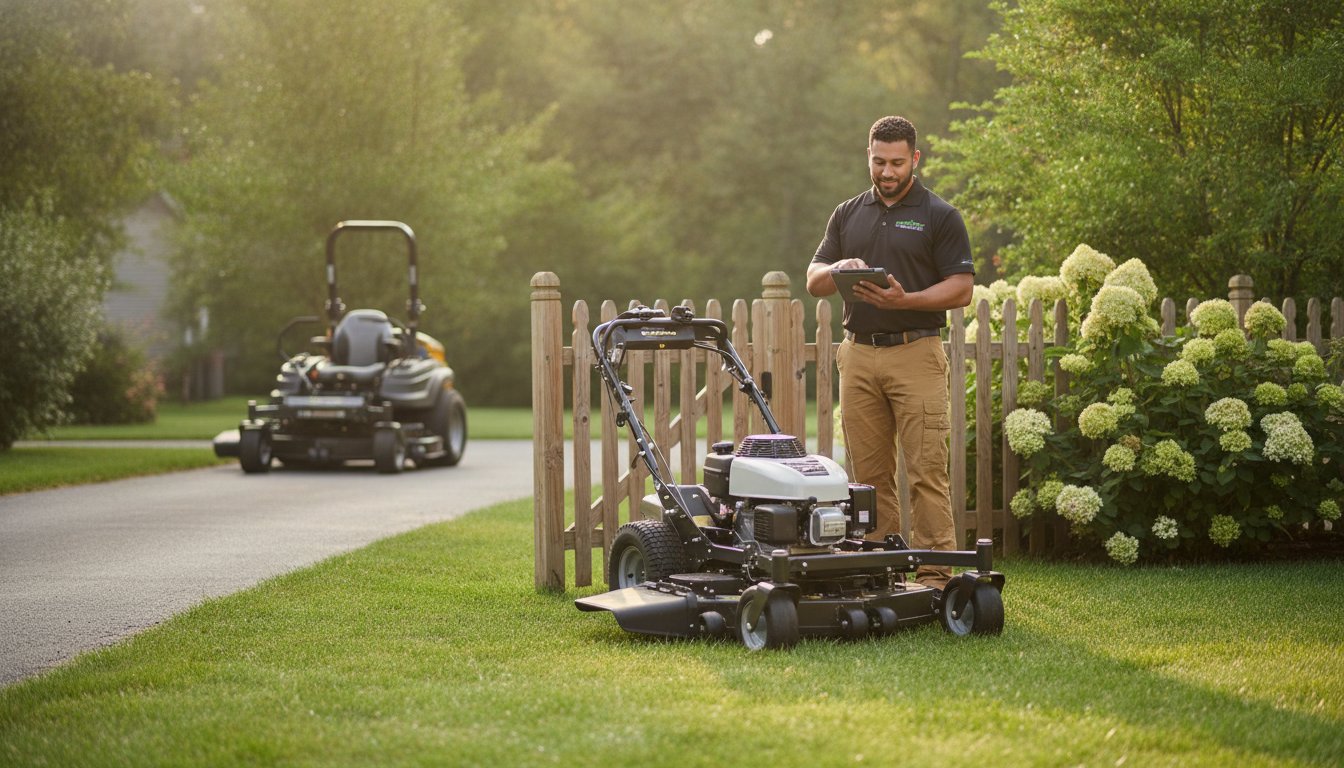
Owning a massive fleet of expensive equipment isn't a badge of honor. It's often a financial anchor. Every time you buy a machine, you're committing to maintenance, depreciation, and the risk of a breakdown during your busiest week. Many contractors find themselves stuck with large zero-turns that can't fit through a standard residential gate. This leaves profitable yards on the table. A walk behind mower rental commercial strategy isn't a backup plan for a broken machine. It's a tactical move to keep your capital liquid and your crews moving. No debt. No downtime. Just results.
You've likely felt the sting of a repair bill that wiped out a week's worth of profit. We agree that scaling requires professional tools, but that shouldn't mean drowning in equipment debt. This article will show you how to leverage rentals to eliminate overhead and maximize your billable hours. You'll learn to optimize route density by accessing tight spaces your competitors avoid. We'll break down the math of predictable monthly costs and how to scale your fleet without the typical logistical headaches.
Key Takeaways
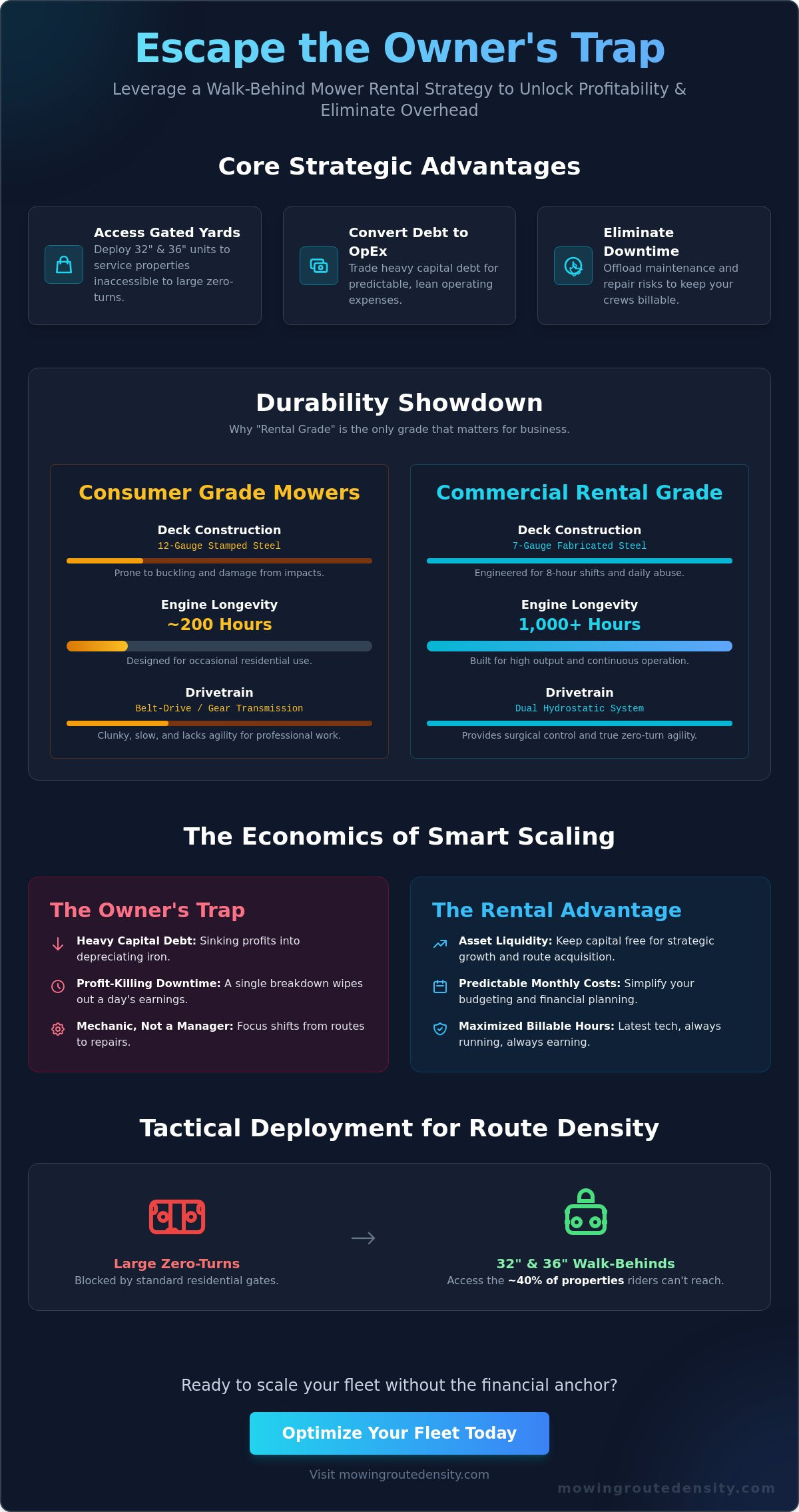
- Stop losing billable hours to residential gate bottlenecks by deploying 32-inch and 36-inch commercial units that zero-turns cannot reach.
- Understand the structural necessity of 7-gauge fabricated decks and commercial engines to ensure your gear survives 8-hour daily shifts.
- Utilize a walk behind mower rental commercial framework to convert heavy capital debt into predictable, lean operating expenses.
- Prioritize asset liquidity and cash flow to fund strategic route acquisitions rather than sinking profit into depreciating iron.
- Eliminate the profit-killing impact of maintenance downtime by offloading equipment upkeep and mechanical repair risks.
Defining the Commercial Walk-Behind: More Than a Push Mower
A commercial walk-behind is a high-torque production tool, not a consumer toy. It's engineered for grueling 8-hour shifts, day after day. If you're still thinking of these as "push mowers," you're losing money. Modern units feature zero-turn capabilities that allow crews to pivot on a dime. This isn't just about speed. It's about precision in tight residential quarters where a riding mower would be a liability. Integrating a walk behind mower rental commercial strategy into your fleet architecture allows you to tackle fenced properties without sacrificing the professional cut quality your clients expect.
Industry standards distinguish these machines by their durability and output. While many Types of lawn mowers exist for the casual user, the commercial variant is a different beast entirely. It's built to handle thick, wet grass at high ground speeds without bogging down. It's the "gate-closer" of your fleet. It handles the 40% of a property that your 60-inch rider can't reach. Using a professional-grade rental ensures you aren't sending crews out with underpowered gear that doubles their time on site.
Core Components of Professional Units
The real difference is under the hood. Most residential mowers rely on simple belt-drive systems that slip under pressure. Professional units have transitioned to dual hydrostatic systems. These systems provide independent power to each drive wheel. This gives the operator surgical control on hills and true zero-turn agility. Deck size is your primary logistical constraint. A 32-inch or 36-inch deck gets you through almost any standard residential gate. A 48-inch or 54-inch deck clears wide-open spaces with efficiency. You need the reinforced leading edges and heavy-duty spindles found in rental-grade units to survive the hidden rocks and roots of a busy route.
The B2B Rental Advantage
Buying a machine enters you into the "Owner’s Trap." You become a mechanic instead of a strategist. A commercial walk-behind is purpose-built for a 1,000-hour service life, whereas consumer models often fail before the 200-hour mark. However, those 1,000 hours require constant oil changes, belt tensioning, and blade sharpening. Walk behind mower rental commercial agreements shift this burden to the provider. It allows you to scale up instantly for the spring rush without taking on high-interest equipment debt. You get the latest technology without the inevitable depreciation hit. Renting keeps your capital liquid. It keeps your crews moving. It keeps your focus on the route, not the repair shop.
Consumer vs. Commercial Durability: Why Rental Grade Matters
Don't fall for the "pro-sumer" marketing trap. Big-box stores sell mowers that look professional but lack the backbone for daily labor. A stamped 12-gauge deck will buckle the first time it meets a hidden property stake. You need 7-gauge fabricated steel. This structural integrity is the primary reason a walk behind mower rental commercial strategy beats owning cheap iron. It’s the difference between a machine that survives the season and one that ends up in a scrap heap by July. You aren't just renting a mower; you're renting structural insurance for your business.
Engine longevity is the next bottleneck in your operations. Consumer engines are designed for roughly 200 hours of total life. In contrast, Kawasaki or Kohler commercial series engines are built for 1,000 hours or more. They feature superior filtration and cooling systems. Rental units undergo strict maintenance cycles. They receive fresh oil, clean filters, and sharp blades on a schedule you likely can't manage while running a crew. This rigor reduces field failure. It keeps your billable hours high. It ensures your team isn't standing around a steaming engine while the sun is still up.
Think about the math of a breakdown. A crew sitting in a parking lot waiting for a repair isn't just a loss of labor cost. It's a loss of opportunity. You're losing the next house. You're losing the house after that. According to Lawn and Garden Equipment Industry Statistics, the industry relies on high-output machinery to maintain profitability in a competitive market. Consumer gear breaks. Commercial gear earns. It's that simple. One broken spindle on a cheap mower can cost you hundreds in lost revenue before lunch. Why take that risk?
Hydrostatic Drives vs. Gear Transmissions
Gear transmissions are a liability for professional crews. They're clunky. They're slow. They lack the agility needed for modern yards. Dual hydrostatic systems give you surgical precision. You can't navigate a tight residential corner with a gear-driven relic without tearing up turf. These systems also handle the brutal heat of summer peaks better. Heat kills transmissions. Commercial hydros are designed to dissipate that heat, ensuring the machine doesn't slow down when the temperature hits 90 degrees. If you want to optimize your equipment strategy, you must prioritize hydro-drive units.
Fabricated Decks and Spindle Strength
Fabricated decks are welded from heavy steel plate, not stamped by a machine. They handle impacts that would total a residential machine. Spindle strength is equally critical. Cast iron spindles are the gold standard because they dissipate heat and resist cracking. Aluminum spindles, common on residential gear, often fail under the stress of commercial use. A rigid deck ensures a level cut. A level cut ensures customer retention. If your mower deck is flexing, your cut quality is trash. Your customers will notice the uneven finish immediately. Utilizing a walk behind mower rental commercial partner ensures you always have a deck that delivers a professional stripe.
Tactical Deployment: Choosing Walk-Behinds for Route Density
Gate access is the primary bottleneck for residential contractors. If your crew has to park a zero-turn and pull out a 21-inch push mower for the backyard, your efficiency just plummeted. You're paying for two machines but only one is doing real work. That is a waste of capital. A walk behind mower rental commercial plan allows you to deploy 32-inch or 36-inch units that glide through standard gates while maintaining high ground speeds. This isn't just about fitting; it's about production. You're replacing slow, manual labor with high-torque mechanical output that keeps your schedule on track during the spring rush.
The American Rental Association notes that equipment flexibility is a cornerstone of modern service logistics. Renting the right size for the right route prevents you from being over-equipped or under-powered. Beyond gate access, consider the weight-to-footprint ratio. Large riders often rut soft residential turf, especially after heavy rain. Walk-behinds distribute weight more effectively across their footprint. This reduces turf damage and the subsequent customer complaints that kill your retention rates. A happy customer stays on the route. A rutted lawn is a cancelled contract.
Optimizing the Residential Cluster
Success in this industry is measured by your "Gate-to-Gate" time. This is the total time from finishing one backyard to starting the next. If you're wrestling with oversized gear or underpowered push mowers, that metric suffers. A single 36-inch walk-behind can effectively replace two 21-inch push mowers on a standard crew. This cuts your labor overhead in half while doubling your speed. Linking your equipment choice to lawn care route density is how you maximize marginal utility. You want the widest possible deck that still guarantees 100% gate access across your entire cluster. Don't let a 36-inch gate stand between you and a profitable afternoon.
Slope Management and Safety
Ride-on units are a liability on inclines. Their high center of gravity makes them prone to tipping on 15 to 20-degree slopes common in suburban neighborhoods. Walk-behinds offer superior stability because the operator remains on the ground. This allows for instant weight shifts to maintain traction and control. This isn't just a safety preference. It's a calculated risk management strategy. Using the right equipment for the terrain reduces your insurance liability and protects your most valuable asset: your labor. Don't risk a rollover accident with a heavy stand-on when a commercial walk-behind offers total control on difficult grades.
The Economics of Rental: Controlling Overhead and Asset Liquidity
Stop viewing equipment rental as a desperate fix for a broken machine. That mindset keeps you small. Strategic contractors use a walk behind mower rental commercial approach to protect their cash flow and maintain asset liquidity. Buying a $10,000 mower is a capital expenditure (CapEx) that ties up your borrowing power. Renting is an operating expense (OpEx). It’s a line item that scales with your revenue. Every dollar you sink into a depreciating piece of iron is a dollar you can't use for buying lawn care routes. Growth comes from acquiring profitable accounts, not from owning a graveyard of used equipment.
Ownership carries hidden anchors that bleed your margins. You have to pay for secure storage. You have to pay for specialized insurance. You have to pay for off-season maintenance when the machine isn't earning a cent. Rental eliminates these drains. It also allows you to trial the latest technology without commitment. If a new model promises better fuel efficiency or faster ground speeds, you can test it on a live route for a month. If it doesn't deliver, you return it. You aren't stuck with a five-year loan on a mediocre machine. You stay lean. You stay agile.
Asset-Light Growth Strategies
Scaling a fleet shouldn't require a massive bank loan. Shifting to commercial mower rental long term allows you to match your equipment costs directly to your seasonal contracts. Compare a standard loan payment to a full-service rental agreement. The loan payment only covers the iron. The rental agreement covers the iron, the maintenance, and the replacement if it fails. You also avoid the "Winter Drain." When the grass stops growing, you return the equipment. You stop paying for assets that are sitting idle in a shed. This keeps your overhead predictable and your profit margins protected during the off-season.
Tax Advantages and Balance Sheets
The tax code rewards the efficient. While Section 179 allows for some depreciation benefits on purchases, rental payments are typically 100% deductible as a business expense. This simplifies your accounting and provides an immediate tax shield for your revenue. Renting a $10,000 unit for $500 per month allows you to generate immediate revenue without the heavy front-end depreciation that kills your net worth on paper. It keeps your debt-to-income ratio low. This makes you more attractive to lenders when you need financing for high-value business acquisitions rather than just more mowers. If you're ready to stop the equipment drain, check out available rental inventory to keep your capital liquid.
Scaling Your Fleet with Mowing Route Density
Owning the best gear is useless if your crews spend half their day on the interstate. Profit isn't found in the machinery itself. It's found in the density of your route. A walk behind mower rental commercial strategy only reaches its full potential when paired with a geographically tight cluster of accounts. You want your blades spinning, not your tires rolling. Mowing Route Density provides the infrastructure to bridge this gap. It connects you with the right equipment for your specific terrain and the right routes to maximize your billable hours. Stop chasing single houses ten miles apart. Start building a territory you can actually dominate.
The transition from a "guy with a mower" to a "contractor with a fleet" requires a shift in perspective. You must stop falling in love with the iron and start obsessing over the logistics. Using the professional lawn equipment rental framework allows you to match specific gear to specific account needs without the long-term burden of a loan. If a route is 90% fenced backyards, you deploy 36-inch walk-behinds. If the route changes, you change the gear. This flexibility is the hallmark of a lean, profitable operation.
The Account Trading Advantage
Efficiency requires tactical sacrifice. You should actively swap distant, high-maintenance accounts for clustered ones that fit your existing territory. This is the account trading advantage. When your accounts are packed together, you justify the use of premium stand on mower rental units or high-torque walk-behinds that move faster than the competition. You aren't just cutting grass; you're building a turnkey asset. A business built on route density and managed equipment overhead is a business ready for a lawn care business exit strategy. Buyers want high margins and low debt. They want a machine that runs, not a balance sheet that bleeds.
Next Steps for the Strategic Contractor
It's time for a cold, hard look at your operations. Audit your current gate-access routes for efficiency gaps. Identify every property where an oversized rider is forcing a crew member to use a slow, underpowered push mower. Calculate the true cost of ownership for your aging walk-behinds. Include the downtime, the parts, and the lost billable hours. Most contractors find that a walk behind mower rental commercial agreement pays for itself in labor savings and increased uptime alone. Don't wait for a total mechanical failure to change your strategy. Join the Mowing Route Density network today. Optimize your territory. Tighten your operations. Scale your business without the debt.
Stop Funding Depreciation and Start Scaling Profit
Your business doesn't need more debt. It needs more billable hours. Relying on oversized riders that can't clear a residential gate is a choice to lose money. Integrating a walk behind mower rental commercial strategy allows you to dominate high-density routes without the weight of equipment loans. You get professional-grade durability and surgical precision exactly when you need it. No maintenance downtime. No storage overhead. Just production.
The path to a liquid, exit-ready business starts with lean operations. We provide a B2B-only marketplace and a national network of service providers focused entirely on contractor profitability. Stop acting like a mechanic and start acting like a strategist. Optimize your routes and rent smarter with Mowing Route Density. It's time to tighten your margins and outpace the competition. Your next profitable route is waiting.
Frequently Asked Questions
Is a 36-inch or 48-inch walk-behind better for residential rental?
The 36-inch unit is superior for high-density residential routes because it guarantees access through standard 40-inch backyard gates. A 48-inch deck is faster in open spaces but becomes a liability when your crew has to park it and use a push mower for the backyard. You lose more time to manual labor than you gain in deck width. Stick to the 36-inch model to keep your "gate-to-gate" time low and your production high.
Do commercial walk-behind rentals include maintenance and blade sharpening?
Professional rental agreements typically include all scheduled maintenance and blade sharpening as part of the monthly fee. This is a primary advantage of the asset-light model. You stop paying for filters, oil, and grinding wheels. More importantly, you stop paying for the labor to perform these tasks. Your crews stay in the field earning revenue instead of wasting billable hours in the shop performing basic mechanical upkeep.
Can I rent a walk-behind mower for a full season to save on costs?
Long-term walk behind mower rental commercial agreements are a strategic way to scale your fleet without the burden of equipment debt. Many providers offer seasonal rates that are significantly lower than daily or weekly prices. This approach allows you to match your equipment expenses directly to your active contracts. You avoid the "winter drain" of paying for machines that sit idle in a shed during the off-season.
What is the difference between a pistol-grip and a T-bar control system?
Pistol-grip systems are traditional but can lead to operator fatigue during long shifts due to the constant squeezing required. T-bar systems are more ergonomic and often preferred for 8-hour production days. The choice affects your labor's endurance and speed. If your crew is fatigued by noon, your afternoon houses will take longer. Test both systems to see which one maintains your team's ground speed throughout the day.
How much insurance coverage do I need for a commercial mower rental?
Most rental providers require proof of General Liability insurance before releasing professional-grade gear. You should also verify if the provider offers a Loss Damage Waiver (LDW) to cover the machine itself in case of theft or accidental damage. Don't assume your standard policy covers rented equipment. Check your specific policy limits to ensure you aren't exposed to a catastrophic financial loss if a unit is totaled on a job site.
Are rental walk-behind mowers equipped with mulching kits or side discharge?
Most units come standard with side discharge to maintain maximum ground speed in thick or wet grass. Mulching kits can often be added upon request, but they require more horsepower and can slow down your crew in heavy spring growth. If your route requires a manicured look without clippings, ask for a mulching setup. Just be prepared for the slight drop in production speed that comes with processing more material under the deck.
What happens if the rental mower breaks down on a job site?
The provider typically swaps the broken machine for a functional unit within a few hours. This eliminates the "Owner's Trap" where a broken spindle can sideline a crew for three days while waiting for parts. You aren't responsible for the repair costs unless the damage was caused by negligence. This predictable uptime is what allows you to maintain high route density and meet your service guarantees during the busiest weeks of the year.
How do I calculate the ROI of renting versus buying a walk-behind?
Compare the total cost of ownership against the monthly rental fee. Ownership includes the loan payment, depreciation, insurance, storage, and maintenance labor. Most contractors forget to factor in the cost of downtime. If owning a machine results in two days of lost production per year, that lost revenue must be added to the "Buy" column. When you run the numbers, the liquidity and uptime of a walk behind mower rental commercial strategy often deliver a higher net profit.


