Your fleet should be a tool for profit, not a museum of depreciating assets. In 2026, a new commercial zero-turn can easily cost you $22,000 before it even hits its first acre. That is a massive hit to your liquid capital. It is a heavy anchor on your growth. Tying up your credit lines in iron is a gamble your margins can't afford. A commercial mower rental long term strategy offers a tactical way out of this trap. You need the gear to get the job done. You don't need the logistical nightmare of owning it.
Every owner knows the frustration of a mower stuck in the shop during peak season. Maintenance costs are unpredictable. Downtime is expensive. We agree that reliability is non-negotiable for your service contracts. This article shows you how to shift to an asset-light model that protects your bottom line. You will learn how to stabilize your monthly overhead, eliminate the burden of depreciation, and build a scalable fleet that mirrors your route density. It's time to stop managing equipment and start managing profit.
Key Takeaways
- Stop sinking capital into depreciating iron. Learn why the asset-light model is the only way to scale safely in a high-inflation market.
- Discover why commercial mower rental long term agreements offer superior tax efficiency and lower operational risk compared to traditional ownership.
- Optimize your route density. Find out how to match specific mower widths to your route profiles without the permanent burden of a fixed fleet.
- Protect your margins with the right contract. Identify the critical terms, such as hours-of-use limits and maintenance support, that define a strategic rental partnership.
- Integrate your fleet with professional logistics. See how the Mowing Route Density platform facilitates rapid growth by connecting your equipment strategy to your actual route data.
The 2026 Shift: Why Pros Are Choosing Long-Term Commercial Mower Rental
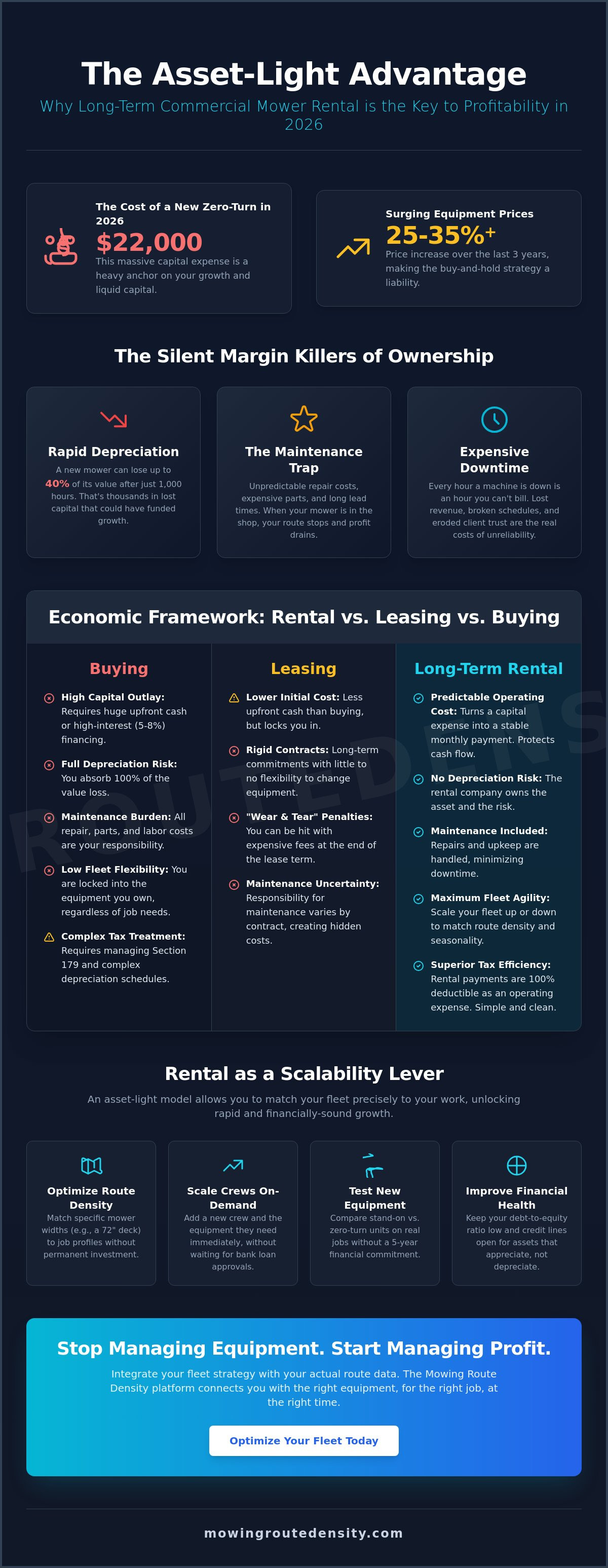
The buy-and-hold strategy is dead. High inflation killed it. Over the last three years, the price of new commercial zero-turn mowers has surged by 25-35%. Dropping $22,000 on a single piece of iron is no longer a sign of success. It is a liability. Smart operators are pivoting to an asset-light model. This approach prioritizes cash flow over equipment titles. By choosing a commercial mower rental long term, you keep your capital liquid. You keep your credit lines open. You focus on the work, not the hardware.
The equipment rental industry has evolved to meet this need. It is no longer just for weekend warriors or emergency backups. It is a strategic tool for professionals who understand that their real product is a well-maintained lawn, not a fleet of aging machines. This shift is a core component of lawn care profit margin optimization. It forces you to look at the true cost of every billable hour. No more guessing. No more hidden drains on your net margin.
The Hidden Costs of Equipment Ownership
Depreciation is a silent margin killer. The moment a new mower rolls off the trailer, its value plummets. In 2026, a unit with 1,000 hours might sell for 40% less than its purchase price. That is thousands of dollars in lost equity. It is capital that could have been spent on customer acquisition or labor. Ownership also brings the "maintenance trap." Older machines require more frequent repairs. Parts are more expensive. Lead times are longer. When your primary mower is in the shop, your route stops. Billable hours are lost. Client trust erodes. Ownership creates a rigid cost structure that doesn't care if it's raining or if a client cancels.
Rental as a Scalability Lever
Fixed fleets lead to inefficient operations. A commercial mower rental long term strategy allows you to match your fleet to your actual route density. Need a 72-inch deck for a new industrial contract? Rent it for the season. Scaling up a new crew in June? Don't wait weeks for a bank to approve an equipment loan. Get the gear on the ground today. This agility lets you test new equipment types, like comparing stand-on units versus zero-turns, without a five-year commitment. You can scale your field teams based on demand, not on your ability to finance more debt. It's about working smarter. It's about staying lean. It's about winning.
Economic Framework: Long-Term Rental vs. Leasing vs. Buying
Stop looking at the monthly payment in a vacuum. You're running a business, not a hobby. Success requires a cold-blooded analysis of the Total Cost of Ownership (TCO). Buying a mower involves a 20% down payment or high-interest financing. In 2026, equipment loans typically range between 5% and 8%. That is expensive money. Leasing often feels like a middle ground, but it locks you into rigid contracts with "wear and tear" penalties. A commercial mower rental long term strategy keeps your balance sheet clean. It turns a massive capital expense into a predictable operating cost. This is the foundation of an asset-light business model.
Tax efficiency is another overlooked advantage. While the Section 179 deduction allows you to deduct up to $1,220,000 for equipment purchases in 2026, it requires you to have the profit to offset it. It also ties you to complex depreciation schedules. Rental payments are simpler. They are 100% deductible as an operational expense in the year they occur. There is no recapture tax when you return the unit. Even the federal government's acquisition guidelines emphasize this type of rigorous comparison between ownership and rental to ensure long-term value. You should follow that lead.
The Rental vs. Financing Math
Ownership means you pay for the machine 365 days a year. It doesn't matter if it's raining or if it's the off-season. You still owe the bank. Rental allows you to scale your costs to your revenue. Off-balance sheet financing benefits keep your debt-to-equity ratio low. This makes your business more attractive to lenders when you need to finance something that actually appreciates, like real estate or a larger shop. You aren't just renting a mower. You're buying financial flexibility.
The Break-even Utilization Rate is the specific number of billable hours per month where the total cost of owning, insuring, and maintaining a mower equals the flat fee of a long-term rental.
The Maintenance and Repair Factor
Downtime is a silent killer. If a $20,000 mower sits in the shop for two weeks in May, you aren't just losing the repair cost. You're losing thousands in billable hours. You're risking client churn. Rental agreements shift this liability back to the provider. If the machine breaks, you get a swap. You stay on the grass. You keep your promises to your customers. This "Zero-Maintenance" advantage ensures your crews are always equipped with the latest, most efficient technology without the risk of obsolescence. If you want to maximize your efficiency, consider optimizing your fleet mix through a rental-first approach.
Tactical Advantages: Aligning Fleet with Route Density
A fixed fleet is a rigid fleet. If your equipment doesn't match your geography, you're bleeding money. Many contractors fall into the trap of buying "all-purpose" machines that are mediocre at everything. They use a 72-inch zero-turn on tight residential clusters because it's what they own. That is waste. Using a commercial mower rental long term strategy allows you to tailor your iron to your actual accounts. You don't just need mowers. You need the specific deck width that maximizes billable hours on every specific street. This precision is what separates high-margin operators from the rest.
Strategic growth requires agility. When you participate in route trading or acquire a new portfolio of accounts, your equipment needs change overnight. Aligning with professional lawn equipment rental providers ensures you have the right tool for the new terrain. This synergy allows you to scale without the friction of selling old gear and financing new units. Following industry best practices for equipment acquisition means focusing on utilization rates. If a mower isn't the perfect fit for your current route density, it's an anchor. Cut it loose. Stop letting your equipment dictate which jobs you can take.
Equipment Agility for Route Expansion
Acquiring a new route cluster is a win. Don't ruin it by forcing the wrong gear onto the job. If your new accounts have narrow gates or steep inclines, your heavy zero-turns will fail you. A commercial mower rental long term agreement lets you pivot. You can easily swap to a stand on mower rental to handle tight spaces without a long-term debt commitment. Stop "making do" with oversized or undersized decks. Use the gear that fits the route. Move on to the next property faster. Efficiency is built on the trailer, but it's executed on the turf.
Density-Driven Fleet Management
High route density is the goal. It reduces travel time. It increases cut time. But it also changes how you view wear and tear. When your machines stay in a tight radius, they spend more time under load and less time sitting on a trailer. You need reliable, modern engines to handle that constant work. Renting ensures you're always running current-year models with peak fuel efficiency. You maximize billable hours per gallon of fuel. You reduce the "dead time" spent hauling gear that isn't optimized for the neighborhood. Every minute saved in transport is a minute earned in profit. Don't let an outdated fleet eat your gains.
Selecting Your Long-Term Rental Strategy: A Contractor’s Checklist
Don't walk into a rental yard and take the first shiny machine you see. You're signing a contract that will affect your margins for months. A commercial mower rental long term agreement requires the same due diligence as an equipment purchase. You need a partner, not just a vendor. If the provider focuses on homeowners, walk away. You need commercial-grade inventory that can handle 40 plus hours of work every single week. Your checklist starts with the machine, but it ends with the support behind it.
Vetting the Provider’s Commercial Fleet
Brand names matter. Tier 1 brands like Toro or John Deere aren't just for show. They are built for the daily grind. Generic models might save you a few dollars on the monthly rate, but they will cost you in fuel waste and mechanical failure. Check the age of the fleet. You don't want to rent someone else's problems. Machines with high hours are more likely to fail when you're behind on a route. Ask about specialized attachments. If a provider can't offer bagging systems or mulching kits, they aren't equipped to support a professional operation. Your margins depend on having the right tool for the specific grass type and client expectation.
Contractual Fine Print for Long-Term Deals
Read the hours of use limits. Overage charges are where providers make their real money. Ensure your limit matches your actual billable hours plus a buffer for growth. You should also clarify what constitutes "normal wear and tear." In a commercial context, this includes blade sharpening and belt adjustments. It shouldn't include major engine overhauls. Negotiate seasonal pauses if you operate in a climate with a hard winter. Don't pay for iron that's sitting in a shed during a blizzard. A replacement guarantee is the most critical clause in a long-term rental contract because it ensures that mechanical failure won't paralyze your crews or derail your service schedule.
Insurance is non-negotiable. Your general liability insurance must cover rented equipment. The industry standard is typically a $1 million to $2 million policy. If you're scaling across regions, verify the provider's ability to swap units or provide service at different locations. This keeps your logistics lean and your downtime at zero. If you're ready to start building a more agile fleet, check out the options for commercial mower rental that align with your growth strategy. Stop letting equipment ownership dictate your limits. Focus on the route, not the repair bill.
Optimizing Your Fleet with Mowing Route Density
Equipment is only as profitable as the route it services. A high-end machine sitting in traffic is a paperweight. Mastering the "Profit Triangle"—Density, Equipment, and Labor—is the only way to protect your net margin in 2026. Integrating commercial mower rental long term with a route-centric business model ensures your assets are always where the money is. The Mowing Route Density platform facilitates this shift. It provides the data you need to align your fleet with your geography. Stop guessing. Start optimizing.
Success in this industry isn't about how many mowers you own. It's about how many billable minutes you extract from every hour of the day. If your crews spend 30% of their shift behind a steering wheel, your equipment strategy is failing. By shifting to a rental model, you gain the agility to adjust your fleet as your route density changes. You don't have to force an old 72-inch deck into a neighborhood of gated backyards just because it's what you have in the shop. You rent the right tool for the cluster you've built.
Leveraging the Route Marketplace
Account trading is the ultimate lever for fleet efficiency. Do you have an outlier account that requires a specialized mower while the rest of your route uses standard zero-turns? That is a logistical drain. Use the marketplace to sell that outlier. Buy accounts that fit your primary rental profile instead. Trading accounts creates tighter clusters. Tighter clusters mean more billable hours per gallon of fuel. It means less time on the trailer and more time on the turf. You can buy routes that fit your current commercial mower rental long term profile, ensuring every machine you pay for is working at its highest capacity.
The Future of Landscaping: Strategic Asset Management
The industry is moving from "mower owners" to "logistics strategists." You don't need a yard full of aging iron to be successful. You need a variable cost structure that breathes with the market. Building a recession-proof business means staying lean. If a contract ends, you return the rental. You don't get stuck with a five-year loan and zero revenue. This is the essence of asset-light growth. It's about shedding debt and increasing agility. It's about focusing on route density rather than equipment maintenance. Optimize your routes and fleet today and stop letting ownership eat your profits.
Build a Leaner, More Profitable Fleet
Ownership is often a pride trap that bleeds your margins dry. You've seen how a commercial mower rental long term strategy eliminates the maintenance trap and protects your liquid capital. It's time to stop letting aging iron dictate your growth. Real success in 2026 depends on your ability to match your equipment to your route density with surgical precision. This approach turns your fleet into a variable cost that scales with your revenue. You don't need more debt. You need better logistics.
We offer access to a national network of commercial equipment providers and an integrated route trading marketplace. Our entire framework is built with a strategic focus on contractor profitability. It's about tightening your operations and cutting the waste that holds you back. Stop managing repairs and start managing your expansion. Optimize your fleet and route density today. Your business is ready for the next level. Let's get to work.
Frequently Asked Questions
Is long-term commercial mower rental cheaper than buying?
Rental is often more cost-effective when you factor in the 40% depreciation hit and high interest rates. Owning a $22,000 mower ties up capital that could grow your business elsewhere. Rental turns a massive capital expense into a predictable monthly overhead. You pay for what you use. You don't pay for a machine to sit in the shop or rust in the winter.
What happens if a rented commercial mower breaks down mid-season?
You get a replacement unit immediately. Professional rental providers prioritize uptime because their business depends on it. You avoid the "maintenance trap" where a single mechanical failure halts your entire route. A swap ensures your crews stay productive. You keep your promises to your clients. The provider handles the repair bill and the logistical headache. You stay on the grass.
Can I swap equipment during a long-term rental contract?
Agility is the whole point. If your route profile changes, your equipment should change too. A long-term contract allows you to swap a wide zero-turn for a stand-on unit if you acquire tighter residential clusters. You aren't stuck with the wrong tool for three years. You trade the asset to match the job. This flexibility is impossible with traditional financing or outright ownership.
Do long-term rentals include insurance and maintenance?
Routine maintenance like oil changes and belt adjustments is standard. You are responsible for daily checks and fuel. Insurance is your burden. You must carry a $1 million to $2 million general liability policy that covers rented equipment. Don't assume the rental yard covers your liability. Verify your coverage before the first trailer gate drops. Protect your business from the unexpected.
How do rental hours-of-use limits work for commercial contractors?
Your contract will define a specific hour threshold for the rental period. This is a logistical guardrail to prevent excessive wear on the machine. You must monitor your tachometers weekly. If your route density is high, you might hit these limits faster. Negotiate these terms upfront to ensure your commercial mower rental long term agreement matches your actual workload and prevents overage charges.
Is a long-term rental considered an operating expense or a capital lease?
Most long-term rentals are classified as operating expenses. This is a strategic advantage for your balance sheet. It keeps your debt-to-equity ratio low. Unlike a purchase, there is no depreciation to track or recapture tax to worry about. You get a clean, 100% deduction every year. It simplifies your accounting and keeps your credit lines open for real estate or business acquisitions.
What are the credit requirements for long-term commercial equipment rental?
Requirements are generally less stringent than bank financing for a purchase. Providers look for business stability and consistent cash flow. It is a faster way to scale your fleet than waiting for traditional loan approvals in a high-inflation economy. You can often get the gear you need in days rather than weeks. This speed allows you to bid on larger contracts with confidence.
Can I customize a rented mower with my own attachments?
Yes, but they must be non-permanent. You can usually add mulching kits or bagging systems to meet specific client needs. Permanent modifications to the frame or engine are forbidden. Always verify these details in your commercial mower rental long term agreement. You need to return the unit in its original configuration. Don't let a customization error turn into a damage claim at the end of the season.


