

Your winter bank balance isn't a weather problem. It's a math problem. Most owners accept the "feast or famine" cycle as an unavoidable industry tax. You grind all summer. You stack cash. Then you watch those margins bleed out through equipment payments and idle overhead during the zero-revenue months. If you are tired of the struggle, managing cash flow in a seasonal lawn business starts with a fundamental shift in your operational strategy.
You don't have to live this way. It's time to stop letting fixed debt and scattered routes dictate your lifestyle. You've felt the pain of high equipment payments when the mowers aren't even running. You've seen fuel costs eat your profits because your stops are spread too thin. We'll show you how to convert heavy assets into variable costs and tighten your operations for maximum density.
This guide breaks down the 2026 blueprint for maintaining predictable year-round reserves. You'll learn how to liquidate inefficient accounts through strategic trading and leverage rental models to keep your overhead lean. We are moving past the "buy and pray" model. We're building a business that stays profitable even when the grass stops growing.
Key Takeaways
- Stop paying for equipment that sits idle. Learn how to identify the "ownership trap" and why traditional accounting fails your bottom line.
- Build a 12-month financial map to anticipate burn rates. Mastering the art of managing cash flow in a seasonal lawn business requires knowing your numbers before the season hits.
- Shift from fixed debt to variable assets. Discover how rental models provide the flexibility to scale your fleet only when the grass is actually growing.
- Slash fuel and labor costs by optimizing your geography. Use account trading to liquidate high-drain stops and acquire denser clusters of profitable work.
- Execute a logistics-first strategy for 2026. Get the three critical moves you need to make now to ensure your reserves stay healthy all winter.
The Seasonal Cash Flow Trap: Why Traditional Lawn Care Accounting Fails
Revenue is a vanity metric. Profit is a sanity metric. But for anyone managing cash flow in a seasonal lawn business, liquidity is the only metric that keeps the doors open. Most contractors fail because they use traditional accounting that ignores the timing of money. They see a healthy profit on their July P&L and assume they are winning. Then January hits. The revenue vanishes, but the equipment notes remain. This is the seasonal cash flow trap: the fundamental mismatch between peak-season income and year-round fixed obligations.
Traditional accounting fails because it doesn't account for the "ownership trap." You are likely paying for mowers that sit in a shed for four months of the year. This isn't just a seasonal dip; it is a structural flaw in your business model. In 2026, the industry is shifting. The most profitable operators are moving from asset-heavy models to asset-light strategies that prioritize agility over ownership.
Fixed vs. Variable Costs in Landscaping
You need to understand the difference between costs that help you and costs that hurt you. Payroll and fuel are variable costs. If the grass isn't growing, you don't pay the crew and you don't fill the tanks. Equipment notes, however, are fixed. They are dangerous because they demand payment regardless of your revenue. Depreciation also erodes your off-season reserves, silently devaluing your assets while they sit idle. It's critical to define cash flow as the speed at which money moves through the business, not just the balance in the bank.
The Hidden Cost of Idle Assets
A commercial mower costs you money every single day, whether it's cutting an acre or collecting dust. When you factor in insurance premiums, storage, and preventative maintenance, the "daily cost" of an idle machine is staggering. Owning a massive fleet is often just a vanity metric. It looks good in the yard, but it kills your profitability during the shoulder seasons. Every dollar spent on a mower that isn't running is a dollar you can't use to fund spring growth. Tightening your operations means admitting that ownership is often a financial drain disguised as an investment.
Scattered routes further complicate this. We call it the "density drain." If your stops are miles apart, you are turning high-value billable hours into low-value drive time. You might have high revenue, but your liquidity is being burned in a gas tank. To survive 2026, you must stop being an equipment collector and start being a logistics strategist.
Forecasting for 2026: Building Your 12-Month Financial Map
Hope is not a strategy. Many owners spend the winter hoping the spring rush will save them. It won't. If your overhead is too high, you'll just be digging a deeper hole with every new customer. Managing cash flow in a seasonal lawn business requires a surgical approach to forecasting. You need a 12-month map that identifies exactly when your cash will dip below your Safety Threshold. This isn't just about revenue. It's about survival.
Your Safety Threshold is the minimum amount of cash needed to cover fixed overhead, not total expenses. In 2026, with SBA 7(a) fixed rates reaching as high as 14.75%, the cost of carrying debt is higher than ever. You must identify your "burn rate" during the shoulder seasons of March and October. These are the months where labor and preparation costs spike but billing hasn't caught up. If you don't have the reserves to bridge these gaps, you'll be forced into high-interest debt just to keep the lights on. Effective Financial Planning for Seasonal Businesses focuses on protecting these margins before the season even starts.
The 12-Month Revenue Heat Map
Stop looking at annual totals. Start looking at monthly billing cycles. Use your historical data to predict exactly when the "Spring Surge" will hit. You need to account for weather-related delays that can push your first big billing cycle back by three weeks. If you haven't planned for that delay, your payroll will bounce. A lean operator integrates lawn care profit margin optimization into every month of the forecast. This ensures that every stop is actually contributing to your cash reserves rather than just keeping the crew busy.
Cutting the Fat: Expense Auditing
Every recurring expense is a leak. Audit your software subscriptions, storage fees, and insurance premiums. If a tool isn't generating billable hours, it's a liability. Renegotiate vendor terms for the off-season. Ask for deferred payments or lower rates when your volume drops. The goal is to drive your fixed overhead as low as possible. When you reach the point where equipment ownership costs more in monthly notes than it generates in monthly profit, it's time to pivot. You can audit your current route profitability to see where you're losing the most liquidity before the 2026 season begins.
Ownership is a vanity metric. Profitability is a logistics metric. By mapping your 2026 peaks and valleys now, you can decide which assets to keep and which to cut. Don't wait for a cash crunch to start making these decisions. Precision today prevents a crisis tomorrow.
Asset Optimization: Rental vs. Ownership in a Seasonal Market
Owning your fleet is a vanity project that kills liquidity. If you're managing cash flow in a seasonal lawn business, you need to stop treating mowers like trophies and start treating them like tools. The total cost of ownership (TCO) isn't just the sticker price. It's the 14.75% interest on an SBA loan, the insurance premiums, the shop space, and the mechanic's bill for a machine that hasn't made a dollar in three months. In 2026, successful contractors are pivoting to professional lawn equipment rental to align their costs with their revenue. Stop collecting assets. Start collecting profit.
Rental agreements provide the ultimate hedge against seasonal dips. When the grass stops growing in October, you return the machine. The expense disappears from your books. This "just-in-time" asset management ensures you only pay for equipment when it's generating billable hours. You also eliminate the risk of maintenance downtime. If a rental mower breaks, you get a replacement. If your owned mower breaks, you get a repair bill and a stalled crew. The math is simple: variable assets protect your margins; fixed debt erodes them.
When to Rent and When to Buy
Apply the 60% Rule. Own the core equipment needed for your year-round maintenance contracts. Rent the rest to handle seasonal peaks. This prevents you from carrying off-season debt for machines that are only billable during the spring rush. If you need a middle ground for expansion, explore commercial lawn mower lease options. These provide a tactical path for growth without the permanent weight of a traditional note. You can return seasonal units when the season ends, effectively turning a fixed liability into a variable asset.
Maintaining Liquidity through Asset-Light Growth
Liquidity is your greatest competitive advantage. Every dollar tied up in a mower you aren't using is a dollar you can't use to grow. Instead of dropping $4,000 as a down payment on a new zero-turn, use that cash to fund a targeted marketing campaign or hire a high-performing lead. This shift in mindset is one of the key strategies to strengthen your financial stability. A clean balance sheet in the winter isn't just a psychological win; it's a strategic one. It means you can pounce on opportunities in March while your competitors are still struggling to pay off their January equipment bills. Work smarter. Stay lean. Keep your cash in your pocket, not in the shed.
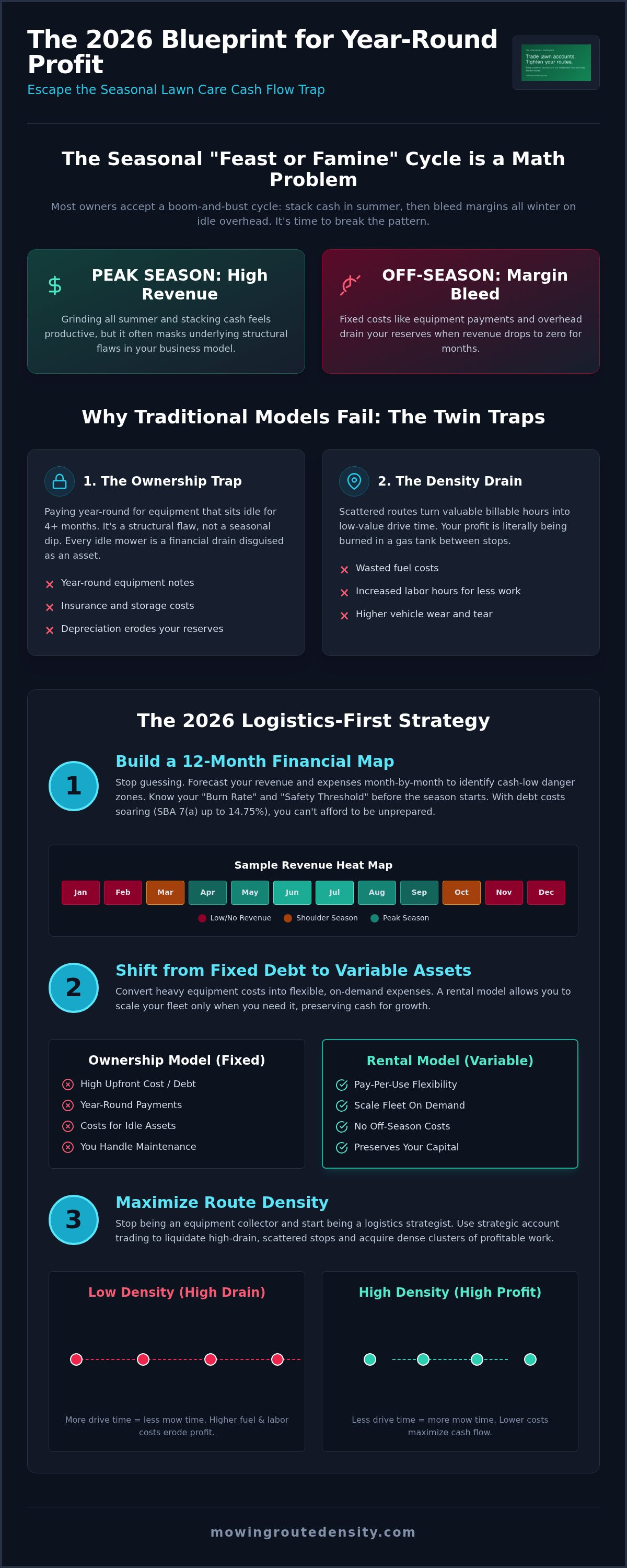
Route Density: The Ultimate Cash Flow Lever
Windshield time is a silent killer. Every mile your trucks travel between stops is a non-billable expense that drains your reserves. When you're managing cash flow in a seasonal lawn business, you must treat your route like a manufacturing line. Any gap in that line is a defect. High lawn care route density is the only way to protect your margins from rising fuel prices and labor costs. If your crews spend 20% of their day driving, you're losing 20% of your billable potential before the first mower even drops.
The math is brutal. Cutting just 10 miles of drive time per day adds thousands to your annual cash flow. It's not just fuel. It's wear on the vehicles. It's payroll for a crew that isn't producing. In a 2026 market defined by labor shortages, a dense route is also easier to manage. You can do more with fewer people because they're spent working, not commuting. You don't need more customers. You need better customers in a tighter circle.
The 5-Step Route Audit
Most owners are afraid to fire a client. They shouldn't be. Start by mapping your current accounts. Identify the "outliers" that sit five miles away from your nearest cluster. Calculate the 'Drive Time Cost' for each stop. If the travel time eats 30% of the job's value, that account is a liability. You need to decide which stops to keep and which to liquidate. Using a lawn account trading platform allows you to swap those profit-killers for accounts that sit right next to your existing jobs.
Acquiring Density via Account Trading
Trading is faster than marketing. Instead of spending months on organic growth, use a marketplace to find accounts in your "golden circle." Sell your off-route stops to generate an immediate cash injection. This isn't just about cleaning up the map. It's about building a defensive moat. When you own 80% of the houses on a single street, you block competitors and maximize your profit per stop. This is how you master managing cash flow in a seasonal lawn business without increasing your marketing spend. Tighten your geography to widen your margins.
Ready to stop burning cash in transit? View available lawn accounts in your target area to start tightening your routes today.
Implementation: Your 2026 Cash Flow Action Plan
The transition from an asset-heavy to a logistics-first model isn't just a theory. It's a survival requirement. Managing cash flow in a seasonal lawn business means you stop prioritizing the size of your fleet and start prioritizing the speed of your capital. You've seen the math. Ownership drains liquidity. Drive time kills margins. Now, you must execute. The first three moves for 2026 are simple: audit your current stops, finalize your seasonal rental agreements, and move every client to automated progress billing. Do it before the first blade of grass grows.
Efficiency doesn't happen by accident. It's built through aggressive logistics management. Use the lawn mowing service provider locator to identify commercial partners that fit your high-density zones. These high-margin B2B contracts provide the steady volume needed to stabilize your weekly inflows. Don't chase every lead. Chase the ones that sit on your existing path. If a job doesn't improve your density, let a competitor have it.
Pre-Season Preparation
Your spring success is determined in January. Finalize your rental agreements now to secure peak capacity without the off-season debt. Execute your route trades to shed any outliers identified in your audit. This is also the time to tighten your billing. Automated payments and progress billing ensure you aren't waiting 30 days for cash while your payroll is due today. Eliminate the lag. Speed up the movement of money into your account. Every day a bill remains unpaid is a day your capital is working for someone else.
Monitoring and Adjusting
A forecast is a living document. Review your actual cash flow against your 12-month map every 30 days. If your burn rate is higher than projected, cut deeper. As you acquire new accounts, re-evaluate your route density immediately. If you face a sudden surge in demand, don't buy gear. Instead, find lawn care subcontractors to handle the overflow. This keeps your costs variable and your balance sheet clean. You want the profit without the permanent overhead.
Here is the tough love: when the spring revenue starts flooding in, stay disciplined. That cash isn't yours to spend on new trucks or personal toys. It belongs to your winter reserves. The "feast" is a trap if you don't save for the "famine." Stick to the asset-light strategy. Keep your overhead lean. If you can't manage your cash when it's plentiful, you'll never survive when it's scarce. 2026 is the year you stop being a contractor and start being a strategist.
Secure Your 2026 Margins Today
The 2026 season doesn't have to be a gamble. You've seen the cost of idle assets and the drain of scattered routes. Moving to an asset-light model is the only way to protect your liquidity. By shifting from fixed equipment debt to variable rental costs, you align your expenses with your actual revenue. Pair this with aggressive route density trading to eliminate the waste that kills most seasonal operations.
Mastering the art of managing cash flow in a seasonal lawn business requires a shift from being an equipment owner to being a logistics strategist. You can reduce your fixed overhead by up to 40% through strategic rental. Our account marketplace offers instant route density without the high cost of marketing. Our national B2B contractor network connects you with high-value leads to keep your cash flowing.
Stop letting "feast or famine" dictate your future. Take control of your balance sheet before the first spring billing cycle. Optimize your 2026 cash flow with Mowing Route Density's rental and trading platform. You have the blueprint. Now, execute. Your most profitable season is within reach.
Frequently Asked Questions
How much cash reserve should a lawn care business keep for the winter?
You must bank enough cash to cover 100% of your fixed overhead for the duration of your off-season. This includes equipment notes, insurance premiums, and core staff retention. If your zero-revenue period lasts four months, you need four months of fixed costs saved by October. Don't base this on total summer expenses. Focus only on the costs that don't disappear when the mowers stop running.
Is it better to rent or lease a commercial lawn mower for a seasonal business?
Renting is the superior choice for managing cash flow in a seasonal lawn business because it offers immediate scalability without long-term debt. Leasing often requires multi-year commitments that leave you paying for idle gear in January. Rental allows you to return equipment the moment revenue drops. It converts a fixed liability into a variable expense that you can cut when the grass stops growing.
How do I calculate the route density of my current lawn care accounts?
Calculate your route density by dividing total billable hours by the total hours your crew is on the clock. Map your accounts and measure the mileage between each job. If you spend more than 15% of your workday in transit, your density is failing. High density means more stops per hour and lower fuel consumption. Tightening this metric is the fastest way to increase your profit per stop.
What are the best ways to generate revenue during the landscaping off-season?
Focus on high-margin, low-asset services like holiday lighting or commercial snow removal. These tasks utilize your existing labor without requiring massive new equipment investments. However, the most effective "revenue" move is often cutting overhead. Reducing your burn rate is just as impactful as finding new work. Don't add new debt just to keep the crew busy during the winter months.
Can I sell my lawn care accounts if they are too far from my main route?
Yes, you should liquidate outlier accounts through a trading platform to improve your logistics. Holding onto an account that is 10 miles off-route is a mistake. The drive time and fuel costs eat your margin. Sell those stops to a contractor who is already in that area. Use the proceeds to acquire accounts closer to your primary clusters and build a more defensible route.
How does equipment depreciation affect my business's cash flow?
Depreciation is a non-cash expense that hides the true cost of ownership. While it provides a tax shield, it doesn't stop the actual cash outflow for repairs and replacement. If you own a mower, you lose value every day it sits idle. Renting avoids this trap because the rental provider absorbs the depreciation. You only pay for the utility of the machine during its billable hours.
What should I do if a customer pays late during my slow season?
Move all customers to automated credit card payments or pre-payment models immediately. Late payments during the slow season cripple your liquidity. Stop acting as a bank for your clients. Require a card on file and bill immediately after service is rendered. If a client refuses to agree to automated terms, they are a financial risk you cannot afford to carry into 2026.
Is it worth taking out a working capital loan for a seasonal business?
Only take a working capital loan if the return on investment exceeds the interest rate, which can reach 14.75% for SBA fixed rates in 2026. Using debt to cover poor management is a death spiral. If you have a cash gap, look at cutting overhead or selling equipment first. Loans should fund growth, not survival. High-interest debt during a zero-revenue month is a weight most businesses can't carry.


