
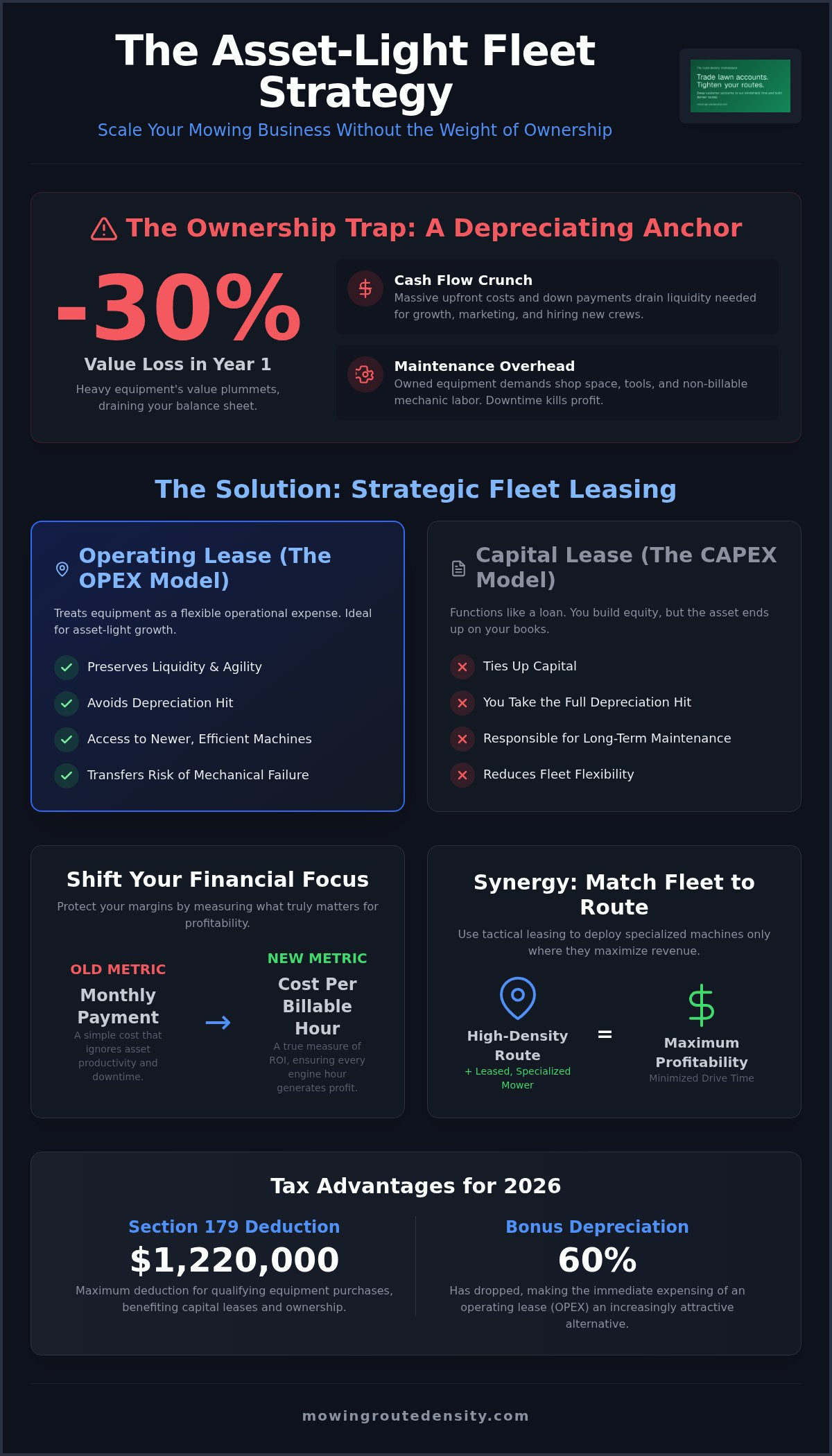
Your zero-turn mower is a depreciating anchor. It isn't a badge of honor. Heavy equipment typically loses 30% of its value in the first year. That's a hard reality for your balance sheet. Why tie up capital in a machine that's losing money while it sits in the trailer? Most contractors feel the sting of billable hours lost to mechanical downtime. You know that scaling requires liquidity, not just more iron. Deciding on a commercial mower rental vs lease is a tactical choice. It dictates how fast you can dominate a new route and drive profitability.
We agree that the old model of buying to grow is broken. It's inefficient and slow. This guide shows you how to stop bleeding cash and start using high-efficiency machinery as a flexible lever. You'll learn to align your fleet with route density to ensure every engine hour generates profit. We'll break down the 8/40/160 rule, the real costs of ownership, and how to build an asset-light business. It's time to scale your fleet without the weight of a traditional balance sheet.
Key Takeaways
- Stop sinking capital into depreciating assets that drain liquidity. Ownership is a logistical anchor that prevents you from bidding on new, profitable contracts.
- Master the choice between a commercial mower rental vs lease by matching your equipment’s most productive lifecycle to your current route requirements.
- Ensure equipment follows route density. Use tactical leasing to deploy specialized machines only where they maximize billable hours and minimize drive time.
- Transition from tracking monthly payments to measuring cost per billable hour. This shift protects your margins and leverages operational tax advantages.
- Leverage a B2B framework to identify the high-density routes necessary to justify and sustain an asset-light fleet strategy.
The Ownership Trap: Why Buying New Equipment Can Stunt Growth
Ownership is a logistical anchor. You buy a mower to build a business. Instead, you build a debt. Massive upfront costs drain the liquidity you need to bid on larger contracts. You can't scale a route if your cash is tied up in a trailer—leveraging services like Trailer Rental Near Me to manage equipment transport flexibly helps keep your balance sheet lean. Every dollar spent on a down payment is a dollar that isn't hiring a new crew or marketing to high-density neighborhoods. When contractors weigh the choice of a commercial mower rental vs lease, they often overlook the opportunity cost of tied-up capital. You aren't just buying steel; you are sacrificing agility.
The tough-love truth is simple. You are in the service and logistics business, not the equipment storage business. Owning a fleet of aging mowers doesn't make you more professional. It makes you a mechanic by default. If your goal is growth, you need assets that move, not assets that sit in a shop. Real profit comes from route density and billable hours. Everything else is just overhead in disguise.
Depreciation and the Cash Flow Crunch
Depreciation is a silent thief. Research shows that heavy equipment typically loses 20% to 30% of its value in the first year alone. If you buy new, your balance sheet bleeds before you cut the first lawn. This CAPEX-heavy approach creates a "dead zone" where the machine's resale value drops faster than its utility grows. High-hour commercial zero-turns are notoriously difficult to offload for a fair price. By adopting an equipment rental model, you avoid the sting of this rapid decline. You pay for the machine's most productive hours and walk away before the maintenance costs exceed the billable utility. This keeps your cash flow predictable and your balance sheet lean.
Maintenance Overhead: The Hidden Profit Killer
Downtime is a silent business killer. A broken belt or a hydraulic failure isn't just a repair bill. It's four hours of lost billable time for an entire crew. Owned equipment demands shop space, specialized tools, and non-billable labor. Every hour you spend turning a wrench is an hour you aren't closing new accounts. Leasing newer machines transfers the risk of catastrophic failure back to the provider. You get predictable uptime and a scalable fleet that matches your current workload. Stop being an equipment manager. Start being a strategist. Focus on tightening your routes and let the leasing structure handle the mechanical headaches.
Think about your current fleet. How many units are sitting idle because of a "minor" repair? How much are you paying for secure storage for machines you only use during peak season? These are the hidden costs that destroy margins. A tactical commercial mower rental vs lease strategy ensures you only pay for what you use. It forces you to confront the reality of your operational waste. If a machine isn't generating revenue today, it shouldn't be costing you money today.
Navigating Commercial Mower Lease Structures for 2026
Leasing isn't just a way to avoid a massive down payment. It's a strategic move to maintain operational flexibility. If you sign a lease without understanding the structure, you're just trading one anchor for another. The goal is to match the lease term to the equipment’s most productive lifecycle. Why pay for a machine for 48 months if its peak efficiency ends at 36? You need a plan that matches your cash flow, especially during seasonal dips. Stop thinking about monthly payments as a burden. Start viewing them as a subscription to uptime.
Operating Leases vs. Capital Leases
Understanding equipment financing and leasing is critical for protecting your margins. Capital leases function like a loan where the asset eventually ends up on your books. You take the depreciation hit, but you own the iron. Operating leases treat the mower as an operational expense (OPEX). You use it. You return it. You move on. Operating leases are superior for asset-light growth strategies because they prioritize liquidity over the illusion of equity in a depreciating asset. In 2026, Section 179 allows you to deduct up to $1,220,000, but bonus depreciation has dropped to 60%. These tax shifts make the OPEX model even more attractive for contractors who want to stay lean.
Fleet Leasing Programs for Scalable Operations
Scaling requires a system, not just a bunch of mowers. Fleet programs allow for staggered replacement cycles. This ensures your crew always has high-efficiency machinery without a massive, simultaneous bill. Master lease agreements simplify the process for contractors adding multiple units annually. You sign once and add units as you win new contracts. Look for walk-away clauses. These are your escape hatch. If the market shifts or a major contract ends, you don't want to be stuck with a lease for a machine that isn't moving. You can build a more resilient business by using a national B2B marketplace to align your equipment needs with actual route demand.
There is a distinct difference between renting to use and leasing to own. Short-term rentals handle seasonal peaks or emergency breakdowns. Leases provide your core capacity. When evaluating commercial mower rental vs lease options, look at your utilization threshold. If a machine won't hit 160 engine hours per month, a rental might be the smarter play. If it's a daily workhorse, a tactical lease keeps your fleet fresh. Don't ignore the 8/40/160 rule. Most lease and rental contracts are based on 8 engine hours per day, 40 per week, and 160 per month. Exceeding these limits triggers surcharges that can kill your profitability. Track your telematics. If you are consistently over-utilizing one machine, it's time to add another unit. If you are under-utilizing, your route density is the problem, not the equipment.
The Strategic Synergy: Why Leasing Must Follow Route Density
Equipment is only profitable when the blades are spinning. Drive time is the primary enemy of your lease payment. Every minute a mower spends on a trailer is a minute it isn't paying for itself. This is why route density must precede your equipment acquisition. You don't buy a mower and hope to fill a schedule. You acquire the density, then deploy the machine. Strategic leasing allows you to tailor your fleet to the specific terrain of a route. If you win a cluster of tight residential properties, you lease stand-ons. If you land a massive industrial park, you bring in the 72-inch zero-turns. You aren't stuck with a one-size-fits-all fleet that compromises your efficiency and burns fuel unnecessarily.
Stop treating your fleet like a static museum. A lease is a tactical tool. Use it to test a new market for 24 months. If the route density doesn't materialize, you walk away. You haven't sunk massive capital into a machine that now needs a home. You've simply paid for a market experiment. This is how you grow an asset-light business. You let the data, the actual route density, dictate the iron. When you evaluate a commercial mower rental vs lease, you're choosing the speed of your expansion. Leasing provides the core, while rentals provide the surge capacity.
Asset-Light Expansion in High-Density Clusters
Clustering your equipment leases minimizes fuel waste and trailer travel. It's about creating high-density pods where machines stay on-site or move minimal distances between stops. To handle the inevitable spikes of the growing season, a professional lawn equipment rental strategy acts as a flexible buffer. It supplements your core leased fleet without a long-term commitment. This Right Mower, Right Route logic ensures you maximize the marginal utility of every leased hour. You aren't paying for excess capacity in October that you only needed in May. You're tightening the operation until it's lean and lethal.
Matching Equipment Life Cycles to Contract Lengths
Risk management is about alignment. If you sign a three-year commercial mowing contract, you should be looking at a 36-month commercial mower rental vs lease structure. Aligning the lease term with the contract length ensures you aren't left with orphaned equipment if a client doesn't renew. It provides a clean exit or an upgrade path at the exact moment your revenue stream changes. It's a common-sense remedy to the financial drain of paying for a machine you no longer have a route for. If your portfolio shifts unexpectedly, route trading can help re-balance a leased fleet by moving accounts to match your existing machinery. This tactical approach turns equipment from a fixed burden into a fluid asset that responds to the market.
Evaluating Your Lease: Key ROI Metrics for Contractors
Stop obsessing over the monthly payment. It's a vanity metric. Real profit is found in the cost per billable hour. If your mower sits on the trailer during a rain delay, that "low" payment is actually a high-cost drain. You need a fleet that scales with your revenue, not against it. A tactical commercial mower rental vs lease strategy hinges on your ability to out-calculate the competition. You aren't just paying for iron. You are paying for the capacity to generate revenue without the burden of long-term debt.
Leasing offers a distinct tax advantage that ownership often lacks. When you treat a lease as an operating expense, the entire payment is typically deductible. This keeps your cash flow predictable and your balance sheet lean. It's a common-sense remedy to the financial drain of depreciation. A good lease should offer a lower Total Cost of Operation (TCO) than an aging machine that spends its Fridays in the repair shop. If you can't prove the ROI on paper, don't sign the contract.
Calculating the Total Cost of Operation (TCO)
Audit your fleet with clinical precision. Include the lease payment, insurance, fuel, and basic consumables like blades and belts. If you aren't tracking these variables, you aren't managing a business; you're managing a hobby. Compare these numbers against your lawn care profit margin optimization targets. You must identify the exact break-even hour mark for every leased unit. If a mower isn't hitting that mark, it's a liability. Most commercial zero-turn leases are built for high-utilization environments. If your route density is low, the machine is costing you more than it earns.
Lease Flexibility and Seasonal Capacity Management
Landscaping is a seasonal game. Your payments should reflect that reality. Negotiate structures that match your revenue ebbs and flows. Why pay full price in January when the grass is dormant? Some providers offer seasonal skip-payment options or reduced off-season rates. These structures protect your liquidity during the lean months. You should also evaluate buy-out options at the end of the term. Usually, equity in a high-hour commercial mower is an illusion. You are often better off walking away and starting a new lease with fresh, high-efficiency machinery. This ensures your crew stays productive and your maintenance overhead stays low.
Watch for "gotcha" clauses. Hour limits are the most common profit killer. If you exceed the standard 160-hour monthly limit, the surcharges will gut your margin. Check the return conditions. If the dealer expects a showroom-ready machine after three years of commercial use, you're in for a fight. Included service plans can mitigate this risk, but they must be factored into your TCO. Protect your bottom line by using a national B2B marketplace to find high-density routes that keep your machines productive and your ROI high.
Optimizing Your Fleet Strategy with Mowing Route Density
Mowing Route Density isn't just a name. It's a B2B framework designed to justify every piece of iron in your fleet. You don't need more mowers; you need more density. A machine is a liability until it's moving on a profitable route. We provide the platform to find the high-density clusters that turn a lease payment from a burden into a leverage point. If your route is scattered, your equipment is bleeding value. Tighten the logistics. Reduce the wear. When you evaluate a commercial mower rental vs lease strategy through our ecosystem, you are making a data-driven decision, not a guess.
Leasing is a tool. Route density is the strategy that makes that tool work. You can have the most efficient zero-turn in the industry, but if it spends forty minutes on a trailer between stops, you've already lost the margin. Trade away the outliers. Sell the low-density accounts that force your crew into non-billable windshield time. Focus on the core clusters where your leased equipment can hit its maximum utility. This is how you build an asset-light business that survives market fluctuations.
Rental and Leasing through a B2B Ecosystem
Scaling requires partners, not just more debt. Use our lawn mowing service provider locator to find reliable partners during over-capacity periods. Instead of leasing a fifth unit for a three-week peak, find a contractor who already has the capacity. This fleet-light approach keeps your overhead low and your agility high. Our marketplace also allows you to offload equipment or entire routes when your strategic focus shifts. You aren't stuck with a five-year commitment if the market changes. You have the flexibility to pivot without the weight of a traditional balance sheet.
Trading Routes to Justify Equipment Upgrades
Scattered accounts are the death of profitability. Use our lawn account trading platform to swap your outliers for a tight cluster. This isn't just about convenience. It's about math. A tight cluster allows you to justify a high-efficiency lease because the machine stays productive. Route density is the best hedge against the fixed cost of a lease payment. It ensures that every hour the engine is running, it's generating billable revenue. Stop buying mowers. Start buying margins. The choice of commercial mower rental vs lease is secondary to the density of the route those machines serve. Build the density first. The fleet will follow.
Build a Fleet That Drives Margins, Not Debt
You aren't in the business of collecting iron. You're in the business of capturing profit. Ownership is often a logistical anchor that slows your expansion and drains your cash. By mastering the tactical choice between a commercial mower rental vs lease, you keep your capital liquid and your crew productive. Focus on the total cost of operation. Ensure every engine hour is a billable hour. If a machine isn't moving, it's costing you money you don't have to lose.
Stop letting scattered routes dictate your equipment needs. Tighten your logistics first. Align your machinery with high-density clusters to maximize utility and minimize fuel waste. We built a national B2B marketplace to solve these exact inefficiencies. It's time to work smarter and cut the waste. Optimize your fleet and trade routes on Mowing Route Density. Our platform is built by landscaping logistics experts to help you scale without the weight of a traditional balance sheet. You have the strategy. Now use the tools to dominate your market.
Frequently Asked Questions
Is it better to lease or buy a commercial lawn mower in 2026?
Leasing is often superior for contractors prioritizing liquidity. Buying a new mower creates an immediate 20% to 30% hit to your balance sheet through depreciation. Leasing allows you to maintain an asset-light model and pivot quickly as your contracts change. If you have high route density and the cash to spare, buying might work. Most scaling businesses find that keeping capital free for labor and marketing drives faster growth.
What are the typical hour limits on a commercial mower lease?
Most contracts follow the 8/40/160 rule. This allows for 8 engine hours per day, 40 per week, and 160 per month. Exceeding these limits triggers steep surcharges that can gut your profit margins. When weighing a commercial mower rental vs lease, you must track your telematics closely. If your crew consistently hits these limits, it's a sign you have the density to justify adding another unit to your fleet.
Can I deduct commercial mower lease payments on my taxes?
You can typically deduct 100% of your lease payments as an operating expense. This is often simpler than managing complex depreciation schedules for owned equipment. In 2026, the Section 179 deduction limit is $1,220,000. This allows you to write off the full cost of equipment, but leasing provides more predictable monthly overhead. Always verify current tax codes with a professional to ensure your fleet strategy aligns with your specific financial situation.
What happens if a leased mower breaks down during the season?
The outcome depends on your specific agreement. Many commercial lease structures include maintenance packages that offload the risk of catastrophic failure to the provider. If you use a rental model, the provider is usually responsible for rapid replacement or on-site repair. This protects your billable hours and prevents crew downtime. Owned equipment leaves you stranded with a repair bill and lost revenue. A tactical lease ensures your blades keep spinning.
Can a new lawn care business qualify for a commercial equipment lease?
New businesses can qualify, but they often face higher scrutiny. Lenders may require a personal guarantee or a larger initial payment to offset the risk of a limited track record. For startups, short-term equipment rental is often the smarter tactical move. It allows you to build a dense route and prove your revenue model before committing to a multi-year lease. Use the rental period to stabilize your cash flow first.
What is the difference between a fair market value (FMV) lease and a $1 buy-out?
An FMV lease offers lower monthly payments and the option to return the mower at the end of the term. This is an operating lease that keeps your balance sheet lean. A $1 buy-out lease is a capital lease where you own the equipment for a nominal fee after the final payment. If you want to stay asset-light and always use high-efficiency machinery, the FMV structure is the superior choice for your business.
How does route density affect my decision to lease equipment?
Route density is the only thing that makes equipment profitable. If your accounts are scattered, a lease payment becomes a fixed burden on a machine that spends too much time on a trailer. High-density clusters ensure your mowers hit their utilization threshold and generate maximum billable hours. Before signing a lease, use a route trading platform to swap your outliers for a tight cluster. This ensures your fleet follows your revenue.
Are there seasonal lease programs for landscaping contractors?
Many providers offer flexible payment structures tailored to the landscaping industry. These programs may include reduced payments or skip-payment options during the dormant winter months. This flexibility protects your liquidity when revenue hits a seasonal low. When evaluating a commercial mower rental vs lease, ask about these seasonal adjustments. A tactical partner understands the ebbs and flows of the service industry and helps you maintain a healthy cash flow year-round.


