

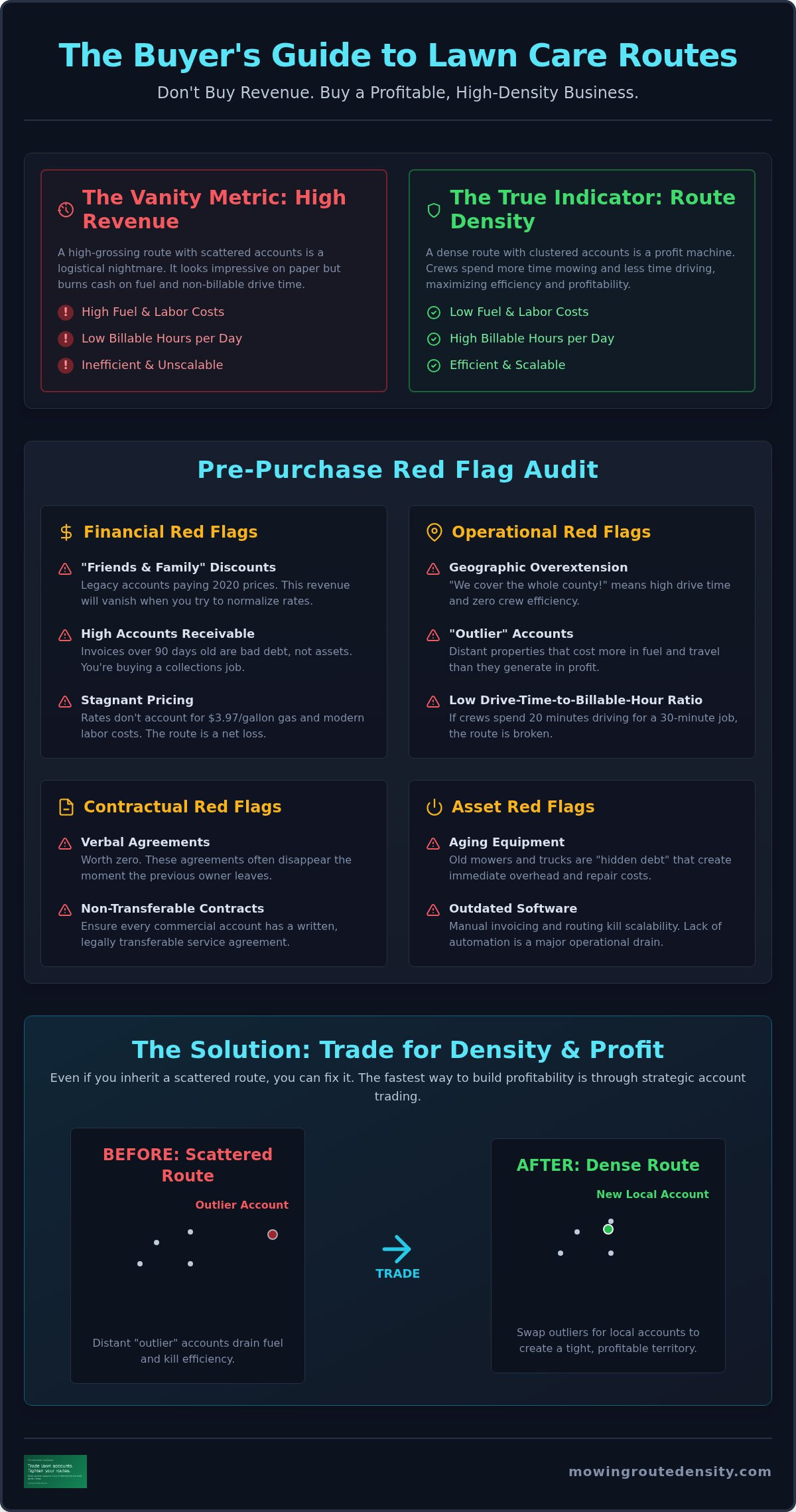
Revenue is a vanity metric. Route density is the only true indicator of a route's value. You think you're buying a gold mine. Without a tight map, you're just buying a high-speed way to burn $3.97-a-gallon gasoline. Many contractors see a million-dollar book of business and ignore the logistics. They fail to spot the red flags when buying lawn care routes until the first payroll hits and the fuel bill arrives. You want growth. You don't want a collection of scattered accounts that keep your crews behind the windshield instead of behind a mower.
It's frustrating to inherit a client list only to realize the loyal accounts are actually high-maintenance drains with one foot out the door. We've all seen a "great deal" turn into a logistical nightmare. This guide will show you how to identify hidden operational drains and financial traps before you sign on the dotted line. We will break down how to verify revenue claims, audit route efficiency to maximize billable hours per mile, and ensure a clean handoff of those critical commercial contracts. Stop buying someone else's waste. Start buying profit.
Key Takeaways
- Stop looking at gross revenue and start auditing individual account margins. High-grossing routes often hide "friends and family" discounts that will bleed your bottom line.
- Identify the red flags when buying lawn care routes by calculating the drive-time-to-billable-hour ratio. If accounts aren't clustered, you are buying a logistical nightmare, not a profitable route.
- Verify that every commercial account has a written, transferable contract. Verbal agreements are zero-value assets that often disappear the moment the previous owner leaves.
- Audit the equipment and software for hidden "debt." Aging mowers and outdated tech subscriptions create immediate overhead that can cripple a new acquisition's cash flow.
- Use account trading to fix a disorganized route post-purchase. Swapping distant outliers for local accounts is the fastest way to turn a scattered list into a dense, profitable territory.
Financial Red Flags: Auditing the Revenue Claims
Revenue is a vanity metric. Profit is the only number that pays the bills. Many contractors see a high-grossing route and assume it's a win. This is a mistake. A route bringing in $500,000 can still be a net loss if the overhead is bloated or the pricing is stagnant. You aren't just buying a list of names. You're buying the right to perform work in the landscape maintenance industry. If that work is priced below market, you're buying a liability. One of the biggest red flags when buying lawn care routes is a seller who focuses on total revenue while glossing over the net margin per stop.
Watch for the "Family and Friends" trap. Sellers often pad their route with legacy accounts. These are people they've known for years. They pay 2020 prices for 2026 labor. Once the seller is gone, the personal loyalty goes with them. These clients will expect the same deep discount from you. If you try to raise rates to a sustainable level, they'll quit. You just paid a multiple for revenue that will vanish in your first thirty days. Demand to see the pricing history for every individual account on the list.
Check the Accounts Receivable (AR) aging report. If the seller has thousands of dollars in "unpaid invoices" over 90 days old, those aren't assets. They're bad debts. You'll spend your first month chasing checks instead of managing crews. Inconsistent billing cycles are another warning sign. If the seller bills whenever they "get around to it," you're inheriting a cash flow nightmare. A scalable business runs on credit cards and automated billing, not a shoebox full of checks and promises.
The 2026 Cost-to-Serve Audit
National average gas prices hit $3.97 per gallon in June 2026. Labor rates are climbing. If the seller hasn't adjusted their pricing to account for these shifts, the route is toxic. Check for "price-locked" contracts that ignore inflation. These are anchors that will sink your profitability. Identify the percentage of accounts on autopay. Manual invoicing is a hidden labor drain that kills your scalability. If more than 20% of the route requires manual chasing, the operational cost is too high.
Verifying Revenue Stability
Profit and Loss statements can be manipulated. Bank statements are harder to fake. Cross-reference the seller's deposits with their reported income. Look for sudden spikes in revenue in the three months leading up to the sale. Sellers often "burn the grass" by taking on one-time projects or prepayments to inflate their numbers. This is one of the most common red flags when buying lawn care routes. Demand twelve months of actual payment history. If you see erratic billing patterns, expect erratic cash flow.
Operational Red Flags: The Route Density Crisis
Drive time is a silent thief. It steals your labor hours and drains your fuel tank. In the lawn care business, you only get paid when the blades are spinning. Every minute your crew spends behind the windshield is a minute of zero ROI. One of the most dangerous red flags when buying lawn care routes is geographic overextension. Sellers often brag about "covering the whole county." In reality, they're just admitting to an inefficient, scattered mess. You don't want a wide reach; you want a tight cluster.
Asset clustering is the foundation of a profitable acquisition. Can one crew hit ten houses on one street? Or are they driving ten miles between every stop? When reviewing key considerations when buying a business, logistics must top your list. A route with low density forces you to pay for non-billable travel time. With fuel prices averaging $3.97 per gallon in June 2026, those miles add up fast. If the accounts aren't close enough to share a single crew efficiently, the route is fundamentally broken. You're buying a logistical nightmare, not a business.
Calculating Marginal Utility per Stop
Analyze the map for "outlier" accounts. These are properties located far from the main cluster. They might pay well on paper, but they cost more in fuel and labor than they generate in profit. Use a lawn care route density framework to audit the seller's map. Spot the difference between a "tight" route and a "scattered" list. If a stop requires twenty minutes of driving for thirty minutes of work, it's an operational drain. You're better off cutting those clients or trading them away immediately.
Logistical Bottlenecks
Efficiency dies in the details. Check for accounts with restricted access hours. If a commercial property only allows mowing between 6:00 AM and 8:00 AM, it ruins your entire day's schedule. Identify properties that require specialized equipment your current fleet lacks. Buying a route that requires a 72-inch zero-turn when you only run 48-inch stand-ons is an immediate capital expense. Analyze traffic patterns during peak hours. A five-mile drive in the suburbs is not the same as a five-mile drive through a congested downtown corridor. If you find your crews stuck in gridlock, you're losing money every second they sit idle. You can tighten your service area by focusing only on the high-density pockets that actually return a profit.
Contractual Red Flags: Protection and Retention
Handshakes don't pay bills. If you're buying a route, you need paper. Verbal agreements are worth zero in an acquisition. One of the most glaring red flags when buying lawn care routes is a seller who claims "everyone is loyal" but has no signed contracts to prove it. Without a written agreement, you have no guarantee the customer will stay for a single service after the handoff. You're buying a wish, not an asset. If the seller can't produce a stack of signed service agreements, the valuation of the route should drop immediately.
Check the transferability clauses. Many commercial contracts are tied to the specific owner, not the business entity. If the contract doesn't allow for an "assignment" to a new owner, the client has a legal out the moment you take over. You must perform thorough due diligence when buying a business to ensure these accounts are legally yours to keep. Don't find out after the closing that your biggest commercial account is legally allowed to walk away because you didn't check the fine print.
Watch for customer concentration risk. If 50% of the route's revenue is tied to one property manager or one large HOA, you're not buying a business. You're buying a job with no safety net. If that one client leaves, your acquisition collapses. A healthy route has a diverse mix of clients where no single account represents more than 10% to 15% of total revenue. Protect yourself from the non-compete loophole, too. Ensure the sales agreement prevents the seller from starting a new "consulting" business and poaching their old clients six months later.
Evaluating Contract Longevity
Analyze the churn rate. How many clients did the seller lose last year? If they're replacing 30% of their list every season, you're buying a leaky bucket. Look for "cancel-at-any-time" clauses. A contract that doesn't require at least a 30-day notice period offers you zero protection. Understanding the lawn care business exit strategy of the seller can reveal if they're dumping the route because they know a major contract is about to expire.
The Handoff Process
A seller who refuses to introduce you to key commercial clients is hiding something. They might know the client is unhappy. They might know the client is looking for a new provider. Demand a 30-day "shadowing" period as part of the deal. Use this time to spot undisclosed "special favors." If the seller has been trimming the neighbor's hedge for free for five years to keep a client happy, you need to know before you're the one expected to do the labor.
Asset Red Flags: Equipment and Overhead Debt
Don't buy a graveyard of rusted steel. Many sellers try to bundle their "junk fleet" into the sale price to offload their mechanical problems onto you. One of the major red flags when buying lawn care routes is an equipment list that looks good on paper but is one hydraulic leak away from the scrap heap. You're buying a route to generate cash, not to spend your weekends turning wrenches. If you take over a fleet with 2,000 hours on every mower, your profit margin will vanish into repair bills and downtime. Fast.
Watch for proprietary tech debt. If the route is tied to a specific business management software with high monthly fees, you're inheriting an overhead burden you didn't ask for. Check the lease obligations too. Are you assuming high-interest loans for equipment that's already depreciated? In July 2026, SBA 7(a) loan interest rates for maturities over 7 years reached a maximum of 9.50%. Taking on expensive debt for aging assets is a fast track to insolvency. You need to know if you're buying tools or a payment plan.
Storage and logistics are often overlooked. Does the route require a local depot you don't currently have? If you're acquiring accounts thirty miles away from your headquarters, you're not just buying a route. You're buying a need for a second shop. If you don't have a place to store equipment or drop off debris near the new route, your "asset" is actually a logistical liability. You can rent commercial mowers to bridge the gap while you audit the seller's fleet and determine your actual needs.
Asset-Light Growth Strategies
Asset-Light Growth is the 2026 standard for scaling a landscaping business without drowning in capital expenditures. Instead of buying a seller's beat-up zero-turns, compare commercial lawn mower lease options against the cost of ownership. Using professional lawn equipment rental is a safer bet for new routes. It allows you to test the profitability of the accounts before committing to a long-term loan. If the route doesn't perform, you simply return the mower. No debt. No anchors.
Equipment Durability Audit
Audit the maintenance logs. Missing logs are a massive red flag. If they didn't track oil changes, they didn't care about the machines. Look for mismatched fleets. Running three different brands of mowers means you need three different sets of belts, blades, and filters. It complicates your logistics and slows down your shop. Finally, evaluate the size. A route full of gated backyards is useless if the seller only provides 60-inch decks. Ensure the tools fit the terrain before you sign the check.
The Solution: Trading for Profitability and Density
Buying a route is only the first step. Most acquisitions are messy by design. Even after you've identified the red flags when buying lawn care routes, you'll likely inherit a handful of "outlier" accounts that don't fit your core service area. Don't keep them. Use them as currency. The fastest way to fix a scattered route is the account swap. You trade your far-flung properties to a competitor who is already working that street. In return, you take their accounts that sit right next to yours. It's a win-win that turns wasted windshield time into billable hours.
Strategic consolidation requires a "cut the bottom to save the top" mentality. If the bottom 10% of your new accounts are responsible for 50% of your drive time, they are parasites. They drain the profits from your high-density clusters. Using a lawn account trading platform allows you to offload these logistical errors with surgical precision. Stop driving across town for one yard. Start owning the neighborhood. Efficiency isn't just about moving faster; it's about driving less.
When you can't trade an account, look to a lawn mowing service provider locator network. Find a reliable subcontractor who is already stationed in that remote area. You keep the contract and the client relationship while they handle the labor. This keeps your crews focused on the dense pockets where your margins are highest. In a market where fuel costs and labor rates are climbing, density is your only real defense against overhead creep.
Post-Acquisition Optimization
Audit your new map on day one. Every stop must pass a strict margin test. Use lawn care profit margin optimization techniques to cluster your work into tight zones. If an account is more than five miles from your nearest stop, it's a candidate for a trade. Don't be afraid to prune the list. A smaller, denser route is always more profitable than a large, scattered one. Use the locator tool to find partners for the stops that don't fit your new, tightened service area.
Final Checklist for Closing
Know your "Walk-Away" criteria. If the seller refuses to provide bank-verified revenue or if more than 20% of the contracts are verbal, kill the deal. These are major red flags when buying lawn care routes that lead to immediate buyer's remorse. Ensure a clean digital handoff of all client data—including gate codes, service histories, and automated payment profiles. Without this data, your transition will be a chaotic mess of missed stops and lost revenue. Real growth starts when you stop chasing accounts and start building a dense, scalable territory through the Mowing Route Density platform.
Build a Dense, Profitable Territory
Buying a route isn't just about adding names to your software. It's about securing billable hours. You've learned how to audit revenue claims and spot the operational gaps that drain cash. Don't ignore the red flags when buying lawn care routes just because the top-line number looks big. A scattered list of accounts is a logistical anchor. A tight cluster is a money machine. You want profit, not just activity.
Fixing a bad acquisition starts with aggressive consolidation. Trade your outliers. Rent your equipment to keep your balance sheet lean. Use our national contractor network to find partners for the work that doesn't fit your footprint. You don't have to settle for someone else's inefficiency. You can build a business that works for you instead of the other way around. Tighten the map and the margins will follow.
Optimize your route density today on our secure account trading platform. Leverage our B2B specialized marketplace and commercial mower rentals to scale without the weight of heavy debt. You have the tools to build a tighter, smarter business. Go get it.
Frequently Asked Questions
What is the most common red flag when buying a lawn care route?
The most common red flag is a revenue claim supported only by verbal agreements or "handshake" deals. If there are no signed service contracts, you aren't buying a business; you're buying a hope. These accounts often evaporate the moment the original owner leaves. Always demand bank-verified deposit records to match the seller's Profit and Loss statement to ensure the money is real.
How do I verify the route density of a potential acquisition?
Plot every account on a map and calculate the actual drive time between stops. You need to see the windshield time required for a crew to complete the route in real-world traffic. If the drive-time-to-billable-hour ratio is high, the route is a logistical drain. Don't trust the seller's word. Run the mileage yourself based on current 2026 traffic patterns to find the truth.
Should I buy the equipment along with the lawn care accounts?
Only buy the equipment if the maintenance logs are perfect and the machines match your current fleet. Inheriting a "junk fleet" of mismatched mowers creates a massive repair and parts inventory headache. It's often smarter to adopt an asset-light strategy. Renting commercial mowers allows you to stabilize the new route's cash flow without taking on the debt of aging, unreliable machines.
How much customer churn is normal after a route handoff?
Expect an immediate churn rate of 5% to 10% during the first 90 days of ownership. Some clients are loyal to the person, not the brand. If the churn rate exceeds 15%, it's one of the major red flags when buying lawn care routes that signals poor service or under-priced contracts. Prepare your cash flow for this dip. Never assume 100% of the list will stay.
Is it better to buy commercial or residential lawn care routes?
Commercial routes offer higher stability and larger margins per stop but require more legal protection. They are better for scaling if you have the right equipment. Residential routes offer better diversification but suffer from lower density and higher administrative overhead per dollar earned. Choose the route type that matches your current operational strengths and your existing crew's equipment setup.
What legal documents do I need to buy a mowing route safely?
You must secure a formal Asset Purchase Agreement, a Bill of Sale, and a strictly defined Non-Compete Agreement. Ensure the contracts include a "Right of Assignment" so you can legally take over existing service agreements. Without these documents, you have no protection. The seller could easily start a new business and poach your new clients the following week using their old contact list.
Can I trade accounts I just bought if they don’t fit my density?
Yes. Trading distant "outlier" accounts is the fastest way to fix a messy acquisition and optimize your margins. Use a secure account trading platform to swap your far-flung stops for accounts that sit closer to your existing clusters. This immediately lowers your fuel consumption. It increases the billable hours your crews can generate in a single day without adding more labor.
How do I calculate the true value of a lawn care contract in 2026?
Subtract the 2026 cost-to-serve from the gross contract price. You must factor in June 2026 fuel prices of $3.97 per gallon and current labor rates. A contract is only valuable if it produces a net profit after all logistical expenses are paid. If the margins are thin, the contract is a liability. It's worth nothing to your business regardless of the gross revenue.


