

Windshield time is a silent tax on your profit margin that you never agreed to pay. Every mile driven between scattered clients is fuel burned and labor wasted on a non-billable activity. You know the frustration of maintaining a route that looks like a shotgun blast across the map. It's inefficient. It's exhausting. Most importantly, it's expensive. If you want to stop hemorrhaging cash on logistics, it's time to sell lawn mowing accounts that no longer fit your operational footprint.
You've built a list of recurring contracts, but not every contract deserves a spot on your trailer. We agree that a scattered route is a failing route. This guide will teach you how to turn those outliers into immediate capital by positioning them for maximum market value. Whether you're looking to fund commercial mower rentals for a tighter route or planning a clean exit from the industry, we provide the roadmap. We break down 2026 valuation multiples, such as the 1.5x to 2.5x SDE standard for smaller portfolios, and the tactical steps required to achieve a maximum payout for your existing contracts.
Key Takeaways
- Stop subsidizing "windshield time" by identifying outlier accounts that drain fuel and labor. Turn logistical dead weight into immediate capital.
- Learn to sell lawn mowing accounts using 2026 valuation metrics that prioritize recurring revenue over one-time service calls.
- Master tactical account swapping to trade your distant clients for those that increase your local route density.
- Clean your payment data and route sheets to prove a 95% collection rate, ensuring you receive the maximum market payout.
- Access a specialized B2B marketplace to connect with vetted professionals ready to pay for high-density contracts.
Turning Dead Weight into Capital: Why You Should Sell Lawn Mowing Accounts
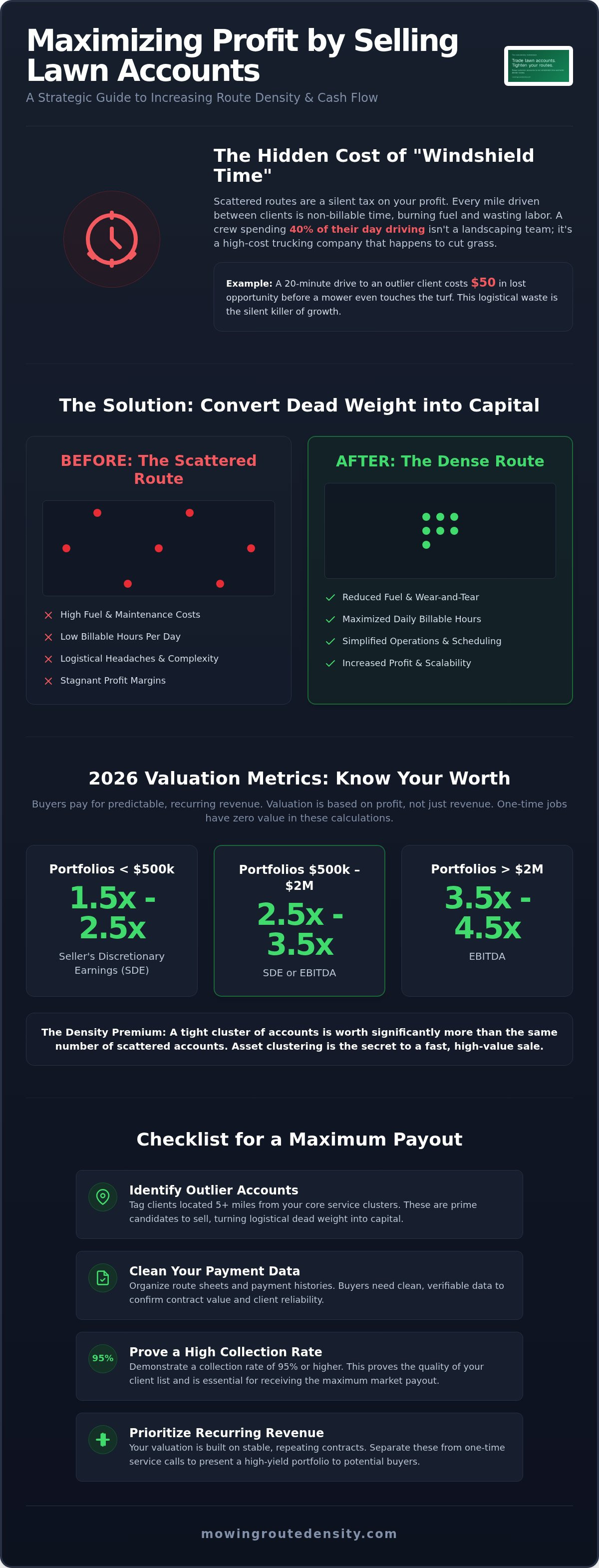
Revenue is a vanity metric. Profit is reality. Many contractors focus on the total number of houses on their route sheets, but they ignore the logistical rot underneath. If your team spends 40% of their day behind a steering wheel, you aren't running a landscaping business. You're running a high-cost trucking company that happens to cut grass. Choosing to sell lawn mowing accounts that sit outside your core service area is a tactical move for lawn care profit margin optimization. It's about tightening the circle.
The Hidden Cost of Scattered Routes
Every mile between stops is a drain on your bottom line. In 2026, fuel prices and labor costs make "windshield time" more expensive than ever. If a crew earns $150 per billable hour but spends 20 minutes driving to a single outlier property, that stop just cost you $50 in lost opportunity before the mower even hits the turf. This is logistical waste. It's the silent killer of growth. You're paying for fuel, wear and tear, and wages while the equipment sits idle in the trailer.
To fix this, you must identify your "outliers." These are the clients located five miles or more from your next closest stop. They might pay on time, but they ruin your daily billable hour targets. By deciding to sell lawn mowing accounts that don't fit your density map, you stop subsidizing these distant stops with the profits from your core cluster. You're not just losing a client; you're gaining back hours of productive labor. It's a trade of low-margin complexity for high-margin simplicity.
Liquidity Over Logistics: The Seller's Advantage
Cash provides options that a scattered route cannot. When you offload inefficient contracts, you convert a logistical liability into immediate capital. This liquidity is a strategic tool. You can use the proceeds to fund a commercial lawn mower lease for high-efficiency equipment that services your dense routes faster. Cash in hand allows for agility. A low-margin contract 20 miles away doesn't.
Understanding the Valuation Metrics of your accounts is the first step toward this transition. An outlier account is worth more to a competitor who already has three houses on that same street. To you, it's a headache. To them, it's a high-margin addition. Selling allows you to capitalize on that discrepancy. It creates a leaner, more manageable operation that is easier to scale. Stop chasing every lead. Start owning every street.
Valuation Metrics: Determining the Market Price of Your Service Contracts
Stop relying on "street smart" rules of thumb. If you want to sell lawn mowing accounts, you need a valuation model that stands up to professional scrutiny. Old-school logic says an account is worth four weeks of revenue. That's lazy. It's also wrong. In the current 2026 market, buyers look at the quality of the contract and the physical proximity of the stops. They want predictable profit, not just a list of names. High-quality accounts are assets; everything else is just a liability on your schedule.
Revenue Multipliers and Profit Margins
Buyers pay for the certainty of recurring revenue. One-time service calls have zero value in these calculations because they don't provide a predictable return on investment. High-margin contracts with established longevity command the highest premiums. Engaging in Strategic Pruning allows you to strip away the low-performing outliers and present a high-yield portfolio to the market. According to 2026 industry data, current valuation ranges include:
- Portfolios under $500,000: 1.5x to 2.5x Seller's Discretionary Earnings (SDE).
- Portfolios $500,000 – $2 million: 2.5x to 3.5x SDE or EBITDA.
- Portfolios over $2 million: 3.5x to 4.5x EBITDA, depending on contract longevity.
The Density Premium: Why Clustered Accounts Sell Faster
Asset clustering is the secret to a fast sale. A buyer doesn't just want clients; they want a route that minimizes fuel consumption and maximizes billable hours. This is why a tight cluster of accounts on a single block is worth significantly more than the same number of accounts scattered across three zip codes. Route Density is the primary value driver for 2026 landscaping acquisitions. When you sell lawn mowing accounts as a geographic cluster, you create a turnkey profit center. This attracts aggressive bids from contractors who want to dominate specific neighborhoods without the overhead of organic marketing.
If you're selling equipment as part of the package, be clinical. Provide maintenance logs. Prove the service history. A well-maintained fleet adds tangible value to the deal, but only if the data backs it up. Unverified equipment is just more dead weight for the buyer to manage. If you're ready to see what your cluster is worth, you can list your portfolio on a specialized account trading platform to find vetted buyers.
Strategic Pruning: Selling Individual Accounts vs. Business Exit
Selling accounts is often mislabeled as a sign of a struggling business. That's a mistake. In reality, the decision to sell lawn mowing accounts is a sign of operational maturity. You must distinguish between a haircut and a decapitation. Pruning is a tactical move to shed low-margin weight and tighten your service circle. An exit is a total liquidation of your brand and assets. Both require a clear head and a clinical approach to the numbers. If you aren't actively managing the shape of your route, the route is managing you.
Tactical Account Swapping for Route Density
You don't always have to lose revenue to gain efficiency. Tactical account swapping allows you to trade your "outlier" clients for someone else's "neighbors." By using a specialized lawn account trading platform, you can identify partners who are already servicing the streets where your distant clients live. The mechanics of a "swap and pay" transaction are simple. You trade accounts of similar value and settle the difference in cash. This reduces fuel overhead and labor waste immediately. You maintain your top-line revenue while significantly increasing your net profit. It's the fastest way to achieve density without spending a dollar on marketing.
Preparing for a Full Business Liquidation
If your goal isn't just optimization but a total departure, you need a lawn care business exit strategy. A full liquidation is about selling a brand and a system, not just a list of names. Buyers in 2026 want to see documented service histories, clean financial records, and a capable team that stays after the owner leaves. Deal structures usually fall into two categories:
- All-Cash Closings: The buyer pays the full amount upfront. These typically command a lower overall multiple but offer the cleanest break.
- Earn-Outs: You receive a portion of the price at closing, with the rest paid out over 12 to 24 months based on client retention. This aligns the seller's interests with the buyer's success.
Regardless of the structure, expect a non-compete agreement. No serious buyer will pay for your list if you can start a new company and poach those same clients six months later. When you decide to sell lawn mowing accounts as a total exit, you are selling the future cash flow of the business. Prove the cash flow is stable, and the buyers will compete for the deal.
Preparing Your Book of Business for the Marketplace
A messy business doesn't sell. If your route sheets are scribbled in a notebook or trapped in your head, you aren't ready to sell lawn mowing accounts. Professional buyers don't pay for "potential" or "handshake deals." They buy proof. They buy systems. They buy predictable cash flow. If you can't prove your revenue with a few clicks, it doesn't exist in the eyes of a serious acquirer. Clean data is the difference between a high-multiple payout and a low-ball offer. You must present your business as a turnkey asset, not a logistical puzzle for the buyer to solve.
Data Integrity: Route Sheets and Payment History
Digital records are the price of entry in 2026. Paper is a liability that suggests poor management and unreliable data. Organize your client list by geographical proximity. This makes the route density you've built obvious at a glance. Proving a 95% or higher collection rate is the industry gold standard. It shows the buyer that your clients are vetted, reliable, and accustomed to professional billing cycles. During the initial due diligence phase, redact sensitive information. Hide house numbers and full names until you have a signed Letter of Intent. Protect your assets until the deal is real.
Vetting the Buyer: Protecting Your Brand Reputation
Your reputation is a tangible asset. Don't sell to an amateur who will abandon your clients or provide sub-par service. Use the lawn mowing service provider locator to research a buyer's history. Check their professional standing and service record. Do they have the logistical capacity to handle your volume? Ensure they have access to professional lawn equipment rental to cover peak season surges or unexpected equipment failures. A buyer without a plan for scaling is a risk to your legacy and any potential earn-out payments.
Detailed documentation must extend to your hardware. If mowers are included in the sale, provide clinical maintenance logs. Show every oil change. Document every blade sharpening. A buyer wants to know the equipment won't die in the middle of the first week of service. Finally, set a firm timeline for the transition period. A two-week handoff is standard. Introduce the new owner to key accounts. Transfer the digital files. Then, exit the route with your capital intact.
List your accounts on a secure B2B marketplace to find vetted buyers now.
Navigating the Trade: Leveraging the Mowing Route Density Platform
Generic platforms are a waste of billable hours. Posting on Craigslist or Facebook groups invites tire-kickers and low-ballers who don't understand logistical value. If you want to sell lawn mowing accounts efficiently, you need a specialized B2B marketplace. The Mowing Route Density platform filters for serious landscaping professionals. It connects sellers with buyers who value route density over raw client numbers. This isn't about finding someone with a truck. It's about finding a strategist with a growth plan. We provide the B2B framework that ensures the transaction is clean, documented, and secure.
Professional buyers often face a hurdle: scaling their fleet to meet the new demand of a purchased route. Our platform solves this by offering integrated rental solutions. A buyer can secure your accounts and immediately access commercial mower rentals to service them. This eliminates the delay of purchasing new hardware. It makes your list more attractive and liquid. When the buyer has a clear path to execution, your payout happens faster. Stop managing the waste of unvetted inquiries. Use a system built for the industry.
Listing Your Accounts for Maximum Exposure
A punchy, data-driven listing is your best sales tool. Don't write a narrative. Provide the numbers. Highlight the geographical cluster and the average drive time between stops. Mention equipment compatibility; if your route is optimized for 60-inch zero-turns, say so. Set a realistic "Buy It Now" price based on the 2026 multipliers discussed earlier. A fair price based on current SDE standards attracts serious offers faster than an inflated number based on sentiment. Clarity sells. Data closes the deal.
From Listing to Close: The Transaction Process
Manage inquiries with clinical precision once the listing is live. Schedule due diligence sessions where the buyer can review your redacted digital records. The handoff should be a structured process, not a chaotic transition. Transfer the route data. Provide the client introductions. Then, step away. The goal is a clean break. Use the proceeds to re-invest in your core territory. Whether you are funding a new lease or acquiring a "neighbor" account, the capital from your sale should drive your next phase of route density optimization. Stop managing the waste. Start trading for profit.
Stop Subsidizing the Miles and Start Scaling the Margin
Operational waste is a choice. You can keep paying for fuel and non-billable labor; or you can tighten your service circle for maximum efficiency. Route density isn't a luxury. It's the only way to survive the 2026 market. We've shown you that outlier accounts are liabilities that drain your most profitable stops. By choosing to sell lawn mowing accounts that don't fit your map, you unlock immediate capital and reclaim wasted hours. You aren't losing revenue. You're shedding dead weight.
Clean data and professional vetting are your best tools for a high-value exit or a tactical swap. Don't leave your payout to chance on generic listing sites. You need a secure account trading platform that understands the logistics of landscaping. Our specialized route density focus ensures you connect with a professional B2B contractor network ready to pay for quality clusters. It's time to stop chasing every lead and start owning every street. List your accounts on the Mowing Route Density marketplace today and build the lean, profitable operation you deserve.
Frequently Asked Questions
How much is a single lawn mowing account worth in 2026?
Valuation depends on whether the account is part of a dense cluster or a logistical outlier. While small portfolios typically trade at 1.5x to 2.5x Seller's Discretionary Earnings, a single isolated account might only fetch four to six weeks of gross revenue. Buyers prioritize recurring revenue over one-time jobs. If you want to sell lawn mowing accounts for a premium, you must prove the stop is profitable after accounting for drive time and fuel.
Is it better to sell individual accounts or a whole route?
It depends on your end goal: optimization or exit. Selling individual accounts is a strategic move to prune your route and eliminate "windshield time" that eats your profit margin. Selling a whole route is a liquidation move. Most successful contractors use individual sales to trade for better density. This keeps the top-line revenue stable while significantly cutting overhead costs like fuel and equipment wear. Optimization is usually the smarter long-term play.
Do I need a broker to sell my lawn care client list?
You don't need a broker for most small to mid-sized transactions. Brokers often charge high commission fees that eat into your liquidity. Using a specialized B2B marketplace allows you to connect directly with serious landscaping professionals who understand the value of route density. This direct approach is faster and keeps more capital in your pocket. Just ensure your digital records are clean and your valuation is based on current market data.
What happens to the service contract when I sell an account?
The service contract is typically assigned to the new owner through an "assignment" clause. This allows the buyer to step into your shoes without the client needing to sign a new agreement immediately. If your contracts don't have this clause, you may need client consent before the close. Professional buyers will insist on seeing these documents during due diligence to ensure the recurring revenue is legally protected after the handoff is complete.
How do I notify my clients that their account has been sold?
Send a formal transition letter at least two weeks before the first service date under the new owner. Be direct and professional. Highlight the buyer's experience and emphasize that service schedules will remain consistent. Don't apologize for the change. Instead, frame it as a strategic partnership that ensures the client receives long-term, high-quality care. A smooth handoff protects your reputation and ensures the buyer achieves the retention rates required for the deal; providing a small token of appreciation, such as handcrafted soy candles, can go a long way in ensuring that transition is met with positivity.
You can sell verbal agreements, but you'll take a significant hit on the price. Buyers pay for predictability. Without a written contract, there's no guarantee the client won't cancel the moment you leave. If you plan to sell lawn mowing accounts, it's worth the effort to move "handshake" clients onto basic service agreements first. This small administrative step can increase the account's market value by providing the buyer with documented revenue security.
How long does it typically take to sell a lawn care route?
A typical sale takes between 30 and 90 days from the initial listing to the final handoff. The timeline depends heavily on the integrity of your data. If your route sheets, payment histories, and maintenance logs are organized digitally, you can close much faster. Messy records lead to extended due diligence periods and often cause buyers to walk away. Clean up your books before you list to ensure a rapid, professional transaction.
Should I include my equipment in the sale of my mowing accounts?
Only include equipment if it adds strategic value to the route. If a buyer is just starting out, a turnkey package with a mower and trailer is attractive. However, established contractors usually have their own fleets and don't want your old hardware. In those cases, sell the accounts separately to a high-density buyer and liquidate the equipment on the secondary market. If you are also looking to clear out smaller items or find deals in the neighborhoods you service, check out Thrifty Yard to discover or list local yard sales. This approach often results in a higher total payout for your business assets.


