
The biggest route on the market is often the worst investment you can make. A sprawling list of accounts across three counties looks impressive on a spreadsheet. In reality, it is a logistical drain that bleeds profit through windshield time and fuel waste. When you are valuing a lawn care route for purchase, do not get blinded by top-line revenue. You aren't just buying a list of names; you're buying a schedule. If that schedule is a mess of "ghost" accounts and hour-long drives between stops, you are buying a liability. High revenue means nothing if your billable hours are lost on the highway.
You already know that growth requires more than just adding mowers to the fleet. It requires surgical precision. We will show you how to look past vanity metrics to find the true market value of a route by prioritizing density and recurring revenue. This guide provides a clear valuation formula for the 2026 market, a due diligence checklist to verify account quality, and a strategy to integrate these new stops into your existing operations. Stop paying for sloppy routes. Start building a dense, profitable footprint that actually sticks.
Key Takeaways
- Master the 2026 math for valuing a lawn care route for purchase by using revenue multiples for residential stops and EBITDA for larger commercial contracts.
- Prioritize route density to eliminate wasted windshield time and ensure your new accounts generate bottom-line profit rather than just vanity revenue.
- Execute a strict due diligence audit to flush out "ghost" accounts and verify that the seller's financial records accurately reflect recurring work.
- Implement a "buy and swap" strategy to keep the most profitable stops while trading away distant accounts to tighten your operational footprint.
- Scale your new route's capacity without massive upfront capital by leveraging commercial mower rentals for immediate field production.
The Fundamentals of Lawn Care Route Valuation
Valuing a lawn care route for purchase is not the same as buying a full-scale landscaping company. You aren't paying for a brand, a website, or a manager's salary. You are paying for the right to service a specific list of recurring accounts. It's a raw asset purchase. In the Landscape maintenance industry, your success depends on the quality of the contract, not the size of the logo on the truck. If you confuse a "route" with a "business," you'll overpay for overhead you don't need.
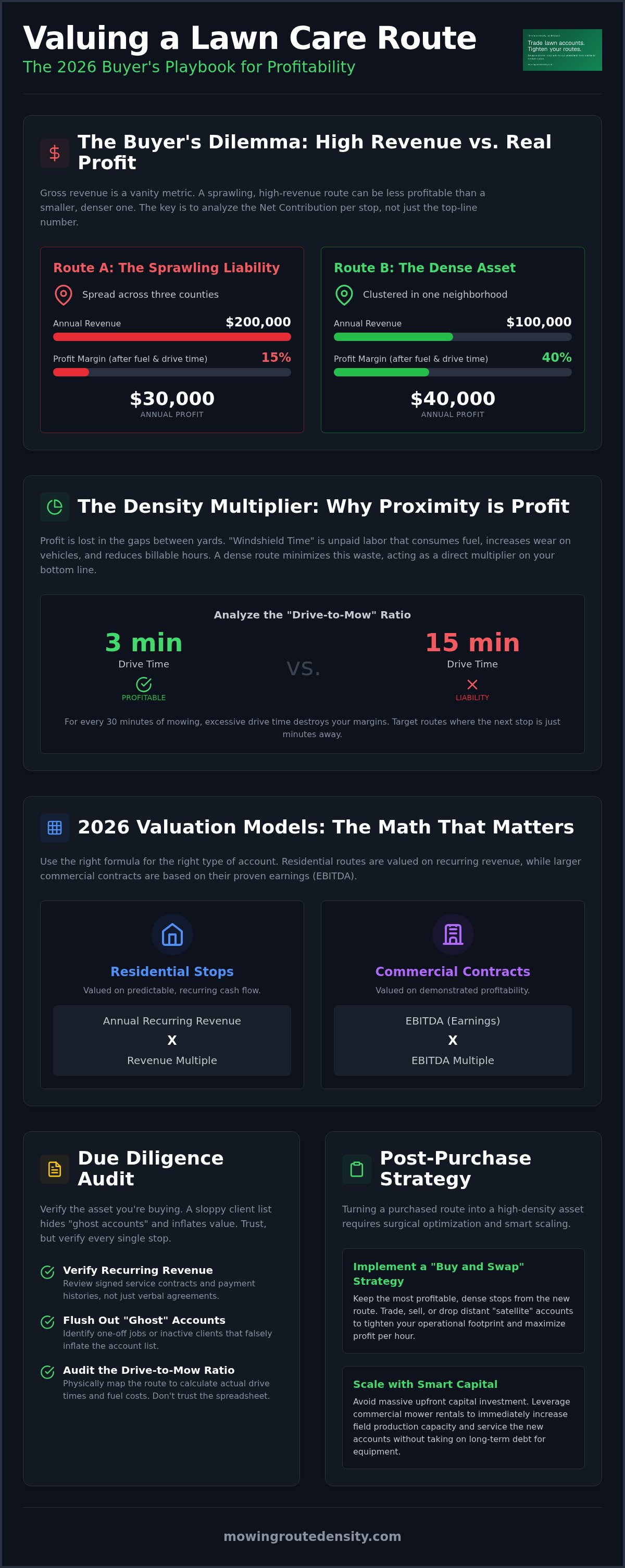
Gross revenue is a vanity metric. It tells you how much money passes through the bank account, but it doesn't tell you how much stays there. A route generating $200,000 in revenue might be worthless if the stops are forty minutes apart. In 2026, the industry has shifted toward "Net Contribution" per stop. This measures the actual dollars left over after labor, fuel, and materials are stripped away. High revenue without density is just a fast way to go broke.
Revenue vs. Profitability: The Buyer’s Lens
Margins matter more than volume. Consider two options. Route A generates $100,000 with 20% margins. Route B generates $60,000 with 40% margins. Route B is the superior investment. It requires less labor, less fuel, and less equipment wear to produce more profit. When you analyze a route, look at the drive time between stops. Windshield time is unpaid labor. If the seller relies on verbal agreements instead of signed service contracts, the value drops. Verbal promises don't survive an ownership change. You need paper to prove the money is real. Much like how scouts rely on hard data to evaluate talent—for example, you can visit K-MiLB to track the daily performance of Korean minor leaguers—you need objective evidence to verify the value of your investment.
Asset-Based vs. Income-Based Approaches
Some sellers try to bundle aging equipment into the deal. Be careful. Old mowers are often liabilities that require immediate maintenance capital. An income-based approach is safer. You're buying the cash flow. This leads to the concept of "Blue Sky" value. Blue Sky value is the premium paid for the certainty of future recurring revenue. You pay this premium because the accounts are already won, scheduled, and profitable. If the list is sloppy, the Blue Sky evaporates. Treat equipment as a separate line item or ignore it entirely to focus on the numbers that actually hit your pocket. Focus on the income, not the iron.
The Density Multiplier: Why Proximity Trumps Volume
Profit isn't found on the mower. It is found in the gaps between the yards. When you are valuing a lawn care route for purchase, the physical distance between stops is your most critical variable. Windshield time is a silent killer. It consumes fuel. It wastes labor. It puts unnecessary wear on your fleet. A route with $50,000 in revenue clustered in one neighborhood is exponentially more valuable than a $100,000 route spread across a city. Density is the only way to protect your margins against rising overhead. Stop buying miles. Start buying minutes.
A tight cluster allows for a higher valuation multiple. Efficiency creates predictable cash flow. While standard SBA business valuation methods provide a framework for income and assets, they often overlook the logistical reality of the field. A sprawling route forces you to pay for non-billable hours. A dense route ensures your crews spend their time producing revenue. High lawn care route density acts as a profit multiplier because it lowers the cost of every single stop on the schedule. If you can't hit the next stop in three minutes, you're losing money.
Calculating the Cost of Windshield Time
Audit the "Drive-to-Mow" ratio before you sign anything. If a crew spends 15 minutes driving for every 30 minutes of mowing, your ROI is already in trouble. Labor is your highest expense. In 2026, labor costs typically range from 25% to 40% of revenue. If your crews are sitting in traffic, that percentage climbs. You are paying for their time, but the customer isn't. Identify "satellite" accounts immediately. These are the outliers that sit ten miles away from the main cluster. They are liabilities. Discount these accounts or exclude them from the sale entirely. You don't want to buy a headache that eats your fuel budget.
Asset Clustering: The Goal of Every Acquisition
The best route to buy is the one you are already driving past. Synergy value is real. If a new route sits directly on your existing path, it is worth more to you than to a competitor. You are adding revenue without adding significant travel time. This is the fastest way to increase your bottom line. After the sale, focus on improving landscaping route efficiency by pruning the outliers. If a stop doesn't fit your map, it doesn't belong on your trailer. Acquiring a route should be a surgical strike. You want to fill the holes in your existing schedule. If you find yourself buying a sloppy route, you can optimize your footprint by offloading the stops that don't fit your core clusters.
Due Diligence: Auditing the Client List for "Ghost" Accounts
Never trust a seller's spreadsheet at face value. It is a marketing document, not a financial reality. When you are valuing a lawn care route for purchase, your biggest risk is the "ghost account." These are customers who stay out of habit but vanish the moment a new face shows up. If you pay for these accounts, you are throwing cash into a shredder. You need to verify that the revenue is stable, recurring, and actually profitable before the check clears. Bank statements don't lie. Spreadsheets do.
Look at the churn rate. If the seller loses 30% of their list every season, you are buying a leaky bucket. Average account age is a better indicator of value. A five-year customer is a solid asset; a five-month customer is a gamble. Review their payment history carefully. Avoid "slow-pay" clients who treat contractors like an interest-free loan. These accounts cost more in administrative labor than they are worth in billable hours. Accurate due diligence is the only way to protect your capital when valuing a lawn care route for purchase.
The 3-Step Account Verification Process
Contract Quality and Renewal Terms
Residential work is often based on verbal handshakes. Commercial accounts are built on signed contracts. Because of this stability, commercial contracts with multi-year terms often command a 20% to 30% premium. They provide the predictability that lenders love. Watch out for hidden costs like "free" leaf cleanups or hedge trimming that the seller did as a favor. If you have to start charging for these services, expect a wave of cancellations. Audit the pricing now. If the rates haven't moved in years, you'll need to hike them immediately. Factor that risk into your offer. If the route is a mess of outliers, use a lawn account trading platform to offload the junk and keep only the high-quality stops.
Valuation Models: 2026 Multiples and Math
Valuing a lawn care route for purchase in 2026 demands a clinical eye for the bottom line. You aren't just buying a list of names. You're buying a cash flow engine. If that engine is inefficient, the price must reflect the fuel it wastes. For small residential routes, the industry standard remains a multiple of monthly gross revenue. It's a blunt instrument, but it works when the seller's books are thin. For larger, commercial-focused operations, you must use an EBITDA multiple. This forces the seller to account for labor, which typically eats 25% to 40% of revenue in today's market.
2026 Route Valuation Multiples:
- Low Density (Scattered): 4x Monthly Gross revenue or 2.0x Annual EBITDA.
- High Density (Clustered): 8x Monthly Gross revenue or 4.0x Annual EBITDA.
- 60%+ Recurring Revenue: These routes often command 1 to 2 turns higher on the EBITDA multiple.
Hyper-local route swaps often use a "Per Stop" valuation. This is common when two contractors trade accounts to tighten their territories. In these cases, you aren't looking at the whole business. You're looking at the net contribution of a single stop. If a stop generates $60 in revenue but costs $45 in labor and fuel to service, its value is minimal. If that same stop is next door to your existing client, its value triples. Efficiency is the only metric that doesn't lie.
The Standard Multiples for 2026
Residential routes trade between 4x and 8x monthly gross revenue. Why the wide range? Density. A route where you hit ten houses on one cul-de-sac is worth the 8x premium. A route that requires a five-mile drive between every stop is a 4x asset at best. Commercial routes are different. They trade on a 2.5x to 4x multiple of annual EBITDA. Buyers are hunting for stability. Auto-pay adoption and modern routing software also push these multiples toward the higher end. If the route is 100% recurring maintenance, it's worth the top-tier price.
Adjusting for Equipment and Overhead
Separate the "Iron" from the "Paper." Mowers, trucks, and trailers are depreciating assets. Contracts are the actual income generators. Value the equipment at its current liquid market rate, not its replacement cost. If the seller’s fleet is junk, don't pay a premium for it. You can bridge those equipment gaps using commercial lawn mower lease options to keep your capital light. Know your "Walk-Away" price. If a seller wants an 8x multiple for a scattered route with 15% margins, they are dreaming. Don't subsidize their inefficiency.
If you find a route with great accounts but terrible density, buy it anyway. You can use our lawn account trading platform to swap those distant stops for accounts that sit right in your target cluster.
Optimization: Turning a Purchased Route into a High-Density Asset
Buying a route is the beginning of the work, not the end. Most sellers offload their routes because they've let them become sloppy and unmanageable. When you are valuing a lawn care route for purchase, you must view it as raw material. You aren't just keeping every stop. You are keeping the ones that fit and trading the ones that don't. This "Buy and Swap" strategy allows you to acquire a large block of business and immediately refine it for maximum density. If a stop doesn't contribute to a tight cluster, it is a drain on your resources.
Use a lawn account trading platform to offload distant accounts to contractors who are already in those neighborhoods. It's a win-win. You shed the travel time. They gain a stop on their existing path. Integrating the remaining high-density accounts into your scheduling software ensures that every billable hour is spent on a mower, not behind a steering wheel. For those stubborn "satellite" accounts that you can't trade yet, use a lawn mowing service provider locator to find reliable partners to cover the work while you focus on your core zones.
The Post-Acquisition "Route Trim"
The Pareto Principle applies to landscaping. Usually, 20% of your accounts cause 80% of your logistical headaches. These are the outliers. They are the stops ten miles away from the cluster. They are the ones that require a different trailer setup. Identify them. Cut them. Swapping one distant account for a closer one can save over $1,500 in annual fuel and labor costs. By trading these outliers, you tighten your footprint and increase the net contribution per stop. Your goal is a map that looks like a series of tight dots, not a spiderweb of long lines.
Scaling with Asset-Light Strategies
A sudden acquisition can strain your fleet. Don't rush out to buy new mowers with high-interest debt. Scaling an operation after valuing a lawn care route for purchase requires a lean approach. Use professional lawn equipment rental to handle the temporary surge in work while you stabilize the route. This keeps your capital liquid. If the route is too large for your current crew to absorb immediately, you need to know how to find lawn care subcontractors to bridge the gap. This allows you to maintain service quality without the long-term overhead of new hires before the route is optimized. Finalize the handoff by personally visiting the top 10% of the new accounts. Ensure the relationship transfers to your brand. A dense route is a profitable route, but only if the customers stay on the schedule.
Building a Lean, High-Density Portfolio
Purchasing a route is a tactical move to tighten your map, not just a way to inflate your top line. You've learned that density is the only metric that guarantees profitability in the 2026 market. Sprawl is a liability that costs you in fuel and wasted labor. When you are valuing a lawn care route for purchase, you must remain unsentimental about the numbers. Audit the list for "ghost" accounts. Use the EBITDA multiples that reflect real-world overhead. If the accounts don't fit your core clusters, they are just distractions that eat your margins.
The smartest contractors buy for the assets and then trim the fat. You don't have to settle for a sloppy schedule. Our B2B operational focus helps you turn a scattered acquisition into a surgical strike. You can optimize your route density by trading accounts on our secure marketplace today. Leveraging our national contractor network allows you to swap your distant outliers for stops that sit right on your existing path. Stop letting windshield time bleed your business dry. Take control of your territory and build a route that actually works for you.
Frequently Asked Questions
How much is a lawn care route worth per customer?
A route is never valued per customer; it is valued by the revenue and density those accounts provide. A single $85 cut next to your existing route is worth more than five $55 cuts twenty miles away. Focus on the total monthly recurring revenue and the time it takes to earn it. Use a monthly gross revenue multiple to find a starting point for the offer.
What is the standard multiple for buying a lawn care business in 2026?
As of August 2026, residential lawn care routes typically trade at 3x Seller's Discretionary Earnings (SDE). Larger operations with heavy commercial contracts sell for 2.5x to 5x EBITDA. If the route has over 60% recurring revenue, expect to pay a premium. Clean financials and high route density can push these multiples toward the higher end of the 2026 market range.
Should I pay for the equipment or just the client list?
Pay for the client list first. Equipment is a depreciating asset that often carries hidden maintenance costs. Value the "Iron" at its current liquid market rate, not the original purchase price. If the fleet is aging, it is often a liability rather than an asset. You can use commercial mower rentals to scale your new route without taking on the seller's old equipment headaches.
How do I prevent customers from leaving after I buy a route?
Retention starts with a seamless transition. Have the seller send a joint introduction letter before you release the final payment. Maintain the same service day and quality standards immediately. Customers leave when they feel ignored or when the price jumps without warning. If you plan to raise rates, wait until you've proven your reliability for at least 60 days.
What is a "due diligence" period when buying mowing accounts?
This is a set window, usually 14 to 30 days, where you verify every claim the seller made. You must review 12 to 24 months of bank statements and merchant processing records. Conduct ride-alongs to check property sizes and terrain difficulty. This is your only chance to flush out "ghost" accounts before you're legally committed to valuing a lawn care route for purchase.
Is it better to buy a route or grow organically through marketing?
Buying a route is faster but carries more financial risk. Organic growth allows you to hand-pick customers for maximum density from day one. However, buying a route gives you immediate cash flow and a territory footprint. The best strategy is often to buy for volume and then trade away the outliers to tighten your map and maximize your billable hours.
What happens if the seller starts a new business and steals the customers back?
You prevent this with a strictly enforced non-compete agreement. The contract must bar the seller from operating a lawn care business within a specific radius for at least three to five years. If they violate it, you have legal recourse for damages. Never close a deal without a signed non-compete. It is the only thing protecting your capital from a "backdoor" competitor.
How does route density affect the final purchase price?
Density is the primary driver of the valuation multiple. A route with high density reduces windshield time and fuel costs, protecting your 10% to 15% net profit margins. When you are valuing a lawn care route for purchase, a clustered list earns a higher multiple of monthly gross revenue. A scattered route fetches a lower price because the labor waste destroys your ROI.


