

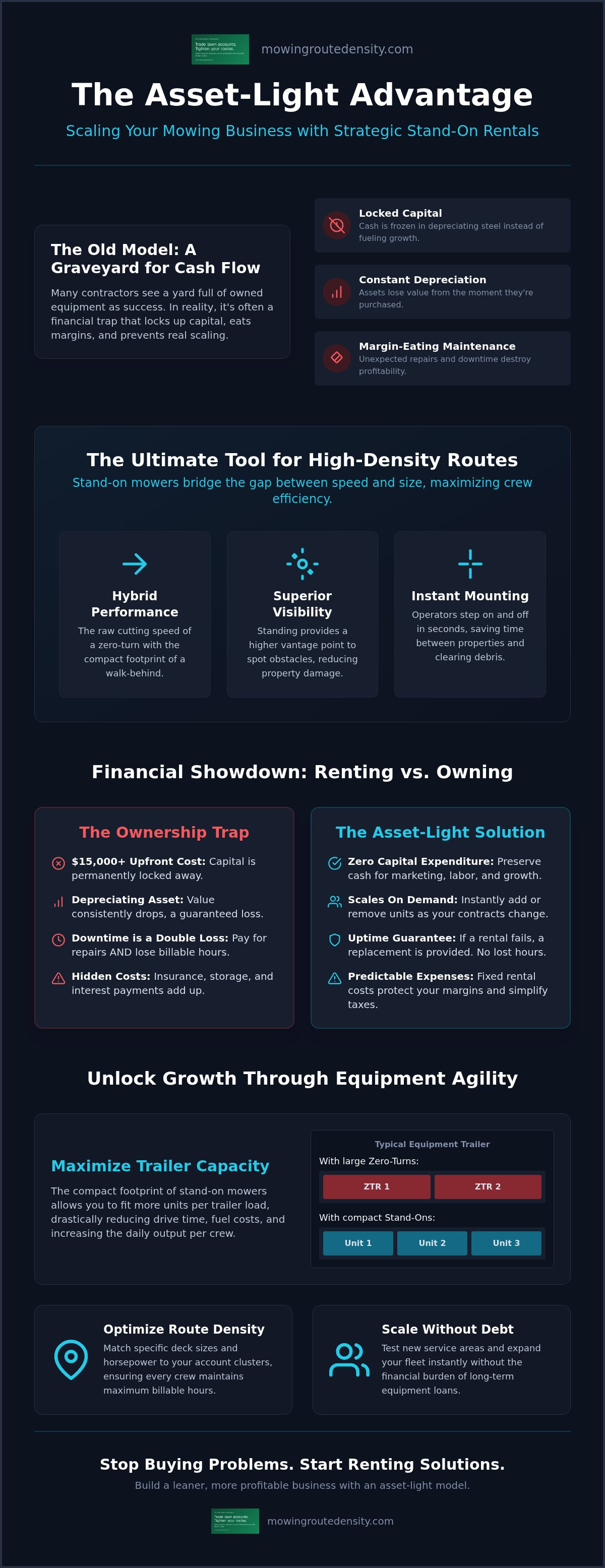
Your equipment fleet is likely your biggest financial leak. Many contractors view a yard full of owned machines as a sign of success. In reality, it is often just a graveyard for your cash flow. Capital stays locked in depreciating assets while maintenance costs eat your margins alive. It is a cycle of waste that prevents real scaling.
You already know that staying agile is the only way to survive seasonal shifts and tight labor markets. A strategic stand on mower rental gives you the power to attack new routes without the long-term debt of a purchase. This approach turns equipment into a variable cost that only exists when it is making you money. It's about tightening your operations and cutting the fluff. You need tools that work for your bottom line, not against it.
This article shows you how to leverage rentals to increase route density and eliminate the overhead of equipment ownership. We will explore how an asset-light model maximizes billable hours per crew and reduces drive time through smarter equipment choices. Stop buying problems and start renting solutions to build a leaner, more profitable business.
Key Takeaways
- Identify why the hybrid speed of a zero-turn and the compact footprint of a walk-behind make the stand-on mower the ultimate tool for high-density commercial routes.
- Stop sinking capital into depreciating assets and use a stand on mower rental to maintain a lean, high-margin operation that scales on demand.
- Learn to match specific deck sizes and engine horsepower to your account clusters to ensure every crew maintains maximum billable hours.
- Maximize your trailer capacity by fitting more compact stand-on units per load, slashing fuel costs and increasing daily crew output.
- Leverage an asset-light business model to test new service areas and scale your fleet instantly without the burden of long-term debt or maintenance overhead.
The Tactical Case for Stand-On Mower Rental
Owning a massive fleet used to be a status symbol in the landscaping industry. In 2026, it is often a liability. High interest rates and volatile demand have turned heavy equipment ownership into a financial anchor for many businesses. A tactical stand on mower rental is not just a temporary fix for a broken machine; it is a strategic procurement method. It allows you to scale your capacity without the weight of long-term debt. Why lock up capital in a single asset that sits idle during seasonal lulls? You must move toward an asset-light model. This means prioritizing operational flexibility over asset accumulation.
Why Stand-On Units Outperform in Dense Routes
Efficiency is won or lost in the seconds between properties. Stand-on units bridge the gap between speed and size. They offer the raw cutting power found in heavy-duty commercial riding lawn mowers while maintaining the compact footprint of a walk-behind. This hybrid design is built for high-density routes where every minute counts. Consider these operational advantages:
- Instant Mounting: Operators can step on and off the platform in a second. There are no seatbelts or complex folding ROPS to fight when clearing debris or moving gates.
- Superior Visibility: Standing provides a higher vantage point. Operators see obstacles, pets, and property edges more clearly than they do from a seated position. This reduces property damage and insurance claims.
- Fatigue Reduction: Modern stand-on platforms use advanced suspension to absorb shocks. Operators stay fresher for longer compared to walking 10 miles a day behind a unit. More stamina leads to higher daily output.
Rental vs. Purchase: The Margin Perspective
The "ownership trap" is a common mistake for scaling contractors. You buy a machine, and the financial clock starts. Depreciation, insurance, and storage costs do not care if it is raining or if a client canceled a contract. When you utilize a stand on mower rental, you align your expenses directly with your revenue-generating activities. This is lean operations in practice.
Renting eliminates the hidden overhead of maintenance. You no longer pay a mechanic to chase hydraulic leaks or sharpen blades on a machine that is only needed for a specific six-week surge. You rent for the contract, finish the job, and return the asset. Your margins stay protected because the cost is fixed and predictable. This approach ensures your cash stays liquid, allowing you to invest in labor or marketing rather than depreciating steel.
Asset-Light Scaling: Why Renting Beats Ownership in 2026
Owning a mower is a bet on the past. Renting is a bet on your future growth. In 2026, the equipment rental industry is projected to hit $83.5 billion in revenue because smart contractors are tired of the ownership trap. Every piece of owned equipment on your trailer is a depreciating asset that demands insurance, storage, and interest payments. A stand on mower rental flips this script. It transforms a massive capital expenditure into a lean, variable operating cost. Don't let depreciating steel dictate your business trajectory. Use rentals to expand your fleet the moment you sign a new contract, not months after you've saved up the cash.
Preserving Working Capital for Growth
Cash is your most valuable tool. When you sink $15,000 into a new stand-on unit, that money is gone. It's locked in a machine that might sit idle two days a week. Use that capital to acquire a competitor's route or launch a marketing blitz instead. Renting keeps your debt-to-income ratio healthy. This makes you a more attractive candidate for business financing when you want to scale your operations. You can also deduct rental payments as direct operational expenses. It is a cleaner tax strategy than chasing depreciation schedules for a decade. Strategic contractors often mix rentals with commercial lawn mower lease options to build a fleet that breathes with their workload. If you're ready to stop the financial bleed, you can find professional equipment that fits your current route needs today.
Eliminating Maintenance Bottlenecks
An owned mower in the repair shop is a double loss. You pay for the parts. You lose the billable hours. Downtime kills your crew's momentum and frustrates your clients. A stand on mower rental solves this with uptime guarantees. If a machine fails, you get a replacement. Your crew stays in the field. You don't need a full-time mechanic on payroll or a warehouse full of spare parts. Focus your labor on billable mowing, not non-billable wrenching. This approach also lets you utilize the newest 2026 tech, like the latest Cub Cadet PRO X or John Deere QuikTrak models. These machines are built for maximum speed and operator comfort. Renting ensures you always have the most efficient tools without the long-term risk of obsolescence.
Evaluating Commercial Stand-On Units for Your Fleet
A machine that doesn't fit your route is a drain on your resources. When selecting a stand on mower rental, you must evaluate technical specs through the lens of logistics. Most contractors grab whatever is available on the lot. This is a mistake. You need to match engine horsepower and deck size to your specific account clusters. If your fleet is mismatched, your billable hours per crew will plummet. Efficiency isn't just about speed; it's about the right tool for the specific terrain.
Choosing the Right Deck Width (36" vs 52")
Deck size dictates your movement. A 36-inch unit is the gate-access king. It's essential for high-density clusters where backyards are only accessible through narrow side entries. If you're servicing professional accounts with tight perimeters, this is your primary asset. Conversely, 52-inch units are the sweet spot for commercial parks and open turf. They provide the necessary swath to clear large areas quickly without the bulk of a 60-inch machine. Consider your trailer space. Fitting three 36-inch units might be more profitable than two 52-inch units if it allows you to split crews across more properties.
Key Features for Professional Durability
Don't settle for consumer-grade equipment. Professional stand on mower rental units must feature hydrostatic drive systems. These systems provide smooth, responsive maneuvering. They allow operators to pivot around obstacles without tearing turf or wasting motion. Look for heavy-duty fabricated decks. Stamped decks found on residential models will buckle under the 40-plus hours of weekly use required in a commercial setting. Safety is also a non-negotiable factor for site compliance. Ensure units have operator-presence systems and stable platforms to prevent accidents that spike insurance premiums.
Optimizing your equipment choice directly impacts your lawn care profit margin optimization. Fuel efficiency is a critical part of this equation. High-efficiency EFI engines can reduce fuel consumption significantly compared to older carbureted models. While some contractors look into SBA loans for equipment to finance a permanent fleet, renting allows you to test this tech immediately. You get the benefits of ergonomic controls and reduced operator fatigue without the long-term debt. Keep your operators fresh. Fresh operators work faster, stay on schedule, and generate more revenue.
Optimizing Route Density Through Equipment Agility
Drive time is a profit killer. It is the non-billable waste that drains your bank account while your crews sit in traffic. To maximize your lawn care route density, you must stop thinking about mowers as just tools. They are logistical assets. A stand on mower rental gives you the agility to restructure your routes on the fly. It allows you to fit more cutting power into a tighter footprint. This is the "Trailer Efficiency" factor. Standard zero-turns are bulky and waste deck space. You can often fit three stand-on units in the space required for two seated models. More units per trailer means more billable hours per crew without adding another truck to the road.
Renting also allows you to "bridge the gap" when testing new geographic territories. Do not buy a machine for a route that might not exist in six months. Rent the asset. Test the density. If the cluster proves profitable, keep the rental or swap it for a different spec. This tactical flexibility ensures you never have capital rotting in a territory that failed to scale. You can locate professional equipment to support your expansion goals immediately, keeping your overhead low while your revenue climbs.
Reducing Drive Time with Compact Fleet Profiles
Tight residential streets and urban clusters are not built for 20-foot trailers. Compact stand-on units allow you to utilize smaller, more maneuverable trucks. This opens up high-density areas that your competitors avoid because their equipment is too cumbersome. You spend less time searching for parking and more time on the turf. Loading and unloading is also faster. There are no seatbelts to click or heavy ROPS to adjust. Every thirty seconds saved at the curb adds up to an extra property by the end of the week. Minimize your non-billable transit time through equipment specialization.
Scaling via the Lawn Account Trading Platform
Orphaned accounts are a cancer on your profit margins. They are the outliers that sit ten miles away from your core cluster. Stop driving to them. Use a lawn account trading platform to swap those distant properties for accounts that sit within your existing routes. Once you acquire a new, dense cluster, you need to scale your fleet instantly. A stand on mower rental allows you to add that capacity the day you close the trade. You don't need a bank's permission to grow. You just need the right equipment for the cluster you just acquired. Eliminate the logistics of "orphaned" accounts and focus on the high-margin density that actually builds wealth.
Scaling Your Operations with Mowing Route Density
Efficiency is the only metric that dictates your survival. Mowing Route Density provides the specialized infrastructure to help you stop reacting to logistics and start mastering them. By using our national B2B platform, you can secure a stand on mower rental that fits your exact route profile without the friction of traditional dealership delays. We focus strictly on professional landscaping logistics. This means every tool on our platform is vetted for commercial performance. You aren't just finding a machine; you are securing a tactical asset that drives billable hours.
Scaling requires more than just equipment. It requires a network. Our lawn mowing service provider locator acts as a strategic B2B framework. It connects you with other contractors for sub-contracting opportunities or route optimization partnerships. This is how you build a resilient business that can pivot when the market shifts. It turns your operation from a collection of trucks into a sophisticated logistics machine. By integrating rental assets into this growth strategy, you maintain the liquidity needed to seize new opportunities as they arise.
Finding the Right Assets Nationally
Our network allows you to locate commercial-grade stand-on units across the country. You can compare rental options from various market providers to ensure you're getting the best spec for your territory. Whether you need a 36-inch gate-access king or a 52-inch turf master, our locator tool connects you with the necessary assets. This ensures your fleet always matches your density goals. If a route isn't dense enough to justify a purchase, the stand on mower rental bridges that gap. You test the market with our equipment before you commit your hard-earned capital.
The Bottom Line: Efficiency Over Ownership
Ownership is a trap that many never escape. A yard full of rusting, paid-off mowers is not an achievement; it is a liability. Audit your current fleet costs. Calculate the downtime, the insurance, and the non-billable mechanic hours. You'll likely find that an asset-light model is the only way to maximize your margins. This approach is also the smartest path toward a high-value lawn care business exit strategy. Buyers want dense routes and lean operations, not a mountain of depreciating hardware. Join our marketplace today. Start optimizing your fleet and reclaim your profitability.
Master Your Margins Through Asset-Light Growth
Your fleet should be a tool for profit, not a source of debt. Success in 2026 requires a radical shift from asset accumulation to operational agility. You've seen how a strategic stand on mower rental is the most efficient way to scale without the anchor of depreciation. It allows you to fit more power on every trailer and crush drive time through high-density clustering. Stop letting maintenance costs and idle machines bleed your bank account dry. It's time to prioritize your cash flow over your collection of steel.
Mowing Route Density provides the national B2B equipment locator and specialized route density optimization tools you need to stay lean. Whether you're swapping orphaned accounts or finding specialized units for a new territory, our secure account trading marketplace is built for your growth. It's time to stop working for your equipment and make your equipment work for you. Audit your fleet. Cut the waste. Optimize your fleet and trade accounts today. You have the strategy; now take the action to build a more liquid, profitable business.
Frequently Asked Questions
Is stand-on mower rental more cost-effective than buying for a growing business?
Yes, especially when you're scaling quickly. Renting preserves your working capital for account acquisitions and marketing instead of locking it in depreciating steel. It eliminates the ownership trap of interest payments and long-term storage costs. A stand on mower rental allows you to match your equipment expenses directly to active revenue streams. You only pay for the machine while it's earning you money, keeping your debt-to-income ratio lean and agile.
What are the typical deck sizes available for commercial stand-on mower rentals?
Commercial fleets typically rely on 36-inch and 52-inch deck sizes to maximize efficiency. The 36-inch units are the standard for gate access in dense residential clusters. The 52-inch models offer the best balance of speed and maneuverability for larger commercial parks. Some providers also offer 48-inch or 61-inch options for specialized turf needs. Choosing the right size ensures you don't waste fuel or labor time on properties that require a more compact footprint.
Can I rent a stand-on mower for long-term seasonal contracts?
Long-term seasonal rentals are a standard practice for professional contractors who prioritize liquidity. This strategy allows you to fulfill a six-month contract without committing to a five-year equipment loan. Most providers offer monthly or seasonal rates that are significantly lower than daily pricing. It's a tactical move to handle surge demand. You get the newest 2026 models for the peak season and return them once the grass stops growing.
How does renting equipment help improve my lawn care route density?
Renting lets you deploy specialized equipment to specific clusters without over-investing in niche hardware. If you acquire a dense cluster of small yards, you can secure a stand on mower rental with a 36-inch deck immediately. This agility prevents you from using oversized, inefficient machines on tight routes. You fit more units on your trailer and reduce the drive time between stops. It turns your equipment fleet into a variable logistical asset.
What maintenance responsibilities do I have when renting a commercial mower?
You're typically responsible for daily upkeep like checking oil levels, cleaning the deck, and ensuring proper tire pressure. Major mechanical repairs and scheduled engine servicing are usually handled by the rental provider. This setup eliminates the need for a full-time in-house mechanic. If a machine breaks down, the provider replaces it, ensuring your crew stays in the field. Always review your specific rental agreement to confirm local insurance and damage waiver requirements.
Are stand-on mowers safer for my crew than zero-turn units?
Stand-on units offer superior visibility and faster emergency egress compared to seated models. An operator can step off the platform instantly if they encounter a hazard or lose traction on a slope. Seated zero-turns often trap operators behind lap bars or seatbelts during a rollover. Standing also provides a better vantage point for spotting obstacles or pets in the turf. This reduced risk often leads to fewer property damage claims and lower insurance premiums.
How do I find a reliable commercial mower rental provider through Mowing Route Density?
Use our national B2B equipment locator to find vetted commercial providers that understand the landscaping industry. Our platform is designed specifically for professional logistics, so you won't waste time with residential-grade hardware. Simply search for the specific machine you need to support your route growth. We connect you with professionals who understand the urgency of fleet uptime. It's the fastest way to scale your operations without the friction of traditional dealership inventory shortages.


