

Stop chasing every lead within a fifty mile radius. Growth isn't about the total number of names on your client list. It's about the distance between them. If your crews spend more time burning diesel than cutting grass, you aren't running a lawn care business. You're running a high-priced delivery service that doesn't deliver anything. Buying lawn care contracts is the most effective way to fix a broken route and reclaim your margins overnight.
You already know that waiting for organic leads is too slow for aggressive scaling. You're also right to be skeptical of informal deals that might leave you with a high-churn client list. This guide will show you how to acquire accounts that actually increase your profit rather than just adding to your overhead. You will learn to identify high-density opportunities and secure predictable cash flow from day one. We will break down the 2026 valuation standards, including the 2.63x SDE multiplier, and provide a roadmap for vetting every acquisition to ensure it tightens your operations instead of bloating them.
Key Takeaways
- Stop waiting for slow organic leads and start buying for proximity to eliminate wasted fuel and labor hours.
- Learn how to calculate the true value of buying lawn care contracts by prioritizing route density over simple revenue multipliers.
- Perform a "tough love" audit on seller revenue and churn rates to avoid inheriting an operational nightmare.
- Protect your investment during the first 30 days by using a joint introduction strategy to maintain client trust.
- Scale your new routes using an asset-light approach with commercial equipment rentals to keep debt low and cash flow high.
Buying Lawn Care Contracts: Why Density Beats Organic Growth
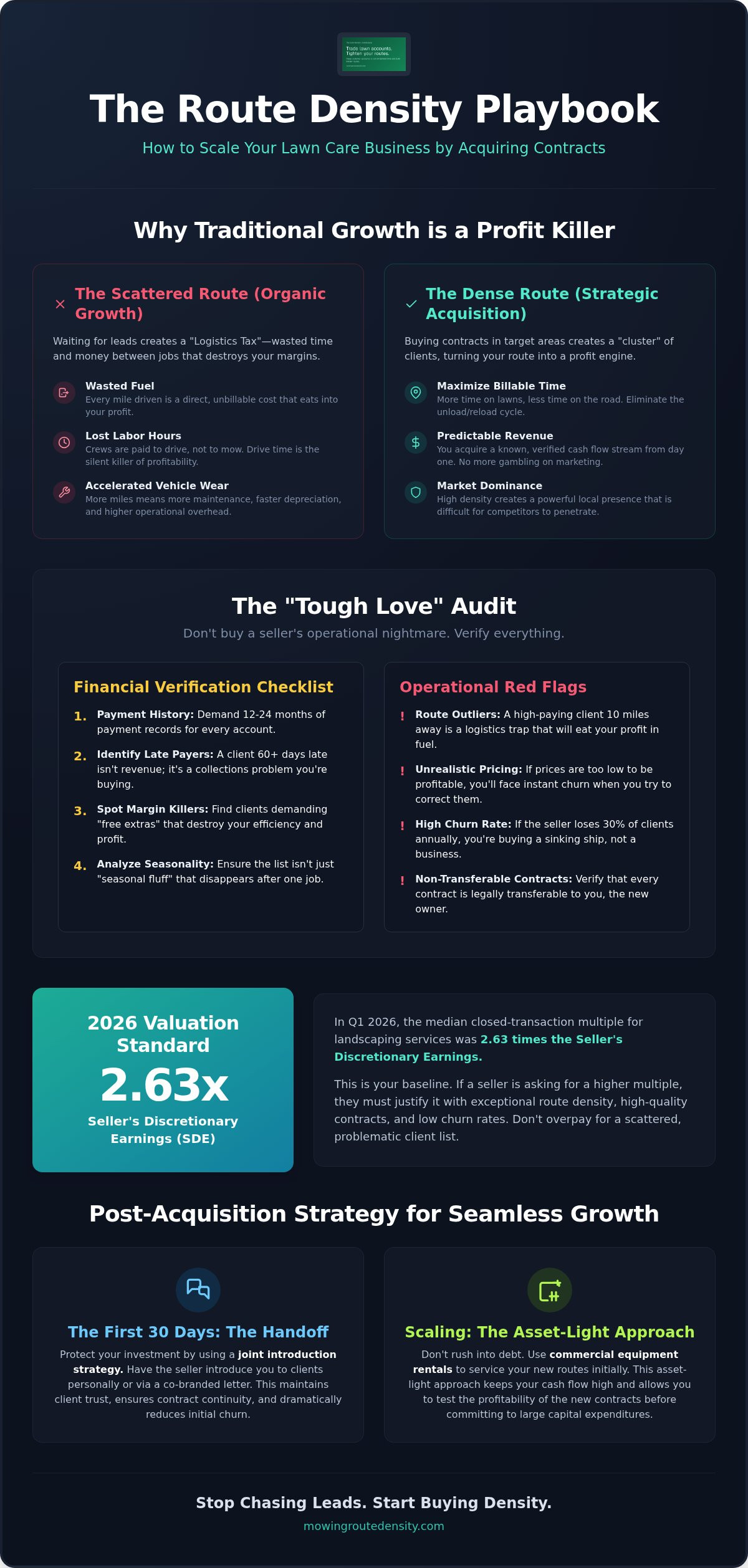
Organic growth is a slow burn. It's expensive. It's unpredictable. In the landscape industry, waiting for the phone to ring often means accepting jobs that are miles apart. This creates a "Logistics Tax." Every mile driven between jobs is a direct hit to your bottom line. You pay for the fuel. You pay for the labor. You pay for the wear on the truck. None of that is billable. Buying lawn care contracts allows you to skip the line and buy market share exactly where you need it. Strategic acquisition isn't just about getting bigger. It's about getting tighter. Your lawn care route density is the single most important metric for your actual take-home pay.
The Math of the "Cluster" Strategy
Drive time is the silent killer of profitability. If your crew spends twenty minutes driving to a thirty-minute mow, you've lost 40% of your earning potential before the gate even opens. Clustering accounts turns a scattered route into a profit engine. One account on a street where you already have three clients is worth significantly more than three accounts five miles away. You eliminate the unload/reload cycle. You cut fuel consumption. Most importantly, you maximize billable hours per man-hour. Tightening your route through buying lawn care contracts in specific neighborhoods ensures your equipment stays on the ground, not on the trailer.
Acquisition vs. Organic Lead Gen: A Cost Comparison
Digital marketing is a gamble. You pay for clicks, not customers. Customer Acquisition Cost (CAC) continues to rise as competition for local keywords gets fiercer. When you buy a client list, you aren't paying for "leads." You're paying for verified revenue. This provides an immediate cash flow injection. There is no "startup lag." You don't have to wait months for SEO to kick in or for referrals to trickle through. You buy the route, you service the route, and you collect the check. It's a clinical, mathematical approach to scaling that preserves your cash for operations instead of sinking it into unproven marketing campaigns.
- Predictable Revenue: You know the exact dollar value of the route on day one.
- Asset Efficiency: You get more work out of the same crew and the same truck.
- Market Dominance: High density makes it harder for competitors to chip away at your territory.
Due Diligence: Don’t Buy a Seller’s Operational Nightmare
Revenue is vanity. Profit is sanity. Don't buy a headache because the top-line number looks impressive. When you are buying lawn care contracts, you are essentially buying a future cash flow stream. If that stream is polluted with late payers and underpriced labor, your investment will evaporate. You need a "Tough Love" audit. Verify the revenue. Don't just look at the total. Look at the individual account history. If 20% of the clients are consistently 60 days late on payments, that's not revenue. That's a collection problem you're paying to inherit. High churn rates are the first warning sign. If the seller is losing 30% of their base annually, you aren't buying a business. You're buying a sinking ship.
Financial Verification Checklist
Demand to see 12 to 24 months of payment history for every account on the list. Late payers aren't just a cash flow nuisance; they're a management drain. Identify clients who demand "extra" services for free. These are margin killers that destroy your efficiency. Check for seasonality. A list full of "seasonal fluff" like one-time leaf cleanups won't sustain your overhead during the peak growing season. Use established business valuation methods to ensure the asking price reflects real, collectible cash flow. In Q1 2026, the median closed-transaction multiple for landscaping services was 2.63x Seller's Discretionary Earnings (SDE). If the seller is asking for more, they better have the density to prove it.
Operational Red Flags
Look for route outliers. One high-paying client ten miles away from your cluster will eat your profit in fuel and non-billable labor. It's a logistics trap. Check for unrealistic pricing. Sellers often underbid to inflate their client count before a sale. If the current pricing doesn't support lawn care profit margin optimization, you'll have to raise prices immediately. That's a recipe for instant churn. Finally, ensure every contract is legally transferable. A handshake deal with the seller doesn't mean the client will write you a check. You need a paper trail to protect your capital.
Don't gamble on forum "handshake" deals. You can secure your next acquisition through a secure lawn account trading platform to ensure the data is verified and the paperwork is tight.
Valuing a Client List: The Math of Route Density
Revenue multipliers are a trap for the uneducated buyer. They ignore the reality of the road. If you're buying lawn care contracts based on a flat percentage of gross revenue, you're likely overpaying for a logistics nightmare. $100,000 in revenue spread across three counties is a liability. That same $100,000 concentrated in two zip codes is a goldmine. This is the "Density Premium." You should be willing to pay more for accounts that sit adjacent to your current routes. The incremental cost to service them is almost zero. You're already there. The fuel is already spent. The labor is already on-site. Every new stop in an existing cluster is pure margin.
Modern Valuation Frameworks
In 2026, the industry has moved toward profit-based models. Gross revenue is a vanity metric. Focus on Seller's Discretionary Earnings (SDE). The median multiplier for landscaping services currently sits at 2.63x SDE. Service frequency also dictates value. Weekly contracts are more valuable than bi-weekly ones because they provide predictable cash flow and lower labor costs per visit. Commercial contracts often command a higher multiplier than residential. They offer larger scale and typically have higher retention rates over multi-year terms. Understanding a professional lawn account trading platform valuation model is essential for staying competitive in this market.
Negotiating the Deal
Use route density data as your primary leverage. If a seller’s list is scattered, it’s an operational drain. Point this out. Explain that their inefficiency is a cost you have to absorb. This justifies a lower multiplier. Don't pay the full price upfront. Structure the payout to protect your capital. A retention-based payout is a risk-mitigation strategy where a portion of the purchase price is only paid if the acquired clients remain with the business for a specified period. This forces the seller to be honest about client satisfaction. It ensures you aren't buying a list of people who are already looking for a new provider.
- Density leverage: Use GPS maps to prove how much travel time you're inheriting.
- Earn-outs: Tie 20-30% of the price to client retention at the 90-day mark.
- Contract quality: Value written, multi-year agreements higher than verbal "handshake" deals.
The Handoff: Ensuring Contract Continuity and Retention
The ink is dry. The wire transfer is complete. You think the hard part is over. It isn't. When buying lawn care contracts, the first 30 days are a high-stakes battle against churn. Customers hate change. They fear a drop in quality or a sudden price hike. If they feel like a line item on a spreadsheet, they will leave. You must manage the transition with surgical precision to protect your investment. Trust is the most fragile asset you've acquired. Don't break it before the first invoice.
The "Joint Introduction" is your strongest weapon. The seller should personally introduce you to every client, either in person or through a coordinated message. This transfers the existing relationship to you. It signals that the seller trusts you to maintain their legacy. Without this, you're just a stranger on their lawn. Standardize your service levels immediately. If the previous crew mowed at three inches, don't switch to two. Keep the schedule consistent. Consistency breeds retention.
Communication Strategy for New Clients
Your "New Ownership" letter must be brief and professional. Focus on continuity. Avoid corporate fluff. Tell them what stays the same. Maintain price consistency for at least the first full season. An immediate price hike is an invitation for them to call your competitors. Identify the "anchor" clients on the route. These are the neighborhood influencers or the high-revenue commercial accounts. If an anchor client leaves, the rest of the neighborhood often follows. Over-communicate with these accounts to ensure total satisfaction during the handoff.
Legal and Administrative Logistics
Friction kills retention. If you force clients to re-enter their billing information or sign complex new portals, you'll lose them. Transfer autopay data seamlessly. Establish professional credibility by maintaining a lawn mowing service provider locator profile. This proves you are a verified professional with a national network, not a fly-by-night operation. Finally, secure non-solicitation agreements from the seller’s former employees. You paid for these contracts. You cannot allow a former technician to quit and poach the very route you just bought.
Ready to build a denser, more profitable route? You can start trading lawn accounts today on a platform built for professional contractors.
Scaling Asset-Light: Leveraging Trading Platforms and Rentals
Ownership is a liability. In the high-stakes game of buying lawn care contracts, the fastest way to kill your momentum is by sinking all your liquidity into heavy equipment. Many contractors make the fatal mistake of financing a new truck and trailer the moment they sign an acquisition deal. This is a capital management error. You've just spent capital on the contracts. Why immediately double your debt for assets that depreciate the moment they hit the turf? Scaling asset-light is the only way to maintain the agility needed for aggressive growth.
Mowing Route Density facilitates a "Buy, Swap, Rent" cycle that protects your cash flow. You buy the route to secure the revenue. You rent the equipment to service the accounts without the long-term debt. Finally, you swap the "geographic orphans" that don't fit your route to maximize your density. This strategic framework ensures that every dollar you spend is focused on revenue-generating activity rather than maintenance and interest payments.
Renting vs. Buying Equipment for New Routes
Financing a $15,000 mower for a route you haven't serviced yet is a gamble. You haven't tested the terrain or the client retention. Use professional lawn equipment rental to bridge the gap during the first 90 days. This allows you to verify the route's profitability before committing to a permanent asset. Renting preserves your capital for more acquisitions. It also eliminates the maintenance overhead on a secondary fleet. If a rented unit breaks down, it’s the rental provider's problem, not yours. You stay on schedule. Your margins stay protected.
The Account Swap: Refining for Maximum Density
No acquisition is perfect. Every list contains "geographic orphans"—those outlier accounts that sit ten miles away from your core cluster. Don't waste fuel on them. Instead of trying to force a scattered route to work, use a B2B marketplace to find local partners for an exchange. You can trade your distant accounts for clients that sit directly inside your existing routes. Account swapping eliminates drive-time waste by exchanging distant accounts for those within your existing clusters. This is the final step in buying lawn care contracts strategically. You don't just accept the list you're given. You refine it until your route is a high-density profit engine. Check your commercial lawn mower lease options to see how tactical equipment use can support this lean scaling model.
Take Control of Your Route Density
Driving ten miles for a single mow is a choice to lose money. You don't have to accept that logistics tax. By strategically buying lawn care contracts, you can turn a scattered schedule into a concentrated profit engine. Remember that the value is in the cluster, not the headcount. Protect your capital by auditing every account and using asset-light scaling strategies like commercial rentals. Swapping geographic outliers for local accounts isn't just a convenience; it's a financial necessity in 2026.
Ready to stop burning fuel and start building real equity? Browse available lawn care routes and scale your business today through our secure B2B trading platform. We provide access to a national network of verified contractors and the asset-light rental solutions you need to scale your fleet without the burden of debt. Your most profitable route is waiting for you to claim it. It's time to work smarter, not harder.
Frequently Asked Questions
How much should I pay for a lawn care client list in 2026?
The median closed-transaction multiple for landscaping services in early 2026 was 2.63x Seller’s Discretionary Earnings (SDE). Don't pay based on gross revenue alone. A scattered list is worth less than a dense cluster. You should adjust your offer based on the drive time requirements. High-density routes in profitable neighborhoods deserve a premium because they maximize billable hours per man-hour and reduce fuel waste.
Is it better to buy a whole lawn care business or just the contracts?
Buying just the contracts is often the smarter move for contractors focused on route density. You avoid inheriting the seller’s debt, aging equipment, or legal liabilities. It allows for asset-light growth where you only pay for the revenue stream. If you need more capacity, renting commercial-grade mowers is safer than buying a seller’s used fleet. Focus on the accounts that fill your geographic gaps.
What is a typical churn rate when buying mowing routes?
Expect a churn rate of 10% to 15% during the first 90 days if the handoff is handled poorly. You can minimize this through a coordinated introduction strategy. If the seller doesn't personally vouch for you, clients may start shopping for new quotes immediately. Your goal when buying lawn care contracts is to make the transition invisible. Consistency in service quality and pricing is your best defense against attrition.
Do I need a lawyer to buy lawn care contracts?
You should always have a legal professional review your purchase agreement. You need to ensure non-compete and non-solicitation clauses are enforceable in your state. However, using a specialized lawn account trading platform can provide standardized templates and secure verification processes that simplify the transaction. This reduces the risk of informal deals that offer zero protection if the seller decides to restart their business in your territory.
How do I verify the revenue of a lawn care route for sale?
Demand to see at least 12 months of verifiable payment history from the seller’s CRM or bank statements. Revenue on a spreadsheet means nothing without a paper trail. Look for consistency in billing and identify any clients who pay late. Verify that the revenue matches the actual work performed. If a seller claims high revenue but has low route density, their profit margins are likely too thin to sustain.
What should be included in a lawn care contract purchase agreement?
A solid agreement must include a detailed client list, a non-compete clause, and a retention-based payout structure. This earn-out ensures a portion of the purchase price is only paid if clients stay for a set period. It should also specify that all contracts are legally transferable. Include non-solicitation agreements for the seller’s former employees to prevent them from poaching the route you just purchased for your business.
Can I buy lawn care accounts if I don’t have enough equipment yet?
You can absolutely buy accounts before owning the fleet to service them. In fact, buying equipment first is a common cash-flow mistake. Utilize commercial-grade mower rentals to service newly acquired routes immediately. This preserves your liquidity for more acquisitions. Once the route proves its profitability and retention, you can decide whether to continue renting or commit to a long-term purchase. It is a proven asset-light scaling strategy.
How do I stop a seller from competing against me after the sale?
You must include a geographically specific and time-bound non-compete clause in the purchase agreement. This prevents the seller from opening a new operation in your service area for a set number of years. Additionally, secure a non-solicitation agreement. This stops them from reaching out to their old clients or hiring away the technicians who know the route. Verbal agreements won't protect you; you need a signed, legally binding document.


