

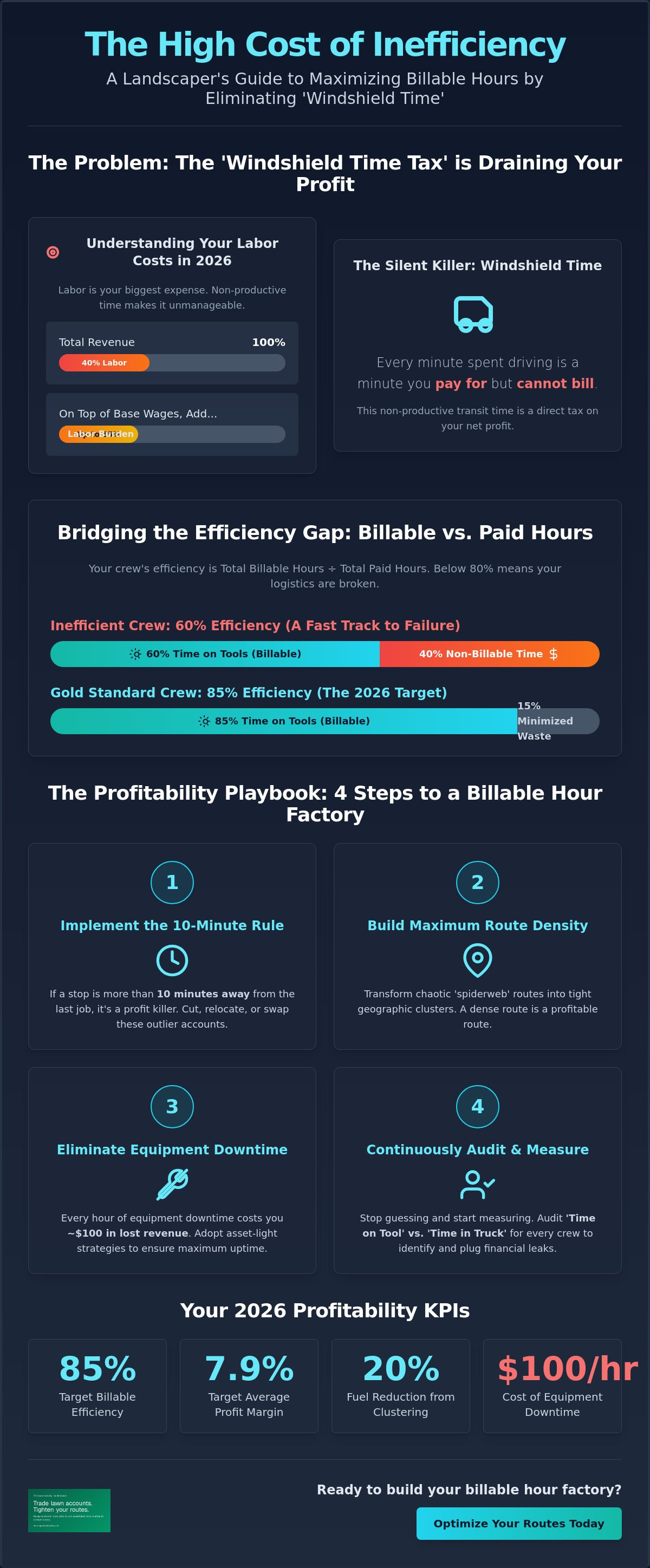
Your crews aren't losing money on the job site. They're losing it on the highway. Every minute spent in windshield time is a minute you pay for but cannot bill. In 2026, labor represents up to 40% of your total revenue. When you add a 20% to 35% labor burden on top of base wages, non-productive transit isn't just an inconvenience. It's a financial bleed. You feel the squeeze every time a mower breaks down mid-shift or a crew spends two hours in traffic to reach a thirty-minute job.
We understand the frustration of seeing high labor costs paired with low output. It's a systemic flaw that prevents scalable growth. You want to maximize billable hours landscaping without adding massive debt to your balance sheet. This framework provides the solution. You'll learn how to eliminate operational waste, turn dead travel time into high-margin billable hours, and reduce your maintenance overhead. We're moving past the "work harder" mentality. It's time to build an operation that manufactures profit through clinical efficiency and strategic asset management.
Key Takeaways
- Stop guessing and start measuring. Identify operational leakage by auditing "Time on Tool" against "Time in Truck" for every crew.
- Implement the 10-Minute Rule. Any stop further than ten minutes from your last job is a profit killer that needs to be cut or relocated.
- Learn to maximize billable hours landscaping through asset-light strategies that eliminate the $100-per-hour cost of equipment downtime.
- Build a "billable hour factory" by using account trading platforms to swap distant outliers for high-density geographic clusters.
- Adopt a continuous audit framework to monitor your labor burden and protect your profit margins from rising 2026 overhead costs.
The Math of the Billable Hour: Identifying Operational Leakage
The billable hour is the only metric that truly matters for your bottom line. It isn't just "working time." It's revenue-generating time spent on-site. Everything else is overhead. To maximize billable hours landscaping, you must treat every minute off-site as a direct tax on your net profit. If your crew is paid for ten hours but only bills for six, your efficiency is 60%. In a 2026 market where labor burden adds up to 35% on top of base wages, a 60% efficiency rate is a fast track to bankruptcy. You're paying for productivity you aren't receiving, and that's a leak you can't afford.
Drive time is the silent killer of your margins. We call it the "Windshield Time Tax." You pay for the fuel. You pay for the insurance. You pay for the wear on the truck. Most importantly, you pay the hourly wage of every person in that cab while they produce zero revenue. Calculating your current efficiency ratio is simple: divide your total billable hours by your total paid man-hours. If that number is below 80%, your logistics are broken. For 2026, 85% efficiency is the new industry gold standard. Anything less means you're leaving thousands on the pavement every month.
The Hidden Cost of Non-Billable Labor
Loading, unloading, and fueling aren't just "part of the job." They're logistical leaks. A 15-minute delay at the gas station or a disorganized shop morning compounds quickly. Across a five-day week, that's over an hour of lost production per employee. For a three-man crew, you've just bought nearly four hours of nothing. "Hustling" on the job site won't recover that time. The problem is structural. Solving it requires viewing your schedule through the lens of combinatorial optimization and integer programming to ensure your assets are always in the right place. You can't fix a bad route with a faster mower.
Benchmarking Industry Profit Margins
High-density routes win because they eliminate the gaps between checks. Sprawling service areas lose because they prioritize the number of accounts over the proximity of accounts. You need to start analyzing lawn route profitability to identify which clients are actually costing you money. Set clear KPIs for every crew. They should know their target ratio of time on tools versus time in the truck. In 2026, successful operators are aiming for a 7.9% average profit margin, but you won't hit that if your crews are spending 30% of their day on the highway. To maximize billable hours landscaping, you must be willing to cut the outliers that drag your averages down. A tight route is a profitable route. A spread-out route is just a hobby.
Eliminating Windshield Time via Strategic Route Optimization
The 10-Minute Rule is the foundation of a profitable route. If a stop is more than ten minutes away from your last job, it's a profit killer. You aren't just losing the driver's time; you're losing the production capacity of the entire crew. To maximize billable hours landscaping, you must build your schedule around geographic anchor points. These are your "hub" clients—large properties or high-value clusters that serve as the day's center of gravity. Every other stop should be a satellite orbiting these hubs. If a client sits in a "Dead Zone" far from your anchors, they're likely costing you more in transit than they pay in service fees.
Static routing is a relic of the past. In 2026, successful operators use dynamic routing to pivot based on weather shifts or equipment status. If a mower goes down, you don't send the crew to a site they can't finish. You reroute them to a property where they can remain productive. Identifying these patterns requires looking at your service map with total honesty. Adopting operational best practices for route management ensures your trucks are moving toward revenue, not just burning fuel. If your current map looks like a spiderweb, you're failing the logistics test.
Asset Clustering for Logistical Efficiency
Asset clustering is the most effective way to eliminate the "Windshield Time Tax." The goal is simple: group properties within walking or short-drive distance. This minimizes trailer hitching and unhitching, which can waste 15 minutes per stop. Use a "Neighborhood Takeover" strategy. Market specifically to the houses adjacent to your anchor points. When a crew can service three lawns without moving the truck, your margins skyrocket. This approach can reduce fuel consumption by 20% while significantly increasing your daily output. If you have outliers that don't fit your clusters, consider using a lawn account trading platform to swap them for closer properties.
The Logistics of Crew Transit
Efficiency starts at the shop, not the job site. Staggered start times prevent morning bottlenecks that leave crews standing around waiting for the gate or the fuel pump. Pre-loading equipment the night before ensures "wheels up" at 7:00 AM sharp. Every minute spent at the shop after 7:05 AM is a minute you'll never get back.
- Stagger crew arrivals by 15-minute intervals to streamline equipment checks.
- Implement in-field refueling to keep crews on-site during peak hours.
- Use digital route sheets to update crews in real-time as conditions change.
Leveraging Asset-Light Strategies to Ensure Maximum Uptime
Equipment is either making you money or costing you money. There's no middle ground. When a zero-turn mower breaks down in the middle of a Tuesday morning, the repair bill is the least of your concerns. The real damage is the $100 plus per hour in lost billable opportunity. You're paying a crew to stand idle while your production schedule collapses. To maximize billable hours landscaping, you must shift your focus from equipment ownership to equipment availability. Owning a fleet of aging machinery is a liability, not an asset, if it can't guarantee 100% uptime during the spring rush. Strategic operators are moving toward the landscaping fleet asset-light strategy to keep their crews on the grass and out of the repair shop.
Maximizing production requires a fleet that matches your route perfectly. University of Miami research on route optimization highlights how service businesses lose efficiency when their physical assets don't align with their geographic clusters. If you're hauling a 72-inch deck to a neighborhood of gated backyards, you've already lost the day. Asset-light models allow you to swap equipment based on the specific needs of your current route density without being locked into a five-year finance power-play.
Minimizing Maintenance Downtime
Maintenance is a necessary evil, but it shouldn't happen on billable time. Outsourcing the headache of oil changes, blade sharpening, and hydraulic leaks ensures your mechanics aren't the ones holding up your revenue. Smart contractors use professional lawn equipment rental as a "Rental Buffer" to bridge repair gaps instantly. This approach ensures your crew never misses a beat when a primary machine fails. Rental models convert fixed capital costs into variable operating expenses that only exist when the equipment is actually producing revenue. This protects your cash flow and keeps your 2026 profit margins intact.
Scaling Capacity Without Capital Expenditure
Growth shouldn't require massive debt. You can scale your capacity for seasonal spikes by utilizing commercial lawn mower lease options instead of purchasing new units. This strategy helps you avoid the "Winter Debt" trap where you're stuck paying for idle machinery during the four-month off-season. Matching equipment size to specific route needs becomes a tactical decision rather than a long-term commitment. You get the newest technology and the highest efficiency without the burden of long-term depreciation. It's a cleaner, leaner way to maximize billable hours landscaping while maintaining the flexibility to pivot as your service area evolves.
Route Density: The Ultimate Billable Hour Factory
Stop chasing every lead that calls. If you want to maximize billable hours landscaping, you need to understand that ten accounts in a single ZIP code are worth significantly more than thirty accounts spread across the county. The difference is the "dead space" between stops. When your crew spends forty minutes driving for a twenty-minute mow, you aren't a landscaper. You're a delivery driver who mows as a hobby. You must identify the "Profit Sucks" in your portfolio. These are the clients who destroy your route flow and force your trucks into high-traffic corridors for a single invoice. Pruning these clients isn't being mean. It's being professional. Every outlier you keep is a direct theft from your bottom line.
Density is the only way to beat the rising costs of labor and fuel. In 2026, the average profit margin for landscaping sits at 7.9%, but that number is a lie for businesses with poor logistics. You can't out-hustle a bad route. To maximize billable hours landscaping, you must curate your client list with the same precision you use to sharpen your blades. If a property doesn't fit your geographic cluster, it doesn't belong on your schedule. You're building a factory where the product is time on the grass. Anything that stops the assembly line is waste.
Trading Out-of-Area Accounts
Outliers are logistical parasites. They eat your fuel, wear your tires, and drain your crew's energy. Instead of just firing them, use an "Account Swap" mechanism to trade them for properties that fit your existing clusters. You can find local partners for these exchanges through a lawn account trading platform. Marginal utility in the context of route density is the additional profit earned by adding one more account to a street where your truck is already parked. If adding a client doesn't increase your density, it likely decreases your actual hourly rate. Trading allows you to tighten your service area without losing total revenue.
Acquiring Targeted Route Density
Buying an entire route is often cheaper than marketing for individual leads. When you buy accounts to "fill in the gaps" of your current schedule, you're building a billable hour factory. The math of adding a neighbor is undeniable. The second house on a street is nearly 90% profit because the mobilization cost is already paid. You're integrating new revenue without increasing your fleet size or your fuel bill. This is how you scale without adding massive debt. You don't need more trucks. You need more stops per mile. If your route is currently a mess of outliers, it's time to reorganize. Visit our lawn account trading platform to start swapping your distant accounts for high-density clusters today.
Implementing a Continuous Operational Audit
Data is the only cure for a leaky business. If you want to maximize billable hours landscaping, you have to stop guessing why your margins are thin. A weekly review of "Time on Tool" versus "Time in Truck" is mandatory. Your software might generate a report, but reports are useless if you don't know which logistical levers to pull. You're looking for the gap between paid hours and billable production. If your crews are paid for 50 hours but only bill for 35, you have a structural failure. You must apply a lawn care profit margin optimization framework to identify whether the issue is the route, the equipment, or the people.
Standardization is the secret to reclaiming lost minutes. Shaving just five minutes off every stop through better on-site procedures can add an entire billable hour to a crew's day. This requires an "Exit Strategy" mindset. You aren't building a job where you're the lead mower. You're building an asset that runs efficiently without your constant intervention. To maximize billable hours landscaping, every movement on the property must be choreographed. Where does the truck park? Who drops the gate? Which direction does the first mower turn? If these aren't standardized, you're bleeding profit through hesitation.
Tracking Crew Performance with Precision
You need to distinguish between a "slow crew" and a "bad route." If a high-density route is underperforming, the problem is personnel. If a fast crew can't hit targets, the route is likely too spread out. Stop rewarding "hustle" and start rewarding efficiency. Incentivize your teams with bonuses based on billable hour targets rather than total hours worked. This aligns their interests with yours. It also naturally eliminates the culture of the "extended lunch" or the unauthorized gas station stop. When the crew knows their bonus depends on the clock at the job site, the truck stays in motion.
Preparing for Scalable Growth
Growth is dangerous if your foundation is cracked. You only add a new crew when you reach the "Route Saturation" tipping point. This is the moment when your current routes are so dense that adding one more client requires a new truck and trailer. Until then, stay lean. If you have overflow work that threatens your route density, use a lawn mowing service provider locator to find reliable sub-contractors. This keeps your core routes tight and your overhead low. Optimize your route density today. Reclaim your margins. Build the business you intended to run in 2026.
Secure Your Profit Margins with Logistical Precision
Hustle isn't a strategy. It's a reaction to bad planning. To truly maximize billable hours landscaping, you have to stop viewing your business as a service provider and start viewing it as a logistics firm. We've covered the math of the windshield time tax. We've explored how asset-light strategies keep your crews on the grass. Now, it's time to execute. You can't reach an 85% efficiency ratio if you're stuck in traffic or waiting on a mechanic. Every minute spent off-site is a direct theft from your bottom line.
You don't have to build this framework alone. Whether you're utilizing our 2026 Asset-Light Growth Framework or accessing our National B2B Contractor Network, the tools for operational excellence are ready. Use our Dedicated Route Trading Marketplace to prune the outliers and tighten your geographic clusters. It's time to stop the operational bleed and start manufacturing profit with clinical precision. Maximize your route density and rent professional gear at Mowing Route Density. Your crews are ready to bill. Make sure your routes let them. You've done the hard work of identifying the waste; now go out and cut it.
Frequently Asked Questions
What is a good billable hour percentage for landscaping?
A healthy billable hour percentage for a landscaping crew is 80% or higher. This means for every ten hours of paid labor, eight hours are spent on revenue-generating tasks at the job site. In 2026, top-tier operators aim for 85% efficiency to offset rising labor and fuel costs. If your percentage falls below 75%, your route logistics or shop procedures are likely leaking profit.
How do I calculate route density for my lawn care business?
Calculate route density by dividing your total number of accounts by the total miles driven per day. A more precise method is measuring the average drive time between stops. To maximize billable hours landscaping, your goal is to keep drive time under ten minutes between properties. High density means your truck stays parked while crews service multiple adjacent accounts.
Is it better to own or rent commercial lawn mowers for billable uptime?
Renting is often superior for ensuring maximum billable uptime. When you own equipment, a breakdown results in zero production while you pay for repairs and idle labor. Rental models ensure you always have a functional machine on the trailer. This converts the high fixed cost of ownership into a variable operating expense that only exists when the equipment is actually generating revenue.
How can I reduce drive time without losing my best customers?
Reduce drive time by building your schedule around geographic hubs and trading away outliers. If a high-value customer is far from your core route, find another contractor to trade with through a B2B network. You aren't losing a customer; you're swapping a logistical nightmare for a profitable local account. This maintains your revenue volume while significantly cutting your non-productive windshield time.
What are the most common "time killers" in field operations?
The biggest time killers are excessive windshield time, morning bottlenecks at the shop, and equipment breakdowns. Loading trailers at 7:00 AM instead of the night before can waste an hour of production across a three-man crew. Every unscheduled trip to the gas station or a repair shop is a direct hit to your billable capacity. Tighten these procedures to stop the bleed.
Should I charge a travel fee for out-of-area landscaping clients?
You should charge a travel fee, but remember that fees rarely cover the full cost of lost opportunity. A travel surcharge might pay for fuel, but it doesn't replace the billable hour you could have earned at a closer property. Use fees as a temporary fix while you work to swap those distant accounts for properties within your existing high-density clusters.
How does account trading help maximize billable hours?
Account trading allows you to maximize billable hours landscaping by physically moving your work closer together. By swapping a distant client for one next door to an existing account, you eliminate the drive time between them. This turns non-productive transit into revenue-generating "time on tool." It is the fastest way to increase route density without spending money on marketing.
Can software alone fix my billable hour problem?
Software is a diagnostic tool, not a cure. It can identify where you're losing time, but it cannot move your clients closer together or fix a broken mower. You must use the data from your software to make hard operational decisions. This includes firing unprofitable clients, trading accounts, and shifting to a more reliable equipment strategy to ensure your crews stay productive.


