

If your accounts aren't clustered, you aren't running a lawn care business. You're running a logistics company that happens to mow grass. It's a blunt reality. Many owners ignore this until the monthly fuel bill arrives. With the national average gas price at $4.56 per gallon as of May 2026, every mile between jobs is a leak in your bucket. Analyzing lawn route profitability isn't a suggestion. It's a survival strategy for your bottom line. Every minute spent behind the wheel is a minute you aren't billing. It's time to stop the bleed.
You've likely felt the frustration of a packed schedule that fails to move the needle on your profit. We agree that more work shouldn't mean less money. This article promises to show you how to stop wasting fuel on windshield time and start measuring the metrics that actually dictate your take-home pay. We'll break down the 72.5 cents per mile cost of operation and provide a clear framework for which accounts to keep and which to cut based on pure data.
Key Takeaways
- Identify windshield time as a silent profit killer and calculate the real cost of non-billable drive time.
- Master the metrics that matter, including Revenue per Route Mile, when analyzing lawn route profitability to ensure every stop is worth the fuel.
- Apply the 'Keep, Swap, or Drop' framework to visualize geographic clusters and eliminate isolated 'island' accounts that drain resources.
- Reduce overhead by comparing the hidden costs of equipment ownership against tactical commercial mower rentals for high-density routes.
- Leverage account trading platforms to acquire jobs that fit your existing clusters and sell off-distance accounts to local competitors.
The Math of Windshield Time: Why Your Route is Bleeding Cash
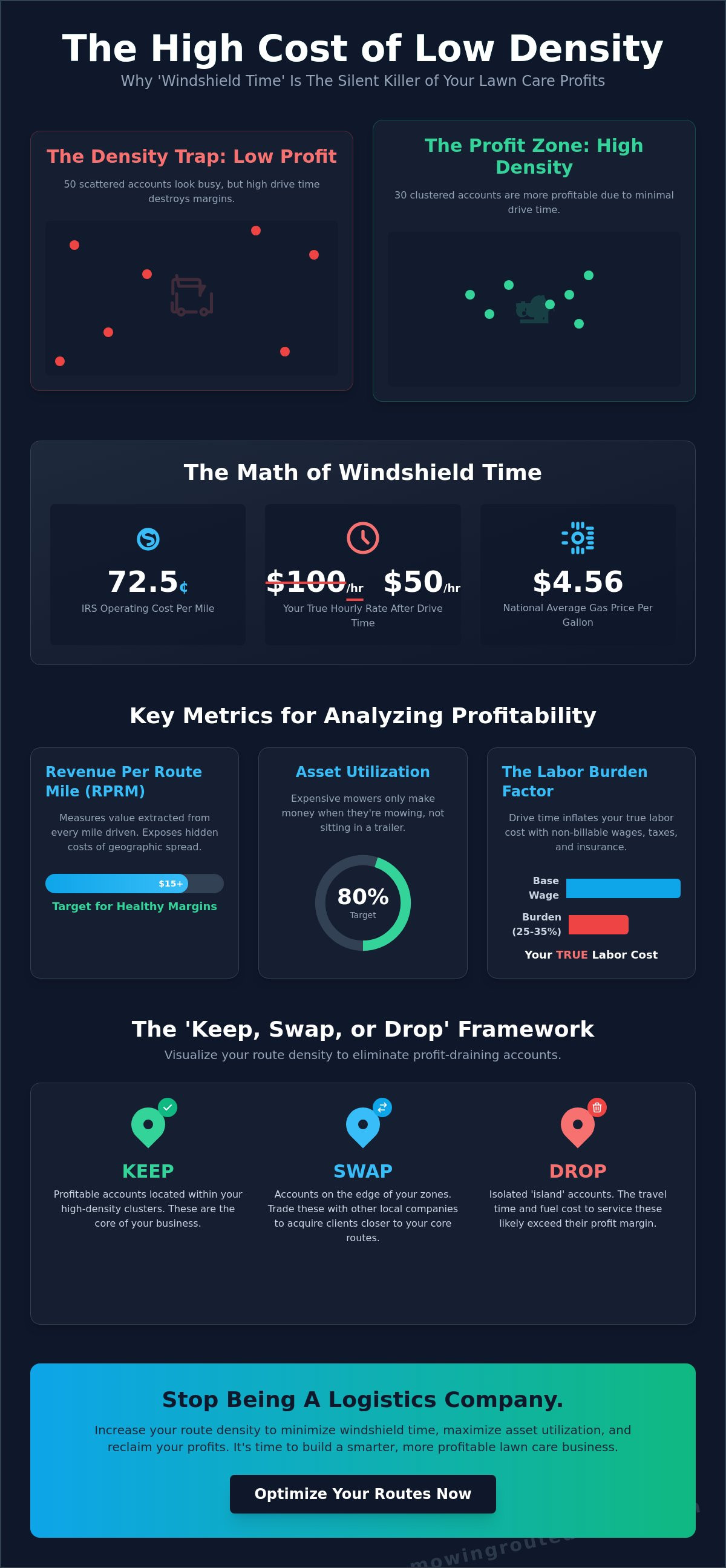
Windshield time is the silent killer of landscaping profit margins. It's a simple, brutal equation. Every minute your crew spends behind the wheel is a minute of non-billable labor and pure fuel burn. You're paying for their time, but no one is paying you for it. This is the "Density Trap." You might think 50 scattered accounts look good on paper, but 30 clustered accounts are almost always more profitable. You've eliminated the waste. You've tightened the schedule. You've stopped the bleeding.
When analyzing lawn route profitability, you must look at your true hourly rate. Most owners make the mistake of only looking at the time spent on the turf. That's a fantasy. Your true hourly rate is calculated as: Total Revenue / (Mowing Time + Drive Time). If you charge $50 for a 30-minute mow but spend 30 minutes driving to get there, your $100 per hour rate just crashed to $50 per hour. That's before you factor in the $4.56 per gallon gas price or the 72.5 cents per mile IRS operating cost. You aren't just losing time; you're losing equity in your vehicles.
The Opportunity Cost of Travel
Travel time is non-billable labor. If your crew earns $25 per hour, a 20-minute drive costs you over $8 in wages alone. Add in the labor burden of taxes and insurance; that cost jumps quickly. Then there's the "Dead Zone." This is the specific distance where the cost of travel exceeds the profit margin of the job. If you're driving 15 miles for a $45 mow, you're likely paying the customer for the privilege of cutting their grass. Identify these losers. Cut them loose.
Identifying the Logistics Bottleneck
Efficiency starts with a hard audit. Look for geographic outliers that pull your trucks away from your high-density hubs. This is a classic Vehicle Routing Problem; you're trying to find the optimal path to minimize cost while hitting all stops. Measure your "Stop-to-Stop" time. This is the total time from the moment you leave one job until you arrive at the next. Compare this to your "Gate-to-Gate" time, which is the actual time the mowers are running. If your stop-to-stop time exceeds 15% of your day, your logistics are broken. Your expensive commercial mowers are sitting idle in a trailer. They only make money when they're on the turf. Stop being a driver and start being a profitable operator.
Key Metrics for Analyzing Lawn Route Profitability
Success isn't measured by the size of your client list. It's measured by the efficiency of your operations. If you aren't tracking the right numbers, you're flying blind. Analyzing lawn route profitability requires moving beyond simple revenue totals. You need to look at how much value you extract from every mile and every hour. High revenue is meaningless if your overhead consumes every dollar.
Asset utilization is a critical factor for your bottom line. Your commercial mowers are expensive investments. A Toro Z Master 2000 HDX costs around $11,000, and it only generates revenue when the blades are spinning. If your equipment sits on a trailer for four hours a day, you're wasting capital. High-performance teams aim for 80% asset utilization. Anything less suggests a logistics failure. When your equipment needs exceed your current fleet, consider tactical mower rentals to maintain density without the long-term debt of ownership.
Revenue Per Route Mile (RPRM)
Revenue Per Route Mile is defined as your total daily revenue divided by the total miles driven from the shop and back. This metric is more important than total revenue for scaling because it exposes the hidden costs of geographic spread. A high total revenue figure can mask a failing business if the mileage required to earn it is excessive. For 2026, aim for a target RPRM of $15 or higher to maintain healthy margins. If your RPRM is slipping, your route is likely too thin to sustain long-term growth.
The Labor Burden Factor
Labor is your largest expense. It's more than just an hourly wage. You must account for the "labor burden," which includes payroll taxes, workers' compensation, and benefits. According to the Cornell University Business Planning Guide, these costs often add 25% to 35% on top of base wages. Drive time inflates this burden significantly. You're paying for insurance and taxes while your crew sits in traffic. This "non-billable" time raises your break-even billable rate. To stay profitable, your on-site rate must cover the dead time spent in transit. If your labor cost is $40 per hour fully burdened, and your crew only spends 60% of their day mowing, your effective cost is actually $66 per hour. Your pricing must reflect this reality or your margins will vanish.
Finally, consider your Man-Hour Rating. This is the total revenue one person generates in a standard 10-hour shift. In 2026, with labor costs ranging from $35 to $70 per hour, a solo operator needs to generate at least $600 to $800 per shift to remain viable. High-density routes make this possible. Low-density routes make it impossible. Stop chasing every lead. Start chasing proximity.
The 'Keep, Swap, or Drop' Framework
Data without action is just a hobby. You've looked at the numbers. You've realized your RPRM is lower than it should be. Now you have to make the hard cuts. Analyzing lawn route profitability requires a spatial audit. Map every account. Use a physical map or a digital tool to visualize your geographic clusters. If an account sits alone on the edge of town, it's an "Island." It doesn't matter if the customer pays on time. It doesn't matter if the lawn is easy. If it's an Island, it's a liability.
Calculating the true margin on these Islands often reveals a net loss once you factor in the 72.5 cents per mile operating cost. You aren't just losing fuel. You're losing the opportunity to service three more houses in your "Anchor" neighborhoods. This is where the SBA Financial Projections Guide becomes useful; it helps you forecast the long-term impact of these logistical drains on your annual bottom line. Every mile driven is a mile away from your core profit center. Tighten the map. Secure the perimeter.
When to Drop a Profitable Account
Apply the '15-Minute Rule.' If travel to a job exceeds 15 minutes, the profit margin on that job must be double your average. If it isn't, you're subsidizing that client's lawn. This creates "Service Drag." One far-flung client delays the whole crew. It pushes your final stops into the evening. It kills morale. Your team wants to work, not sit in traffic. A frustrated crew is a crew that quits. Don't let a single outlier destroy your labor retention. If the math doesn't work, the account doesn't stay.
Account Trading: The Strategic Pivot
Growth doesn't always come from marketing. Marketing is expensive and slow. Account trading is immediate. If you have an Island account, chances are a competitor is already working in that neighborhood. Swapping that account with them for one in your cluster is a win-win. You trade a logistics headache for a high-density asset. Using a specialized lawn account trading platform allows you to fix your density issues in days rather than months. It's a strategic pivot. You're selling your outliers to contractors who are already there and buying their outliers that are already in your backyard. This is how you build a dominant presence in a specific neighborhood without spending a dime on flyers. Focus on your Anchor neighborhoods. Let the competition handle the rest.
Operational Levers: Rental vs. Asset Ownership
Ownership is a vanity metric. Profit is a sanity metric. Many contractors fall into the trap of buying a fleet they only fully utilize for three months of the year. They take on 60-month loans for equipment that sits idle during the off-season. This is dead capital. Analyzing lawn route profitability requires you to look beyond the equipment's shiny paint and focus on its cost per billable hour. If your mower isn't running, it's costing you storage, insurance, and interest. It's a liability; not an asset.
Tactical rental allows you to scale your route without the anchor of massive debt. You can deploy high-quality commercial mowers specifically when your route density justifies it. This asset-light approach keeps your balance sheet clean. It gives you the flexibility to walk away from a neighborhood that isn't performing without being stuck with a payment. You're buying the utility of the machine. You aren't buying the headache of its long-term maintenance. Scale with logic. Not with loans. Check out our commercial mower rental options to stay lean while you grow.
Maximizing Fleet Flexibility
Renting specialized equipment for seasonal contracts eliminates the "Maintenance Gap." When an owned mower breaks, your crew stops. Your schedule collapses. When a rental mower has an issue, you swap it out and keep moving. This ensures your high-density routes stay on track. Rental also allows you to test new route clusters. Don't buy a $16,000 Exmark Lazer Z for a new neighborhood until you've proven the RPRM works. Rent first. Verify the math. Then commit.
The Financial Case for Asset-Light Operations
Equipment loans weigh down your credit and your cash flow. Rental fees are different. They are 100% tax-deductible operational expenses in the year they are paid. This simplifies your accounting and reduces your tax burden immediately. You avoid the slow grind of depreciation schedules. By choosing an asset-light model, you reduce the risk of "Over-Equipping" a route that hasn't reached peak density. You're matching your costs directly to your revenue. That's how you protect your margin.
Scaling via Mowing Route Density and Account Trading
Scaling a broken model only breaks it faster. If your route is spread thin, adding more trucks just adds more fuel and maintenance bills. True scale comes from dominating a zip code, not a city. Analyzing lawn route profitability reveals that the most successful contractors aren't the ones with the most flyers. They're the ones with the shortest drive times. You don't need more leads. You need better geography.
Stop trying to grow through organic marketing alone. It's slow and expensive. Instead, use a marketplace to buy accounts that fit your existing clusters. Sell your outlying accounts to contractors who are already in those neighborhoods. It's a strategic exchange. You're cleaning your map. You're tightening your perimeter. Rent additional mowers only when your density map proves the need for more boots on the ground. Don't buy a machine for a maybe. Rent for a definitely. If you have low-density areas you can't quite quit, leverage a B2B network. Use a service provider locator to find subcontractors who are already in those zones. Let them take the windshield time while you focus on your core clusters.
The Account Trading Marketplace
Valuing a lawn care account list is about more than just gross revenue. You must factor in logistics and revenue stability. An account that is two minutes away from your current anchor is worth significantly more than one ten miles away. Perform your due diligence. Verify the payment history. Check the gate access. When you find accounts that don't fit your density goals, don't just drop them. Trade or sell your accounts on our marketplace. Turn your logistical headaches into cash or better-located assets. It's the fastest way to fix a fragmented route.
Your 2026 Growth Roadmap
Growth requires a methodical approach. Follow this three-phase plan to dominate your local market. Phase 1: Audit and map. Use the metrics we discussed to identify every island in your fleet. Phase 2: Swap and drop. Use the marketplace to trade your outliers for clustered accounts. Phase 3: Rent and scale. Once your density is locked in, add capacity with rental gear to handle the increased volume without taking on long-term debt. Focus on neighborhood domination rather than city coverage. One hundred houses in one neighborhood is a gold mine. One hundred houses spread across ten zip codes is a graveyard. Optimize your route density and rent commercial gear today. Stop driving. Start profiting.
Stop Driving and Start Dominating
You've seen the hard math. You know that windshield time is a leak in your bucket. Analyzing lawn route profitability isn't just about spreadsheets; it's about reclaiming your time and your margins. You must ruthlessly cut the "Islands" that drain your fuel and labor. Focus on Revenue Per Route Mile. Tighten your geographic footprint until every stop feels like a win. Every mile you save is money back in your pocket.
Don't let equipment debt or distant accounts hold you back. You have the tools to pivot. Use our B2B Marketplace for Route Trading to swap those outliers for clustered accounts. Leverage our Commercial-Grade Mower Rentals to scale without the weight of long-term loans. Connect with our National Contractor Network to find the right partners. It's time to stop acting like a delivery driver and start acting like a strategist. Efficiency is your only path to real growth.
Scale your business with our account trading platform and mower rentals. The math doesn't lie. Your most profitable season is waiting on the other side of a tighter route map. Go get it.
Frequently Asked Questions
How do I calculate route density for my lawn care business?
Density is calculated by dividing your total number of accounts by the total miles driven in a day. You want this number as high as possible. If you service 10 yards over 100 miles, you're a courier. If you service 10 yards on one block, you're a profitable operator. High density reduces the 72.5 cents per mile cost of operation that eats your profit. Use a map to visualize clusters.
What is a good profit margin for a residential mowing route?
A healthy residential mowing route should aim for a gross profit margin between 50% and 60%. This is only achievable if you control your labor burden. Remember that taxes and insurance add 25% to 35% on top of base wages. If your drive time is high, your margin will vanish into the $4.56 per gallon national average fuel cost. Tighten the route to protect the bottom line.
Is it better to buy existing lawn care routes or grow organically?
Buying or trading accounts is the fastest way to achieve density. Organic growth through marketing is slow and often results in scattered island accounts. Analyzing lawn route profitability shows that acquiring a cluster of 10 houses in one neighborhood is more valuable than signing 20 houses across five zip codes. Use a trading platform to swap your outliers for local clusters and skip the marketing grind.
How can I reduce drive time between my landscaping jobs?
Reduce drive time by ruthlessly cutting island accounts that sit more than 15 minutes away from your core clusters. You can swap these outliers with local competitors who are already in those areas. This is a win-win. You trade a logistics headache for a job next door. Using an account trading platform makes this process immediate. Stop being a driver. Start being a mower.
What are the benefits of renting commercial lawn mowers vs. buying?
Renting commercial gear eliminates the maintenance gap and keeps debt off your balance sheet. When an owned mower breaks, your crew stops. When a rental mower fails, you swap it for a fresh one. Rental fees are also 100% tax-deductible as operational expenses. It allows you to scale up for high-density contracts without the long-term risk of an $11,000 equipment loan. Stay lean while you grow.
How much is a lawn care account list worth when selling?
A lawn care account list is often valued at 2 to 4 times the monthly recurring revenue. However, density is the ultimate multiplier. A clustered list in a single neighborhood commands a higher price than a scattered list of the same total value. Buyers are looking for efficiency. They want to buy profit; not a logistics nightmare. Prove your Revenue Per Route Mile is high to maximize your sale price.
Can I swap landscaping accounts with other contractors legally?
Yes, swapping accounts is a legal and strategic way to optimize your route. It requires a clear agreement and a professional handoff to maintain client continuity. Using a dedicated lawn account trading platform provides the framework for these transactions. It's often the only way to fix a fragmented route without losing revenue. You're trading geography, not just customers. It's a common sense remedy for business waste.
What metrics should I track to see if a specific lawn job is profitable?
Track Revenue Per Route Mile and your Man-Hour Rating for every job. Analyzing lawn route profitability requires knowing exactly how much revenue one person generates in a shift. If a job has a high gate-to-gate time but a massive stop-to-stop time, it's a loser. Your target should be at least $15 per route mile to cover the 72.5 cents per mile IRS rate and rising fuel costs.


