Why are you paying $5.35 per gallon for diesel to haul heavy iron that sits idle half the year? In 2026, a massive equipment yard is often a liability, not an asset. You didn't start this business to become a full-time mechanic or a slave to depreciating machinery. With commercial auto insurance premiums spiking by as much as 30% this year, the old way of scaling is broken. Adopting a landscaping fleet asset-light strategy is the only way to protect your bottom line. It's time to stop the bleed.
I understand the frustration of high monthly loan payments and the waste of paying for off-season storage. You need the agility to scale up or down without the anchor of fixed overhead. This article delivers a 2026 growth checklist designed to slash your debt-to-income ratio and maximize profit per account. We will break down how to leverage lawn mower rental and account trading to build a leaner, more profitable operation. You'll learn to focus on owning the customer relationship, not the mower. It's about working smarter, not just harder.
Key Takeaways
- Identify and liquidate "zombie" assets that drain cash flow through depreciation and off-season storage. Learn to audit your fleet with clinical precision to stop paying for iron that isn't earning.
- Implement a landscaping fleet asset-light strategy to shift your focus from owning machinery to owning high-margin routes. Build an agile operation that scales without the burden of heavy equipment debt.
- Use a tactical framework to determine the "utilization threshold" for your gear. Know exactly when to buy and when lawn mower rental offers a superior return on investment for your bottom line.
- Leverage a lawn account trading platform to increase route density and eliminate fuel waste. Tighten your geographic clusters to ensure every billable hour is maximized for profit, not travel time.
- Follow a 10-step transition checklist to transform your business into a lean, profit-driven machine. Gain the strategic foresight to scale up or down based on 2026 market volatility.
The Hidden Cost of Ownership: Why Your Landscaping Fleet is Bleeding Profit
Owning a massive fleet used to be a sign of success. In 2026, it's a sign of stagnation. The "Asset-Heavy Trap" is simple: you buy more equipment to handle more work, but the overhead eats the growth. You end up working for your equipment, not the other way around. Every truck in the yard and every mower on the trailer represents locked-up capital that isn't working for you. This is the fundamental flaw of the "Iron-First" philosophy. It prioritizes the tools over the profit margin. A "Route-First" approach flips this. It focuses on density and customer acquisition before committing to a single monthly payment.
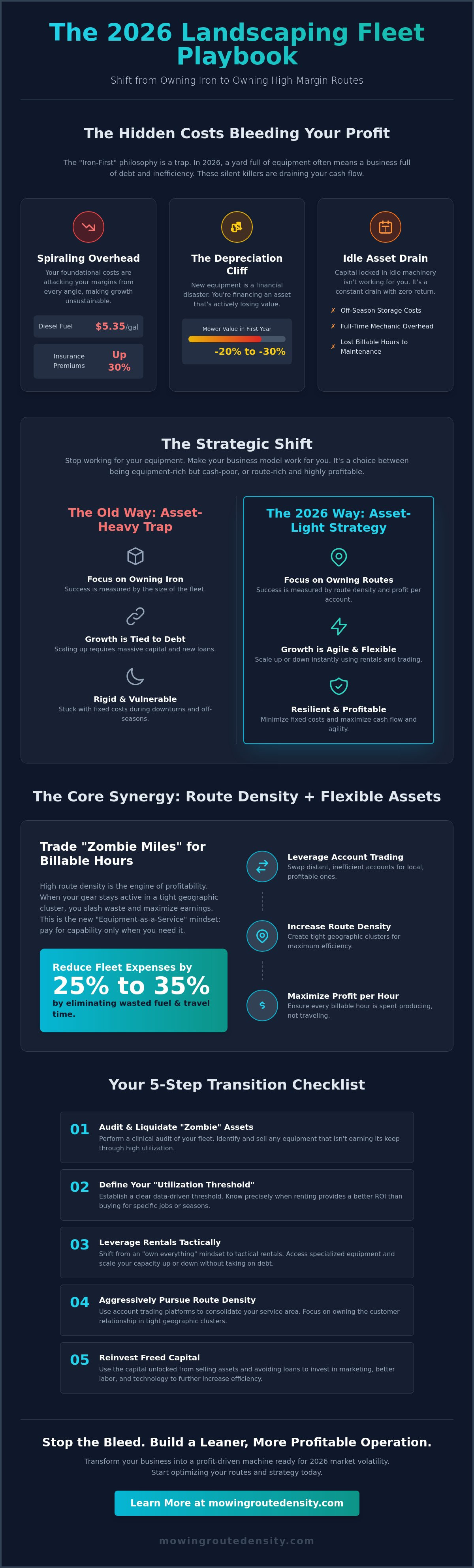
Traditional ownership limits your ability to pivot. When the market shifts or a major contract falls through, you're still stuck with the debt. You can't just turn off a loan payment like you can a subscription. This lack of agility is why a landscaping fleet asset-light strategy is becoming the industry standard for survival. You need to identify the "Silent Killers" before they sink your business. With commercial auto insurance premiums projected to rise by as much as 30% through 2026 and diesel sitting at $5.35 per gallon, the cost of just having a fleet on the road is higher than ever. Then there's storage. Paying to house gear during the off-season is pure waste. It's money down the drain with zero ROI.
The Depreciation Cliff and Capital Lock-up
New commercial mowers are a financial disaster the moment they leave the dealer. They lose 20-30% of their value in the first year alone. In a high-interest rate environment, financing that equipment is even more dangerous. You're paying a premium for an asset that is actively losing value. This is where lawn care profit margin optimization starts. It begins by reducing overhead and freeing up cash. Locked-up capital prevents you from investing in marketing or better labor. You're equipment-rich but cash-poor. That's a dangerous way to run a business.
The Maintenance and Labor Overhead
The "I need to own it to control it" mindset is a myth. Ownership doesn't give you control; it gives you responsibility for every breakdown. A full-time mechanic is a massive fixed cost. When you factor in benefits, shop space, and tools, the bill is staggering. Transitioning to an asset-light model allows you to outsource that headache to rental providers. There's also the hidden labor cost of moving idle equipment. Every hour your crew spends shuffling gear between sites instead of mowing is a lost billable hour. Stop paying people to manage your iron. Start paying them to produce results. A landscaping fleet asset-light strategy removes these bottlenecks and puts the focus back on production.
Defining the Asset-Light Strategy: Leveraging Route Density over Iron
An asset-light strategy isn't about being small. It's about being efficient. In the 2026 market, this framework focuses on securing high-margin routes while maintaining flexible access to equipment. You stop being an equipment owner who happens to mow lawns. Instead, you become a logistics expert who owns the customer relationship. This shift allows you to dodge the 30% spike in insurance premiums and the volatility of $5.35 per gallon diesel. By decoupling your growth from your equipment debt, you create a business that can breathe. You prioritize cash flow over "shiny object" syndrome.
The synergy between route density and equipment utilization is the core of this model. If your mower isn't spinning blades, it's costing you money. High route density ensures that your gear stays active in a tight geographic area. This reduces the 25% to 35% of fleet expenses typically lost to fuel and travel. Smart contractors in 2026 are aggressively using a lawn account trading platform to swap distant accounts for local ones. They are trading "zombie miles" for billable hours. This is the new "Equipment-as-a-Service" mindset. You pay for the capability when you need it, rather than the burden of owning it 365 days a year.
The Power of Route Density
Route density is the ratio of billable hours to travel hours. It's the single most important metric in your business. Analyzing lawn route profitability dictates exactly how much iron you actually need. When your accounts are clustered, you need fewer trucks and fewer trailers to hit the same revenue targets. High density allows you to run smaller, specialized fleets that stay on-site longer. You stop paying crews to sit in traffic. You start paying them to produce profit.
Strategic Equipment Sourcing
You must differentiate between core assets and peak demand gear. Your core assets are the machines you use every single day. Everything else is a liability. Using professional lawn equipment rental allows you to handle seasonal surges without taking on long-term debt. This is the shift from CapEx to OpEx. You treat equipment as an operating expense that scales with your revenue. If the work isn't there, the expense disappears. This flexibility is the only way to maintain a healthy debt-to-income ratio in an uncertain economy. Don't buy for the "what if." Rent for the "right now."
Ownership vs. Rental: A 2026 Framework for Equipment Acquisition
In 2026, cash is your most valuable tool. Financing a fleet of mowers is a five-year commitment to a depreciating pile of iron. High interest rates make traditional equipment loans a heavy burden on your monthly cash flow. Buying makes sense for your "daily drivers," but tactical rental is the surgical strike you need for everything else. You pay for the work, not the metal. This approach keeps your balance sheet clean. A lean debt-to-income ratio makes you more attractive to banks when you actually need a business loan for expansion, not just for maintenance.
The "Technology Risk" is another factor often ignored. Landscaping technology is evolving faster than ever. From autonomous mowers to high-capacity battery systems, the gear you buy today might be obsolete in three years. Owning a massive fleet locks you into old, inefficient technology. A landscaping fleet asset-light strategy allows you to cycle through the latest equipment without the sting of resale loss. You stay competitive. You stay efficient. You let the rental companies deal with the rapid cycle of equipment obsolescence.
The 60% Utilization Rule
Equipment sitting idle 40% of the time is a financial failure. It's a "zombie asset" that eats profit while doing nothing. To calculate your utilization rate, divide your billable hours per asset by the total available work hours in a week. If that number is below 60%, you shouldn't own it. Buying for the "busy season" is a mistake. Use lawn mower rental to cover your peak demand while keeping your owned assets running at 100% capacity. This ensures every piece of owned iron is earning its keep every single day.
Risk Mitigation and Agility
Economic downturns happen. When they do, the asset-light contractor has the ultimate advantage: they can just give back the keys. You can't do that with a bank loan. This model also allows for rapid geographic expansion. If you want to test a new market 50 miles away, you don't need to buy a new truck and trailer set. You rent the gear locally. This reduces your entry risk to almost zero. Breakdowns are no longer a crisis either. If a rental unit fails, the provider swaps it out. You don't need a backup fleet taking up space in your yard. You maintain your landscaping fleet asset-light strategy and keep the crews moving without the overhead of "just in case" machinery.
The Asset-Light Transition Checklist: 10 Steps to a Leaner Operation
Transitioning to a landscaping fleet asset-light strategy isn't an overnight switch. It's a calculated retreat from waste. It requires a cold, hard look at your balance sheet. You have to be willing to kill off the "zombie" assets that feel like security but act like anchors. Every piece of equipment that isn't generating billable hours 80% of the time is a drain on your focus and your cash. Stop the bleed. Follow this roadmap to reclaim your margins.
Phase 1: The Operational Audit
You can't fix what you haven't measured. Step 1 is a total inventory audit. List every mower, truck, and trailer you own. Calculate the "all-in" monthly cost for each. This isn't just the loan payment. Include insurance, storage, and the average monthly maintenance bill. Step 2 is mapping your accounts. Identify the "dead zones" where travel time exceeds 20% of your crew's day. These geographic outliers are the primary cause of equipment wear and fuel waste. Step 3 is categorizing your gear. Define your "Core Fleet" as the machines that run every single day. Everything else belongs in the "Variable Fleet." This distinction is critical for your 2026 growth.
Phase 2: Execution and Optimization
Now, you cut. Step 4 is the purge. Sell off any equipment used less than three days a week. Use that working capital to pay down high-interest debt or build a cash reserve. Step 5 is where you "buy" density. Use a lawn account trading platform to swap distant accounts for local ones. Shrink your footprint to expand your profit. Step 6 is establishing a relationship with a national equipment rental partner. You need a reliable source for specialized gear on a just-in-time basis. Step 7 is reinvestment. Take the money you saved on iron and put it into high-performing sales and marketing.
Step 8 requires you to liquidate outlier accounts that cannot be traded. If a route doesn't have the density to support your landscaping fleet asset-light strategy, drop it. Step 9 is the implementation of a strict "rental-first" policy for all new contracts. Don't buy a new machine until the contract revenue justifies the debt twice over. Finally, Step 10 is a monthly review of your debt-to-income ratio. Your goal is a business that is agile, liquid, and ready to pivot. Own the route. Rent the iron. Scale the profit.
Scaling Without the Weight: Leveraging the Mowing Route Density Ecosystem
Adopting a landscaping fleet asset-light strategy is a competitive necessity in 2026. The industry is no longer about who has the biggest trailer. It's about who has the tightest route. The Mowing Route Density platform provides the infrastructure to make this transition possible. It moves your business away from the "Iron-First" trap and toward a model where every asset is maximized. You don't need to struggle with the logistics of downsizing alone. This ecosystem is built to replace heavy debt with high-velocity cash flow.
The platform functions as a strategic hub for the modern contractor. By utilizing the lawn account trading platform, you can actively shape your service area rather than just accepting whatever work comes your way. This isn't just about growth. It's about pruning the waste. When you use the lawn mowing service provider locator, you find the right partners to fill gaps in your schedule without adding more permanent overhead. You gain the ability to scale up for a massive commercial contract or scale down during a drought without the pressure of fixed loan payments. The future of landscaping is lean, dense, and debt-free.
For contractors taking on these larger commercial developments, ML Traffic Engineers UK offers specialized transport planning and traffic engineering documentation to support planning applications and ensure site access is professionally managed.
Trading Accounts for Maximum Density
Route density is your ultimate weapon against $5.35 per gallon diesel and rising labor costs. Our marketplace allows you to swap a distant, "outlier" account for one right next door to your core cluster. This isn't just a convenience. It's a massive reduction in fleet wear and tear. Clustered accounts mean your trucks spend more time parked and your mowers spend more time spinning. You eliminate the "zombie miles" that kill your profit margins. In 2026, the contractor with the shortest drive time wins every single time.
Renting for Scalability
Landing a large commercial contract shouldn't require a $100,000 equipment investment. That's a legacy mindset that invites unnecessary risk. Through our platform, you can access lawn mower rental options that match your contract's specific needs. You pay for the equipment only while it's earning you money. The rental process is designed for speed and simplicity. You get the gear, finish the job, and give back the keys. This keeps your balance sheet clean and your business agile. Don't let a lack of iron stop you from bidding big. Start optimizing your fleet and routes today and build a business that works for you, not the bank.
Take Command of Your Margins Today
The era of "bigger is better" in landscaping equipment is over. You now have the blueprint to stop hemorrhaging cash on idle machinery and high-interest loans. By liquidating zombie assets and focusing on route density, you transform your business into a high-margin, agile operation. Implementing a landscaping fleet asset-light strategy allows you to thrive in a volatile 2026 market by keeping your capital liquid and your overhead low. You are no longer just a mower; you are a logistics strategist.
Stop playing defense with your cash flow. Our national commercial mower rental network gives you the gear you need only when you need it. Our secure lawn account trading marketplace helps you cut travel time by clustering your accounts with surgical precision. These peer-to-peer business efficiency tools ensure you never pay for a machine that isn't actively earning. You've identified the waste. Now, it's time to cut it out for good.
The path to a leaner, more profitable future is one click away. Optimize your fleet and trade for density on the Mowing Route Density platform. It's time to work smarter and own the route, not the iron. You have the tools to win.
Frequently Asked Questions
What is an asset-light strategy for landscaping?
It's a business model that prioritizes owning the customer relationship and route density over owning heavy machinery. Instead of taking on debt for a massive fleet, you use flexible equipment access like lawn mower rental to handle production. This strategy reduces fixed overhead and allows you to pivot quickly when market conditions change. It's about being a logistics expert first and an equipment owner second.
Is renting commercial mowers really cheaper than owning them?
It's often cheaper when you factor in the "silent killers" like 20-30% first-year depreciation and rising insurance premiums. Ownership is a 365-day expense; rental is a billable-hour expense. If a mower sits idle for 40% of the year, the cost per hour of ownership sky-rockets. Tactical rental eliminates storage, off-season maintenance, and the risk of technology obsolescence. You pay for the work performed, not the metal in the yard.
How does route density affect my fleet management costs?
High route density is the only way to neutralize $5.35 per gallon diesel and labor waste. When your accounts are clustered, your trucks stay parked and your mowers stay active. This reduces the 25% to 35% of fleet expenses typically lost to fuel and travel. A successful landscaping fleet asset-light strategy relies on tight geographic clusters to minimize the number of trucks and trailers needed to service your book of business.
What is the best way to transition from an asset-heavy to an asset-light model?
Start with a cold, hard audit of your current equipment utilization. Identify "zombie assets" that earn less than they cost in monthly payments and maintenance. Liquidate underutilized gear to free up working capital and pay down debt. Simultaneously, use a lawn account trading platform to swap distant accounts for local ones. This process tightens your operations and creates the cash flow needed to scale using a rental-first approach.
Can I scale a national landscaping business without owning equipment?
You can scale by focusing on being a high-level service orchestrator. Manage large portfolios by leveraging a lawn mowing service provider locator to find local partners and using national rental networks for specialized gear. This allows you to enter new markets without the massive capital expenditure of buying new trucks. You own the contracts and the quality control, while the equipment burden stays with the rental providers and subcontractors.
How do I know which equipment to sell and which to keep?
Follow the 60% utilization rule. If a piece of equipment isn't running at least three days a week during your peak season, it's a liability. Keep your "daily drivers" that stay at 100% capacity. Sell the specialized or "backup" gear that spends most of its time in the shop or the yard. You can always use lawn mower rental to cover seasonal surges or specific project needs without carrying the year-round debt.
What role does account trading play in fleet optimization?
Account trading is the engine that drives route density. It allows you to surgically remove "outlier" accounts that are too far from your core service area. By trading these distant accounts for ones closer to your existing routes, you reduce travel time and wear on your fleet. This optimization means you can service more clients with fewer machines. It's the most effective way to lower your total cost of ownership.
How much can I save by reducing my landscaping fleet size?
Savings vary, but reducing your fleet can slash your fixed overhead by thousands of dollars monthly. You eliminate high-interest loan payments, off-season storage, and the projected 30% increase in commercial auto insurance premiums. Beyond the direct costs, you save on the "hidden" labor of moving idle equipment. Freeing up this capital allows you to reinvest in marketing and sales, which drives higher-margin growth than a yard full of iron ever will.


