
Every minute your mower blades aren't spinning, your profit is bleeding out onto the asphalt. It's a harsh reality. Most owners think growth means more trucks and more territory. They're wrong. Expansion without concentration is just a faster way to go broke. Learning how to build a dense lawn care route is the only way to protect your bottom line in a market where the average net profit margin often struggles to stay between 10% and 15%.
You're tired of watching fuel consumption and unproductive labor hours erase your hard work. We agree. Windshield time is a waste of your crew's talent and your company's capital. It puts unnecessary wear on your equipment and adds zero value to your customers. This article delivers a pragmatic framework for clustering accounts and tightening your operations for peak profitability. You'll learn how to engineer a route where the mower rarely leaves the ground. We will cover the mechanics of account trading, the logic of geographic clustering, and how to scale your reach without the massive overhead of buying more trucks.
Key Takeaways
- Stop treating windshield time as an unavoidable cost; it is a profit-killing inefficiency that can be engineered out of your schedule.
- Learn how to build a dense lawn care route by utilizing account trading platforms to swap high-maintenance outliers for profitable, neighboring properties.
- Implement hyper-local marketing strategies like the "Nine-Around" method to ensure your mower blades stay on the ground while your trucks stay parked.
- Adopt an asset-light growth model by using commercial equipment rentals to service new clusters without the burden of long-term fleet debt.
What is Lawn Care Route Density and Why Does it Rule Your Bottom Line?
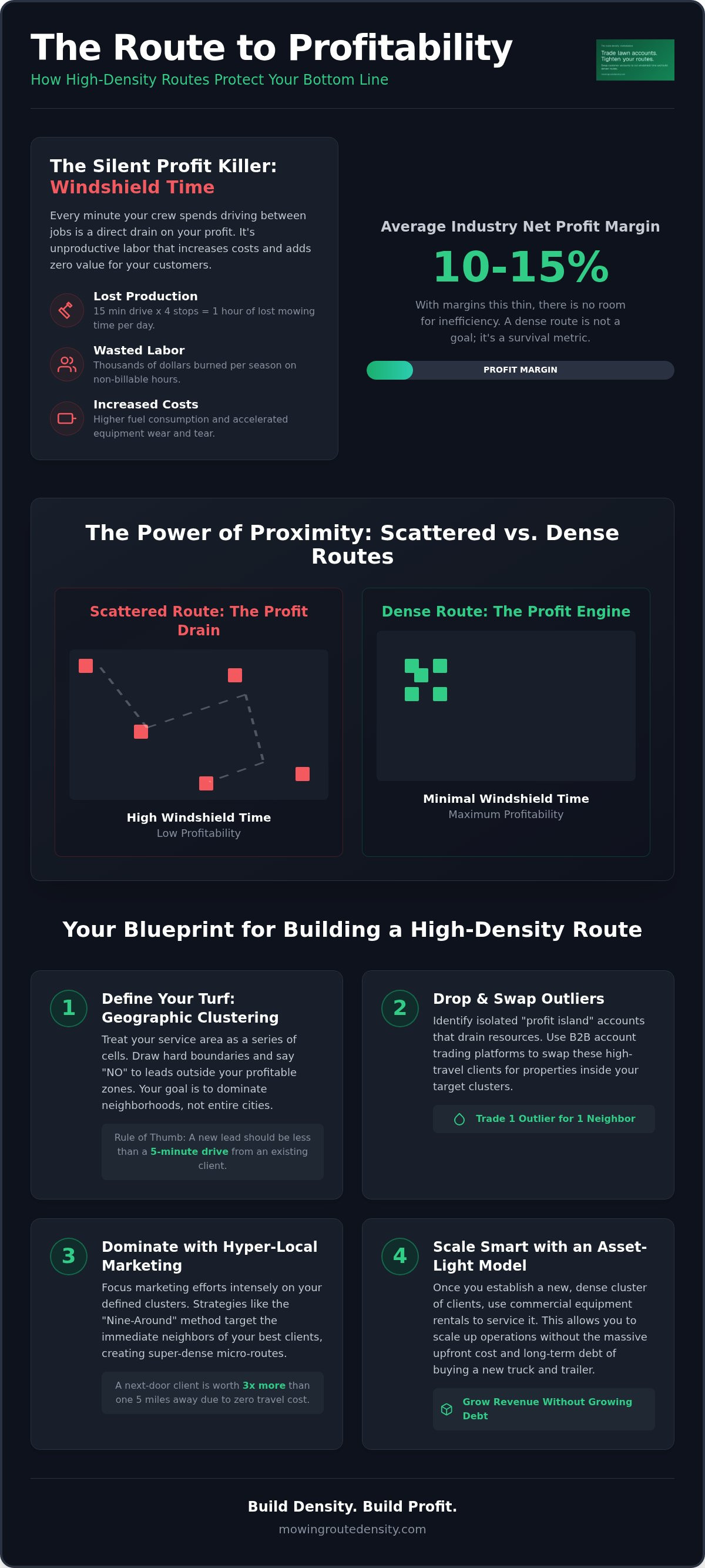
Route density is the ratio of billable mowing time to total shift time. It's the only metric that truly determines if you're a business owner or just a driver with a mower. If your crew is in the truck, they aren't making money. They're spending it. Every minute of windshield time is a minute of unpaid labor. It is theft from your net profit. Imagine five yards on a single cul-de-sac versus five yards scattered across ten miles. The labor is the same. The revenue is the same. But the profit? It's not even close. In 2026, with average net profit margins hovering between 10% and 15%, you can't afford to be a transport company that happens to cut grass. You need to know how to build a dense lawn care route to survive. This logistical challenge is a real-world application of the Vehicle Routing Problem, where the goal is to minimize the distance traveled between stops.
Fuel and labor costs in 2026 have turned efficiency from a goal into a survival metric. When gas prices spike and labor remains scarce, your margins disappear in the gaps between jobs. Understanding how to build a dense lawn care route requires a shift in mindset from "service provider" to "logistics strategist." You're no longer just looking for grass to cut; you're looking for clusters to dominate.
The Silent Cost of Windshield Time
Think a 15-minute drive between jobs is harmless? It isn't. Multiply that by four stops a day. That is an hour of lost production. At current labor rates, you're burning thousands per season in windshield time. That doesn't include fuel or trailer maintenance. It doesn't account for tire wear or oil changes. One extra yard per day, at a national average of $55 to $85, adds significant annual revenue per truck. Stop donating your profit to the gas station.
Defining Your Ideal Route Radius
Density starts with saying "no." Establish a maximum drive-time rule for new leads. If it's more than five minutes from an existing stop, it's an outlier. You need anchor accounts. These are high-value properties that justify a crew's presence in a specific cell. Once an anchor is set, every new lead must be within a tight radius. Route density is the primary driver of marginal utility in landscaping. You aren't just looking for clients; you're looking for neighbors. If you have an outlier that's killing your efficiency, use a B2B account trading platform to swap it for something closer.
The Logistics of Asset Clustering: Engineering Your Service Area
Profit isn't found in the total number of yards you mow. It is found in the space between them. Asset clustering is the practice of treating your service area as a series of distinct geographic cells rather than a wide net. When you focus your marketing and labor on a tight cluster, you create an environment where your crew spends more time mowing and less time driving. This is the foundation of how to build a dense lawn care route. A house next door to an existing client is worth triple a lead five miles away. Why? Because the travel cost is zero. The equipment stays off the trailer. The engine stays warm. The labor stays productive.
Analyze your current map today. You will likely find profit islands where you have four or five clients in a single neighborhood. You will also see dead zones where a single account sits isolated, miles from the nearest cluster. These outliers are draining your resources. You can use this guide on lawn care route density to audit your current operations and identify where you are losing money on transit. Tightening these gaps is the fastest way to increase your margins without raising prices.
Identifying High-Potential Clusters
Start by mapping every active account. Look for natural groupings. A high-potential cluster isn't just a group of houses; it's a neighborhood with stable demographics and similar lot sizes. These areas allow for standardized pricing and predictable service times. If an account doesn't fit into a cluster, it is an outlier. Outliers pull your crew away from the core. They increase fuel consumption. They decrease billable hours. Cut them or trade them. Focus only on the cells that offer the highest return on labor.
Setting Geographic Boundaries
You must draw hard lines on your map. Decide where you will no longer provide service. This requires a psychological shift. You have to say no to profitable work if it lacks density. A $60 mow that takes 30 minutes to reach is a net loss. It isn't growth; it's a distraction. If you receive a lead outside your boundaries, don't just ignore it. Use a lawn mowing service provider locator to find a partner who already services that area. Trading these leads keeps your route tight while maintaining professional relationships. If you want to stop bleeding cash, visit mowingroutedensity.com to find better ways to optimize your territory and reclaim your billable hours.
Trading Your Way to Density: The 'Drop and Swap' Method
Organic growth is a gamble. It is slow. It is passive. You're at the mercy of whoever happens to call you. That is no way to run a lean operation. If you want to master how to build a dense lawn care route, you have to stop waiting and start engineering. The fastest way to consolidate your territory isn't through door hangers. It is through strategic account trading. By using a lawn account trading platform, you can treat your client list like a professional portfolio. You drop the outliers that bleed your fuel budget. You swap them for accounts that sit directly in your target clusters.
The 'Drop and Swap' strategy is pure logic. You identify an account that is five miles away from your nearest stop. To you, that account is a liability. To a competitor whose shop is around the corner from it, that same account is a high-margin asset. You trade. You give them your outlier, and they give you one of theirs that sits in your "profit island." This is how you value a lawn care account. It isn't just about the monthly billings. It is about geographic proximity to your existing labor. A $50 mow in your cluster is worth more than a $75 mow that requires a 20-minute drive. Buying existing routes in specific neighborhoods allows you to instantly dominate a cell without the lead-generation lag.
Leveraging the Route Marketplace
Don't assume your competitors are enemies. In the world of logistics, they are potential partners. Many contractors are struggling with the same "dead zones" you are. Use the marketplace to find these operators. Negotiate swaps that improve margins for both businesses. Always perform due diligence before closing a trade. Check the customer's payment history. Verify the service expectations. A bad customer in a good location is still a bad customer. Focus on quality accounts that fit your equipment and crew capabilities.
Selling Your Outliers for Liquidity
Sometimes you won't find a direct swap. In that case, sell the outlier. Turn that inefficient account into immediate cash. Use that capital to fund aggressive, hyper-local marketing in your core zones. This is a tactical application of a lawn care business exit strategy applied to specific route segments. You are cutting the fat to strengthen the muscle. Account liquidity allows for rapid geographic pivoting, moving your resources from low-margin sprawl to high-density clusters in weeks instead of years.
Tactical Marketing for Neighborhood Dominance
Marketing for a lawn care business is often misunderstood as a broad-reach game. It isn't. If you want to know how to build a dense lawn care route, you have to stop thinking about zip codes and start thinking about house numbers. If your truck is parked in front of #12, you should already be targeting #10 and #14. This is hyper-local dominance. Every neighbor who sees your crew is a high-probability lead. They see the quality of the cut. They see the reliability of your schedule. Most importantly, they are already on your existing path. Capturing them requires the 'Nine-Around' strategy. Every time you sign a new client, place door hangers on the nine closest houses. This includes the three across the street, the two on either side, and the four behind. You are already there; the marketing cost per lead is virtually zero.
The Power of Physical Presence
Your truck and trailer are mobile billboards. In a high-end cluster, being seen every Tuesday morning builds more trust than a thousand Facebook ads. Neighbors notice consistency. They notice when a crew looks professional and the equipment is top-tier. Using professional lawn equipment rental allows you to keep your fleet looking modern and performing at peak efficiency without the massive capital outlay of ownership. Clean mowers and uniformed crews signal authority. They tell the neighborhood that you are the specialist for their specific street. Don't underestimate the silent salesperson parked at the curb.
Referral Loops and Cluster Discounts
Incentivize the density you want. Offer 'neighbor discounts' specifically for adjacent properties. If three houses on one cul-de-sac sign up, give them all a small break on the monthly rate. You aren't losing money; you're saving it on fuel and transit labor. The goal is to mow three yards in a row without ever moving the truck. This is where your profit margin jumps from the industry average toward the 20-25% range seen in optimized routes. Track your ROI based on cluster density, not just total lead volume. A lead five miles away is a distraction. A lead next door is a gold mine. Stop chasing sprawl and start owning the block. To find the tools you need to dominate your local market, visit mowingroutedensity.com and start tightening your route today.
Scaling Dense Routes with Asset-Light Equipment Strategies
Scaling a business is a high-risk maneuver. Many owners choke their cash flow by taking on massive equipment debt the moment they see growth. This is a mistake. If you are learning how to build a dense lawn care route, you must protect your liquidity. You don't need to own every asset to dominate a neighborhood. Use commercial lawn mower lease options to test the viability of a new cluster. If the density doesn't hit your targets, you aren't stuck with a monthly payment on a machine you don't need. Growth should be funded by profit, not high-interest liabilities.
Matching equipment size to your specific cluster is equally vital. Stand-on mowers are the gold standard for high-density residential routes. They offer better visibility and allow for faster mounting and dismounting at every stop. Zero-turns are for your large anchor accounts. Every second saved in the transition from truck to turf increases your margin. Use the 'Rental Buffer' to handle seasonal density spikes. Renting temporary units allows you to service more clients during the spring rush without carrying the overhead of an oversized fleet during the dormant season. It keeps your operation lean and your balance sheet clean.
Rental vs. Ownership in a High-Density Model
Ownership is often a trap. It carries the constant burden of maintenance, storage, and depreciation. Rental mowers allow you to add crews only when your route density justifies the additional labor. This model provides extreme flexibility. If a neighborhood cluster doesn't materialize as planned, you simply return the equipment. You reduce your maintenance overhead and keep your focus on logistics. Your goal is a lean, profitable machine; not a collection of aging hardware that requires constant repair.
Strategic Subcontracting for Density Gaps
Even the best-engineered routes will have gaps. Don't let a few isolated accounts destroy your crew's efficiency. Use our find lawn care subcontractors guide to identify partners who can handle your outliers. This keeps your primary crews locked into their high-density cells while you still collect a management fee on the distant properties. You maintain your brand standards without sacrificing your operational rhythm. Route density is the difference between having a stressful job and owning a profitable, scalable machine.
Tighten Your Route and Reclaim Your Margins
Sprawl is the enemy of your bottom line. You've learned that route density isn't something you wait for; it is something you engineer through aggressive clustering and tactical account trading. Stop letting windshield time steal your labor hours. Mastering how to build a dense lawn care route means making hard choices about where you work and who you serve. It requires a shift from chasing every lead to dominating specific neighborhood cells.
You have the framework. Now you need the tools. Access our national account trading platform to swap your outliers for local gold. Leverage our flexible commercial mower rental fleet to scale into new clusters without the weight of equipment debt. Connect with our B2B contractor network to fill your service gaps with reliable partners. Every minute saved in transit is a minute earned in profit.
Optimize your route density today on the Mowing Route Density marketplace. Your most profitable season is waiting just around the corner. Get to work.
Frequently Asked Questions
What is a good route density for a lawn care business?
High density means spending at least 80% of your shift with mower blades on the ground. If your crew drives more than 15 minutes between stops, your density is failing. You should aim for neighborhood clusters where stops are less than five minutes apart. This level of concentration allows you to push past the industry average and reach net profit margins of 20% or higher.
How do I fire a client that is too far away without losing money?
Don't just walk away; trade the account for cash or a closer lead. Use an account trading platform to offload the outlier to a contractor who already works in that specific area. This turns a logistical liability into immediate liquidity. You stop losing money on fuel and labor transit. You gain capital to reinvest in your core clusters. It is a clean break that protects your reputation.
Is it better to buy a lawn care route or grow one organically?
Buying a targeted route is the fastest way to achieve density. Organic growth is passive and often leads to geographic sprawl, which kills your margins. When you buy a route in a specific neighborhood, you instantly own the cluster. You skip the marketing lag. You eliminate the windshield time from day one. It is a strategic investment in immediate operational efficiency rather than a slow hope for referrals.
How can I reduce drive time if my clients are spread out?
You must aggressively consolidate your service area by cutting or trading outliers. Analyze your map and identify your profit islands. Stop taking leads outside these zones. If you have accounts scattered across town, use a "Drop and Swap" strategy to trade them for accounts closer to your home base. Tightening your radius is the only permanent cure for excessive drive time and bleeding margins.
What tools can help me calculate my route density?
Use route optimization software and GPS tracking to measure your billable versus non-billable hours. These tools reveal exactly how much time your crew spends in the truck. Calculate your revenue per mile to see the true cost of your current layout. Knowing how to build a dense lawn care route requires hard data, not guesswork. If the numbers show high travel time, your density is a financial drain.
Does route density really affect my profit margin that much?
Density is the single biggest factor in your profitability. While average margins stay between 10% and 15%, optimized routes can reach 25%. The difference is found in fuel savings, labor efficiency, and reduced equipment wear. Every mile driven is a cost with zero revenue. When you eliminate that waste, every dollar saved goes directly to your bottom line. Density turns a struggling job into a profitable machine.
How do I swap lawn care accounts with a competitor?
Use a B2B account trading platform to find local contractors with complementary dead zones. List your outliers and search for accounts that sit within your target clusters. Negotiate a swap based on monthly billing value and geographic proximity. It is a pragmatic solution that helps both businesses cut waste. You aren't losing a customer; you are trading a liability for a high-margin asset that fits your route.
Should I use different mowers for high-density residential routes?
Equipment choice must match your route's geography. Stand-on mowers are often superior for dense residential clusters because they offer faster mounting and better maneuverability in tight spaces. This speed reduces the time spent at each stop. If you aren't ready to buy, use commercial rental options to test different deck sizes. Matching the machine to the neighborhood is a key step in learning how to build a dense lawn care route.


