

Buying a lawn route isn't an investment until you've survived the first 90 days. Most owners treat an acquisition like a passive asset. They're wrong. The moment a customer sees a new face on their turf, they start looking for reasons to cancel. You didn't buy a business; you bought the opportunity to prove yourself. Implementing aggressive client retention strategies after buying lawn accounts is the only way to stop your capital from evaporating.
You likely expected clean data and loyal customers. Instead, you're dealing with inconsistent service logs and a route that wastes fuel. It's a logistical headache. This guide shows you how to protect your investment and stop customer churn during a route acquisition with high-density retention tactics. We'll cover how to maintain 90% retention through the first season, optimize your new route for maximum density, and scale operations using rental equipment to avoid heavy debt.
Key Takeaways
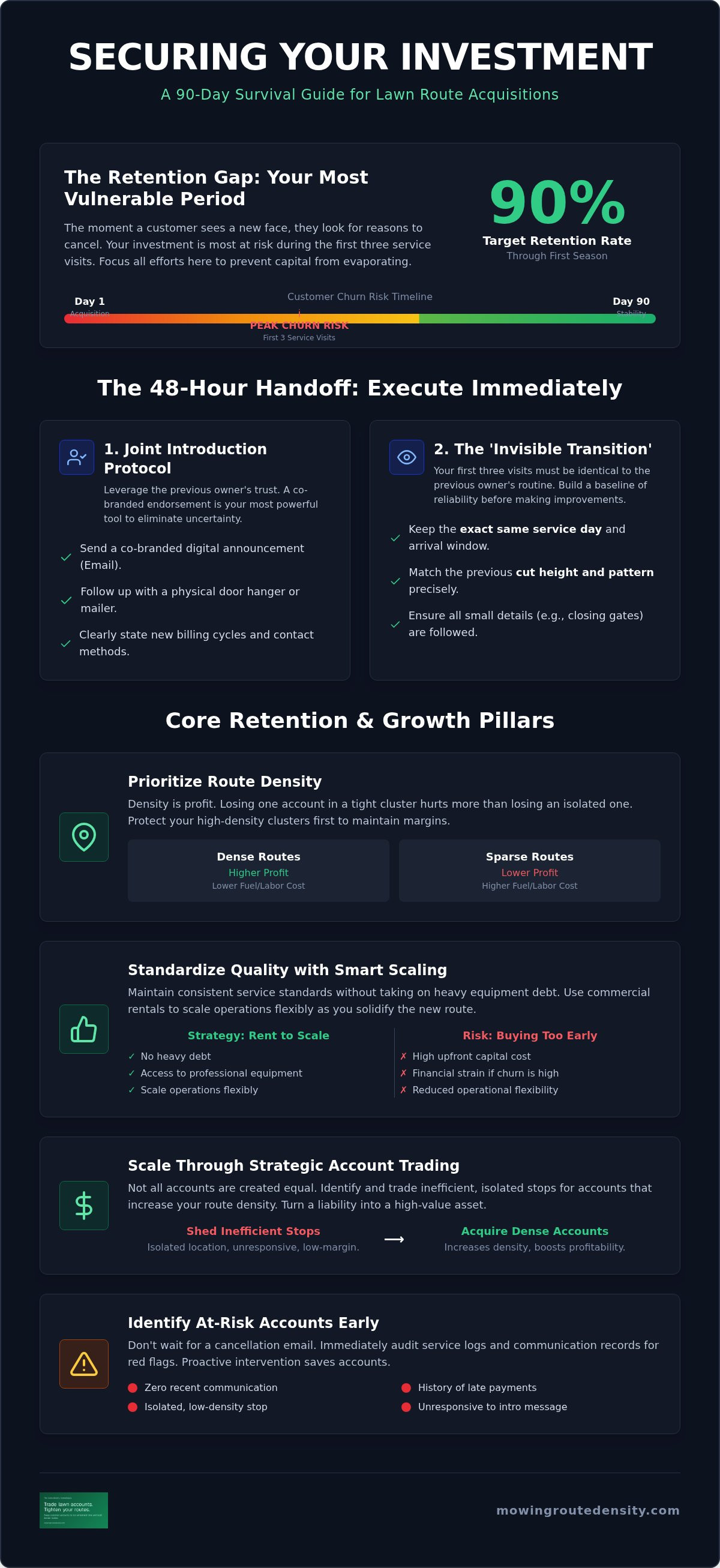
- Close the "Retention Gap" by focusing on the first three service visits when customer uncertainty and churn risks are at their peak.
- Execute a 48-hour handoff strategy using co-branded introductions and standardized quality protocols to establish immediate authority with new clients.
- Implement tactical client retention strategies after buying lawn accounts by prioritizing route density to ensure on-time service and higher profit margins.
- Maintain consistent service standards across your new portfolio by utilizing commercial mower rentals instead of taking on heavy equipment debt.
- Scale your operations through strategic account trading, shedding inefficient stops to focus on the density that drives bottom-line profitability.
The Retention Gap: Why Buying Lawn Accounts Fails Without a Plan
Buying a route is the easy part. Keeping it is the job. Most new owners fail because they ignore the "Retention Gap." This is the critical window between the wire transfer and the third service visit. It's the period where your investment is most vulnerable. Customers are naturally skeptical. They're waiting for you to mess up. If you don't have a plan, they'll find a reason to leave before your second invoice hits their inbox.
Customer churn peaks when uncertainty is high. Clients don't care about your business goals or your background. They care that the gate is closed. They care that the edges are crisp. They care that the bill is accurate. Transitioning from "The Guy" to "The System" is the only way to scale an acquisition from a lawn account trading platform. If the service relies on a personality, it's fragile. If it relies on a process, it's an asset. You bought a list of names. They aren't yours yet.
Calculating the Real Cost of Churn
You must look at the numbers with clinical precision. Every lost account is a direct hit to your acquisition ROI. If you lose 10% of a bought route, you haven't just lost revenue. You've lost the density that made the route profitable. Your fuel overhead per stop increases. Your labor efficiency drops. Effective customer retention isn't just about keeping people happy; it's about protecting your margins. Losing a high-value cluster can turn a profitable acquisition into a financial drain overnight. You're paying for the route, so make sure the route stays put.
Identifying At-Risk Accounts Early
Don't wait for a cancellation email to realize there's a problem. Audit the previous owner's service logs immediately. Look for red flags. Accounts with zero recent communication or a history of late payments are high-risk. Silence is rarely a good sign in this business. Use client retention strategies after buying lawn accounts that prioritize high-margin, high-density clusters. If a stop is isolated and the customer is unresponsive, it's a liability. Focus your energy where the density is highest. Tight routes are resilient routes. Identify the weak links before they break your schedule.
The 48-Hour Handoff: Immediate Client Retention Strategies
The transition doesn't start next week. It starts now. The ink on the contract is dry; the clock on your investment is ticking. You have exactly 48 hours to secure the trust you just purchased. Most churn happens because of silence. When a client discovers an ownership change through a different logo on a bill, they feel blindsided. They feel like a commodity. Immediate client retention strategies after buying lawn accounts require more than just a new billing address. They require a tactical, high-speed communication plan that eliminates uncertainty before it turns into a cancellation.
Execution is everything. You must validate the transfer through the eyes of the previous owner. Clients have a relationship with the seller, not you. Use that leverage while it still exists. At the same time, you need to prove your operational maturity. Establishing a professional lawn mowing service provider locator profile provides instant B2B credibility. It shows the client they aren't being handed off to a hobbyist, but to a structured organization with a localized presence.
The Joint Introduction Protocol
The previous owner must vouch for your standards. A co-branded introduction letter is the most effective tool in your kit. This isn't a "passing the torch" story. It's a professional endorsement. In 2026, a multi-channel approach is mandatory. Send a digital announcement via email, but follow it with a physical door hanger or mailer. The message must be clear: the service they love is staying, but the back-end systems are getting an upgrade. Set firm expectations on billing cycles and contact methods immediately. Clarity prevents friction. Friction causes churn.
The 'Invisible Transition' Strategy
Success in retaining customers after an acquisition often depends on what you don't change. Your first three visits should be identical to the previous owner's routine. Keep the same service day. Keep the same arrival window. If the client expects a Friday morning cut, don't show up on Tuesday afternoon. Match the previous cut height and pattern exactly. Don't try to "improve" the lawn on day one by changing the blade height. You're building a baseline of reliability. Once the client sees that the quality is stable, you can gradually introduce your specific service enhancements. Stability is the foundation of density. If you're looking to expand your footprint further, you can always find vetted routes on a lawn account trading platform to fill the gaps in your schedule.
Establish a strict 24-hour feedback loop for the first 30 days. If a client reaches out with a question, they need an answer before the sun goes down. This responsiveness proves you're paying attention. It turns a nervous customer into a long-term asset. Don't give them a reason to look for a competitor. Give them every reason to stay.
Optimizing Route Density to Improve Service Reliability
High lawn care route density is the ultimate retention tool. It's not just about fuel savings. It's about reliability. When your stops are grouped tightly, your crews spend more time mowing and less time idling in traffic. This is the backbone of effective client retention strategies after buying lawn accounts. If a crew is 20 minutes behind due to a flat tire or a broken gate, a dense route allows them to catch up. A spread-out route guarantees they'll be late for the rest of the day. Late arrivals lead to phone calls. Phone calls lead to cancellations. You can't afford that friction during a transition.
Tighter routes also enable "same-day" fixes. If a client has a complaint or a special request, your crew is likely already in the neighborhood. Addressing a concern within hours instead of days is the gold standard of service. It kills complaints before they fester. You aren't just buying accounts; you're buying a schedule. If that schedule is a logistical mess, your retention will suffer. Eliminate the outliers that drain your resources. Every mile of deadheading is a threat to the service levels of your core cluster. Tighten the map to tighten your grip on the portfolio.
Clustering Assets for Maximum Response
Don't just add new accounts to the end of a list. Group them with existing routes based on geography, not just the day of the week. Build your schedule around "Anchor Accounts." These are your most stable, high-margin clients in a specific area. By clustering new acquisitions around these anchors, you create a buffer for your crews. This density is the primary driver for lawn care profit margin optimization. More billable hours. Less windshield time. It's common sense, yet most owners ignore it in favor of "more volume." Volume without density is just more work for less money.
Pruning Inefficient Accounts
Keeping a "lone wolf" account 20 minutes away from your main cluster is a management failure. It hurts your entire route. One stop that is out of the way can ripple through your whole day, making every subsequent client wait. Be unsentimental. If an account doesn't fit your density, sell it. Use a route exchange to trade that outlier for a stop that fits your core area. You can also replace these low-density drains with high-density leads via locator tools. Don't let a single distant account dictate your logistics. Tighten the route. Cut the waste. Protect the core.
Standardizing Quality with Professional Equipment
You bought the accounts, but did you buy the right tools to service them? Often, a route acquisition comes with a fleet of tired, mismatched machines. This is a liability. New clients use one primary metric to judge your value: the quality of the cut. If your blades are dull or your deck is unlevel, they'll notice before you even leave the driveway. Implementing client retention strategies after buying lawn accounts requires a commitment to uniform excellence. You can't provide a premium service with inherited junk. Broken mowers don't make money. They lose clients.
Standardization is the goal. Every property in your new portfolio should look like it was serviced by the same professional crew. This builds a cohesive brand image and simplifies training for your operators. To avoid the high upfront costs of a fleet overhaul, consider professional lawn equipment rental. It allows you to deploy high-spec machines immediately without draining your acquisition capital. Consistency breeds trust. Trust stops churn.
The Asset-Light Scaling Model
Buying a route is a major financial commitment. Don't double down on risk by financing a dozen new mowers on day one. Using commercial lawn mower lease options lets you scale your fleet to match your new route volume while keeping your balance sheet lean. Renting or leasing during the transition period protects your cash flow. It gives you the flexibility to match specific mower deck sizes to the properties you just acquired. A 60-inch deck is useless on a route of gated residential backyards. Get the right tool for the specific job.
Eliminating Downtime Churn
A missed mow is a broken promise. In the first 90 days of an acquisition, one equipment failure can lead to an immediate cancellation. Clients are already looking for a reason to leave. Don't give them one by failing to show up. You need an equipment redundancy plan. If a mower goes down, you must have a backup ready to roll within the hour. Reliability is the foundation of client trust in 2026. If you need to upgrade your fleet without the debt, rent commercial mowers to keep your crews moving and your routes profitable.
Scaling Your Portfolio Through Strategic Account Trading
Retention is easier when you aren't fighting your own map. Most owners cling to every account they buy, even the ones that don't fit their operational "sweet spot." That's a mistake. If a stop requires a specific mower you don't own or sits 15 miles from your core cluster, you're going to provide subpar service eventually. Subpar service leads to churn. Strategic trading is one of the most overlooked client retention strategies after buying lawn accounts. It's about refinement. It's about logic. You're not just a mower; you're a logistics manager.
A specialized route is a defensible route. When you dominate a specific neighborhood, you become the local expert. You know the soil, the grass types, and the gate codes. Clients stay because you are the most reliable option in their immediate area. If you're running 60-inch zero-turns, a route of 36-inch gates is a death sentence for your labor budget. Trade those accounts to a contractor with the right stand-on equipment. You get the accounts you can mow efficiently. They get the accounts they can actually enter. Everybody wins, especially the client. Use a marketplace to constantly prune your route for maximum profitability and minimum drive time.
The Ethics of Account Swapping
Trading an account doesn't mean abandoning a client. It means finding them a better fit. You must ensure a warm handoff to maintain your professional standing. Explain the provider change to the client as an "upgrade" in service. Tell them you've partnered with a specialist who focuses exclusively on their street to ensure more consistent arrival times. This protects your brand reputation while you consolidate your route. A professional handoff prevents the bad blood that kills future referrals. Don't just dump the data; manage the transition.
Building a National Contractor Network
You don't have to grow in a vacuum. Leverage a locator tool to find other professionals in your target clusters. Collaborate with other pros to swap outliers for density. If another contractor has an outlier in your neighborhood, and you have one in theirs, a swap is a common-sense remedy for both of you. This type of strategic collaboration turns logistical drains into profitable density. It's a "work smarter" approach to scaling that avoids the debt of traditional expansion. It keeps your crews in a tight radius and your billable hours high. Ready to tighten your route and stop the waste? Scale your business with Mowing Route Density's account trading platform today.
Securing Your Route Acquisition for Long-Term Growth
Success in an acquisition isn't measured by the number of names on a spreadsheet. It's measured by the number of clients you keep after the first 90 days. You've learned that the transition period is a battle against uncertainty. You win that battle through immediate communication, standardized cut quality, and aggressive route density. Don't let outliers drain your fuel budget or delay your crews. Clustering your assets is the only way to protect your profit margins and ensure your crews arrive on time, every time.
Executing these client retention strategies after buying lawn accounts ensures your investment remains a growing asset rather than a evaporating liability. You don't have to carry the burden of fleet debt or inefficient geography alone. Optimize your routes and secure your retention with Mowing Route Density. Our platform provides access to commercial mower rentals for instant scalability and a secure marketplace to trade outliers for high-density accounts. Leverage our national network of professional contractors to refine your portfolio and eliminate drive-time waste. Take control of your logistics and build a business that runs on precision. Your most profitable season is within reach.
Frequently Asked Questions
How do I announce an ownership change to my new lawn care clients?
Announce the change using a co-branded letter from both you and the previous owner to validate the transfer. This endorsement leverages the seller's existing trust to bridge the gap with skeptical clients. Use a multi-channel approach including email and physical door hangers. Be direct about billing stability and schedule consistency to eliminate the uncertainty that leads to immediate cancellations.
What is an acceptable client attrition rate after buying a route?
Maintaining a 90% retention rate through the first full season is the professional benchmark for a successful acquisition. Some churn is inevitable as clients move or change budgets, but losing more than 15% indicates a failure in your transition protocol. Focus your energy on high-density clusters. Losing isolated accounts is manageable, but losing stops within a tight cluster destroys your route efficiency.
Should I change the pricing immediately after buying lawn accounts?
No, you should keep existing pricing for at least the first 90 days to establish a baseline of trust. Raising rates during an ownership change is the fastest way to trigger mass churn. Once you have proven your reliability and cut quality, you can evaluate price adjustments. Base these changes on your specific labor costs and fuel overhead rather than the previous owner's numbers.
How do I handle clients who were 'friends' with the previous owner?
Transition these accounts into your professional system immediately by emphasizing your standardized service logs and scheduling. Friends of the previous owner often expect informal "special deals" that kill your profit margins. Be polite but firm about your operational standards. If a "friend" account refuses to adapt to your professional billing or scheduling, it's a liability that should be traded for a higher-density stop.
Is it better to buy commercial or residential lawn accounts for retention?
Commercial accounts often provide more stable retention due to formal service contracts, while residential accounts offer superior route density. Effective client retention strategies after buying lawn accounts depend on matching the portfolio to your equipment capability. Commercial clients prioritize liability coverage and reliability. Residential clients prioritize consistent service days and crisp edges. Choose the asset type that fits your operational sweet spot.
What happens if a client refuses to sign a contract with the new owner?
Offer a three-visit trial period to prove your service quality before insisting on a formal contract. Some clients are naturally hesitant to commit to a new provider they haven't vetted. If they still refuse after a month of perfect service, evaluate the account's density. An uncontracted account is a risk, but if it sits in the middle of a profitable cluster, it may be worth keeping on a month-to-month basis.
Can I use rental equipment to service a newly bought route?
Yes, utilizing commercial mower rentals is a strategic way to scale your fleet without taking on heavy debt during an acquisition. It allows you to deploy high-spec machines that match the specific deck size requirements of your new route. This flexibility prevents the downtime churn caused by inherited, aging equipment. Renting ensures your crews stay moving while you stabilize your new cash flow.


