
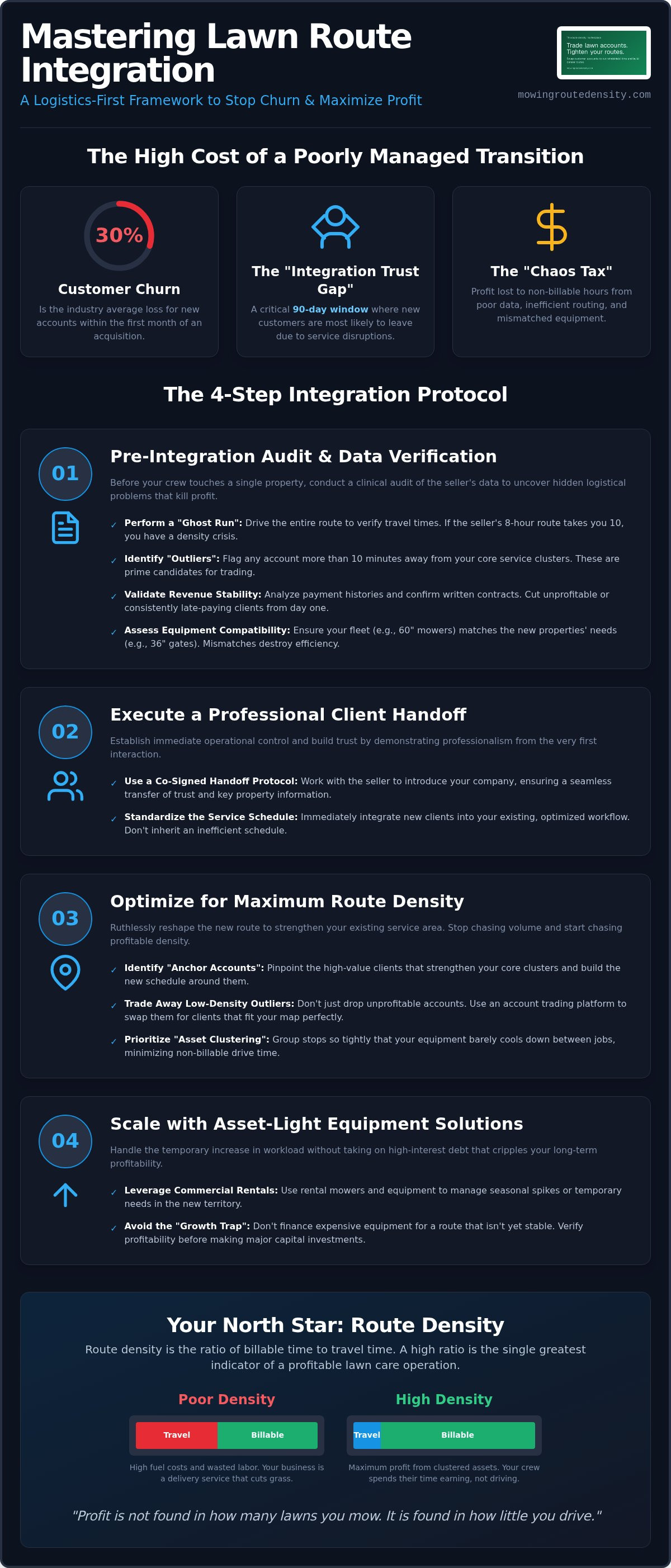
Thirty percent of your new customers will likely fire you within the first month of an acquisition. That is the industry average for poorly managed transitions. You didn't buy a list of names just to watch your investment evaporate through churn and high fuel costs. Learning how to integrate a purchased lawn route requires more than a handshake and a new invoice template. It requires a clinical look at your logistics.
You know the frustration of inheriting a route that looks like a shotgun blast across the map. Inefficient stop-and-go patterns and mismatched equipment will eat your profit margins faster than $4.09 per gallon gasoline. We're going to stop that bleed. This guide provides a pragmatic, logistics-first framework to stabilize your new accounts and tighten your route density for 2026. We will show you how to audit inherited equipment, leverage rental solutions for temporary spikes, and use route trading to swap out low-density outliers that kill your billable hours.
Key Takeaways
- Identify the 90-day "Integration Trust Gap" to proactively stop the 30% customer churn common in route acquisitions.
- Perform a "Ghost Run" to verify seller data and logistical timing before your crew ever hits the first property.
- Master how to integrate a purchased lawn route by identifying anchor accounts and trading away low-density outliers that kill your billable hours.
- Avoid the growth trap of high-interest debt by leveraging commercial mower rentals to handle seasonal spikes in your new territory.
- Establish immediate operational control using a co-signed handoff protocol and a standardized service schedule that fits your existing flow.
The Logistics of Integration: Why Purchased Routes Bleed Cash
Buying a route is the easy part. Integrating it without losing your shirt is where most owners fail. You aren't just adding names to a spreadsheet. You are executing a post-merger integration of two distinct logistical networks. If these networks don't mesh perfectly, your profit bleeds out on the asphalt between stops. Drive time is a parasite. It's non-billable. It burns fuel. It wears down your crews. When you learn how to integrate a purchased lawn route, you start by acknowledging the "Integration Trust Gap." This is the 90-day window where churn is at its peak. Customers didn't choose you; they were sold to you. One missed gate or a late arrival, and they are gone. Stop chasing volume and start chasing profitable density.
The True Cost of a Disorganized Handoff
A 20% churn rate is a disaster for your acquisition ROI. You paid for 100 accounts but only kept 80. This makes every remaining account 25% more expensive to have acquired. Then comes the "chaos tax." This is the time wasted when a seller provides poor data. Wrong gate codes. Incorrect lot sizes. Vague service requirements. Every minute your crew spends sitting in the truck deciphering a new property is profit you will never see again. Non-billable hours skyrocket when you add distant, non-clustered accounts. If a new stop adds 20 minutes of drive time but only 40 minutes of billable work, it's dragging your entire operation toward the red.
Route Density as the North Star
To survive the transition, you must prioritize lawn care route density over everything else. Profit is not found in how many lawns you mow. It is found in how little you drive. We focus on "Asset Clustering." This means grouping stops so tightly that your equipment barely has time to cool down between jobs. Mastering how to integrate a purchased lawn route requires a ruthless audit of the new map. You must identify which accounts strengthen your existing clusters and which ones are outliers that need to be traded away. Route density is the ratio of billable time to travel time. If that ratio is low, your business is just a glorified delivery service that happens to cut grass. Tighten the route or lose the profit.
Step 1: The Pre-Integration Audit and Data Verification
Sellers lie. They don't always do it maliciously, but they want the highest possible valuation. This means they gloss over the logistical nightmares. Before you finalize the transition, you must scrub the seller's data with clinical precision. Verify every address. Test every gate code. Confirm the specific service requirements for every property. When you buy an existing business, the paperwork is only half the battle. The real work happens on the pavement. Perform a "Ghost Run." Drive the entire route in a standard truck without equipment. Time the travel between every stop. If the seller says a route takes eight hours but your Ghost Run shows ten, you have a density problem that will eat your labor budget.
Identify your "Outliers" immediately. These are accounts that sit more than 10 minutes away from your core clusters. In a high-density model, 10 minutes of windshield time is a profit killer. You also need to inventory any inherited equipment against your current fleet standards. If your crews run 60-inch zero-turns but the new route is packed with 36-inch gates, your efficiency will crater. Understanding how to integrate a purchased lawn route means knowing exactly where the friction points are before your crews ever clock in.
Validating Revenue Stability
Don't inherit a collection's headache. Analyze the payment history of every new client. If a customer is consistently 45 days late, they aren't an asset; they're a liability. Check for "handshake deals." Verbal agreements are worthless during an acquisition. You need written contracts to ensure client longevity. Use a lawn care profit margin optimization mindset to cut unprofitable accounts early. If an account doesn't meet your minimum margin requirements, don't try to "fix" it. Cut it or price it correctly from day one. If you find outliers that don't fit your density goals, you can use a lawn account trading platform to swap them for stops that actually make sense for your map.
Equipment and Fleet Compatibility
Terrain dictates your gear. Assess if the new route requires specialized equipment like stand-on mowers for hills or walk-behinds for tight residential spaces. Audit equipment durability against the new terrain to prevent unexpected maintenance spikes. If the inherited equipment is junk, don't let it infect your fleet. Standardize your gear quickly to keep your maintenance schedules predictable and your parts inventory lean. Mismatched equipment leads to mismatched results.
Step 2: Executing the Professional Client Handoff Protocol
The first 48 hours after a sale are the most dangerous. If you stay silent, the customer's imagination fills the void with fear. They assume the service quality will drop or the price will spike. You must control the narrative immediately. Mastering how to integrate a purchased lawn route requires a tactical communication plan that starts with a "Joint Introduction Letter." This document must be co-signed by the seller and you. It validates the transition. It tells the client that the previous owner trusts you with their property. This is a foundational piece of customer retention strategies that prevents the knee-jerk reaction to call a competitor.
Standardize the service schedule on Day 1. If the previous owner mowed a property on Tuesday but that stop is now part of your Friday cluster, move it. Don't ask for permission; state the new schedule as part of your professional optimization. Explain that this change reduces truck emissions and improves service reliability. Implement a "Welcome Audit" during the first visit. This is a free, comprehensive property assessment. It establishes a new baseline for turf health and identifies existing damage. This protects you from being blamed for pre-existing issues and positions you as an expert rather than just a guy with a mower.
The 48-Hour Communication Rule
High-value accounts need more than a letter. You must contact your top 20% of revenue-generating clients via phone or in person within 48 hours of the acquisition. Use a script that emphasizes continuity and professional upgrades. Mention your GPS-tracked fleet, digital invoicing, and standardized service windows. If you've inherited pricing that sits below the 2026 market average of $50 to $55 per visit for a quarter-acre lot, address it with logic. Don't apologize for your rates. Explain that your pricing reflects the cost of professional labor and the specialized equipment required to maintain their property to your standards.
Establishing Operational Authority
Authority is earned the moment your truck pulls up. You aren't "the new guy" taking over a route. You are the professional upgrade the property deserves. Leverage the lawn mowing service provider locator mindset by demonstrating national-scale professionalism on a local level. This means branded uniforms, clean equipment, and standardized safety protocols. When a customer sees a uniformed crew following a digital checklist, their anxiety about the transition evaporates. Set clear expectations on billing cycles and communication channels immediately. If you only communicate via a client portal, tell them now. Clarity eliminates friction. Friction causes churn. Eliminate both to protect your investment.
Step 3: Optimizing the New Route for Maximum Density
You didn't buy a route to become a professional driver. You bought it to mow grass and collect checks. If your truck is moving, you are losing money. Once the initial 30-day transition period settles, you must ruthlessly optimize the map. Integration is not a one-time event; it is a continuous process of tightening your footprint. Start by identifying your "Anchor Accounts." These are your high-margin, reliable stops that dictate the flow of your day. Every other property on the route must justify its existence by its proximity to these anchors. If an account doesn't fit the cluster, it's a logistical tumor that needs to be removed. Re-evaluating your fuel consumption and labor hours after the first four weeks will reveal the true cost of your new acquisition.
Consolidate your service days immediately. If you have three new accounts in a single neighborhood spread across three different days, you are failing. Force them into a single "neighborhood block." This minimizes truck rolls and keeps your crews on the turf rather than on the highway. National fuel prices hit $4.09 per gallon in July 2026. You cannot afford to ignore a single mile of waste. Understanding how to integrate a purchased lawn route means recognizing that a full schedule is not the same as a profitable one. Density is the only metric that guarantees a return on your investment.
Tactical Account Swapping
The math of density is simple but brutal. Losing one $50 account that sits 15 minutes away can actually save you $100 in combined fuel, labor, and vehicle depreciation over a month. Don't be afraid to let go of "revenue" that costs more than it earns. Use a lawn account trading platform to swap these distant outliers for properties that sit within your existing clusters. Finding local partners to take over your "orphaned" accounts allows you to maintain professional relationships while cleaning up your own logistics. To maximize your margins today, trade away your inefficient accounts and stop the profit bleed.
Asset Clustering Strategies
Aim to group your accounts within a 3-mile radius. This creates a "service zone" where travel time between stops is negligible. Optimize your equipment deployment based on these clusters. If a specific neighborhood is dominated by small residential gates, ensure the trailer in that zone is equipped with the right walk-behind or stand-on units. Forcing a 72-inch deck into a route designed for 36-inch gates is an operational failure. Clustering your properties reduces the stop-and-go wear and tear on your fleet, extending the life of your transmissions and tires while keeping your billable field time at its peak. Tight routes build stable businesses.
Step 4: Scaling with Asset-Light Equipment Solutions
The "Growth Trap" is the most common way to kill a profitable acquisition. You buy a route and immediately rush to the dealer. You sign for a $15,000 zero-turn mower at 5.99% or higher interest. This is a mistake. Debt is a fixed cost that doesn't care if your new customers churn. During the first 90 days of learning how to integrate a purchased lawn route, your primary goal is cash flow preservation, not asset accumulation. Scale your fleet capacity only after the integration period proves the route is stable. Until then, keep your overhead variable and your capital liquid.
Leverage commercial lawn mower lease options to handle seasonal spikes or the sudden influx of new properties. Leasing allows you to use the newest, most efficient technology without the long-term burden of a depreciating asset on your balance sheet. Once you have 90 days of data, you can decide if the route justifies a permanent equipment purchase. By then, you will know exactly which mower decks fit the gates and which terrains require specialized traction. Use this period to test the performance of different units before committing to a purchase that qualifies for the $2,560,000 Section 179 deduction in 2026.
Tactical Equipment Rental for New Routes
Choosing professional lawn equipment rental is a tactical move for the savvy contractor. It's safer than financing. If a cluster of new accounts cancels, you simply return the rental. You aren't stuck with a monthly payment on a machine that's sitting in the shop. Rentals also allow you to match mower deck sizes to specific property requirements without a massive capital outlay. If you inherit a route with thirty 36-inch gates, rent the walk-behinds you need. Don't buy them until you know those customers are staying. Use rentals to manage maintenance downtime too. A broken spindle shouldn't lead to a missed service day. A rental backup ensures 100% reliability during the critical trust-building phase of a transition.
The Future of Your Route Portfolio
Treat your route as a liquid asset. You should always be in a position to buy, optimize, or sell parts of your portfolio for a profit. Use the Mowing Route Density platform to continuously "tighten" your service area by trading away the outliers that drive up your overhead. Integration is not a project with a start and end date. It is an ongoing process of operational refinement. Every mile you cut from your route and every minute you shave off your gate-to-gate time is pure profit. Stay lean. Stay asset-light. Keep your density high and your debt low. That is how you win in the 2026 landscape.
Mastering the Logistics of Acquisition
Buying a route is a financial transaction. Integrating it is a logistical war. You've learned that profit isn't found in a long list of names but in the density of your stops. By auditing every address, professionalizing the handoff, and ruthlessly trading away outliers, you stop the 30% churn that kills most acquisitions. Mastering how to integrate a purchased lawn route means choosing asset-light scaling over high-interest debt. It means keeping your trucks on the turf and off the highway. Every mile you cut is cash back in your pocket.
Stop letting inefficient routes drain your billable hours. You can optimize your route density and scale your fleet with Mowing Route Density today. Our specialized B2B marketplace provides a professional platform for account trading, while our commercial-grade mower rentals help you scale without the burden of long-term debt. We provide the expert guidance on route logistics you need to turn a messy acquisition into a lean, profitable machine. Tighten your route. Protect your margins. Build a business that actually works for you.
Frequently Asked Questions
What is the typical customer churn rate after buying a lawn route?
Industry professionals report a 30% churn rate during the first month of a disorganized transition. This loss happens because customers feel like an afterthought. You can reduce this by closing the "Integration Trust Gap" with immediate, professional communication and high-quality service. Churn is a direct reflection of your logistical preparation and your ability to manage the handoff.
How do I notify customers that I have purchased their lawn care route?
Send a co-signed "Joint Introduction Letter" within 48 hours of the sale to validate your authority. Follow up with a "Welcome Audit" to establish a new property baseline. Don't just send an email and hope for the best. Make your first visit a professional upgrade that proves you are more reliable than the previous owner.
Should I keep the seller's original pricing for new accounts?
Only keep the seller's pricing if it meets your minimum margin requirements. In 2026, standard residential visits average $50 to $55 for a quarter-acre lot. If the inherited rates are lower, adjust them immediately. Don't subsidize a customer's lawn care with your own profit. Professional service requires professional rates to remain sustainable.
How do I determine if a purchased route has good density?
Calculate the ratio of billable time to travel time. If your crew spends more than 10 minutes driving between stops, your density is weak. Perform a "Ghost Run" to verify the actual travel logistics without the weight of a trailer. High density means clustering your accounts within a three-mile radius to maximize billable field time.
Is it better to buy a lawn route or grow organically in 2026?
Buying a route is a shortcut to scale, but it requires a strict framework for how to integrate a purchased lawn route. Organic growth is slower and often more expensive when you factor in marketing costs. Buying allows you to acquire density instantly, provided you have the logistical discipline to manage the transition without losing your investment.
What equipment is best for a newly acquired residential route?
Use equipment that matches your existing fleet standards to keep maintenance predictable. If the new route has narrow gates, don't buy new gear and take on high-interest debt immediately. Leverage commercial rentals to test 36-inch or 48-inch decks on the new terrain. This keeps your overhead variable while you stabilize the new accounts.
Can I trade away specific accounts from a route I just bought?
Yes. You should aggressively trade away "Outlier" accounts that sit more than 10 minutes from your core clusters. Use a B2B trading platform to swap these distant properties for stops that fit your existing map. Revenue that kills your density is not profit; it is a logistical drain on your fuel and labor budgets.
How long does it take to fully integrate a new lawn care route?
A full integration typically takes 90 days. The first 30 days are focused on stabilizing the customer relationship and closing the trust gap. The remaining 60 days are for logistical optimization, route tightening, and equipment standardization. True integration is finished only when the new accounts match your target profit margins and operational flow.


