
Your biggest profit leak isn't a broken engine or a missed quote. It's the empty space in your trailers and the dead air between your jobs. You're likely burning fuel and billable hours on low-density routes that bleed cash. This is the reality of the 2026 landscape. A modern B2B lawn care marketplace offers a way out of this trap. It's not about finding more leads. It's about cutting waste. High capital expenditure for specialized gear doesn't have to be your default anymore.
You already know that commercial work requires a level of precision that residential mows don't. This guide shows you how to move beyond chasing volume and start prioritizing efficiency. You'll discover how to trade accounts to tighten your routes and use equipment rental to scale without the debt. We're looking at how to win by treating your routes like a jigsaw puzzle and your fleet like a flexible resource. It's time to stop driving and start earning.
Key Takeaways
- Stop confusing lead-gen with operational strategy. A professional exchange doesn't focus on consumer discounts; it prioritizes asset liquidity and route density.
- Eliminate windshield time by trading outliers for closer accounts. Using a B2B lawn care marketplace allows you to swap geographic dead weight for profitable density.
- Protect your margins by avoiding residential-focused apps. These platforms devalue your specialized expertise and prioritize consumer discounts over contractor profit.
- Scale your fleet without the burden of high capital expenditure. Use tactical mower rentals to handle seasonal peaks while keeping your overhead lean.
- Audit your operations to identify high-cost outliers. Turn your inefficient routes into tradable assets that improve your profit per billable hour.
What is a B2B Lawn Care Marketplace? Defining the Professional Exchange
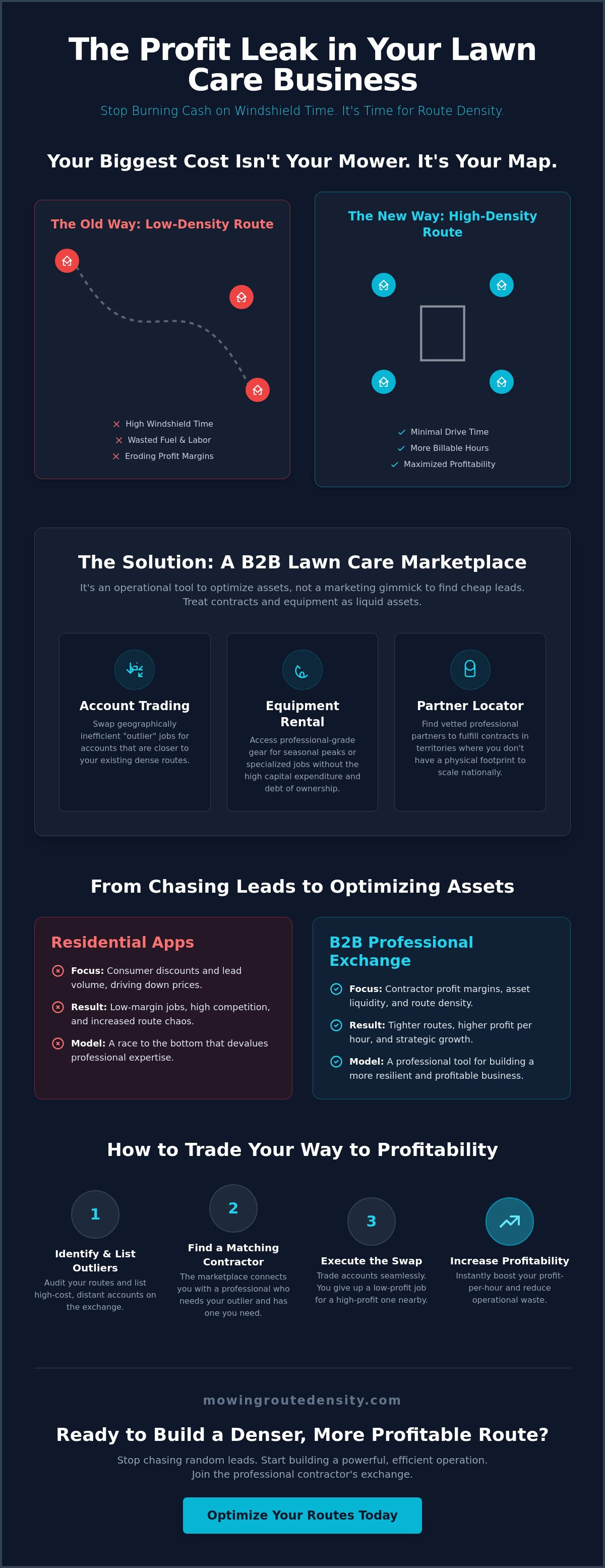
A B2B lawn care marketplace isn't a digital bulletin board for homeowners looking for a cheap mow. It's a high-performance engine for commercial contractors. Think of it as a specialized B2B online marketplace designed to solve the industry's biggest drain: logistical waste. While B2C apps focus on driving down prices for consumers, a professional exchange focuses on driving up margins for providers. It's an operational tool, not a marketing gimmick. It treats service contracts and machinery as liquid assets that can be moved, traded, or rented to maximize every billable hour.
This ecosystem stands on three functional pillars. First, a lawn account trading platform allows you to swap geographic "outliers" for jobs that sit right next to your existing routes. Second, a lawn mower rental marketplace provides access to professional gear without the suffocating debt of a purchase. Third, a service provider locator helps you find vetted partners to fulfill national contracts in territories where you lack a physical footprint. Scaling a national operation requires this level of specialized infrastructure. You can't manage a multi-state portfolio using tools designed for residential driveways.
The Shift from Lead-Gen to Asset Optimization
Chasing leads is often a trap. Traditional lead-gen platforms prioritize volume over density. They hand you a job forty minutes away from your cluster. You take it because you want the revenue. Then, you realize the fuel and labor costs ate the profit before the blades even touched the grass. It's a cycle of busy work that leads to bankruptcy. A marketplace shifts the focus to asset optimization. It creates liquidity for your service contracts. If a route doesn't make sense, you don't just suffer through it; you trade it. This platform also facilitates access to professional-grade equipment. It ensures you have the right tool for the specific job without the long-term overhead of ownership.
Core Participants in the B2B Ecosystem
Who actually uses this? It starts with the established contractor looking to shed dead weight. These are the firms that realized a single 15-acre property in the wrong zip code is costing them more than it's worth. They use the exchange to offload that contract to someone already in that area. Next are the aggressive firms seeking immediate density in new territories. They don't want to wait three years for organic growth. They want to trade for a cluster of accounts today. Finally, fleet managers use the rental model to scale for seasonal peaks. They avoid the trap of paying for idle machinery during the winter. It's about strategic foresight and lean operations. It's about the bottom line.
How Marketplaces Facilitate Route Density and Asset Liquidity
Windshield time is profit death. Every minute your crew spends on the highway is a minute they aren't billing. In a competitive market with steady projected industry growth, you can't afford logistical sloppiness. A B2B lawn care marketplace isn't just for finding new work. It’s for fixing the work you already have. It allows you to treat your service area like a chess board. Move pieces. Eliminate gaps. Tighten the perimeter. You aren't just mowing grass; you're managing a logistical network.
Trading Accounts to Tighten Operations
Look at your map. You likely have "outliers." These are accounts that sit 15 miles away from your main cluster. They drain fuel. They wear down tires. They kill morale. Swapping these accounts with another professional contractor is the common-sense solution. You give up a distant 5-acre site for one that’s two blocks away from your current route. You don't lose revenue; you gain efficiency. You can exchange accounts today to stop the bleeding. Buying density is faster than building it. Marketing takes months. A trade takes minutes. It’s a surgical strike against waste. You prune the dead weight and graft on profitable growth.
The mechanics are simple. You list the account you want to shed and specify your target territory. Another contractor with the opposite problem finds your listing. You swap. Both businesses become more profitable instantly. No more "hustling" for random leads that pull you in ten different directions. You focus on the cluster. You own the neighborhood. You win on density.
The Financial Logic of Asset Liquidity
Stop viewing contracts as permanent chores. Start viewing them as tradable assets. A B2B lawn care marketplace provides the liquidity you need to pivot. Maybe you want to exit a specific zip code entirely. Instead of letting those contracts lapse or selling your entire book of business, you trade them for assets in your target zone. It’s about flexibility. If your labor costs spike in one area, you move your assets elsewhere. You aren't trapped by your current map.
Calculate the ROI of a denser route. If you cut 30 minutes of drive time per day, you’ve saved 2.5 hours a week. That’s an extra billable job. That’s pure profit. You’re doing the same amount of work but keeping more of the money. That is the definition of asset optimization. It’s not about working harder. It’s about making your route work for you. Treat your contracts like currency. Spend them wisely.
The Fallacy of Residential Apps for Commercial Scaling
Residential apps are a race to the bottom. They train customers to look for the cheapest price, not the best service. For a commercial contractor, this is poison. You aren't selling a one-off mow; you're selling operational reliability. A true B2B lawn care marketplace operates on a completely different logic. It isn't about connecting a desperate mower with a cheap homeowner. It's about connecting professionals who understand the value of route density. Stop chasing homeowners. They don't understand your overhead. They don't respect your margins.
The global shift toward platform business models has been misunderstood in the landscaping industry. Most contractors see "platform" and think of consumer-facing apps that devalue their work. But in the B2B world, the platform is a tool for asset optimization. It’s about trading high-value contracts and managing specialized equipment. It’s a peer-to-peer exchange of professional assets, not a discount bin for labor.
Why B2C Leads Often Kill Commercial Margins
Residential leads are fragmented. They force your crews into suburban mazes. You might find a dozen jobs on a consumer app, but if they are spread across five zip codes, your profit is gone. Drive time kills you. Labor costs soar. These apps also lack professional vetting. You're often forced to compete against amateurs who don't carry the proper commercial insurance. They bid low because they don't know their own costs. You can't win that game.
Industry data confirms the risk. While residential jobs might offer higher individual margins of 25-40 percent, the overhead of managing those fragmented accounts is a logistical nightmare. Commercial contracts operate on tighter margins of 15-25 percent but offer massive total contract values. If you try to scale a commercial business using residential leads, you'll drown in administrative overhead and fuel receipts. You need density. You need professional-grade volume. Consumer apps won't give you that.
The Professional Alternative: B2B Exclusivity
Commercial providers need a contractor-only environment. You need to know that the person on the other side of a trade understands the necessary commercial licensing and why a pesticide applicator certification matters. A B2B lawn care marketplace preserves your brand positioning. It doesn't force you to bid against weekend warriors. It connects you with peers who value reliability over the lowest possible price.
In this space, your credentials are your currency. You aren't just another name on a list; you're a vetted partner. This exclusivity ensures that when you use a service provider locator, you're finding someone who can actually handle a 20-acre office park. It maintains the professional standards necessary for high-stakes commercial work. Don't let your business be commoditized by an app designed for the suburbs. Stick to the professional exchange.
Tactical Implementation: Integrating Marketplace Assets into Your Fleet
Strategy without a checklist is just a wish. To turn a B2B lawn care marketplace into a profit center, you need a methodical approach. Most contractors fail because they treat these tools as emergencies rather than standard operating procedures. Stop guessing where your money goes. Start measuring. Follow these five steps to tighten your operations and reclaim your margins.
- Step 1: Audit current route density. Map every account. Identify high-cost outliers that sit more than ten miles from your core clusters. These are your profit killers.
- Step 2: Utilize the equipment rental marketplace. Identify seasonal peaks where your current fleet is overextended. Rent specialized mowers instead of financing new ones.
- Step 3: List outliers for trade. Use the lawn account trading platform to offload distant jobs. Seek accounts that fill gaps in your existing high-density routes.
- Step 4: Use the provider locator. When a national contract requires service in a territory you can't reach efficiently, find a vetted B2B partner to handle the fulfillment.
- Step 5: Review route density metrics. Every quarter, calculate your profit per billable hour. Confirm that your drive time has decreased and your margin has improved.
Matching Equipment Rentals to Route Needs
Ownership is often a trap. Buying a $15,000 commercial zero-turn for a three-month peak is bad math. You're paying for insurance, storage, and maintenance on a machine that sits idle half the year. Strategic use of mower rentals allows you to match your capacity to your actual workload. You scale up when the grass is growing and scale down when it isn't. This preserves your capital for high-impact investments like better labor or marketing. You avoid long-term debt and the burden of off-season maintenance. It’s about being lean. It’s about being smart. Optimize your fleet operations now by leveraging flexible rental models.
Using Provider Locators for Subcontracting
Winning a national contract is a milestone. Fulfilling it is a challenge. You don't need to own a truck in every city to service a multi-state portfolio. You need a network. Using a service provider locator allows you to find reliable B2B partners for overflow work. These aren't random laborers. They are professional contractors who meet your standards for reliability and insurance. This network allows you to handle national contracts with local precision. You standardize service quality across a distributed network without the massive overhead of regional offices. You maintain control. You maintain the client. You keep the profit.
Mowing Route Density: The Professional Contractor’s Exchange
Mowing Route Density is the definitive B2B lawn care marketplace for serious operators. We don't deal in residential leads or consumer discounts. Our mission is pure operational efficiency. We provide the infrastructure to turn your logistical headaches into scalable assets. If you're tired of driving past competitors to reach a single account, you're in the right place. We help you fix your map. We help you secure your margins. We help you win.
Most platforms want to sell you more work. We want to sell you better work. There's a difference. More work often means more trucks, more debt, and more windshield time. Better work means higher density and lower overhead. Our platform prioritizes the bottom line by facilitating the exchange of professional assets. Whether you're utilizing our lawn account trading platform to swap outliers or our service provider locator to fulfill national contracts, every tool is designed for the professional landscape contractor. We don't do fluff. We do results.
A Platform Built for Professionals, by Professionals
We speak the language of overhead and labor management. Our platform eliminates the noise found in consumer-facing apps. We focus on the "tough love" of waste reduction. Every mile you save is a dollar back in your pocket. By using our B2B lawn care marketplace, you're choosing strategic density over random growth. It's about working smarter. It's about protecting your billable hours. We understand that a commercial contract for a 6-acre property can range from $29,000 to $41,000 annually. You can't leave that kind of revenue to chance or inefficient routing. We give you the tools to manage those high-stakes assets with surgical precision.
Our environment is exclusive. We vet participants to ensure they meet professional standards. You won't find amateurs here. You'll find peers who respect the industry's regulatory landscape, from pesticide licensing to the C-27 Landscape Contractor requirements. This exclusivity maintains your premium brand positioning. It ensures that every trade and every rental happens within a network of reliable, commercial-grade providers.
Join the National Network of Efficient Operators
Access a secure marketplace designed for commercial account liquidity. Whether you're seeking an exit strategy for a specific region or looking to dominate a new territory, our tools make it possible. You can leverage high-quality commercial mower rentals to scale without the weight of permanent debt. This is asset-light growth. It’s the future of the industry. You avoid the trap of buying equipment for a peak season only to watch it rust in the winter. You stay lean. You stay profitable.
Professional contractors trust us for national growth because we provide the local precision they need. You don't have to guess who is reliable in a new market. You use our provider locator to find them. You trade your way into a new city. You rent your way into a new fleet. It’s a common-sense remedy to the financial drains that kill most landscaping businesses. Don't let your profit evaporate in drive time. Optimize your routes and fleet at Mowing Route Density and start running a leaner, more profitable operation today.
Stop Leaving Profit on the Highway
Operating a landscaping business in 2026 requires more than just high-quality work. It requires a clinical approach to your logistics. You've seen how "windshield time" destroys your bottom line and how fragmented routes bleed fuel and labor hours. A true B2B lawn care marketplace provides the specific tools you need to stop the bleeding. By treating your contracts as tradable assets and your fleet as a flexible resource, you reclaim control over your margins.
Don't let your capital get tied up in idle machinery or distant zip codes. Use our secure route trading platform to cluster your jobs. Leverage our commercial-grade equipment rental network to scale without the debt. When you win national contracts, rely on our service provider locator to find vetted partners who speak your language. The industry is changing. The contractors who win are the ones who prioritize density over volume.
Optimize your route density and scale your fleet today. It's time to run a leaner, more profitable operation. You've got the expertise. Now, get the efficiency to match.
Frequently Asked Questions
How is a B2B lawn care marketplace different from homeowner apps?
A B2B lawn care marketplace focuses on operational efficiency between professionals rather than price-driven consumer leads. Homeowner apps prioritize the lowest bidder. This platform prioritizes the highest density. It’s an exchange for assets like service contracts and equipment; it is not a marketing tool for residential mows. You are trading with peers, not chasing homeowners.
Can I actually trade service routes with other contractors?
Yes, account trading is a primary function of the platform. You can list geographic outliers that drain your fuel and labor. You trade them for accounts that sit within your existing clusters. This eliminates dead air between jobs and turns a scattered route into a profitable network. It is a common-sense solution for logistical waste.
Is commercial mower rental cost-effective for a growing business?
Renting is highly cost-effective because it eliminates long-term debt and off-season maintenance costs. You only pay for the capacity you need during peak growth months. This keeps your capital liquid for other investments. It is a strategic way to scale your fleet without the burden of owning idle machinery during the winter.
How does a provider locator tool help with national contracts?
The locator tool connects you with vetted partners to fulfill national contracts in territories where you don't have a physical presence. You keep the contract and the client relationship. They provide the local labor. This allows you to manage a national portfolio with local precision and zero additional overhead for trucks or regional offices.
Will using a B2B marketplace hurt my brand reputation?
No, it protects your reputation by ensuring you only work with professional-grade peers. Unlike residential apps that commoditize your service, a B2B lawn care marketplace reinforces your standards. You are trading with contractors who understand commercial insurance and industrial-scale reliability. It is about professional exclusivity and maintaining premium brand positioning.
What are the risks of buying existing lawn care routes through a platform?
The main risk is failing to audit the route's actual density. You must verify that the accounts are geographically clustered and have clear contract terms. Use the platform’s data to identify high-cost outliers before you commit. A strategic purchase should decrease your drive time. It should not just increase your volume for the sake of it.
How do I ensure the quality of service when using a B2B locator?
You ensure quality by utilizing the vetting features of the service provider locator. Look for partners who hold necessary credentials like a C-27 Landscape Contractor license or state-specific pesticide certifications. The platform helps filter for reliability. You should always verify their specific commercial experience and equipment standards before subcontracting any overflow work.
Can I use the marketplace to sell my business or specific routes?
Yes, the platform provides immediate liquidity for specific routes or your entire commercial book of business. This is an ideal exit strategy for contractors looking to retire or pivot to new service areas. You can sell your accounts to local partners who value the density you have built. It ensures a clean and profitable transition.


