Stop chasing every commercial lead that hits your inbox. In 2026, more leads won't save a business with a fractured route. They'll just accelerate your burn rate on fuel and labor. The reality of lawn care lead generation B2B today is that a lead's value isn't determined by the contract size alone. It's determined by how close that property sits to your existing accounts. If you're still treating lead gen like a numbers game instead of a logistical puzzle, you're losing money every time your trucks leave the shop.
You've felt the sting of a "profitable" contract that actually eats your margins through windshield time and equipment wear. It's frustrating to watch your crews sit in traffic while your overhead climbs. This guide reveals why modern B2B growth is now about asset alignment and route density rather than simple volume. You'll learn to use account trading and equipment rental to scale an asset-light operation that prioritizes predictable revenue over vanity metrics. We're moving past traditional marketing and into a future of lean, clustered profitability.
Key Takeaways
- Stop chasing volume. Learn why modern lawn care lead generation B2B is a logistical strategy designed to eliminate wasted fuel and windshield time.
- Use route density as your primary bidding weapon. High-density clusters allow you to undercut competitors on price while maintaining higher profit margins.
- Discover how to acquire commercial contracts instantly through account trading. It's often more cost-effective than building an organic marketing funnel from scratch.
- Rebuild your digital presence to appeal to property managers. Position your brand as a logistics partner rather than just a service provider to win high-value RFPs.
- Scale your operations without heavy capital investment. Use strategic equipment rental to fulfill new contracts while keeping your balance sheet lean and flexible.
The 2026 Paradigm Shift in B2B Lawn Care Lead Generation
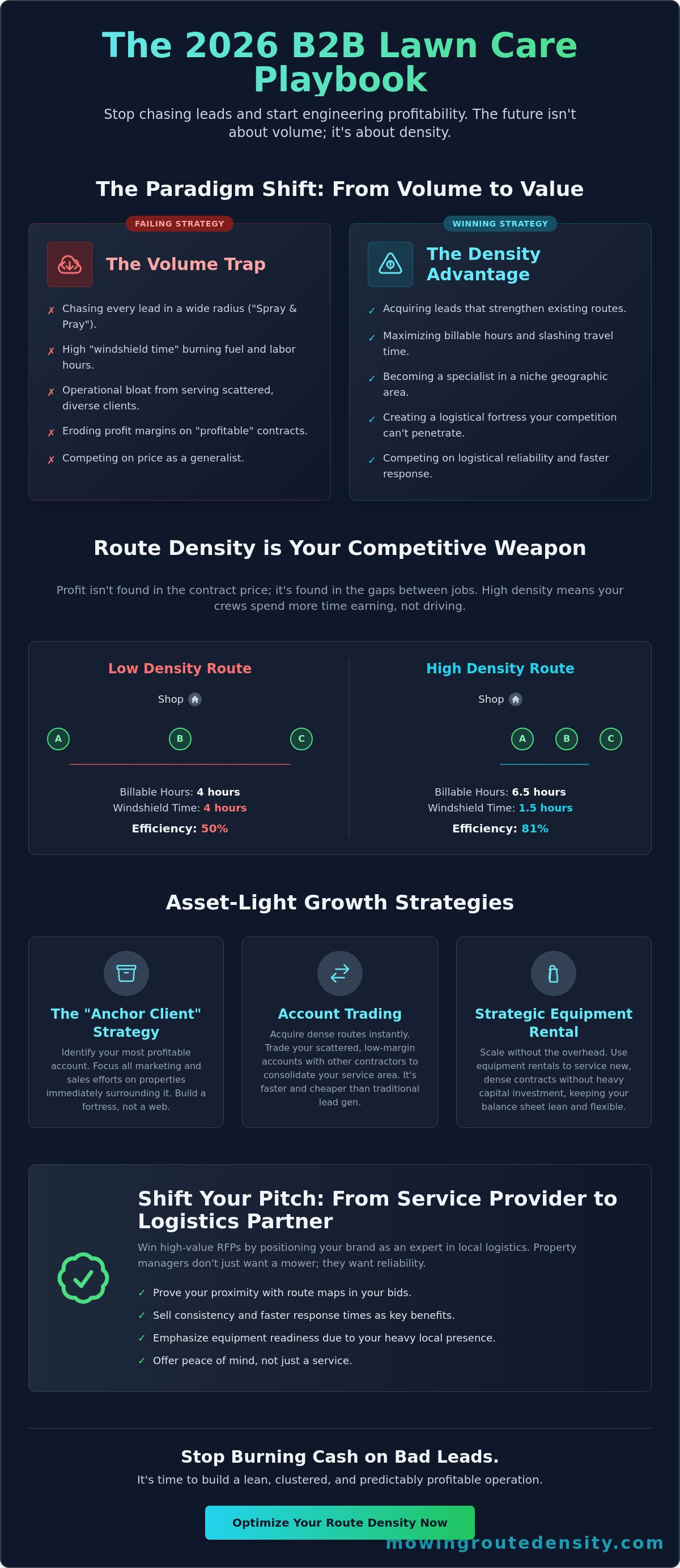
The old playbook for lead generation is broken. In 2026, "spray and pray" marketing isn't just ineffective; it's a financial liability. If you're buying every commercial lead within a fifty-mile radius, you're subsidizing your own failure. Every mile of windshield time between jobs is a leak in your bucket. High fuel costs and persistent labor shortages have made scattered routes impossible to sustain. Successful lawn care lead generation B2B now requires a transition from quantity-based acquisition to asset-aligned growth. This means only taking work that strengthens your existing clusters. A lead that forces a crew to drive forty minutes away isn't a win. It's a logistical nightmare that erodes the profit of every other job on that route.
The Death of the Generalist Contractor
Generalist contractors are dying out. Chasing every lead leads to operational bloat. You end up with a mix of small retail centers, sprawling HOAs, and isolated industrial parks. Each requires different equipment and different crew mindsets. By specializing in specific B2B niches, you improve your conversion rates instantly. Property managers don't want a "jack of all trades." They want a specialist who understands their specific compliance and aesthetic needs. Stop competing on price alone. When you tighten your focus, you can compete on logistical reliability. You're the expert who is always on-site because you're already next door. This focus reduces the need for constant, expensive lead acquisition because your reputation for reliability in a specific area does the selling for you.
Logistics as Your Secret Sales Weapon
Logistics is your most powerful sales tool. Commercial clients prioritize contractors who already have a heavy presence in their area. Density equals consistency. If your trucks are already in the industrial park three days a week, the client knows you won't skip their service due to a breakdown or traffic. Your equipment readiness becomes a selling point. When you bid on a contract, show them your route maps. Prove that your proximity allows for faster response times and lower overhead. You aren't just selling a mow; you're selling the peace of mind that comes from a contractor who has mastered the local grid. Mastering lawn care lead generation B2B through the lens of logistics ensures that every new contract converted actually adds to your bottom line instead of draining your resources through travel and fatigue.
Leveraging Route Density as a Competitive B2B Advantage
Route density is the ratio of billable hours to total on-clock time. It’s the only metric that matters once your trucks leave the shop. Most contractors think they need more leads. They're wrong. They need better-located leads. High route density is your ultimate weapon in lawn care lead generation B2B. When your crews spend less time behind the wheel and more time on the mower, your cost per stop plummets. This efficiency allows you to submit lower bids for neighboring properties without sacrificing a dime of profit. You aren't just guessing on numbers; you're leveraging a logistical reality your competitors can't match. If they have to drive twenty minutes to reach a site and you're already next door, you've already won the contract.
The "Anchor Client" strategy is the foundation of this approach. Identify your most profitable commercial contract. That property is the center of your universe. Every marketing dollar you spend should radiate outward from that point. Don't look for work across town. Look for work across the street. Building leads around your most profitable routes ensures that every new win strengthens your existing infrastructure instead of stretching it thin. It's about building a fortress in a specific zip code rather than a fragile web across a county.
The Math of High-Density Lead Gen
Profit isn't found in the contract price; it's found in the gaps between jobs. We calculate "Lead Value" based on proximity to current routes. A lead two minutes away is worth ten times more than one twenty minutes away. If you can reduce your total daily drive time by just 15%, you effectively double your available budget for targeted lawn care lead generation B2B activities. This isn't magic; it's math. Tightening your service area is the fastest route to lawn care profit margin optimization. Every minute saved on the road is a minute earned in billable labor. Stop paying for leads that require a road trip to service.
Proximity Marketing for Commercial Hubs
Industrial parks and HOAs are the perfect environments for the "cloning" effect. Once you win one B2B contract in a hub, your fleet becomes a rolling billboard. Your trucks are visible. Your crews are active. This visibility acts as a passive lead generation engine. Property managers talk. They see your efficiency. They notice your consistency. Use this local dominance to approach neighboring facilities. Tell them you're already there on Tuesdays. Offer them a "neighbor rate" that reflects your zero-travel-time advantage. You can even use a lawn account trading platform to swap distant, isolated accounts for ones that fit your core clusters. Dominating a single hub is always more profitable than being a minor player in ten different markets.
Account Trading: The Modern Alternative to Traditional Lead Gen
Traditional marketing is a slow burn. You pay for ads, wait for clicks, and hope the property manager on the other end has a site that actually fits your route. It’s inefficient. In 2026, savvy contractors are moving toward a more liquid model: the B2B lawn care marketplace. Instead of hunting for new leads, you trade for them. Think of your client list as a tradable asset. If you have a high-value commercial account that’s ten miles away from your nearest crew, that account is a liability. On a marketplace, that same account is a valuable chip you can swap for a property right next door to your current anchor site. You aren't just growing; you're optimizing.
Buying a route or individual commercial contracts is often cheaper and faster than organic lawn care lead generation B2B. It removes the uncertainty of the sales funnel. You aren't bidding against five other hungry contractors; you're taking over an established relationship with known margins. This shift toward account liquidity allows you to treat your business like a portfolio. You divest from the outliers and double down on the clusters. It’s a clean, professional way to fix logistical messes that traditional marketing only makes worse.
Acquisition vs. Lead Generation
Compare the Customer Acquisition Cost (CAC). Digital ads require a monthly retainer and a per-click fee. You might spend thousands before you land a single RFP. Route purchases provide immediate billable hours. The CAC is baked into the purchase price, and the revenue starts on day one. It’s a predictable transaction. However, due diligence is mandatory. You must verify the contract terms, payment history, and site requirements before trading. Don't inherit someone else's underpriced headache. Look for clean contracts with clear scopes of work. If the math doesn't work, walk away. Speed to revenue is only a benefit if that revenue is profitable.
Route Swapping for Operational Tightening
Route swapping is the ultimate tool for operational tightening. You likely have "outlier" accounts. These are the jobs that look good on paper but kill your schedule. Use a marketplace to find partners for mutual route optimization. Your outlier is likely an anchor for another contractor. By trading these accounts, both businesses reduce overhead instantly. You cut fuel consumption. You reduce wear on your fleet. You give your crews more time on the grass and less time in the truck. Strategic account divestment isn't a sign of weakness. It’s a sign of a strategist who values density over ego. Stop trying to own the whole map. Own the street.
Building a B2B Lead Engine That Actually Converts
Most lawn care websites look like hobbyist scrapbooks. They're filled with close-ups of flowers and "about us" sections that read like family histories. That’s a waste of digital real estate. A facility manager or a COO isn't looking for a garden enthusiast. They're looking for a reliable vendor who won't disrupt their operations. Your lawn care lead generation B2B strategy depends on your website looking like a logistics firm. You need to signal professional capacity. Highlight your fleet size. List your safety certifications. Show your insurance limits. If your digital presence doesn't scream "logistical reliability," you'll never survive a professional RFP process.
An RFP-ready website is a tool for pre-qualification. It should provide every piece of data a procurement officer needs to check a box. This includes your service area maps, your equipment redundancy plans, and your labor stability metrics. You aren't selling a mow; you're selling a frictionless service. When a decision-maker lands on your page, they should immediately see that you have the assets to handle their portfolio without a hitch. If they have to hunt for your contact info or your license number, you've already lost the lead. Use case studies to prove your operational efficiency. Show them how you reduced a previous client's site complaints by optimizing service windows.
Adopting this level of professional-grade infrastructure is essential for any elite service business looking to scale; for example, plaintiff law firms often learn more about Nexus Legal Group to access specialized growth systems designed for high-stakes operations.
The Commercial Decision-Maker Persona
Facility managers have one primary goal: zero complaints from tenants or employees. They don't care about "flower power." They care about uptime and consistency. They want to know that your crews will be off the property before the morning rush. Your marketing should focus on "fleet readiness" and "service windows" rather than aesthetic fluff. Craft punchy, data-backed claims about your reliability. Our fleet maintains a 98% uptime rate to ensure your site is always compliant. We utilize dedicated route clusters to guarantee 24-hour response times. These are the sentences that get quoted in boardrooms. Focus on the pain of operational disruption and position your business as the cure.
Leveraging Contractor Networks
Search engines are crowded, but professional networks are targeted. Leveraging a lawn mowing service provider locator is essential for regional visibility. These locators act as a shortcut for high-intent B2B inquiries. Procurement teams use these databases to find contractors who actually have the equipment and density to service their locations. Optimize your profile with specific details about your mower types and crew capacities. Don't be a generic entry. Be the contractor that clearly defines their logistical boundaries. Being featured in the right database is often the difference between a cold call and a warm RFP invitation.
Stop wasting time on general marketing and start positioning your business for professional discovery. List your company on our service provider locator to connect with commercial clients who value density over discounts.
Scaling Without the Overhead: The Asset-Light B2B Strategy
Winning a high-value commercial contract is only half the battle. The other half is servicing it without drowning in debt. Many contractors think they need to buy a new zero-turn every time they land a big HOA. That’s a mistake. In 2026, successful lawn care lead generation B2B leads to profitable growth only if you keep your balance sheet lean. Buying equipment for a single new route is a trap. It ties up your cash and increases your monthly overhead. If that contract cancels in six months, you’re left with a depreciating asset and a payment you can’t afford. Asset-light scaling is the only way to protect your margins.
Strategic fulfillment means matching your equipment to your current contract load. You don't need a fleet that covers your peak capacity if that capacity is only used three days a week. Use professional lawn equipment rental to fill the gaps. This approach allows you to scale your fleet on-demand. When your lead generation engine brings in a new cluster of accounts, you rent the necessary gear to service them immediately. You avoid the massive capital expenditure of a purchase while still capturing the revenue. It’s about being an agile strategist, not an equipment collector.
On-Demand Fleet Expansion
Owning underutilized equipment is a silent profit killer. Every hour a mower sits in your shop, it’s costing you money in depreciation and storage. Commercial mower rentals bridge the gap during growth spurts or seasonal peaks. If you win a large industrial park contract, rent the specific wide-area mowers required for that site. This flexibility keeps your operation nimble. You aren't locked into long-term financing for specialized gear that might not fit your next route. Renting gives you the freedom to test the profitability of a new route before committing to a permanent asset. It’s a low-risk way to scale your B2B footprint.
Your Growth Roadmap for 2026
Transitioning to a density-first strategy requires a shift in mindset. Stop measuring success by the number of trucks you own. Start measuring it by the billable hours per mile. Follow this checklist to close the loop on your lawn care lead generation B2B efforts:
- Audit your current routes: Identify your high-density anchors and your isolated outliers.
- Trade for density: Use a marketplace to swap those outliers for accounts that sit within your existing clusters.
- Rent for growth: Use on-demand equipment rentals to service new contract wins without taking on debt.
- Optimize digital presence: Ensure your website speaks the language of logistics to attract the right commercial decision-makers.
The future of the industry belongs to the lean and the localized. Stop chasing every lead and start building a fortress in your backyard. Optimize your route density and scale with Mowing Route Density to ensure every new contract is a win for your bottom line.
Dominate Your Local Grid Through Strategic Density
Profitability in 2026 isn't about how many trucks you have on the road. It's about how little distance those trucks travel between jobs. We've moved past the era where any lead was a good lead. Mastering lawn care lead generation B2B today requires you to prioritize route density and asset alignment above all else. You must stop subsidizing windshield time and start building a fortress of clustered accounts. By treating your client list as a tradable asset and using on-demand equipment to fulfill new wins, you can scale without the crushing weight of traditional overhead.
The tools for this transformation are already at your fingertips. You can optimize your operation through our secure lawn account trading platform or tap into commercial-grade mower rentals to bridge growth gaps. Our national network of professional contractors provides the infrastructure you need to stop guessing and start growing with precision. The status quo is a slow drain on your bank account. It's time to tighten your operation and focus on the only metric that matters: billable hours.
Tighten your routes and scale your B2B operations with Mowing Route Density. Your most profitable year is waiting just across the street.
Frequently Asked Questions
How is B2B lead generation different from residential lawn care?
B2B lead generation focuses on high lifetime value and operational alignment rather than simple job volume. Commercial contracts require proof of capacity, insurance, and compliance that residential customers rarely demand. You aren't just selling a mow; you're selling a liability-free service to a professional buyer. Property managers prioritize logistical reliability over the absolute lowest price because their primary goal is tenant satisfaction.
Is buying a lawn care route better than running Google Ads?
Buying a route is often superior because it provides immediate billable hours and eliminates the uncertainty of a marketing funnel. Google Ads can have a high Customer Acquisition Cost and often attract leads that sit outside your service area. A route purchase gives you established revenue in a specific cluster. It's a predictable business transaction rather than a gamble on search engine algorithms.
What is the most effective way to target commercial facility managers?
The most effective strategy is to position your company as a logistics partner rather than a service provider. Facility managers care about "uptime" and zero tenant complaints. They don't care about your passion for gardening. Show them your equipment redundancy plans and your response time metrics. Use data to prove that your crews will be off-site before their business day begins.
How does route density affect my ability to win B2B contracts?
High route density is your primary bidding advantage in lawn care lead generation B2B. When your stops are tightly clustered, your fuel and labor costs per job drop significantly. This efficiency allows you to submit aggressive bids that still yield high margins. Competitors with scattered routes can't match your pricing without losing money on windshield time, giving you a massive edge in the RFP process.
Can I rent commercial lawn mowers to fulfill a new large contract?
You can and should rent equipment to bridge growth gaps. Renting commercial mowers allows you to fulfill new contracts immediately without taking on long-term debt or massive capital expenditure. This asset-light approach keeps your balance sheet clean and flexible. It's a strategic way to test a new route's profitability before committing to a permanent equipment purchase.
What should I look for in a B2B lawn care marketplace?
Look for transparency, verified contract data, and secure transaction protocols. You need to see the actual contract terms and the payment history of the accounts before committing. A quality platform facilitates secure transitions and ensures the leads are logistically viable for your current routes. Avoid any marketplace that doesn't vet the quality or the location of the accounts being traded.
How do I swap lawn care accounts with other contractors safely?
Safe account swapping happens on professional platforms that act as intermediaries. You identify "outlier" accounts that don't fit your route and find a contractor who already anchors that specific area. This mutual optimization reduces travel for both parties and increases profit for everyone involved. Always verify the contract scope and site requirements before finalizing any trade to ensure the account is a good fit.
What are the most important metrics for B2B lead generation in 2026?
The most critical metrics for lawn care lead generation B2B today are billable hours per mile and lead proximity. If a lead isn't within a tight radius of your current cluster, its value is significantly lower. You must track your acquisition costs against the density they create. Growth that stretches your route too thin is a net loss, regardless of the contract's face value.


