
Your marketing budget is a financial leak. Every time your crew drives past a competitor's client to reach a scattered account, you're burning profit. Growth shouldn't mean more miles. It should mean more density. Most contractors accept fragmented routes as an unavoidable cost of doing business. They're wrong. Leveraging a lawn account trading platform is the tactical shift required to stop the bleed and reclaim your schedule.
You already know that windshield time is the silent killer of your bottom line. Fuel costs are rising and labor is too expensive to waste on the road. You don't necessarily need more leads; you need better geography. This guide will show you how to use account trading to consolidate your service area and maximize every billable hour. We'll break down how to reduce drive time by 30% or more and exit low-density neighborhoods without losing money. It's time to stop working harder and start tightening your routes for maximum profitability in 2026.
Key Takeaways
- Stop treating windshield time as a necessary evil. It is a profit leak that you can surgically remove through route consolidation.
- Understand how a lawn account trading platform shifts your business from chasing random leads to acquiring high-density assets.
- Identify the specific audit metrics required to verify recurring revenue stability before you finalize any account swap or purchase.
- Combine route consolidation with commercial mower rentals to scale your service area without taking on massive equipment debt.
- Learn to liquidate your most distant, unprofitable accounts to fund expansion in your core neighborhoods.
The Route Fragmentation Tax: Why Traditional Growth is Failing Contractors
Windshield time is a profit killer. It's the silent tax on your business. Most contractors think adding more clients is the only way to grow. They're wrong. If those clients are 15 minutes apart, you aren't growing; you're just getting busier and poorer. Traditional growth models rely on volume. Modern profitability relies on density. Every mile your truck travels between jobs is a mile where you're paying for labor, fuel, and insurance without a single cent of revenue coming in. It's time to stop treating travel as a cost of doing business and start treating it as a failure of strategy.
The Hidden Cost of Low Density
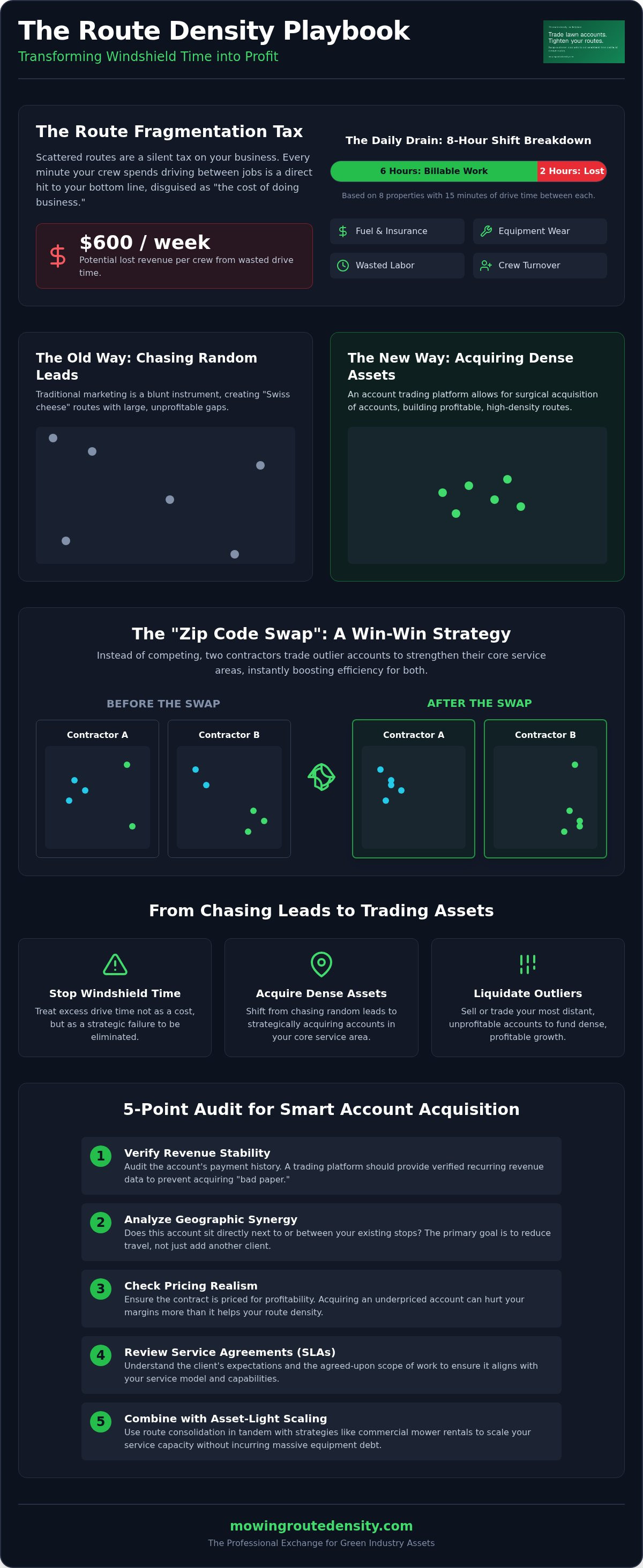
Let's look at the math. If your crew averages 15 minutes of drive time between stops and they hit eight properties a day, you've lost two hours of billable labor. Every single day. That's ten hours a week per crew. If your billable rate is $60 per hour, that's $600 a week in vanished revenue per truck. This isn't just about labor. Fragmented routes force your trucks to eat more fuel. They cause your equipment to age faster on the road than on the grass. Tires wear down. Oil needs changing sooner. These costs compound until they swallow your margins. Then there's the crew. Skilled laborers want to work. They don't want to stare at a dashboard for 25% of their shift. High turnover often starts in the passenger seat of a truck stuck in traffic. It's demoralizing to waste time when there's work to be done.
Why Marketing Isn't the Only Answer
Marketing is a blunt instrument. You spend money on digital ads and hope the leads fall into your existing routes. Usually, they don't. They create "Swiss cheese" routes with massive gaps that you feel obligated to fill. The cost of customer acquisition is rising. This makes distant leads a liability, not an asset. You're essentially paying to lose money. Route Density is the only metric that matters. It's the ratio of billable time to travel time. Instead of gambling on ads, smart owners use a lawn account trading platform to surgically acquire accounts that sit right next to their current stops. This approach mirrors the strategic logic of Mergers and acquisitions (M&A), where assets are traded or combined to maximize operational efficiency. Stop chasing every random lead that clicks an ad. Start trading for the accounts that actually fit your map. A lawn account trading platform allows you to treat your accounts as liquid assets rather than permanent obligations. If an account doesn't fit your density goals, trade it for one that does.
What is a Lawn Account Trading Platform?
A lawn account trading platform is not a lead generation service. It's a professional exchange for established business assets. Traditional growth relies on marketing to strangers. That's expensive. It's also unpredictable. In 2026, the industry has shifted toward an asset-exchange model. Instead of buying clicks, you're acquiring contracts with a known payment history and a fixed location. This platform acts as a secure intermediary. It ensures that when a contract changes hands, the transition is seamless and the revenue is real. It's about trading what you have for what you actually need.
How Account Swapping Works
The "Zip Code Swap" is the most efficient move in the playbook. Imagine you have five accounts in a neighborhood twenty minutes away. Another contractor has five accounts in your backyard. You both lose money on travel. By swapping those accounts, you both gain density instantly. This isn't just about convenience. It's about protecting service level agreements (SLAs). Clients get better service because the crew is already in the area. You get better margins because the truck doesn't move. Swapping is faster than organic growth because it bypasses the sales cycle entirely. You can browse active trade opportunities to see where your routes can be tightened today.
Secure Marketplaces for Green Industry Assets
Buying a route shouldn't be a gamble. Using a specialized lawn account trading platform ensures you aren't buying "bad paper." Bad paper refers to contracts with inconsistent payment histories or unrealistic pricing. These platforms verify revenue before any listing goes live. This level of due diligence is similar to the standards found in the SBA guide to buying an existing business. You need to know the numbers are real. The integrated service provider locator allows you to identify vetted partners in your specific region. This reduces the risk of fraud and ensures that the handoff between contractors is professional. You aren't just getting a list of names. You're getting a verified stream of billable hours. It's a surgical approach to expansion that prioritizes the health of your balance sheet over the size of your ego.
Trading vs. Buying: Strategic Frameworks for Asset Acquisition
Growth requires capital. Consolidation requires strategy. You have two primary levers on a lawn account trading platform: buying and swapping. Buying is for expansion. Swapping is for optimization. Both methods aim to solve the same problem of inefficiency. If you have cash and need immediate market share, you buy. If you have a fragmented route and need immediate margin, you swap. This choice defines your trajectory for the next fiscal year. Capital is finite. Time is non-renewable. You must decide which one you're willing to spend to fix your route density.
The "Asset-Light" model is the most aggressive way to scale in 2026. This approach focuses on increasing revenue without adding a single truck or trailer to your fleet. Most contractors think a million-dollar business requires ten trucks. It doesn't. A million-dollar business with high density can often run on six. By using a lawn account trading platform to consolidate your service area, you reduce the physical footprint of your operations. You spend less on maintenance and insurance while your billable hours per crew member skyrocket. This mirrors broader landscaping industry consolidation trends where the most profitable firms are those that dominate specific high-value clusters rather than entire counties.
When to Buy Existing Routes
Buying is a surgical strike. It's the fastest way to enter a new territory or lock down a neighborhood where you already have a presence. When buying lawn care routes, ignore the vanity metrics. Gross revenue is a distraction. Focus on EBITDA multiples. A high-margin commercial contract is worth a premium because it anchors a route. If a route has a net profit margin of 20% to 25%, it's an asset. If it's struggling at 10%, it's a liability you're paying to fix. Use the platform to find sellers who have already done the legwork of customer acquisition so you can skip the three-year marketing grind.
The Logic of the Geographic Swap
The geographic swap is a zero-sum move that creates value out of thin air. Imagine you have a cluster of accounts on the North side of town, but your shop is on the South side. You're losing money on every bridge you cross. Another contractor is in the exact opposite position. A coordinated trade allows both of you to exit unprofitable territory without losing a cent of revenue. This isn't just a theory. A successful swap can result in a 20% net profit increase simply by eliminating the fuel and labor waste of the commute. Churn is the only risk. You minimize this through professional handoffs. Clients don't care who mows the grass as long as the quality remains consistent and the schedule is met. Coordinate the transition, introduce the new provider, and watch your margins expand overnight.
Due Diligence: 5 Metrics for Evaluating Accounts on a Trading Platform
Never buy a route based on a spreadsheet alone. Numbers can be manipulated. Due diligence is your only insurance policy against buying someone else's headache. When you use a lawn account trading platform, you must vet every asset with clinical precision. You aren't just looking for revenue. You're looking for compatibility. If an account doesn't fit your operational rhythm, it's a liability. Treat every potential acquisition like a surgical graft. It must take hold without killing the host business. Focus on these five metrics to protect your capital.
- Density Potential: How close is the property to your existing anchor accounts? If it adds more than five minutes of travel, the margin is already shrinking.
- Equipment Requirements: Standardize your fleet. If your crew runs 60-inch ZTRs and the property has a 36-inch gate, you've just created a logistical bottleneck.
- Payment Reliability: Audit the payment history. Accounts on auto-pay are worth a premium. Late payers are a drain on your administrative labor.
- Service Frequency: Recurring weekly contracts provide predictable cash flow. Bi-weekly or "on-call" accounts disrupt your routing and lower your equipment ROI.
- Client Fit: Don't mix residential crews with commercial expectations. Ensure the service level agreements (SLAs) match your team's current training and gear.
Assessing Revenue Stability
Revenue isn't profit. One-time cleanup leads are sugar highs. They look good on the books today but disappear tomorrow. You want recurring mowing contracts that provide a steady floor for your business. High churn rates are a massive red flag. If an account has changed hands three times in two years, the problem is likely the property or the client, not the contractor. Contractual Liquidity is the inherent ability of a service agreement to be reassigned to a new contractor while maintaining its full revenue potential and customer retention. You want assets that stay put after the handoff.
Verifying Route Density Potential
Use mapping tools to run a "Cluster Test." Identify how many potential accounts sit within a 2-mile radius of your target acquisition. The goal is to minimize the distance between the trailer gate dropping and the blades engaging. This is the core of any lawn care profit margin optimization strategy. If you can't see your next stop from the current one, you haven't reached peak density yet. Every minute saved on the road is a minute earned on the turf. Join our national network to audit active trade opportunities in your area today.
Scaling with Mowing Route Density: The Asset-Light Expansion Model
Ownership is often a trap. In the old model, growth meant more debt, more trucks, and more headaches. In 2026, the most profitable contractors are "Consolidators." They don't care about the size of their fleet. They care about the density of their map. By using a lawn account trading platform, you can expand your footprint without the traditional capital risks. It is a shift from being a service provider to being a strategic asset manager. You are no longer just cutting grass; you are optimizing a logistics network for maximum billable output.
The math of the industry is clear. While average net profit margins hover between 10% and 15%, highly optimized routes are hitting 20% to 25%. That extra 10% isn't found by raising prices. It's found by cutting the waste out of your day. A lawn account trading platform allows you to surgically add accounts in clusters. This approach ensures your crews spend their time behind a mower, not a steering wheel. It is the only way to scale rapidly in a market where labor and fuel costs continue to squeeze the unprepared.
Combining Equipment Rental with Route Acquisition
Don't let the bank own your business. When you acquire a new cluster of accounts, your first instinct might be to buy new gear. Resist it. Heavy equipment debt kills cash flow during the off-season. Instead, look into commercial lawn mower lease options to match your fleet size to your current route density. This allows you to scale your overhead dynamically. If you trade away a distant route, you can return the rental gear. If you acquire a high-density neighborhood, you can pull a professional-grade ZTR immediately. You maintain high standards without the long-term liability of a five-year loan.
Joining the National Contractor Network
You aren't an island. Scaling requires a network of B2B partnerships. Use the lawn mowing service provider locator to find trade partners who are looking to optimize their own routes. This network is also your best tool for finding reliable lawn care subcontractors when you have overflow work in a high-density area. These partnerships are the foundation of a long-term lawn care business exit strategy. A buyer will pay a premium for a business that operates in a tight, five-mile radius. They won't pay for a scattered mess of accounts that requires three hours of driving a day. Build for density now, and you'll have a liquid asset when you're ready to sell.
Tighten Your Routes and Reclaim Your Profit
Stop accepting the fragmentation tax as an unavoidable cost of doing business. You've seen the math. Every mile of travel is a leak in your balance sheet. By 2026, the gap between profitable consolidators and struggling operators will only widen. Growth isn't about the total number of names on your client list. It's about the proximity of those names to each other. If you aren't optimizing for density, you're working for the gas station and the insurance company instead of yourself.
Consolidating your service area is a surgical necessity. Use a lawn account trading platform to swap your outliers for local assets. This strategy, combined with dynamic equipment scaling, ensures you aren't paying for machines that sit idle or trucks that sit in traffic. You're building a business that is lean, liquid, and ready for a high-value exit. You've identified the drains in your operation. Now, plug them.
Gain access to a national B2B marketplace to find vetted trade partners today. Leverage our professional locator tool to network with fellow contractors and optimize your routes with high-performance equipment rentals. Start trading accounts and optimizing your route density today at Mowing Route Density. The road is for travel; the turf is for profit. Keep your blades spinning where it counts.
Frequently Asked Questions
What exactly is a lawn account trading platform?
It's a professional B2B marketplace where contractors trade service contracts to optimize their geography. Think of it as a stock market for routes. You list the accounts that don't fit your current map and find partners with accounts that do. This lawn account trading platform approach replaces expensive marketing with strategic asset swapping. It turns your client list into a liquid asset you can reconfigure for better margins.
How do I determine the value of a mowing route for a trade?
Value is dictated by net profitability and location, not just gross revenue. A route with ten houses on one block is worth more than twenty houses spread across three zip codes. Audit the EBITDA and payment reliability. Use the current Prime Rate of 6.75% as a benchmark for your capital costs. For swaps, value is usually determined by a straight revenue-for-revenue exchange of recurring contracts.
Is it better to buy existing lawn care routes or grow organically?
Organic growth is a marketing gamble that often results in fragmented routes. Buying existing routes allows for immediate territory dominance. You skip the three-year customer acquisition cycle. The consolidator wins by acquiring density. If you have the capital, skip the ads. Buy the contracts that already sit next to your current stops to maximize your billable hours instantly. It's about buying time, not just leads.
How do I handle the transition of customers during an account swap?
Professionalism prevents churn. Notify the client together with the new provider. Introduce the change as a strategic move to provide better, more localized service. Most clients don't care about the logo on the truck. They care about the schedule and the quality. Ensure the new contractor has all site details and gate codes before the first visit. A clean transition protects the asset value for both parties.
What are the risks of using a lawn care account exchange?
The biggest risk is "bad paper," which refers to contracts with poor payment history or low margins. Verify every account's service history before signing. There's also a risk of client attrition during the handoff. You mitigate this by using a reputable lawn account trading platform that vets its participants. Don't trade for accounts you haven't audited. Trust the data, not the sales pitch or a handshake.
Can I trade commercial landscaping contracts on these platforms?
Commercial contracts are ideal for trading because they anchor routes. These high-margin assets often require specific equipment or crews. Trading a distant commercial property for a cluster of residential accounts in your core area can drastically reduce your windshield time. Just ensure the new provider has the equipment capacity. Commercial accounts often have stricter service level agreements, so the handoff must be methodical and well-documented.
How does route density affect my business's resale value?
Density is the primary driver of resale value. A buyer isn't just buying revenue; they're buying efficiency. A business with a 25% net profit margin commands a higher EBITDA multiple than one with 10%. Dense routes require fewer trucks and less fuel. This makes your business a turnkey asset. If your accounts are scattered, you're selling a job. If they're clustered, you're selling a high-yield investment.
Do I need special software to participate in an account trade?
You don't need proprietary software, but you do need a professional network. A specialized platform provides the tools to map density and verify revenue. It acts as the secure intermediary for the trade. While you can try to find partners manually, a platform automates the due diligence. It connects you with vetted contractors. This ensures you're trading with professionals who value operational efficiency as much as you do.


