Owning a fleet of heavy machinery isn't a sign of success. Often, it's just a massive drain on your monthly cash flow. You know the drill. A zero-turn goes down, and suddenly your best crew is sitting in the shop instead of billing hours. The upfront cost of new commercial gear is skyrocketing. Maintenance schedules alone can kill your margins. Utilizing a tactical stand on mower rental allows you to bypass these bottlenecks. It keeps your team moving without the anchor of a five-figure loan.
It's a pragmatic shift. In 2025, the equipment rental penetration rate hit nearly 60 percent for a reason. Smart operators are choosing flexibility over ownership. This article explains how to leverage rentals to maximize crew efficiency and protect your capital. You'll learn how to increase square footage mowed per hour and maintain an asset-light model. We also show you how to test equipment performance before committing to a purchase. Stop letting depreciating assets dictate your growth. Learn to scale with precision instead.
Key Takeaways
- Stand-on units offer superior operator visibility and faster mounting than zero-turns. This significantly reduces "stop-and-start" time on multi-stop residential routes.
- Move the burden of maintenance and equipment downtime to the rental provider. It's a pragmatic way to keep your billable hours high without a shop full of broken gear.
- A tactical stand on mower rental allows you to stress test new route clusters. You can prove profitability before committing to permanent hires or equipment debt.
- Match deck sizes to your specific terrain for maximum efficiency. Use 36-inch decks for gated residential access and 48-inch units for mid-sized commercial lots.
- Standardize controls across your fleet to eliminate the learning curve for crew members. This keeps productivity high and prevents afternoon slowdowns caused by operator fatigue.
Why Stand-On Mowers Outperform in High-Density Routes
High-density routes are won or lost in the margins. Every second spent navigating a tight corner or wrestling a bulky zero-turn is money leaking out of your business. If your crews are servicing tight residential clusters, a heavy riding mower is often a liability. It's too slow. It's too big. It's too difficult to see what's directly in front of the deck. Opting for a stand on mower rental solves these logistical bottlenecks immediately. It's about choosing the right tool for the specific job, not just the biggest machine in the shed.
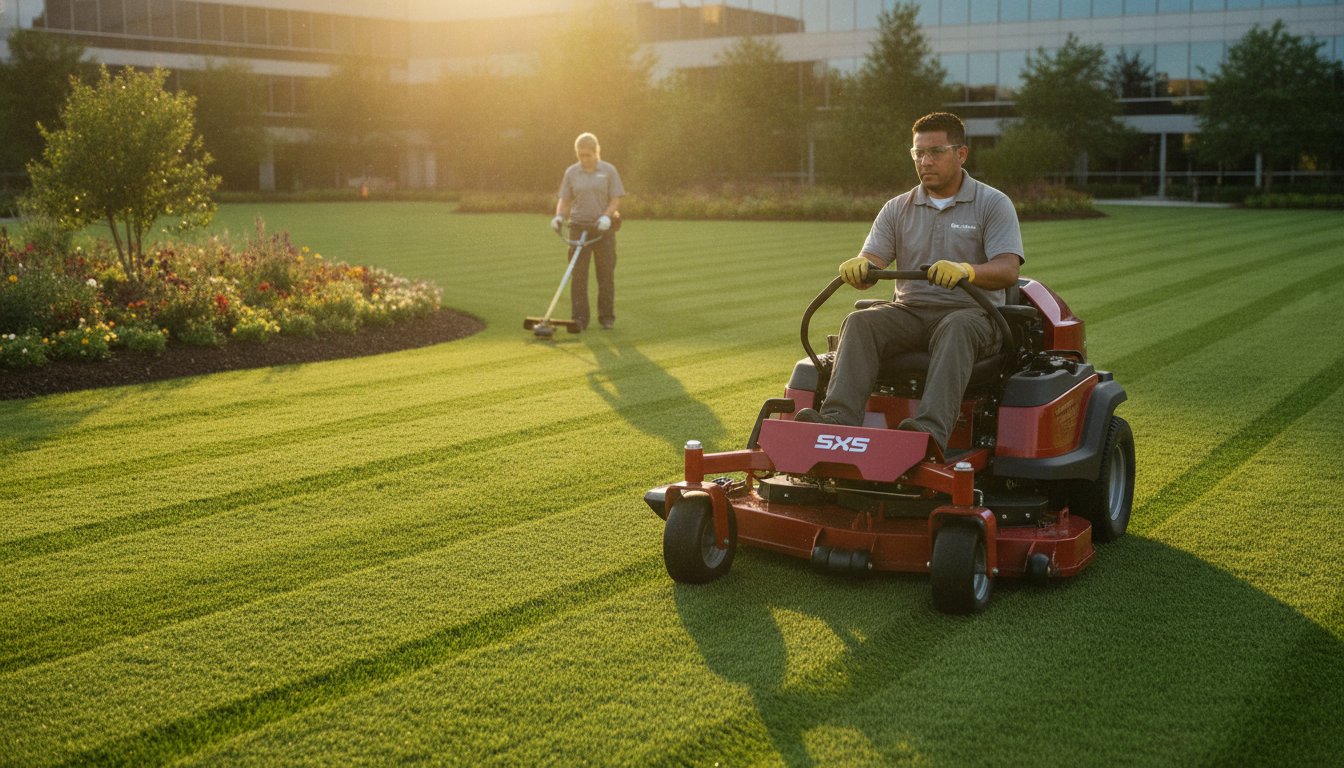
Operator visibility is the primary tactical advantage. When you stand, you see the entire field of play. You spot the hidden stump, the dog toy, or the low-hanging branch before it causes downtime. Sitting down limits your perspective. Standing up expands it. This 360-degree awareness allows for aggressive, confident navigation through complex landscapes. It turns a nervous crawl into a productive sprint. Stability is another win. These units maintain a lower center of gravity. They hug slopes that would make a traditional rider tip. It's about keeping your crew safe and your billable hours consistent. Don't let poor visibility dictate your speed.
Speed and Agility: The Stand-On Advantage
Stop-and-start time is a profit killer. On a multi-stop route, your operator might dismount 20 times a day to move debris or open gates. A stand-on mower eliminates the struggle of climbing in and out of a seat. You simply step off. You step back on. This saves roughly 15 to 30 seconds per property. Across a dense route of 30 yards, that's 15 minutes of pure gain. When comparing types of commercial mowers, the stand-on's shorter wheelbase also provides a tighter zero-turn radius. It enters gated backyards where larger machines fail. It reduces the need for exhausting walk-behind work. Your crew stays fresh. Your afternoon slowdown disappears. Efficiency isn't just about blade speed; it's about movement.
Trailer Space Optimization
Logistics don't stop at the curb. Your trailer is a fixed asset with limited square footage. A stand-on mower has a significantly smaller footprint than a sit-down zero-turn. This is simple math. You can often fit three stand-ons in the space required for two riders. This creates built-in redundancy. If one machine hits a rock, you have two backups on the trailer ready to go. You aren't sending a crew back to the shop. You're keeping them in the field. Hauling more cutting power in a smaller trailer also lightens the load. It reduces fuel consumption. It minimizes wear on your truck. It's a lean approach to field operations that prioritizes results over equipment ego. Fit more. Cut more. Earn more.
The Financial Logic of Stand-On Mower Rental vs. Ownership
Owning a fleet is often an ego trip. Renting is a business strategy. Every dollar tied up in an equipment loan is a dollar not spent on acquiring new accounts or marketing your services. A stand on mower rental keeps your balance sheet clean. It turns a massive capital expenditure into a predictable, fixed operating cost. This is about liquidity. Can you afford to have $15,000 sitting in a trailer during a rainy week? Probably not. By renting, you preserve your working capital for growth, not for paying interest on depreciating iron.
The math is simple but often ignored. Ownership comes with a tail of hidden expenses. You pay for the machine, the insurance, the storage, and the inevitable repairs. When you rent, those costs vanish. You shift the risk of mechanical failure and the burden of maintenance to the provider. If a machine goes down, you get a replacement. Your billable hours stay intact. Your crew stays in the field. From a tax perspective, rental payments are typically fully deductible as a business expense. You aren't calculating depreciation schedules over five years. You're writing off the cost today.
Asset-Light Growth Strategies for 2026
Rapid expansion requires agility. In 2026, the most successful contractors will operate with minimal debt and maximum flexibility. Using a professional lawn equipment rental framework allows you to bid on large commercial contracts without the long-term liability of a purchase. You scale up when the work is there. You scale down when the season ends. You aren't stuck with equipment payments in December when the grass isn't growing. It's about matching your overhead to your revenue in real-time. This lean approach ensures you never over-extend your cash flow for temporary gains.
Total Cost of Ownership (TCO) vs. Rental Rates
Owners frequently underestimate the "downed" equipment cost. One broken hydraulic line on a busy Tuesday can cost you five billable hours and a frustrated client. Rental eliminates the opportunity cost of maintenance by ensuring you always have a functional unit ready to work. Even when your team follows safe mower operation guidelines, parts fail. When they do, the rental yard handles the headache. You just keep cutting. Stop worrying about oil changes and winterization. Focus on route density. If you want to protect your margins, you must optimize your equipment strategy for cash flow, not just for the sake of having your name on a title.
Selecting the Right Stand-On Unit: Deck Size and Terrain
Selecting a stand on mower rental isn't about picking the most powerful engine on the lot. It's about matching the machine to the physical constraints of your route. A 60-inch deck is useless if half your properties have 40-inch gates. You're paying for productivity you can't use. Conversely, using a 36-inch unit on a two-acre commercial lot is a waste of labor. You're paying a crew member to walk twice as far as necessary. Precision is profit. Securing a stand on mower rental with the correct specs ensures your crew isn't fighting the machine all day.
- 36-inch decks: The gold standard for residential gated access. These units slip through standard backyard gates where zero-turns get stuck.
- 48-inch to 52-inch decks: The "sweet spot." Use these for mid-sized commercial lots and open residential lawns. They offer a balance of speed and maneuverability.
- 60-inch+ decks: Reserved for wide-open acreage and municipal contracts. Maximize your square footage per hour when obstacles are minimal.
Terrain considerations are equally vital. Choosing between aggressive tread for slopes and turf-friendly tires depends on your client list. If you're mowing steep retention ponds, you need the grip. If you're on high-end residential turf, aggressive tires will tear up the grass during tight turns. Renting allows you to swap machines based on the specific terrain of your current contract. You don't have to compromise with a "one-size-fits-all" tire choice that performs poorly in both scenarios.
Matching Deck Width to Route Profile
Before you call the rental yard, audit your route. Count exactly how many gates are under 40 inches. This data dictates your fleet mix. If you're scaling, use lawn care route density metrics to determine if you need one specialized gate-mower or a fleet of versatile mid-sized units. Consider trailer weight distribution too. A 60-inch stand-on is heavy. Loading it improperly can strain your axles and increase fuel costs. Optimize the load for the road, not just the lawn.
Engine Power and Fuel Efficiency
Renting gives you access to modern tech like Electronic Fuel Injection (EFI). EFI engines are more efficient than carbureted models. They start easier in the cold. They adjust to load changes instantly. In the thick, wet grass of spring, engine torque is more important than raw horsepower. You need a machine that won't bog down when the going gets tough. Bogging down kills your ground speed. It ruins the cut quality. High-torque stand-on units maintain blade tip speed, ensuring a clean pass the first time. This reduces rework. It saves fuel. It protects your bottom line.

Maximizing Crew Productivity with Rental Fleet Integration
A machine is only as fast as the person standing on it. You can secure a stand on mower rental with the best specs in the world, but if your operator is fumbling with the controls, your margins are shrinking. Standardize your choices. If your team knows one brand, rent that brand. Mixing control layouts for a marginal price break is a rookie mistake. It invites accidents. It kills muscle memory. It turns a high-speed machine into a slow-moving liability. Consistency in the cockpit leads to consistency in the field.
Rituals prevent disasters. Every rental needs a five-minute pre-start inspection before the trailer leaves the shop. Check the fluids. Inspect the blades. Verify the tire pressure. A flat tire at the shop is a ten-minute fix. A flat tire on a residential route is an hour of lost billable time. Timing also matters. Don't rent for the sake of having a backup. Align your pickups with your high-density days. If you're paying for the iron, make sure it's cutting grass, not sitting in the sun. Every hour a rental unit sits idle is pure waste.
The 10-Minute Operator Orientation
Training should be clinical and fast. Hydrostatic drives require a soft touch. Operators must master smooth lever movements to avoid scalping or tearing turf. Safety isn't optional. Teach them the bailing protocol. If the machine slides, they step off. They don't ride it to the bottom. Quick-adjust deck heights are there for a reason. Use them. Switching from a three-inch cut to a four-inch cut shouldn't require a toolbox. It should take three seconds. Emphasize the platform's suspension too. It's designed to absorb shock, but only if the operator stands correctly. Knees slightly bent. Weight centered. This reduces fatigue and prevents the afternoon slowdown that kills your daily route completion rate.
Logistics: Pick-up, Delivery, and Maintenance
Stop hauling if it's costing you money. Calculate the labor cost of sending a tech to the rental yard. If delivery is cheaper than losing two billable hours, pay the fee. When the machine arrives, document everything. Use your phone. Take high-resolution photos of the deck, tires, and engine bay. This isn't just for you; it's to protect your cash flow from unfair damage claims. If the unit fails mid-route, stop. Call the provider immediately. You aren't their free mechanic. Let them handle the repair or swap the unit while you focus on the next account. Your job is to manage the route, not the hardware.
Scaling Your Business: Combining Equipment and Route Density
Equipment is a tool. Route density is the engine. Many contractors confuse the two. They think a shiny new fleet equals growth. It doesn't. It equals debt. True scaling happens when you maximize mower-on-ground hours and minimize windshield time. A stand on mower rental is the tactical bridge that allows you to expand your footprint without over-leveraging your future. Use it to stress test new service areas. If a neighborhood doesn't yield the density you need, you walk away without an equipment loan hanging around your neck. Precision beats volume every time.
Profitability is about clusters. Servicing ten houses on one block is infinitely more valuable than twenty houses spread across a county. When you identify a tight cluster of accounts, deploy rental units to service them immediately. You don't wait for a bank's approval. You move when the opportunity is hot. This asset-light approach ensures your overhead remains flexible. You aren't building a museum of depreciating machinery. You're building a cash-flow machine. Stop letting equipment pride dictate your business decisions.
Strategic Growth via Route Trading
Route density isn't always built; sometimes it's bought. Using a lawn account trading platform allows you to acquire established clusters of clients instantly. This strategy complements your rental plan perfectly. Buying a dense route is significantly safer when you can rent the capacity to service it. You prove the margins first. You stabilize the labor second. Only then do you consider long-term investments. This is the most direct path to lawn care profit margin optimization. You control the overhead, so the overhead doesn't control you.
Building a Recession-Proof Asset-Light Fleet
Pride of ownership is a financial trap. In a volatile economy, the ability to pivot is your greatest asset. If a major commercial contract is lost, an owner-operator is stuck with the payments. An asset-light strategist simply returns the stand on mower rental. You stop the bleeding instantly. You maintain a lean operation that prioritizes liquid cash over equipment pride. This isn't about being small. It's about being smart. You have the power to scale up for the spring rush and trim down for the winter lull without a single phone call to a collections department. It's time to work smarter. You should optimize your fleet and routes today to ensure your business stays profitable regardless of the economic climate.
Protect Your Cash Flow and Dominate Your Routes
Business success isn't measured by the size of your equipment loan. It's measured by your margin per hour. You've seen how stand-on units cut through residential obstacles faster than riding mowers. You know the math behind shifting maintenance risks to a provider. Now, you need to execute. Relying on a stand on mower rental isn't just a backup plan. It's a strategic move to keep your business agile while your competitors are bogged down by high interest rates and repair bills.
Focus on what actually drives revenue: route density. By combining flexible equipment with smart route acquisition, you build a business that can pivot in any economy. As a B2B landscaping specialist, we provide the tools you need to succeed. Our national contractor network and integrated route trading tools ensure you're never cutting alone. This is about making your overhead work for you, not against you.
Optimize your fleet with tactical rentals on Mowing Route Density today. It's time to stop working for your equipment and start making your equipment work for your bottom line. You've got the strategy. Now go get the yards.
Frequently Asked Questions
How much does it typically cost to rent a stand-on mower daily?
Market rates fluctuate based on deck size and model year. Generally, you'll see daily rates for newer commercial units fall within a predictable industry range. Weekly and monthly rates offer significantly better economies of scale for contractors managing long-term contracts. You should always check with your local provider for the most current pricing in your specific region to ensure your bids remain accurate.
Do I need a special trailer to transport a rented stand-on mower?
You don't need a specialized trailer, but you must verify that your current setup handles the weight. Most stand-on units weigh between 800 and 1,200 pounds. A standard utility trailer with a functional ramp gate is usually sufficient. Their compact footprint often allows you to fit them alongside other equipment more easily than a full-sized zero-turn rider, which optimizes your trailer floor space.
Is a stand-on mower safer than a traditional zero-turn rider on hills?
Yes, because stand-on mowers typically feature a lower center of gravity. This design provides superior stability on side hills and slopes. The operator can also shift their body weight to counter-balance the machine's movement. In an emergency, it's much faster and safer to step off a platform than to struggle out of a seated position. This safety factor protects both your crew and your equipment.
Can I rent a stand-on mower with a bagger or mulching kit?
Availability depends on the specific rental fleet inventory. Many commercial providers offer units with mulching kits already installed to improve efficiency on residential routes. Bagger attachments are less common in rental fleets due to high maintenance overhead. It's best to verify these specific attachments before scheduling your stand on mower rental to avoid logistical delays on the job site.
What happens if the rented mower breaks down while I'm on a job?
You should call the rental provider immediately. Most professional B2B rental services will either send a technician to your site or swap the machine for a functional unit. This is a primary benefit of the rental model. You avoid the billable hour loss associated with waiting on your own shop's repair backlog. It keeps your field team moving while the provider handles the mechanical headache.
Do rental companies provide insurance for the equipment, or do I need my own?
Most providers offer a Damage Waiver for an additional fee to cover accidental equipment damage. This is not a substitute for your own commercial general liability insurance. You should always verify that your existing policy covers rented equipment. This protects your business from theft or major liability claims while the machine is in your possession. Don't leave your cash flow exposed to avoidable risks.
Is there a minimum rental period for commercial landscaping equipment?
Most yards offer daily, weekly, and monthly options. While there isn't usually a strict minimum beyond one day, the administrative cost of a single-day rental is often higher. For scaling field teams, a weekly or monthly stand on mower rental typically provides the best ROI. It lowers the daily overhead cost per billable hour and ensures equipment availability during your busiest route windows.
Can stand-on mowers fit through a standard 36-inch backyard gate?
Only if you rent a unit with a 32-inch or 36-inch deck. A 36-inch deck is designed specifically for this purpose, though some models have a slightly wider total width due to the discharge chute. Always measure the actual clearance of the machine with the chute up before attempting to navigate tight residential gates. Precision in equipment selection prevents property damage and keeps your crew's momentum high.


