
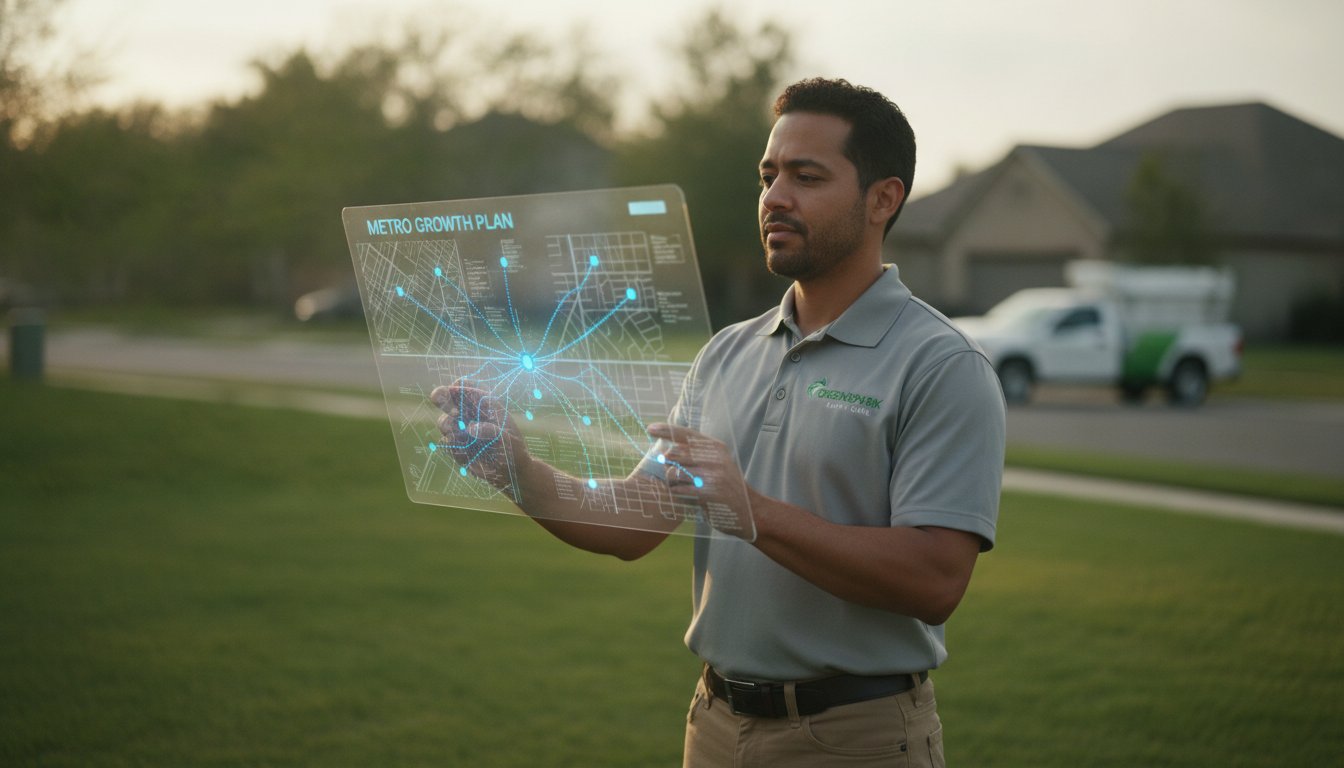
Your equipment isn't your most valuable asset. Your route density is. Most traditional banks don't understand this. They see a list of recurring contracts and demand hard collateral you might not have. This makes securing lawn care route acquisition financing a massive hurdle for operators who want to scale. You're stuck looking at interest rates as high as 17.25% for conventional loans or 13.5% for SBA 7(a) options. It's a frustrating bottleneck that keeps efficient businesses small.
We agree that you shouldn't have to drain your working capital or risk your personal assets just to grow your footprint. You know that density is the only way to beat rising fuel costs and labor gaps. This article promises to teach you how to secure funding with favorable terms while minimizing your personal financial exposure. We will analyze the July 2026 SBA loan cap increases to $10 million and detail how to structure deals that pay for themselves from day one. It's time to stop overpaying for growth and start optimizing your capital.
Key Takeaways
- Stop confusing equipment loans with route funding. Learn why banks struggle with intangible assets and how to present your recurring revenue as a bankable asset.
- Navigate the complexities of lawn care route acquisition financing by leveraging SBA 7(a) loans and seller-backed earn-outs. Protect your working capital from high-interest drains.
- Underwrite your own success by focusing on route density and historical churn. Clustered accounts are the only metrics that matter to a serious lender.
- Prepare a professional deal book with three years of tax returns and a contingency-heavy Letter of Intent. Don't let sloppy paperwork kill a profitable acquisition.
- Explore asset-light growth strategies. Use trading platforms to swap accounts for better density instead of taking on unnecessary debt.
The Mechanics of Route Acquisition Financing vs. Equipment Loans
Buying a new zero-turn mower is simple. You sign the papers, the bank takes a lien on the machine, and you drive it onto the trailer. If you stop paying, they take the mower back. This is asset-backed lending. It's predictable. It's also limited. You can have a fleet of twenty mowers, but if they aren't dropping decks on profitable properties, you're just managing a depreciating graveyard of steel. Iron doesn't grow your business. Accounts do.
Buying a competitor's customer list is a different animal. This requires lawn care route acquisition financing. Unlike an equipment loan, this funding targets the intangible value of recurring revenue and service contracts. You aren't just buying "stuff." You are buying the rights to future cash flow. Understanding the Mechanics of Route Acquisition Financing is the difference between slow, organic struggle and aggressive, profitable scaling. Lawn care route acquisition financing is a tool for immediate market share expansion.
Intangible Assets: Valuing the Recurring Revenue
Lenders use the term "goodwill" to describe the value of your reputation and client relationships. In the service industry, goodwill is everything. When you buy a route, you usually aren't buying the legal entity of the other company. You are buying their list. Banks struggle here. They can't tow a "client list" to an auction if you default. This creates the "Collateral Gap."
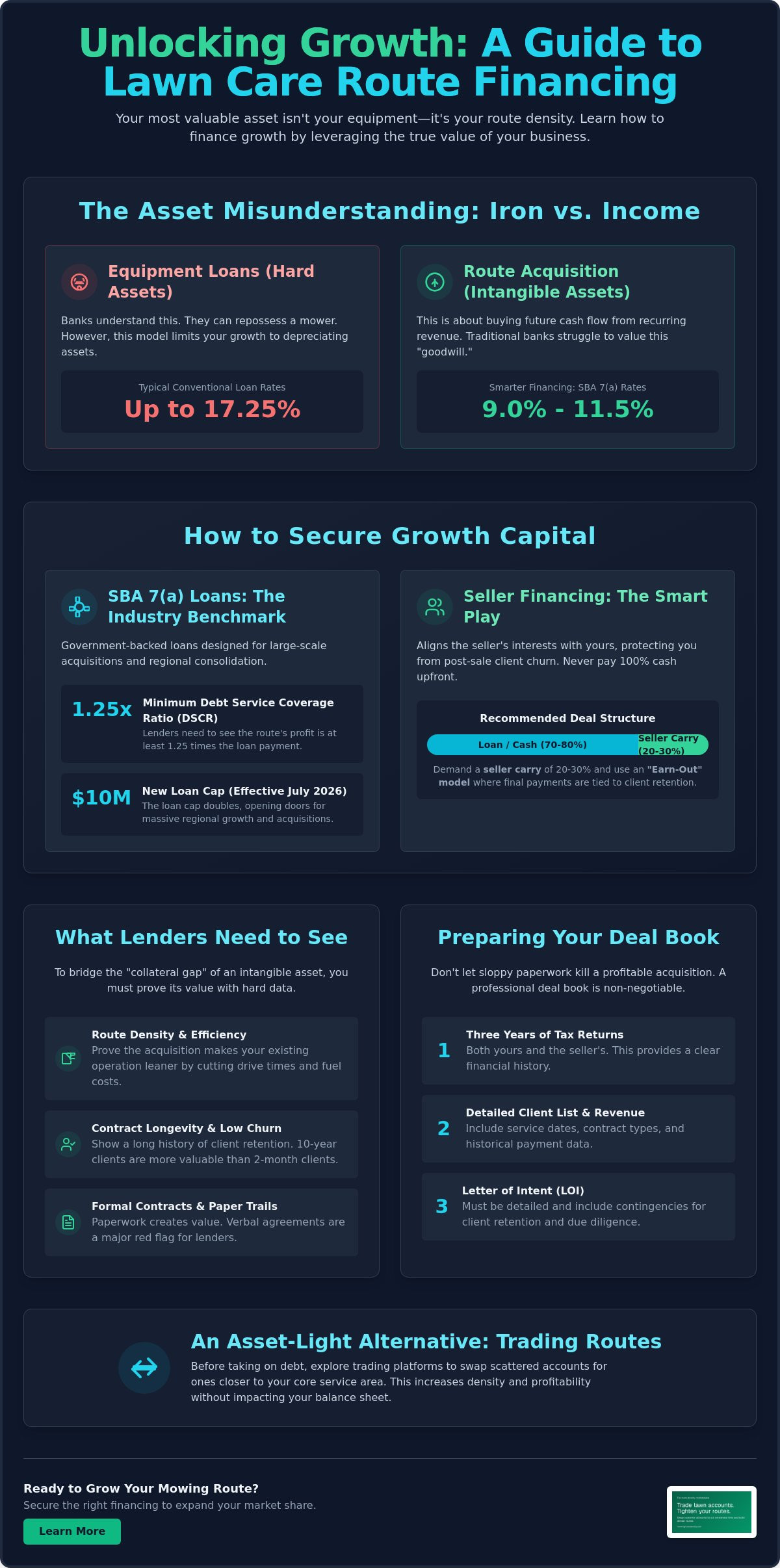
Lenders look at contract longevity and historical retention to bridge this gap. They want to see that a customer has paid for ten years, not two months. They value the "stickiness" of the revenue. If the accounts are all verbal agreements with no paper trail, your financing options will dry up. Paperwork creates value. Contracts create collateral. Proven revenue is the only currency that matters in an acquisition.
Why Traditional Banks Often Fail Landscapers
Most local banks have a deep bias toward hard assets. They understand a $60,000 truck. They don't understand a $60,000 route that generates $15,000 in monthly recurring revenue. They see the "seasonal business" stigma and get nervous. They worry about what happens when the grass stops growing in January. They see risk where you see opportunity.
To overcome this, you must pivot the conversation to route density. Density is your real security. A lender is more likely to fund a deal if you can prove that adding these new accounts will cut your drive time by 20 percent. You are making your existing operation more efficient. You aren't just getting bigger; you are getting leaner. If a traditional bank won't move, alternative lenders or seller financing often fill the gap. They value the cash flow, not just the iron.
Strategic Funding Sources for Buying Mowing Routes
Cash is oxygen. Without it, your expansion suffocates. You shouldn't rely on high-interest credit cards or draining your payroll account to grow. Professional growth requires professional lawn care route acquisition financing. You have several paths to the capital you need. Each has a specific cost and a specific risk profile. Choosing the wrong one can cripple your margins before you even finish the first round of the season.
SBA 7(a) loans remain the industry benchmark for large deals. As of June 2026, variable rates hover between 9.0% and 11.5%. These are based on the current 6.75% Prime Rate plus a lender margin. Effective July 4, 2026, the SBA 7(a) loan cap doubles to $10 million. This change allows for massive regional consolidation. Check the latest Strategic Funding Sources to understand the full requirements for these government-backed programs.
The Power of Seller Financing in Landscaping
Never pay 100% cash upfront. It's a rookie mistake. Demand a seller carry of at least 20% to 30%. This aligns the seller's interests with your own. If the clients leave three months after the sale, the seller loses money too. Use an "Earn-Out" model. This structure ties final payments to actual revenue retention. It protects your cash flow from the "handshake deal" that disappears the moment the old owner leaves. It's a common-sense remedy to the risk of client churn.
SBA Loans for Large-Scale Acquisitions
Lenders prioritize the Debt Service Coverage Ratio (DSCR) when reviewing lawn care route acquisition financing applications. They want to see that the route's profit is at least 1.25 times the loan payment. They love mowing contracts. Recurring revenue is predictable. It's bankable. You usually only need a 10% down payment for an SBA acquisition. This leverage allows you to buy a $1 million route with $100,000 in cash. It's a calculated move. It's not a gamble.
Conventional bank loans work for smaller "tuck-in" acquisitions. These are simpler. They are also faster. If you need speed and have high margins, revenue-based financing offers capital in days. It's expensive, but it's effective for seizing a deal before a competitor wakes up. If the debt feels too heavy, consider using a lawn account trading platform to find growth without the interest payments.
Underwriting the Deal: What Lenders Need to See
Lenders don't care about your passion for curb appeal. They care about risk mitigation. When you apply for lawn care route acquisition financing, you're asking a bank to bet on a revenue stream they don't yet control. They need to see a predictable, efficient machine. This process of Underwriting the Deal focuses on the cold reality of your logistical math. If the numbers don't prove profitability, the loan dies on the desk.
Density as a Financial Metric
Density is not just a logistical convenience. It is a financial powerhouse. If you have ten stops on one block, your profit per billable hour skyrockets. If those ten stops are spread across three zip codes, you are just a delivery driver who happens to mow grass. Calculate your "Stop-per-Hour" revenue to prove your margin to a lender. They want to see that the acquisition will actually lower your average overhead per stop. When buying lawn care contracts, visualize the route on a map for your lender. Show them the clusters. Prove that your trucks will spend more time cutting and less time burning fuel in traffic.
Reviewing the P&L for "Owner Add-Backs"
Small business books are notoriously messy. You will likely find the seller's personal truck payment, their home internet, and even family cell phone plans buried in the operating expenses. You must identify these "owner add-backs" to find the real Seller's Discretionary Earnings (SDE). Most owner-operated lawn care businesses trade between 2.5x and 4.5x SDE. If the seller is claiming a profit that doesn't account for their own labor, the deal is overpriced. Adjust for fuel waste and maintenance neglect. Ensure the resulting debt service doesn't choke your working capital during the transition. A profitable route on paper can quickly become a cash-flow anchor if the underwriting is sloppy.
Don't ignore the historical churn rates. If the seller loses 30 percent of their clients every year, you aren't buying a business. You're buying a sieve. Lenders look for contract longevity to ensure the lawn care route acquisition financing is backed by stable revenue. Finally, perform a rigorous equipment audit. A zero-turn mower with 2,000 hours is a liability, not an asset. If the fleet is nearing the end of its useful life, the "deal" might actually be a hidden capital expenditure nightmare. Verify the iron before you sign the note.
Providing this level of transparency is standard in professional lending; just as auto finance companies utilize Verifacto for integrated loan management and risk monitoring, you must offer your lender a clear window into your operations to build trust.
Preparing Your "Deal Book" for Acquisition Funding
Don't walk into a bank with a handshake and a dream. You'll get laughed out of the office. Professional lawn care route acquisition financing requires a deal book. This is a comprehensive dossier that proves the target route is worth the debt. Lenders need to see three years of tax returns from both you and the seller. They want to see consistency. They want to see that the profit isn't a one-year fluke. Secure a professional valuation. Don't rely on the seller's gut feeling about what their business is worth. Guessing is for amateurs.
Draft a Letter of Intent (LOI) that protects you. Include specific financing contingencies. This ensures that your lawn care route acquisition financing is a hard requirement for the deal to close. If your lender pulls out or the interest rate spikes, you need an exit. This isn't just paperwork. It's your safety net.
The Integration Plan: Proving You Can Manage Growth
Lenders fear chaos. They worry that you will buy fifty accounts and lose twenty in the first month because of poor service. Your deal book must include a post-acquisition integration plan. Detail how you will manage labor. Show how you will retain the existing crews. Crews are the backbone of the route. If they quit, the customers follow. Demonstrate how you will absorb these new stops into your current logistics without blowing your fuel budget. Use lawn care profit margin optimization strategies to prove that this growth is sustainable. Efficiency is the only way to pay down the debt.
Finalizing the Purchase Agreement
The final agreement needs teeth. Lenders will insist on a non-compete clause. You don't want the seller opening a new shop across the street two months later. Decide between an asset or stock purchase. Most buyers prefer an asset purchase. It allows you to "step up" the basis of the equipment and save on taxes. Use escrow or holdback accounts. Keep 10% to 20% of the purchase price in escrow for six months. If the client list shrinks beyond a certain point, that money stays with you. It's a common-sense way to ensure you get what you paid for.
If you're struggling to find the right accounts to buy, use our lawn account trading platform to build density without the bank's permission.
Asset-Light Growth: Trading Routes to Avoid High-Interest Debt
Debt is a weight. It drags down your agility. While lawn care route acquisition financing is a powerful tool for scaling, it is not the only path to a larger footprint. With conventional business loan rates reaching as high as 17.25 percent, interest can quickly suffocate your monthly margins. You end up working for the bank instead of yourself. Financing is a tactic, not a requirement. Sometimes the most profitable move is to grow without signing your life away to a lender. You need to maximize your liquidity by knowing when to buy and when to swap.
Swapping for Density: The Ultimate Financing Alternative
Every operator has outlier accounts. These are the properties that sit fifteen minutes away from your core cluster. They are silent profit killers. You burn fuel, waste labor hours, and add unnecessary wear to your trucks just to reach them. Instead of seeking more debt to buy new accounts, use a lawn account trading platform to swap your outliers for accounts that fit your existing routes.
Trading increases your billable hours immediately. It eliminates the logistical friction that eats your bottom line. You gain the same revenue as a traditional acquisition but without the interest payments or the "collateral gap" that stalls bank approvals. This isn't just growth. It's optimization. By trading for accounts in your core cluster, you reduce travel waste and turn windshield time into mowing time. It's a common-sense remedy to the high cost of geographic sprawl.
The Asset-Light Scaling Framework
Scaling doesn't require a yard full of owned, depreciating iron. You can combine strategic route acquisition with commercial lawn mower rental to handle seasonal surges or new contract wins. This keeps your balance sheet lean and your cash flow flexible. If you need equipment for the long haul, explore commercial lawn mower lease options to preserve your working capital for labor and marketing.
Maintaining a lean balance sheet protects your creditworthiness. It ensures that when a massive, once-in-a-decade opportunity appears, you are ready to secure lawn care route acquisition financing with the best possible terms. Don't over-leverage your business on small wins. Use trading and rentals to build a dense, profitable foundation first. Work smarter, not harder. Efficiency is the only real security in the service industry.
Ready to scale? Explore the Mowing Route Density marketplace and start trading your way to a more profitable route today.
Take Control of Your Route Density
Growth is not an accident. It is the result of disciplined capital management and logistical precision. You've learned that lawn care route acquisition financing is a tool for expansion, but it shouldn't be your only strategy. Whether you choose SBA 7(a) loans or seller-backed earn-outs, your focus must remain on route density. Clustered accounts are the only way to protect your margins from rising fuel and labor costs. Paperwork matters, but the logistical math of your routes matters more.
Debt isn't always the answer. Sometimes, the fastest path to profitability is swapping your outlier accounts for properties that fit your core routes. You don't need a massive bank loan to tighten your schedule. You need a smarter way to manage your portfolio. Our B2B focused marketplace provides asset-light scaling solutions through a national network of lawn care professionals. It's time to stop burning fuel on windshield time and start optimizing your billable hours. Optimize your route density and trade accounts on our marketplace today. You have the tools. Now, go build a leaner, more profitable operation.
Frequently Asked Questions
Can I get financing for a lawn care route if I have no collateral?
Yes, but you'll need to rely on cash-flow-based lending like the SBA 7(a) program. These lenders prioritize the recurring revenue of the accounts over hard assets like trucks or mowers. You will still need a solid credit score, typically 650 or higher, and a proven track record of operational efficiency. The bank is betting on the "stickiness" of the client list rather than physical equipment they can seize.
How much of a down payment is required for an SBA loan to buy a route?
You should expect to put down at least 10 percent of the total purchase price. This is the standard equity requirement for most SBA-backed business acquisitions. If you're acquiring a route valued at $300,000, you'll need $30,000 in liquid cash ready for the closing table. Lenders want to see that you have "skin in the game" before they risk their capital on your expansion.
What is the typical interest rate for lawn care business acquisition loans?
For lawn care route acquisition financing through the SBA, variable rates currently range from 9.0% to 11.5% as of June 2026. These rates are based on the Prime Rate of 6.75% plus a lender margin. Conventional bank loans are often more expensive, with rates spanning from 8% to 17.25%. If you choose an online lender for speed, be prepared for rates as high as 36 percent. Always calculate the impact of interest on your stop-per-hour margins before signing.
Is seller financing better than a bank loan for buying mowing accounts?
Seller financing is often the superior choice because it aligns the interests of both parties. It typically offers more flexible terms and lower interest rates than traditional lawn care route acquisition financing from a bank. Most importantly, it allows for earn-out structures where payments are tied to client retention. If the customers disappear after the sale, the seller's payout decreases. This protects your cash flow during the critical transition period.
How do I prove the value of a customer list to a lender?
Provide density maps and stop-per-hour revenue reports. A lender doesn't care about the names on the list; they care about the logistics of the route. Show them that the accounts are clustered tightly to minimize fuel and labor waste. Back this up with three years of the seller's tax returns and a verified churn report. If you can prove a retention rate over 80 percent, you've demonstrated a stable, bankable asset.
Can I finance the purchase of a competitor’s equipment and routes together?
Yes, you can bundle both into a single acquisition loan. In fact, having hard assets like commercial mowers and trucks can make your application more attractive to traditional banks. The equipment serves as tangible collateral, which may help you secure a slightly lower interest rate. Just ensure you conduct a thorough equipment audit first. Financing a fleet that requires immediate, expensive repairs will choke your working capital.
What happens if I lose clients immediately after financing the acquisition?
You are still responsible for the full loan payment unless you've built protections into your purchase agreement. This is why you must use escrow holdbacks or earn-outs. Keep 10 to 20 percent of the purchase price in escrow for the first six months. If the revenue drops below a specific threshold due to client churn, that money is returned to you instead of the seller. Don't pay for accounts that don't stay.
How long does it take to get approved for route acquisition funding?
The timeline depends entirely on the lender you choose. SBA loans are the slowest, averaging 60 to 90 days from the initial application to the final wire transfer. Conventional bank loans typically take 30 to 45 days. While online lenders can provide funding in as little as 48 hours, they charge a massive premium for that speed. Plan your acquisition at least three months in advance to avoid being forced into a high-interest trap.


