

Revenue is a vanity metric that can bankrupt your business. If you're buying lawn care contracts just to see a bigger number on your balance sheet, you're likely buying a logistical nightmare. Every mile of windshield time between stops is a leak in your profit bucket. You've felt the sting of $120 per hour labor rates and high fuel costs while your trucks sit in traffic. You're tired of scattered routes that look like a messy spiderweb on a map.
It's time to stop buying revenue and start buying density. You need a route that makes sense for your bottom line, not just your ego. This 2026 due diligence checklist provides a pragmatic framework for acquiring contracts that actually stick and stay profitable. We'll examine how to verify unreliable client data, calculate true route density, and build a transition plan that minimizes immediate cancellations. This isn't about growth at any cost; it's about tightening your operations and securing predictable, recurring revenue.
Key Takeaways
- Prioritize route density over vanity revenue to eliminate wasted fuel and unbillable windshield time.
- Audit service scope and frequency to ensure you are acquiring steady maintenance work rather than unpredictable on-call liabilities.
- Mitigate churn risk when buying lawn care contracts by identifying accounts tied too closely to the previous owner’s personality.
- Execute a seamless handoff through joint site visits and immediate CRM data integration to maintain client trust.
- Protect your cash flow by leveraging equipment rental strategies instead of sinking capital into new mowers for unproven routes.
Proximity Over Price: Why You Are Buying Density, Not Just Revenue
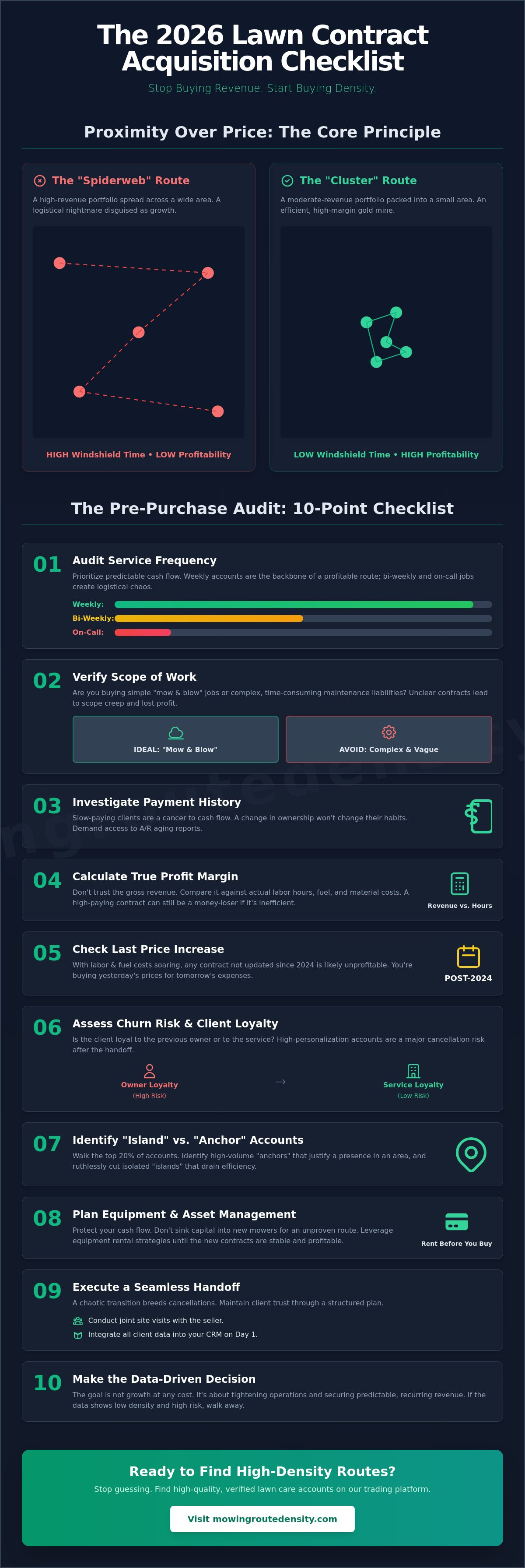
Revenue is a vanity metric. If you're buying lawn care contracts based solely on the gross top-line number, you're likely purchasing a logistical nightmare. A million-dollar portfolio spread across three counties is a liability; a $500,000 portfolio packed into two zip codes is a gold mine. Many buyers obsess over multiples of monthly revenue while ignoring the logistical rot of drive time. Miles don't pay. Minutes do. You must shift your focus from total volume to the surgical acquisition of proximity.
When you're buying lawn care contracts, you are actually purchasing time. Specifically, you're purchasing the reduction of unbillable travel. This is the "Cluster Effect." Adding one new property on a street where you already have three doesn't just add one unit of revenue. It increases the profitability of all four. You eliminate the setup and teardown time for that specific neighborhood. You turn a losing route into a high-margin machine by tightening the physical gap between jobs. A low-paying contract in a dense neighborhood beats a high-paying outlier every single time.
The Math of Windshield Time
Sitting in traffic is a financial drain. With labor rates currently between $50 and $120 per hour, every minute spent behind the wheel is money evaporating from your bottom line. Fuel consumption further erodes the margins of those "prestige" accounts that sit 20 minutes away from your core route. If a crew spends two hours a day driving, you've lost 25% of your billable potential before the first mower hits the grass. Route density is the ratio of billable hours to total shift hours. High density means your equipment stays on the ground, not on the trailer.
Asset Clustering vs. Geographic Spread
Your goal is to identify anchor accounts. These are high-volume properties that justify your presence in a specific geographic footprint. Everything else should cluster around them to maximize efficiency. Avoid "island accounts" at all costs. These are isolated contracts that require long travel times with no hope of nearby expansion. Before signing any deal, use lawn care profit margin optimization strategies to vet the potential acquisition. You must also spend time understanding service-level agreements attached to these contracts. An island account with a strict, high-maintenance SLA will kill your crew's efficiency. Tighten your footprint. Cut the outliers. Optimize for proximity, not just price.
The Pre-Purchase Audit: A 10-Point Checklist for Contract Viability
Don't trust a seller's spreadsheet at face value. It is a marketing document designed to hide operational rot. When buying lawn care contracts, you must strip away the vanity metrics and look at the mechanical reality of the work. If you don't audit the frequency, scope, and payment history of every account, you're not buying an asset; you're buying a headache. You need to know exactly what your crews are walking into before the first trailer gate drops.
Start with service frequency. Weekly accounts are the backbone of a profitable route. They provide predictable cash flow and keep the turf manageable. Bi-weekly accounts are a logistical trap; they often require double the work for only 50% more pay. On-call work is even worse. It's a scheduling leak that prevents you from optimizing your route. Next, audit the scope of work. Are you buying simple "mow and blow" accounts or are you on the hook for complex pruning and bed maintenance? If the contract isn't clear, the client will expect the world for pennies. Verify the payment history immediately. Slow-pay clients are a cancer to your cash flow. If a client hasn't paid the current owner on time, they won't start paying you on time just because you have a new logo.
Financial Due Diligence
Compare gross revenue against actual labor hours spent on-site. If a property pays a premium but eats up four hours of a three-man crew's time, the margin is dead. You must also identify seasonal fluctuations. Does the contract value drop in July when the grass goes dormant? Most importantly, check the date of the last price increase. With labor rates currently between $50 and $120 per hour, any contract that hasn't been adjusted since 2024 is likely underwater. Finding vetted accounts shouldn't be a guessing game. You can find high-quality, verified listings through our lawn account trading platform to ensure you're starting with solid data.
Operational Site Surveys
You must walk the top 20% of the accounts before signing the deal. These properties represent the majority of your acquired value. Check for equipment compatibility. If your 60-inch zero-turn mower can't fit through a 36-inch backyard gate, your productivity just plummeted. You'll be stuck using a push mower, which doubles your labor cost for that stop. Assess the "turf quality" as well. Poorly maintained lawns are an opportunity for upsells like fertilization and aeration, but they can also be a sign of a "price-shopper" client who refuses to invest in their property. When buying lawn care contracts, look for the obstacles that slow down crews. Steep hills, narrow gates, and excessive lawn ornaments are all hidden taxes on your efficiency. If the site difficulty is too high, the contract price must reflect it.
Mitigating the "Churn" Risk: Vetting the Client Relationship
Acquiring a route is easy. Keeping it is where most contractors fail. When buying lawn care contracts, you aren't just buying grass to cut. You're buying a relationship that has likely been built on years of personal trust. If that trust was tied specifically to the previous owner, you're standing in a "Seller Shadow." The moment the founder disappears, the client starts looking for reasons to cancel. You need to know which accounts are loyal to the brand and which are loyal to the man.
Analyze the longevity of every account. If the average client has been on the books for less than two years, you're looking at a high-churn portfolio. These are often "Price Shoppers" who will leave you for a small discount from the next guy with a trailer. You want "Quality Seekers." These clients value reliability and professional results over the lowest bid. They are the ones who have stayed for five years or more. They provide the predictable, recurring revenue that justifies your investment. Use a phased handoff for your largest commercial accounts. Don't just show up with a new crew. Have the seller introduce you personally. This transition period is critical for maintaining the 54% of industry revenue that commercial clients represent.
Identifying High-Risk Accounts
Spot the red flags early. A client who has cycled through three providers in three years is a liability, not an asset. They are the common denominator in their own dissatisfaction. You should also be wary of "Founder-Only" relationships. If a client expects the owner to be the one on the mower, your crew will never satisfy them. Strategic disqualification is a tool for the wise. If a contract feels unstable or the client seems combative, leave it out of the deal. It's better to buy 40 solid accounts than 50 accounts where 10 are guaranteed to quit in the first month.
The "Stickiness" Strategy
You need a plan to anchor these clients to your business immediately. Start with a professional introduction letter that focuses on continuity, not change. Don't talk about your "vision." Talk about how you'll keep their lawn looking better than ever. Offer a "First Mow Guarantee" under your new management. This shows confidence and removes the risk for the client. Leverage your professional equipment to demonstrate immediate value. When a client sees a well-maintained fleet and a crew in uniform, their transition anxiety disappears. You're not just another guy with a mower. You're a professional operation that respects their property and their time. When buying lawn care contracts, your first 30 days determine the next three years of profitability.
Executing the Handoff: Ensuring a Seamless Transition
The deal is signed. The real work begins now. A sloppy handoff is the fastest way to lose the route density you just paid for. When buying lawn care contracts, you must treat the first 14 days as a high-stakes operation. Every detail matters. Every client interaction counts. You aren't just taking over a list of addresses; you're taking over a reputation. If you fumble the transition, you're just burning cash.
Your first move is securing the data. Import every client list into your CRM immediately. Don't settle for a messy stack of paper or a poorly formatted Excel sheet. You need standardized service notes, gate codes, and specific property preferences. This isn't just about names. It's about preserving the institutional knowledge of the previous owner. If a client has a specific request about where to blow grass clippings, and you ignore it, you've already failed. Set up automated communication to introduce your brand and explain the transition. Clarity kills anxiety. If you need to fill gaps in your fleet to handle a sudden influx of work, check our lawn mower rental options to keep your crews moving.
Next, perform joint site visits. The seller must introduce you to key commercial contacts personally. This is non-negotiable for high-value accounts. A face-to-face handoff solidifies the relationship and transfers authority. While on-site, perform a final equipment audit. Ensure the assets you acquired actually match the route requirements. If the route has expanded, you might need to scale up quickly. Don't wait until the first morning of the shift to realize your trailer is too small.
Data and CRM Integration
Billing must transition immediately. Move clients to your payment gateway on day one. Delays in billing create confusion and open the door for clients to reconsider their service. Ensure historical data is preserved. You need this for future quoting and identifying seasonal trends. If you lose the history, you're flying blind. Standardize your service level agreements to ensure your new clients understand exactly what is included in their maintenance package.
The Human Element
Retain the existing crew if possible. They know the route. They know the tricky narrow gates and the specific "island accounts" mentioned in your earlier audits. Manage their expectations carefully. They are likely nervous about a new boss. Be firm but fair. For complex commercial sites, follow the "One-Week Overlap" rule. Have the previous owner or lead tech on-site for the first full cycle. This ensures the 54% of industry revenue that commercial clients represent remains secure. Double-man the route for the first two weeks. Over-investing in quality control now prevents expensive churn later. When buying lawn care contracts, your execution is your insurance policy.
Scaling Your New Route: Equipment and Asset Management
Scaling isn't about buying more stuff. It's about maximizing the billable hours of the stuff you already have. The biggest mistake you can make after buying lawn care contracts is rushing to the dealer for a fleet of new zero-turn mowers. You've just spent significant capital on the acquisition. Don't drown your cash flow in equipment debt before you've even mowed the first lawn. This is the capital trap. New debt on unproven routes is a recipe for a mid-season crisis. You need an asset-light approach until the route proves its stability and the churn settles.
Smart operators use a strategic bridge. Instead of heavy financing, leverage professional lawn equipment rental to handle the immediate influx of work. This allows you to scale your capacity without the long-term liability of a five-year loan. Rental gives you the flexibility to test the route's actual requirements. If the data from your operational site survey showed a high volume of narrow backyard gates, you can rent specific stand-on units that fit. If the route turns out to be less dense than promised, you aren't stuck with a monthly payment for a machine that sits on the trailer.
Asset-Light Scaling Strategies
Match the mower width to the terrain data you gathered in your pre-purchase audit. Don't overwork your existing fleet by forcing a 60-inch deck into a 52-inch world. This leads to turf damage and equipment strain. Renting specialized mowers for specific contract requirements keeps your overhead lean. It also maintains equipment longevity. Your primary fleet should stay focused on your core "anchor accounts," while rented units fill the gaps on the new, experimental routes. This approach protects your margins while you're still in the transition phase.
The Account Trading Marketplace
Even the best portfolio acquisition will include a few "island accounts." These are the outliers that sit 15 minutes away from your cluster. Don't keep them just because you paid for them. They are a tax on your efficiency. Use an account trading platform to swap these low-density contracts for ones that sit directly on your existing routes. You can surgically refine your footprint by trading away your "scraps" to contractors who are already in those neighborhoods. This isn't just about buying lawn care contracts; it's about trading up for better density. If an account doesn't contribute to a tight, profitable cluster, sell it and reinvest that time into a property that does. Tighten your route. Cut the waste. Protect the bottom line.
Build a Route That Works for You
Efficiency isn't an accident. It's the result of surgical precision during the acquisition phase. You've learned that route density is your most valuable asset. Revenue without proximity is just a slow way to go broke. By auditing every contract for viability and managing the handoff with professional care, you protect your investment from day one. Don't let the capital trap of new equipment kill your momentum. Use rentals to bridge the gap while you refine your footprint.
Success in buying lawn care contracts requires the right tools and a verified network. You don't have to guess which accounts are worth the effort. Access a national network of professional contractors and stop chasing outliers that drain your fuel tank and your patience. Focus on the clusters that drive real profit.
Find your next profitable route on our account trading platform. We provide a secure B2B marketplace for account swaps and commercial mower rental for rapid scaling. We give you the infrastructure to support lean growth and operational excellence. It's time to stop driving and start earning. Build the dense, profitable route your business deserves.
Frequently Asked Questions
How much should I pay for a lawn care contract?
Valuation typically follows industry multiples. Owner-operated businesses often sell for 2x to 4x Seller's Discretionary Earnings (SDE). Larger, professionally managed firms command 4x to 6x EBITDA. Contracts with 60% or more recurring maintenance revenue often earn a premium of 1 to 2 turns higher. Don't pay a premium for revenue that isn't dense or recurring.
Can I buy just the contracts without buying the whole business?
Yes, you can execute an asset purchase to acquire specific routes. This is a common strategy when buying lawn care contracts to surgically increase your route density. It allows you to grow your footprint without inheriting the seller's corporate liabilities or debt. Focus on the accounts that fit your existing geographic clusters.
What is the average retention rate for acquired lawn care accounts?
Retention usually sits between 80% and 90% if you manage the transition professionally. If the handoff is sloppy, expect to lose 20% of the accounts within the first 30 days. High churn is often the result of the "Seller Shadow" where clients leave because their personal relationship was with the previous owner, not the brand.
Do I need a lawyer to buy lawn care contracts?
You need a lawyer to draft or review the Asset Purchase Agreement. Handshake deals are a liability. A lawyer ensures the contract includes non-compete clauses and protects you from the seller's previous debts or legal issues. It's a necessary expense to secure your investment and ensure the accounts you're buying are legally transferable.
Should I buy the equipment along with the contracts?
Only buy the equipment if it is in good condition and compatible with your current fleet. Inheriting aged or mismatched mowers creates a maintenance bottleneck. Many successful buyers prefer an asset-light approach. They use equipment rentals to scale up for a new route rather than taking on the high overhead of aging machinery.
How do I stop clients from canceling after I buy the route?
Minimize transition anxiety through professional communication and a "First Mow Guarantee." Have the seller introduce you personally to high-value commercial clients. For residential accounts, a clear introduction letter focusing on continuity and reliability is essential. Prove your value immediately with well-maintained equipment and a disciplined crew.
What is the best time of year to buy lawn care contracts?
Late fall and winter are the ideal times for acquisitions. This timing gives you the off-season to integrate client data into your CRM and introduce your team before the spring rush. Buying in the middle of the peak season is a recipe for operational failure. You won't have the time to audit the sites or build client trust.
How do I verify the revenue of the contracts I am buying?
Verify revenue by cross-referencing the seller's CRM data with their bank statements and tax returns. Buying lawn care contracts based on a simple spreadsheet is a mistake. Look for the actual cash deposits that match the invoiced amounts. If the seller cannot provide a clear paper trail of payments, the revenue isn't real.


