
Stop thinking about the price per yard. In 2026, the only metric that matters in a lawn route purchase negotiation is the density of the cluster. You aren't just buying a list of addresses. You're buying billable minutes and the elimination of windshield time.
You already know the frustration of watching your profit burn away in traffic. Low route density and rising fuel costs are the silent killers of your bottom line. It's time to stop guessing and start calculating. We'll show you how to master the tactical framework for your next acquisition to secure high-margin accounts and minimize drive time between stops. This playbook provides a clinical look at 2026 valuation multiples, which currently range from 2x to 4x SDE for owner-operated businesses. We'll move from basic valuation to securing legally binding non-competes from the seller. You'll learn to identify the premium drivers that make a route worth the investment and the red flags that signal a messy handoff. Let's tighten your operations and cut the waste.
Key Takeaways
- Stop chasing top-line revenue that erodes your margins. Learn how to prioritize route density over total account volume to maximize billable hours.
- Master the lawn route purchase negotiation by using performance-based earn-outs to share risk and protect your capital from customer churn.
- Audit the "quality of earnings" to separate profitable clusters from logistical nightmares before you make an initial offer.
- Secure your investment with ironclad non-compete clauses and formal asset purchase agreements that provide legal protection.
- Refine your acquisition immediately by trimming the fat and offloading stops that don't fit your high-density operational profile.
The Strategic Logic: Why Buying Density Beats Buying Revenue
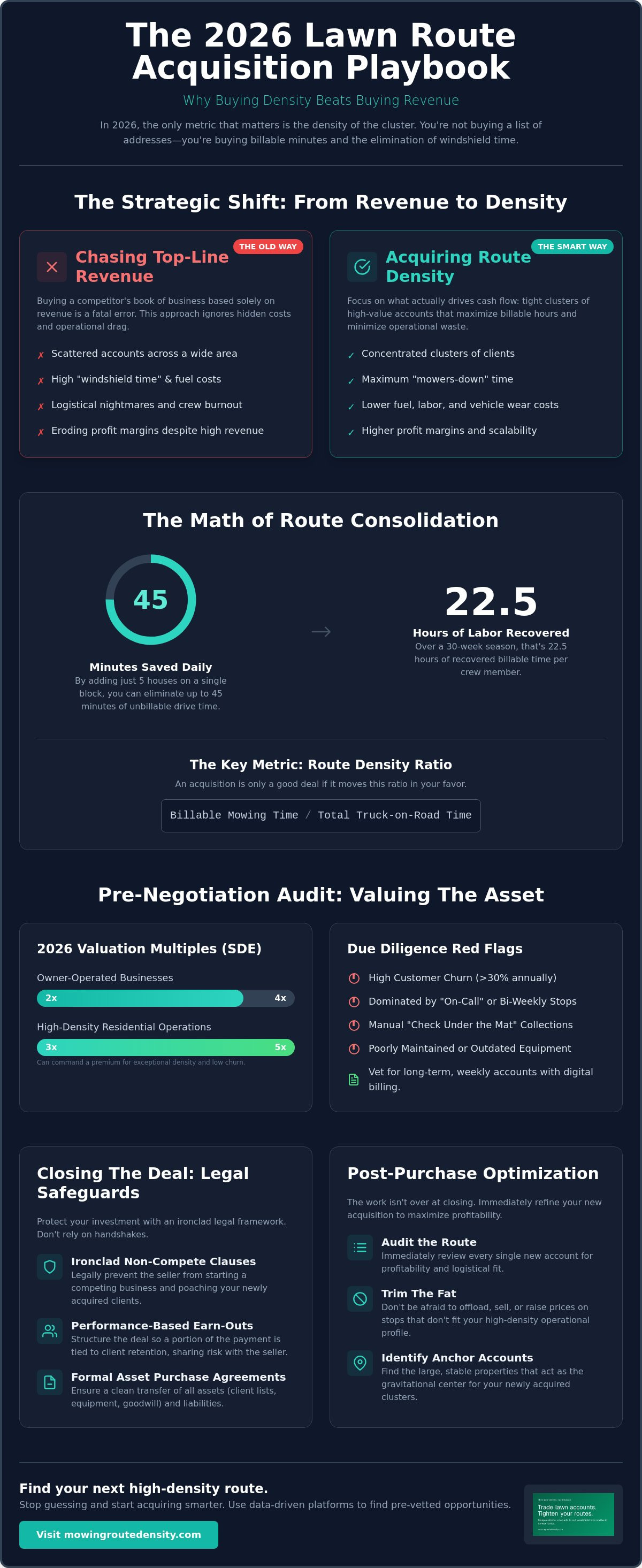
Revenue is a vanity metric. Profit is sanity. Many contractors make the mistake of buying a competitor's book of business based solely on the top-line number. This is a fatal error in any lawn route purchase negotiation. If those accounts are scattered across three counties, you aren't buying an asset. You're buying a logistical nightmare. Stop buying top-line revenue that kills your bottom-line margins. You need to focus on what actually drives cash flow: density.
Think about the "Density Premium." A $40 residential stop located exactly next door to an existing client is worth significantly more than a $60 commercial stop five miles away. The five-mile gap costs you fuel, vehicle wear, and unbillable labor. By the time your crew unloads the trailer at that $60 stop, you've already lost the margin. High-density clusters allow you to maximize the "mowers-down" time and minimize the "trucks-up" time. Identify "anchor accounts" that justify the acquisition of a specific geographic cluster. These are large, stable properties that act as the gravitational center for your route. If an acquisition doesn't offer a clear anchor or a tight cluster, walk away.
The Math of Route Consolidation
The math is simple but brutal. Adding five houses on a single block can eliminate up to 45 minutes of daily unbillable drive time. Over a 30-week season, that's 22.5 hours of recovered labor per crew member. Calculate your current cost-per-mile, including fuel, insurance, and depreciation, to set a negotiation ceiling. You should know exactly how much every minute of transit costs your business. Route density is the ratio of billable mowing time to total truck-on-road time. If an acquisition doesn't move that ratio in your favor, it's a bad deal.
Growth via Acquisition vs. Organic Sales
Marketing has a hidden cost that many owners ignore. Lead generation in 2026 is expensive, competitive, and slow. Buying a route provides immediate cash flow without the "slow burn" of organic acquisition. It’s often cheaper to buy a cluster of accounts than to spend months on digital ads and door-knocking. You can use a lawn account trading platform to find pre-vetted opportunities that fit your existing footprint. Applying negotiation theory and tactics to your acquisition strategy helps you move past emotional bargaining. You aren't just haggling over price; you're engineering a more efficient machine. Work smarter by acquiring the density your competitors are wasting.
The Pre-Negotiation Audit: Valuing the Asset
Don't walk into a lawn route purchase negotiation blind. Revenue figures don't tell the whole story. You need to analyze the "quality of earnings" before you even think about an initial offer. Is the money coming from stable, long-term contracts or a rotating door of one-off jobs? Look at the historical churn rates. If the seller loses 30% of their clients every season, you’re buying a leaky bucket. Verify the age of every account. Long-term loyalty is an asset; a list of brand-new clients is a gamble.
Audit the service frequency with clinical precision. Weekly accounts are the backbone of a profitable route. Bi-weekly stops often require more work for less pay because of overgrown turf and increased wear on equipment. "On-call" clients are scheduling nightmares that disrupt your flow. Every stop on that list must be vetted for its impact on your crew's efficiency. Are you buying a streamlined operation or a collection of headaches?
The Due Diligence Checklist
Start by reviewing a buying lawn care contracts checklist to spot red flags early. How are payments handled? Avoid routes that still rely on "check under the mat" collections. You want digital trails and automated billing. Use the SBA guide to buying a business to ensure you aren't missing legal requirements or hidden liabilities. Finally, assess the equipment. Is the seller including commercial-grade mowers with documented maintenance logs, or are they offloading junk? If you need better gear to service the new route, you can always look into lawn mower rental options to bridge the gap without heavy upfront debt.
Calculating a Realistic Offer
In 2026, market trends favor buyers in high-competition regions. Data from June 2026 shows that owner-operated businesses typically value between 2x and 4x Seller's Discretionary Earnings (SDE). However, residential operations can command 3x to 5x SDE if the recurring revenue is stable. Adjust your multiple based on route density scores. A route with 90% density commands a 20% premium over scattered accounts. If more than 60% of the revenue comes from maintenance contracts, the valuation multiple can jump by 1 to 2 points. Don't pay for potential. Pay for the tangible efficiency of the current route structure.
Executing the Lawn Route Purchase Negotiation
Negotiation is a collaboration, not a combat sport. If you treat the seller like an enemy, you'll pay for it during the customer handoff. A successful lawn route purchase negotiation focuses on "Risk Sharing." You shouldn't shoulder the entire burden of customer churn alone. Move a portion of the purchase price into a performance-based earn-out. If the seller claims their accounts are loyal, they should have no problem tying the final 20% of the payment to a 90-day retention clause. If customers cancel because they only liked the previous owner, the price drops. This protects your capital and keeps the seller motivated to help with a smooth transition.
Liquidity is your best leverage. Showing the seller you have the funds ready can often beat a higher, contingent offer. Review your options for lawn care route acquisition financing before you reach the table. As of June 2026, variable rates on standard SBA 7(a) loans range from 9.0% to 11.5% APR. Knowing your cost of capital allows you to move fast. A seller who is ready to retire or exit the industry will often take a slightly lower price for a guaranteed, quick close.
The 5-Step Negotiation Sequence
- Step 1: Establishing the "Why." Understand the seller’s motivation. Are they retiring, or is the business failing because of poor management? Retirement deals are usually cleaner.
- Step 2: The Data Exchange. Don't take their word for it. Review route sheets and P&L statements. Look for the density clusters discussed in section one.
- Step 3: The Anchor Offer. Start with a logic-based number. Base it on the 2x to 4x SDE valuation range for owner-operated routes. Avoid lowballing; it kills the trust needed for the handoff.
- Step 4: The Clawback Discussion. Define the "Clawback." This is a specific dollar amount returned to you for every account that cancels within the first 60 days.
- Step 5: The Handoff Agreement. Define how the seller introduces you. A joint letter or a face-to-face introduction is mandatory to maintain customer trust.
Common Negotiation Pitfalls to Avoid
Don't pay for "potential." If the seller has five houses that "might" sign up next month, they're worth zero dollars today. You only pay for active, billable accounts. Also, investigate the seller’s reputation. If they've been doing sloppy work or skipping stops, you aren't buying a route; you're buying a list of angry people who are about to fire you. Finally, never close without a legally binding non-compete agreement. It must cover a specific radius and a multi-year duration. Without it, the seller could take your cash and start a new route across the street two weeks later. Secure your territory or don't sign the check.
Closing the Deal: Contracts and Legal Safeguards
Trust is a luxury you can't afford during a closing. You aren't buying a friendship; you're buying a revenue stream. Handshakes don't hold up in court. If you close a deal on a whim, you're begging for a lawsuit. A successful lawn route purchase negotiation must culminate in a signed Lawn Asset Purchase Agreement. This document is your only shield against seller's remorse or hidden liabilities. It defines exactly what you're paying for, from the physical equipment to the specific customer data. Get every detail in writing or prepare to lose your investment. Period.
The non-compete clause is the most critical component of your contract. It prevents the seller from taking your cash and starting a new operation across the street two weeks later. This clause must be specific. Define a clear geographic radius and a multi-year duration. Without it, your new route density could vanish overnight as the former owner "poaches" their old favorites. If you want to skip the legal headaches of unverified private deals, use a professional lawn account trading platform to find routes that already have clean data and established histories.
Protecting Your New Customer List
Acquisition is a high-risk moment for customer churn. You need a formal transition plan. Draft a joint introduction letter that explains the change in ownership while emphasizing service continuity. This letter should be sent immediately after the contract is signed. Ensure all digital assets, including CRM data, billing history, and gate codes, are transferred on day one. If the seller refuses to hand over the logins, the deal isn't done. Legal remedies for breach of contract should be clearly outlined to handle any attempts by the seller to contact clients after the handoff. You're paying for the relationship; make sure you actually own it.
The Financial Handoff
Don't hand over a suitcase of cash. Use an escrow account or a neutral third party for the final payout. This ensures the funds are only released once all conditions, such as the equipment inspection and data transfer, are met. You also need to prorate service fees with clinical precision. If the deal closes on the 15th, who gets the revenue for work done on the 12th? The transition period should typically last 14-30 days to ensure 100% client retention. During this time, the seller should be available to introduce your crew to the properties and explain specific client preferences. This isn't a courtesy; it's a requirement for a successful integration.
Post-Purchase Optimization: Refining Your New Route
Acquisition is only the first half of the game. Integration is the second. If you stop at the closing table, you've already lost. Your initial lawn route purchase negotiation likely included several "outlier" accounts that sit miles away from your primary clusters. These are profit killers. You need to identify and offload any stops that don't fit your density profile immediately. Every minute spent driving to a lone residential account is a minute you aren't billing. Cut the waste. Tighten the footprint.
Scaling your equipment to match the new volume shouldn't bankrupt your business. Don't rush out to buy a fleet of brand-new zero-turns before the ink is dry. Instead, use a lawn mowing service provider locator to find reliable partners to handle the accounts that are too far out. This allows you to maintain the revenue while you focus your internal resources on the high-density "fortress" you're building. You're an operator, not a collector of addresses. If an account doesn't contribute to your density, it doesn't belong on your trailer.
The 90-Day Efficiency Audit
Wait until you have a full quarter of data before making permanent changes. Re-calculate your route density scores based on actual field performance, not the seller's old spreadsheets. Are your crews actually spending more time mowing than driving? If the volume is there but the speed isn't, it’s time to upgrade your gear. Instead of taking on heavy upfront debt, look into commercial lawn mower rentals to test higher-capacity machines on your new terrain. Pair this with route management software to lock in your drive-time gains. If you aren't measuring it, you aren't managing it.
Trading for Perfection
Perfection isn't found; it's engineered. You will inevitably have accounts that are logistical nightmares for you but perfect for a competitor. Swap them. Trading outlier accounts with other local contractors allows you to consolidate your territory without losing market presence. Use the Mowing Route Density platform to find these trades and finalize your geographic fortress. A 10% increase in route density often results in a 25% increase in net profit. Stop settling for a scattered book of business. Start building a high-margin machine that runs with clinical precision.
Build Your Geographic Fortress
Your business doesn't grow by collecting addresses. It grows by owning the block. You've seen the math. High-density clusters are the only way to protect your margins against rising labor and fuel costs. A successful lawn route purchase negotiation isn't about winning a price war; it's about securing a logistical advantage that your competitors can't touch. Stop paying for drive time and start paying for billable minutes.
The framework is clear. Audit the quality of earnings. Secure your territory with ironclad non-competes. Trade away the outliers that drain your resources. You now have the tactical playbook to move from a scattered operation to a streamlined, high-margin machine. It's time to stop guessing and start executing. Every minute saved on the road is a dollar added to your bottom line.
Take the first step toward a tighter, more profitable footprint. We provide a secure B2B trading platform and a national network of professional contractors specialized in route density optimization. Browse the Marketplace to Start Your Route Negotiation Today. The most efficient route always wins. Go build yours.
Tactical Answers for Route Buyers
How much should I pay for a lawn care route in 2026?
Expect to pay between 2x and 4x Seller's Discretionary Earnings (SDE) for owner-operated routes. Residential "mow-and-blow" operations with high recurring revenue often command a premium, ranging from 3x to 5x SDE. If you're looking at a larger, managed business, valuations typically fall between 4.5x and 5.5x EBITDA. Always adjust your offer based on route density; scattered accounts aren't worth the same multiple as a tight cluster.
What is a typical retention rate after buying a mowing route?
Target a retention rate of 90% or higher during the first 90 days. Some churn is natural when a new owner takes over, but professional introductions and consistent service schedules prevent mass exits. If your retention drops below 80%, it usually indicates a failure in the handoff process or a misalignment in pricing. Dense routes often see better retention because your crews are a visible, constant presence in the neighborhood.
Is it better to buy a whole business or just the customer list?
Buy the assets, not the legal entity. An asset purchase allows you to acquire the customer list and equipment without inheriting the seller's old tax liabilities or legal debts. This approach is the safest way to execute a lawn route purchase negotiation. You get the revenue stream and the density you need while leaving the seller's corporate baggage behind. It's a cleaner break for everyone involved.
How do I prevent the seller from stealing the customers back?
You must secure a legally binding non-compete agreement that covers a specific geographic radius and a multi-year duration. This contract should be a mandatory condition of the sale. Without it, you have no protection if the seller decides to start a new route across the street. Make sure the agreement includes clear financial penalties for "poaching" any accounts included in the original sale. Don't close the deal without it.
Can I finance the purchase of a lawn care route?
Yes, you can utilize SBA 7(a) loans, which currently carry variable rates between 9.0% and 11.5% APR as of June 2026. Seller financing is another common option where you pay the purchase price over several months or years. This is often the best route because it keeps the seller invested in your success. If the accounts cancel, you have the leverage to adjust your remaining payments accordingly.
How do I verify the revenue claims made by a seller?
Demand three years of tax returns, bank statements, and current route sheets. You need to see that the money actually hit the bank account, not just a spreadsheet. Cross-reference their CRM data with their billing history to ensure the accounts are active and paying the stated rates. If a seller is hesitant to provide transparent financial records, it's a sign they're hiding churn or inflating their numbers.
What happens if a customer cancels right after I buy the route?
Include a "clawback" clause in your purchase agreement to handle immediate cancellations. This clause allows you to deduct a specific dollar amount from the final payout for every client who exits within the first 60 to 90 days. Never pay the full purchase price on day one. Keep a portion of the funds in an escrow account until the transition period is over to protect your capital from unexpected churn.
Do I need a lawyer for a lawn route purchase negotiation?
Yes, you need a professional to draft the asset purchase agreement and the non-compete clauses. While you can handle the initial lawn route purchase negotiation and the valuation yourself, a lawyer ensures the final contracts are enforceable in your state. A few hundred dollars in legal fees is a small price to pay to protect a five-figure investment. Don't risk your bottom line on a DIY contract.


