
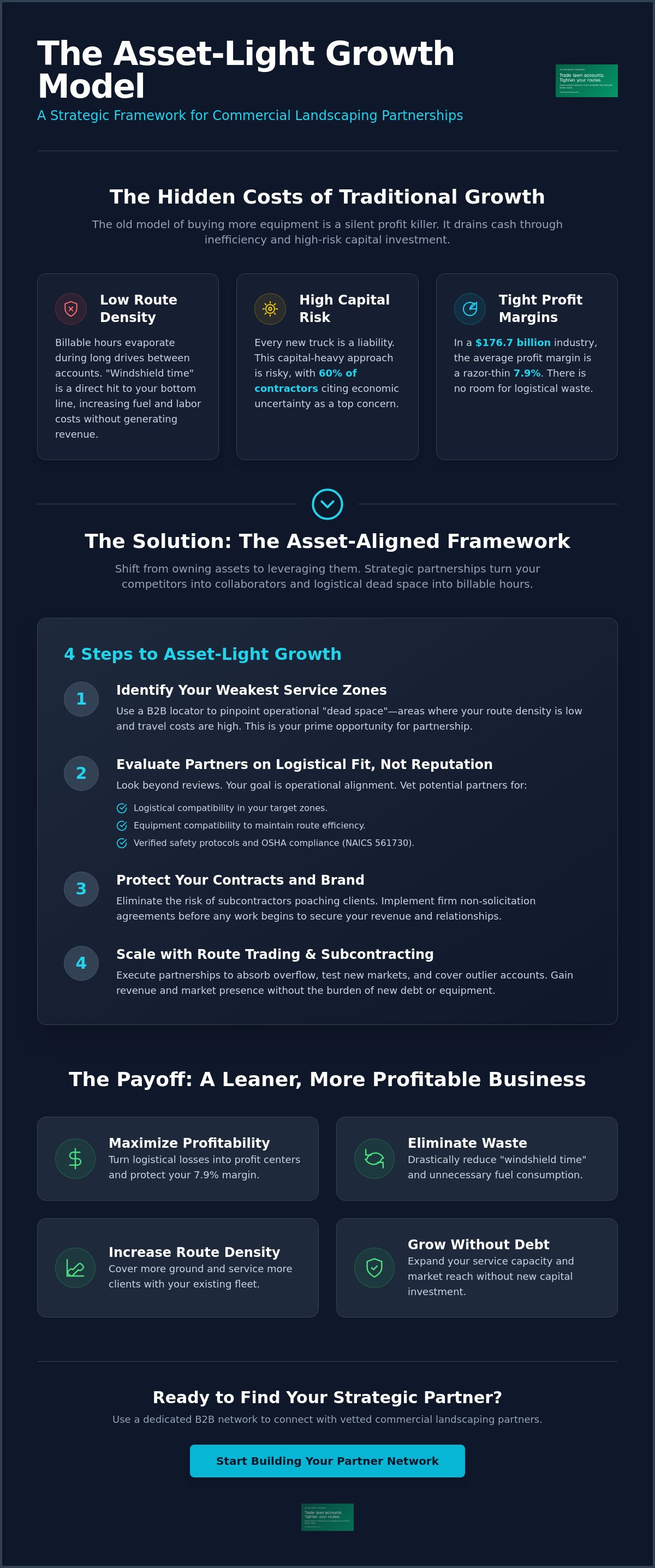
Every new truck you add to your fleet is often a liability masquerading as an asset. If that vehicle spends more time in gridlock than on a job site, you aren't growing. You're bleeding cash. The traditional model of buying your way to scale is broken. It ties up capital in equipment that sits idle and forces you to swallow the rising costs of fuel and labor. To protect your margins in a $176.7 billion industry, you need a leaner strategy. You must find commercial landscaping partners who can absorb the overflow without compromising your brand.
You already know that low route density is a silent profit killer. It's frustrating to watch billable hours evaporate during long drives between accounts. You need a way to cover more ground without the risk of unreliable subcontractors ruining your client relationships. This article provides a strategic B2B framework to identify and integrate partners who align with your operational standards. You'll learn how to vet high-quality collaborators to maximize your route density and eliminate logistical waste. We will walk through the exact steps to build a verified partner network that drives asset-light growth and keeps your business focused on profitability rather than hardware.
Key Takeaways
- Stop relying on casual networking to grow your business. Learn why strategic asset alignment is the only way to eliminate drive-time waste.
- Evaluate partners based on logistical compatibility rather than just reputation. Target collaborators who already have density in your weakest service zones.
- Discover how to use a B2B locator to find commercial landscaping partners who can turn your operational dead space into billable hours.
- Protect your contracts with firm non-solicitation agreements. Eliminate the risk of subcontractors stealing clients while you scale.
- Shift to an asset-light growth strategy. Use route trading and equipment rentals to increase your capacity without the burden of new debt.
Beyond the Handshake: Why Modern Landscaping Partnerships Require Strategic Alignment
Most contractors treat networking as a social exercise. They trade business cards at local mixers and hope for a referral. This is a waste of time. In a $176.7 billion industry where the average profit margin sits at a tight 7.9%, you can't afford to hope for growth. True commercial landscaping partnerships aren't about referrals. They are a formal Strategic alliance focused on B2B asset-sharing and route-density optimization. You aren't looking for a friend. You're looking for a logistical match.
Traditional networking fails because it ignores the physical reality of the service industry. You don't need more contacts; you need more billable hours per mile. To scale effectively, you must find commercial landscaping partners whose operational footprint complements your own. This represents a shift from organic growth to asset-aligned acquisition. It's the difference between buying a new truck and simply leveraging someone else's existing route. You gain the revenue without the debt.
Consider the marginal utility of your next account. If a new property is thirty miles from your current hub, the cost of labor and fuel might outweigh the contract's value. A strategic partner already operating in that zone has a higher marginal utility for that same account. By trading or subcontracting that work, you turn a logistical nightmare into a streamlined profit center. You stop fighting the geography and start using it to your advantage.
The Cost of Isolated Operations
Isolated operations are expensive. Low route density is a leak in your bucket. It drains profit through windshield time and unnecessary fuel consumption. This dead space is a systemic issue in national landscaping logistics. You're paying for a crew to sit in traffic. That's a liability. You need to identify the exact moment when a partner becomes more profitable than a new hire. If your overhead for a new route exceeds the cost of a vetted partner, the choice is simple. Stop hiring. Start partnering. Protecting your margins requires you to find commercial landscaping partners who can absorb your outliers.
Partnership as a Scaling Mechanism
Scaling usually requires heavy capital. You buy the mower. You buy the trailer. You hire the crew. This capital-heavy expansion is risky. Economic uncertainty is a top concern for 60% of contractors today. A better way is asset-light growth. Use partners to test new markets before you drop six figures on equipment. A lawn mowing service provider locator is essential here. It helps you identify the specific gaps in your coverage. It allows you to find contractors in the exact zones where you lack density. You keep the client relationship. They get the density. Your business grows without the weight of new equipment.
The Asset-Aligned Framework: How to Evaluate Potential Commercial Partners
Reputation is a vanity metric. A company can have a five-star rating and still be a logistical disaster for your specific needs. When you set out to find commercial landscaping partners, you must look past the handshake. You need technical and logistical compatibility. You're looking for a partner whose operations mirror your own standards. If their crews lack discipline or their equipment is failing, your brand pays the price. Efficiency is the only metric that matters.
Start by auditing their labor management and safety protocols. OSHA standards for NAICS code 561730 aren't suggestions; they are the floor. Verify their compliance records and insurance coverage before discussing a single blade of grass. Establishing Securing Stability in Subcontracting requires a clear understanding of legal and safety obligations from day one. If they can't prove their commitment to safety, they'll eventually become a liability on your balance sheet.
Equipment Compatibility and Standards
Mismatched equipment kills route timing. If your routes are built for stand-on mowers and your partner shows up with wide-deck zero-turns, your estimated labor hours will be wrong. You need consistency. Ask for maintenance logs. Check the age of their fleet. A partner with frequent breakdowns is just a source of excuses. If a potential collaborator has the right talent but lacks the specific hardware for a job, suggest professional lawn equipment rental to bridge the gap. This keeps the project moving without forcing a permanent capital investment.
Logistical Proximity and Route Density
Proximity is the engine of profit. Follow the "Three-Mile Rule." If a partner’s existing accounts aren't within a three-mile radius of your target zone, the partnership won't solve your drive-time waste. Map their current service areas against your "dead zones." You want a partner who can absorb new accounts instantly because they're already on the street. This isn't about general coverage. It's about surgical precision in specific neighborhoods. When you find commercial landscaping partners with high density in your weakest areas, you've found a gold mine. You can optimize your service footprint today by identifying these logistical overlaps.
Evaluate their capacity for immediate absorption. Can they handle five new commercial properties by next Tuesday? If they're already maxed out, they aren't a scaling partner; they're a bottleneck. Look for firms that maintain a slight buffer in their scheduling or have the flexibility to scale their labor force quickly. Your goal is to find a partner who treats your overflow as their high-density opportunity.
Utilizing B2B Locators to Eliminate Operational Dead Space
Operational dead space is the distance between your profitable accounts. It's the time your crews spend on the highway instead of behind a mower. If you want to stop paying for windshield time, you need a systematic approach to fill those gaps. You don't need more leads in random zip codes. You need to find commercial landscaping partners who are already working exactly where you have holes in your schedule. This requires a shift from broad marketing to targeted logistical scouting.
The process starts with an internal audit. Look at your GPS data and labor logs. Identify the specific routes where drive time exceeds 15% of the total shift. These are your low-density zones. Once you've mapped these inefficiencies, use a specialized locator tool to find contractors currently servicing those specific neighborhoods. Don't waste time on residential crews that lack the insurance or equipment for commercial contracts. Filter for B2B-ready providers who understand commercial SLAs and reporting requirements. Finally, don't just ask them to take a job. Propose a route swap. Trade your outlier accounts in their territory for their outliers in yours. It's a win for both balance sheets.
The Role of the B2B Lawn Care Marketplace
Traditional account sales are often messy and final. A B2B lawn care marketplace introduces liquidity into your service area. It allows you to treat accounts as tradable assets rather than permanent burdens. Trading accounts is often superior to selling them because it maintains your revenue volume while slashing your overhead. You keep the billable hours. You lose the drive time. These asset-aligned growth platforms make it possible to find commercial landscaping partners who view your logistical waste as their density gain. It's a pragmatic way to tighten your operations without shrinking your footprint.
Locators vs. Lead Generation
Lead generation is often a trap. It creates noise by bringing in scattered opportunities that might actually decrease your route density. You don't need more random dots on a map. You need density. While lawn care lead generation B2B is useful for expansion, it must be used as a tool for strategic, zone-specific growth. A locator tool is different. It helps you find "contractor-ready" partners who already have the infrastructure in place. It prioritizes logistical fit over a sales pitch. Focus on finding partners who can absorb your outlier accounts instantly. This turns your operational dead space into immediate profit.
Risk Management: Securing Stability in Subcontracting and Route Swaps
Fear of client theft is the most common excuse for staying small. It's a valid concern but usually points to a failure in contract structure rather than a flaw in the partnership model. If you want to find commercial landscaping partners who respect your boundaries, you need non-solicitation agreements that actually have teeth. These documents must be specific to the B2B context. They should clearly define the financial penalties for direct solicitation and outline the duration of the restriction. Don't rely on a handshake to protect your portfolio. Professionalism requires paperwork.
Quality control is the next hurdle. Unreliable subcontractors exist because they often lack skin in the game. You fix this by structuring performance-based payouts. Tie a percentage of the contract value to verified service logs and client satisfaction reports. If the job isn't done to spec, the payout reflects the failure. Using formal account trading platforms ensures these handoffs are documented and secure. This moves the relationship from a casual favor to a professional obligation. It's about creating a system where the partner is incentivized to perform as well as your own internal crews.
Vetting for Operational Stability
Insurance is your first line of defense. Does their coverage match the specific requirements of your largest commercial client? If their limits are too low, they are a non-starter. You also need to verify their backup equipment plan. Peak season waits for no one. If their primary mower goes down, do they have a backup or a rental agreement ready? Finally, look at their employee retention rates. High turnover in their crew leads to inconsistent service on your accounts. Crew continuity is a prerequisite for long-term trust.
Account Valuation and Due Diligence
Trading an account isn't as simple as swapping revenue totals. You must value the route based on its density and profit potential. A $10,000 account that is five miles away is worth significantly more than a $12,000 account that is fifteen miles away. Review historical service logs before you accept a trade. You need to see the actual labor hours spent, not just the quoted price. Integrating this partner management into your lawn care profit margin optimization strategy ensures that every trade actively lowers your overhead. You can secure your growth right now by using our lawn account trading platform to find verified partners.
Mowing Route Density: The Hub for Asset-Light Growth and Partner Discovery
Scaling is often a trap that leads to massive debt and thinning margins. You don't need more trucks. You need more density. Mowing Route Density is built to facilitate this exact transition. Our platform provides the infrastructure to find commercial landscaping partners who can turn your logistical waste into shared profit. We prioritize a "Route Density First" philosophy because, in 2026, efficiency is the only sustainable competitive advantage. If your growth strategy relies on buying hardware, you're already behind.
Our platform integrates three critical tools: a lawn account trading platform, a lawn mower rental service, and a specialized locator. This ecosystem allows you to refine your service area with surgical precision. You can swap outlier accounts that drain your fuel for high-density properties that pad your bottom line. Use our locator tool to find commercial landscaping partners who are already operating in your target zones. This isn't about general networking. It's about finding the specific contractor who can help you eliminate every second of non-billable drive time.
Equipping Your Partners for Success
Subcontracting costs are often high because you're paying for the partner's equipment overhead. You can lower those costs by leveraging our lawn mower rental fleet. If a potential partner has the labor but lacks the specific high-capacity mowers required for your commercial accounts, we bridge that gap. Providing your partner with access to professional-grade rentals ensures your accounts are serviced to your standards without forcing them into a high-interest loan. It reduces their overhead. It lowers your subcontracting costs. This synergy allows for scalable growth during seasonal surges without permanent capital risk.
Joining the National Contractor Network
Efficiency doesn't happen in a vacuum. You need a network of like-minded strategists. By becoming a verified provider in our lawn mowing service provider locator, you position your firm as a strategic asset for other contractors. You can list your outlier accounts for trade or sale on our lawn account trading platform. This isn't just about offloading work. It's about refining your footprint until every stop on your map is optimized for maximum profit. Your next step is to audit your routes and identify your gaps. Stop fighting for territory. Start trading for density. Join the network today and transform your operational waste into billable hours.
Stop Buying Trucks and Start Trading for Density
The days of measuring success by the size of your fleet are over. In a tight market, your profit lives in the gaps between your accounts. Every mile of windshield time is a choice to lose money. You've learned that true scale comes from asset-aligned partnerships, not more debt. By shifting to a strategy of route density and technical vetting, you protect your margins and your brand simultaneously. It's time to stop fighting the geography of your market and start optimizing it.
Your next step is to find commercial landscaping partners who treat your operational waste as their high-density opportunity. Use a secure account trading platform to swap outlier accounts for profitable local clusters. Leverage a high-quality commercial mower rental fleet to equip your partners without taking on the risk yourself. Joining a national network of B2B-focused contractors is the fastest way to achieve an asset-light business model that actually scales.
Find your next strategic partner on the Mowing Route Density Locator and take control of your service footprint today. You have the framework. Now, go execute it.
Frequently Asked Questions
How do I find commercial landscaping partners in a new market?
Use a specialized B2B locator tool to identify contractors already servicing those specific zones. Cold calling is a gamble that wastes your time. A locator allows you to target firms with established routes in your new territory. This ensures they can absorb your accounts without adding massive overhead. It's the only way to find commercial landscaping partners who can provide immediate logistical value.
What is the difference between a subcontractor and a strategic partner?
A subcontractor is a transactional hire brought in to finish a specific job. A strategic partner is an asset-aligned collaborator focused on mutual route density. Partners trade accounts or share resources to lower overhead for both parties. It is a long-term logistical alliance rather than a one-off work order. You aren't just buying labor; you're optimizing your entire service footprint.
How do I ensure a partner doesn’t steal my commercial accounts?
Implement a formal non-solicitation agreement with specific financial penalties. Trust is not a strategy. You need a contract that clearly defines the boundaries of the relationship and the consequences of poaching. Professional B2B platforms often provide the framework for these secure handoffs. This documentation protects your portfolio while you leverage outside crews to scale your operations.
What equipment standards should I require from a landscaping partner?
Require equipment that matches your route’s technical needs, such as specific deck sizes or mower types. Mismatched hardware leads to timing delays and inconsistent results. Ask for maintenance logs and proof of insurance for every piece of gear. If a potential partner lacks the right machinery, suggest a professional rental to maintain your service standards without forcing a permanent purchase.
How do I value a commercial mowing route for a swap?
Value a route based on its proximity to other stops and its actual profit margin. A high-revenue account with high drive time is often a liability. Focus on billable hours per mile. An account’s true worth is determined by how much it costs you to service it. Trading a distant, expensive account for a local, high-density stop is always a win.
Can I rent equipment for a partner to use on my accounts?
Yes, you can leverage a professional mower rental service to equip a partner for your specific contracts. This lowers their barrier to entry and ensures the work is done with high-capacity machinery. It is a pragmatic way to maintain quality control without adding new assets to your own balance sheet. You get the results you need while keeping your capital liquid.
What are the benefits of using a B2B lawn care marketplace?
A B2B marketplace provides liquidity for your accounts. It allows you to trade outlier properties for ones that fit your existing routes perfectly. This is the most efficient way to find commercial landscaping partners who value your logistical waste as their density gain. It turns static accounts into tradable assets, allowing you to refine your footprint and increase your hourly profitability.
How does route density affect the cost of a partnership?
High route density significantly lowers the service cost for the partner. If they are already on that street, their overhead for your account is minimal. This efficiency allows you to negotiate better subcontracting rates because the partner isn't charging you for drive time. Density is the primary lever for increasing billable hours and reducing fuel waste in any commercial partnership.


