Spending $5,000 on digital ads to find scattered customers is often a total waste of capital compared to simply purchasing their neighbors. You're likely tired of watching your profit margins evaporate during forty-minute drives between residential jobs. Windshield time is a silent killer of growth. You already know that density is the only way to protect your bottom line. Traditional marketing feels like throwing darts at a map. To truly dominate a territory in 2026, you need to buy existing lawn care routes rather than chasing individual leads. It's the difference between building a puzzle piece by piece and buying the whole finished picture.
We agree that scaling through manual customer acquisition is often too slow and too expensive. This article will teach you how to evaluate and acquire established routes to eliminate logistical waste and secure immediate cash flow. You'll learn how to navigate current valuation multiples, which are hitting 2.0x to 3.0x SDE for routes under $500,000 this year, and how to spot the recurring revenue gems that command a premium. We're going to break down the tactical steps to achieve market share dominance and peak operational efficiency. It's time to stop driving and start growing.
Key Takeaways
- Eliminate the profit-killing "windshield time" trap by prioritizing geographic density over scattered organic leads.
- Discover why you should buy existing lawn care routes to secure instant cash flow and skip the 12-month ramp-up period of traditional marketing.
- Learn to conduct a clinical profitability audit that verifies actual gross margins and route logistics before signing a contract.
- Compare the financial reality of broker-led deals versus direct handshake acquisitions to find the most efficient path for your specific scale.
- Master the first 30 days of integration to ensure you retain over 95% of acquired accounts without overextending your current equipment fleet.
The Scaling Wall: Why Buying Existing Lawn Care Routes Becomes a Necessity
You've hit the wall. Your revenue is climbing, but your bank account remains flat. This is the "Scaling Wall" in the landscape maintenance industry. It happens when your crews spend more time behind a steering wheel than behind a mower. Organic growth is often the culprit. You snag a client here and another three miles away. Soon, your profit is leaking out of the tailpipe of your trucks. To fix this, smart contractors stop waiting for the phone to ring. They buy existing lawn care routes to force density into their schedule. It is a shift from reactive growth to tactical dominance.
The Math of the Mowing Minute
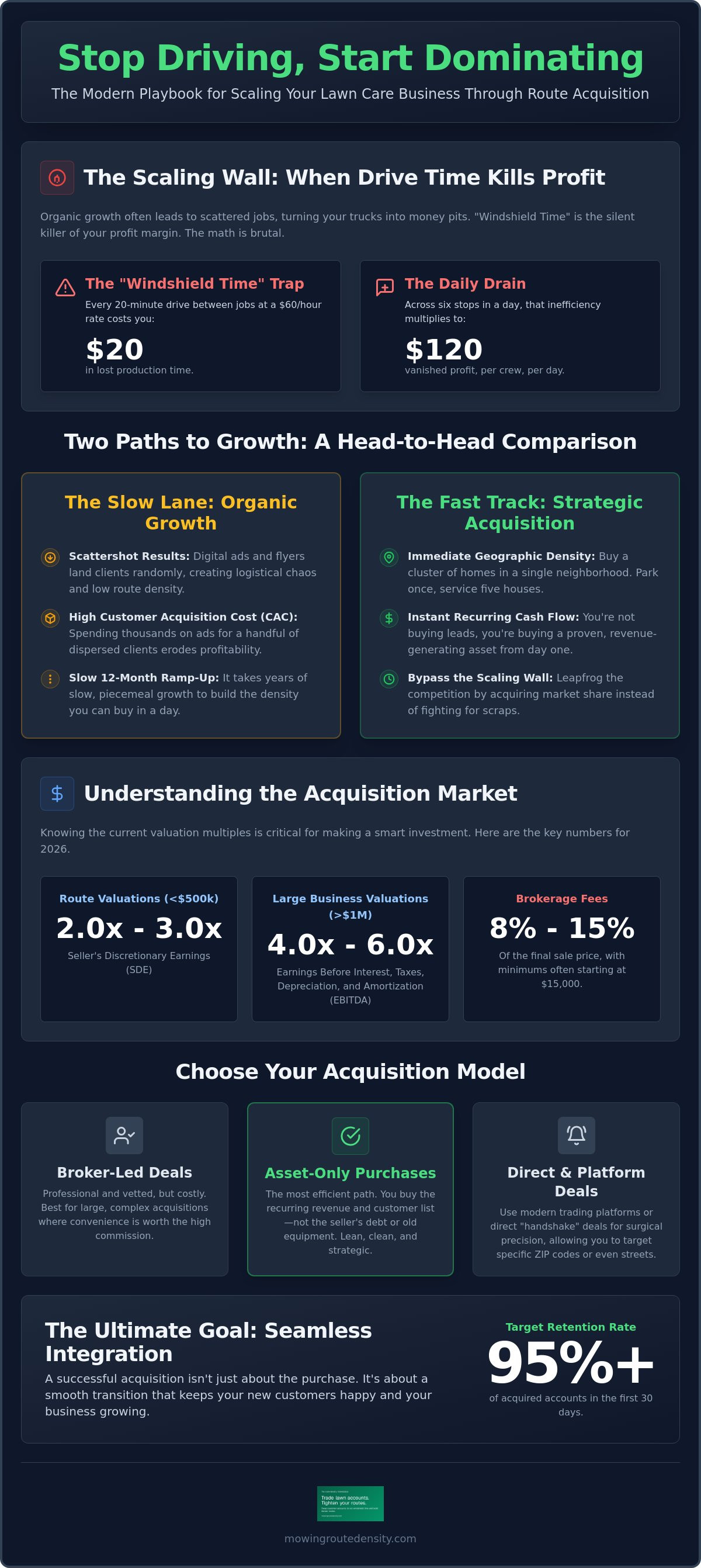
Every minute your engine idles in traffic is a minute you aren't getting paid. If your crew earns $60 per billable hour, a twenty-minute drive costs you $20 in lost production. You also have to factor in fuel and vehicle wear. Multiply that loss by six stops a day. That is $120 per crew, per day, simply vanished. Reducing drive time by just five minutes per stop adds 30 minutes of billable time back to the shift. That is pure profit with zero additional overhead. Route density is the ratio of billable service time to total shift time. High density means your equipment stays hot and your labor stays productive. Low density means you are just a glorified delivery service that happens to cut grass.
Organic Growth vs. Strategic Acquisition
Digital ads and door-hangers are scattershot by nature. You might spend hundreds of dollars to land one client on the other side of town. This creates a high Customer Acquisition Cost (CAC) that actually decreases your overall operational efficiency. Strategic acquisition is different. When you buy existing lawn care routes, you are buying a cluster of homes in a single neighborhood. You are buying the ability to park the truck once and service five houses on the same block. This is how you move from being a mower to a strategist. You stop fighting for scraps and start owning territories.
The "Scaling Wall" is the point where labor costs outpace revenue because your logistics are broken. You cannot out-market a bad route. You cannot work hard enough to overcome a forty-minute commute between jobs. Acquisition allows you to bypass the slow, messy process of organic lead generation. It provides the volume you need to justify a dedicated crew in a specific zone. If you want to scale in 2026, you have to stop thinking about individual customers and start thinking about geographic clusters.
Route Acquisition Models: Brokers, Direct Purchases, and Tactical Swaps
Acquiring revenue isn't a one-size-fits-all process. You have to decide if you're buying a corporate entity or just a list of addresses. Most contractors fail because they don't understand the vehicle they're using to buy existing lawn care routes. Are you looking for a massive regional expansion or a surgical strike on a single ZIP code? Your strategy dictates your source. Don't waste capital on a model that doesn't fit your operational capacity.
Broker-led transactions are the standard for businesses with over $1 million in earnings. These deals often trade at 4 to 6 times EBITDA in 2026. They're professional. They're vetted. But they come with a price. Expect to pay broker fees between 8% and 12% of the final sale price. If the deal is under $250,000, that fee can jump to 15%. Many brokers even have minimum fees starting at $15,000. Is the convenience worth the commission? For the scaling contractor, the answer is often a tactical "no."
Asset-only purchases are often more efficient. You aren't buying the seller's bad debt or their aging truck fleet. You're buying the recurring revenue and the geographic density. This is a lean approach. It keeps your balance sheet clean. It lets you focus on what matters: billable hours. You want the contracts, not the headaches of a legacy business entity.
Navigating the Lawn Account Trading Platform
Traditional marketplaces are often too broad. You don't need a dry cleaner in Ohio; you need ten lawns in a specific neighborhood. Using a lawn account trading platform allows for this level of surgical precision. These platforms filter by location and route density. They offer a layer of security that unvetted social media groups lack. You can verify the legitimacy of accounts before capital leaves your hand. Why risk your cash on a "handshake" from a stranger on a forum? Use a dedicated exchange to find clusters that actually fit your current route map.
The Direct Buyout Strategy
Sometimes the best route isn't listed for sale. It's currently being serviced by a competitor who is tired of the drive. Look for operators who are struggling with the "Scaling Wall." They have distant accounts that are killing their margins. These are your targets. This guide to buying a business highlights the importance of valuation and negotiation in these private deals. In 2026, routes under $500,000 are transacting at 2.0x to 3.0x SDE. Negotiate based on a multiple of monthly recurring revenue (MRR). Ensure you include a non-compete agreement. Without it, you're just paying a competitor to steal your new customers back next season. If you're looking to tighten your territory, you can view available account clusters in our marketplace to see what fits your current map.
Buying Routes vs. Organic Marketing: A Comparison of Growth Velocity
Marketing is a gamble. Buying is a transaction. When you buy existing lawn care routes, you're bypassing the uncertainty of "maybe" and moving straight to "paid." Organic growth through SEO or PPC is a slow burn. You spend capital today hoping for a lead in three months. Acquisition is different. You pay for the result, not the attempt. In the high-stakes 2026 market, waiting for the phone to ring is a strategy for the stagnant. Speed to market is your only real competitive advantage.
Consider the Customer Acquisition Cost (CAC). A single residential lead from digital ads can cost significantly when you factor in management fees and low conversion rates. Acquisition multiples for routes under $500,000 currently sit between 2.0x and 3.0x SDE. While the upfront check is larger, the cash flow is instantaneous. You aren't waiting six months for a Google ranking to move. You're collecting $55 to $85 per cut starting on day one. Organic marketing takes 6 to 12 months to ramp up. Acquisition takes as long as the due diligence process.
Operational load is the only real friction. A sudden influx of 50 stops can break a weak system. You must have the infrastructure to absorb the volume. However, this is a "good" problem. It forces you to optimize. It forces you to tighten your logistics. The alternative is a slow, agonizing leak of capital into inefficient, scattered routes.
Financial Comparison: The 12-Month Outlook
An organic growth model requires constant feeding. Stop the ads, and the leads stop. A purchased route is a permanent asset. Within 12 months, a dense route often pays for itself through the "Density Bonus." This is the reduction in overhead for your existing accounts. By adding stops to a current neighborhood, you lower the fuel and labor cost for every client on that street. Your profit margins can jump from the industry average of 15% to a lean 25% simply by cutting travel time. The break-even point arrives faster when you stop paying for the privilege of driving.
Risk Mitigation in Acquisition
Inherited clients are flighty. They didn't choose you; they were sold to you. You must perform thorough due diligence on the business before closing. Check the contracts. Verify the recurring revenue. A 10% churn rate post-acquisition is standard, but it is still often more profitable than the high CAC of organic leads because the remaining 90% are already clustered. Warm up these clients with a direct introduction. Show them your professional standards immediately. If you're worried about equipment, evaluate it separately. Often, the "bundled" gear is just a liability. Focus on the accounts. They are the only asset that generates billable hours.
Due Diligence: Assessing the Real Value of an Existing Route
Revenue is vanity; profit is sanity. You aren't buying a business; you're buying a cash-flow engine. If the engine is full of sludge, your capital is gone. Most contractors look at gross revenue and get blinded. Big mistake. Revenue pays for the truck; margin pays for your lifestyle. When you buy existing lawn care routes, you must strip away the fluff. You need to see the actual cost of labor, fuel, and equipment maintenance for those specific stops. Don't pay for the seller's inefficient habits.
Check the client list for "zombies." These are accounts that haven't paid in 60 days or only call when they have a problem. You don't want them. Verify the contracts. A "handshake" means the client can fire you the moment you pull up in a different truck. You need written agreements to protect your investment. If the seller can't produce them, the route's value drops significantly. You're buying air, not assets. Identify these problem accounts early so you can exclude them from the final valuation.
The Tactical Due Diligence Checklist
Don't trust a single spreadsheet. Demand 12 months of P&L statements. Compare them to tax returns. If the numbers don't match, walk away. Use this buying lawn care contracts checklist to ensure you don't miss critical red flags. Interview the seller on their service philosophy. Do they treat clients like partners or like chores? If your brand is high-end and theirs is "budget," you'll lose half the route in a month. Brand alignment is a prerequisite for retention.
The Logistics Audit
Never buy a route you haven't driven. "Ghosting" the route is mandatory. You need to see the gate codes. You need to see the aggressive dogs. You need to see the properties that require a 21-inch mower because the gate is too narrow for a zero-turn. These "hidden" obstacles kill your billable minutes. Your lawn route purchase negotiation should be based on geographic clustering, not just customer count. If the accounts are tight, pay the premium. If they're scattered, cut the price. Ready to start? You can find vetted accounts today on our platform to ensure your next move is a profitable one.
Strategic Integration: Maximizing Route Density Post-Acquisition
Integration is where the deal is won or lost. Most contractors think the work ends at the closing table. It's actually just beginning. You didn't buy existing lawn care routes to run a parallel business with separate overhead. You bought them to achieve total territory dominance. The goal is 95% retention during the transition. To get there, you need a proactive 30-day communication plan. Send a physical letter. Follow up with a call. Introduce your professional standards immediately. Show these new clients why the change is an upgrade, not a disruption.
Stop thinking about the "old" route map. It's dead. Take every new stop and dump it into your optimization software. Merge them with your existing crew schedules. If a new stop is next door to an old one, that is a massive logistical win. If a new stop is ten miles away from your nearest cluster, it's a liability. You must be willing to cut the outliers if they don't fit your density model. Billable minutes are the only currency that matters. Re-optimizing the route ensures you aren't just adding revenue, but actually increasing your profit per man-hour.
Scaling Without Capital Strain
Acquiring a route is a significant capital outlay. Don't make it harder by taking on equipment debt at the same time. Professional lawn equipment rental is a tactical move for the asset-light contractor. it keeps your cash flow liquid for the purchase itself. Why buy a depreciating zero-turn when you can rent a brand-new model? Newer assets have higher uptime and better fuel efficiency. They reduce the risk of a mechanical failure during a critical integration phase. Use rented gear to service the new density while you stabilize the revenue. It's a lean way to grow without the weight of a high-interest loan.
Filling the Gaps
No route is perfectly tight on day one. There will be outliers. These are the profit killers that destroy your margins. Don't send a full crew ten miles for one lawn. Use a lawn mowing service provider locator to find a reliable subcontractor for those distant stops. It turns a logistical nightmare into a hands-off referral fee or a simple subcontracted margin. Once the outliers are handled, focus your marketing on the "holes" in your new clusters. Achieve 100% density by winning the neighbors of your newly acquired accounts. This is how you move from "inherited" revenue to an "integrated" territory. You aren't just mowing grass. You're owning the street.
Tighten Your Territory and Protect Your Profits
Windshield time is a silent tax on your business. You can keep paying your crews to sit in traffic, or you can buy the neighborhood. Density is the only real driver of profitability in this industry. Strategic acquisition allows you to skip the 12-month marketing ramp-up and move straight to immediate cash flow. It's the most effective way to scale a lean operation in 2026.
Success requires more than just a checkbook. You need a rigorous audit and a plan for asset-light integration. When you decide to buy existing lawn care routes, leverage a secure account trading platform and a national network of professional contractors to find the right clusters. Don't let equipment debt stall your growth. Utilize commercial-grade mower rentals for instant scalability as you merge new stops into your schedule.
Optimize your route density today on the Mowing Route Density marketplace. Stop chasing leads and start owning territories. Your bottom line will thank you.
Frequently Asked Questions
Is it better to buy a lawn care route or start from scratch?
Buying an existing route is almost always the superior choice for contractors who value their time and profit margins. Starting from scratch creates a "shotgun" effect where customers are scattered across the map, leading to excessive windshield time. When you buy existing lawn care routes, you're purchasing geographic density and immediate cash flow. You skip the expensive ramp-up of marketing and move straight into billable hours. It's the difference between building a machine and just turning the key.
How much should I pay for an existing lawn care route in 2026?
In 2026, routes with under $500,000 in revenue typically transact at 2.0x to 3.0x Seller's Discretionary Earnings (SDE). If the business generates over $1 million and has a professional management team, you might see multiples of 4.0x to 6.0x EBITDA. Expect to pay a premium of 1 to 2 additional multiple turns if the route has over 60% recurring contract revenue. Always value the actual cash flow remaining after labor and overhead, not just the gross revenue.
How do I prevent customers from canceling after I buy a route?
Retention starts with a proactive 30-day communication plan. Send a formal introduction letter followed by a phone call to establish your professional standards and service philosophy. Don't change the service day or the price immediately, as customers hate surprises during a transition. Show them the upgrade in quality through better equipment and more reliable scheduling. A smooth handoff ensures you retain the 95% or more of accounts needed to make the deal profitable.
Can I get financing to buy existing lawn care routes?
Seller financing is the most common tool for smaller route acquisitions. It aligns the seller's interests with yours during the transition period. For larger deals, SBA 7(a) loans are a viable option, though they require clean books and a longer closing period. Many contractors also use asset-backed loans if equipment is included in the deal. Always ensure the debt service doesn't choke your monthly cash flow or prevent you from investing in route density.
What is a fair multiple for a lawn care business client list?
A fair multiple for a standalone client list is usually 0.8x to 1.2x annual recurring revenue, or 2.0x to 3.0x SDE for smaller owner-operated businesses. The value shifts based on density. A tight route in one neighborhood is worth significantly more than a scattered list of names across three counties. If the accounts aren't under written contract, the multiple should drop. You're paying for the certainty of future revenue, not just a list of phone numbers.
Should I buy the equipment along with the lawn care route?
Usually, the answer is no. Most sellers have aging, poorly maintained equipment that becomes an immediate liability. Buying used gear often leads to repair costs and downtime during your most critical integration phase. It's often smarter to buy the accounts and use professional mower rentals to scale without the debt. Only buy the equipment if it's under two years old and matches your current fleet's specifications to keep your maintenance lean and functional.
How do I verify the revenue of a lawn care route before buying?
Demand at least 12 months of tax returns and matching bank statements. Don't rely on "cash" claims that aren't documented in a ledger. Review the logs in their routing or CRM software to see service history and payment consistency. If a customer hasn't paid in 60 days, they aren't a client; they're a "zombie" account that should be excluded from the valuation. Verify the recurring revenue through written service agreements whenever possible.
What are the biggest risks when buying a mowing route?
The biggest risk is customer churn immediately after the sale. If the seller had a "personal" relationship rather than a professional one, clients might leave when he does. Other risks include hidden logistical nightmares like narrow gates or aggressive dogs that kill your billable minutes per stop. Finally, bad data regarding profitability is a major threat. If the seller didn't track their fuel and labor costs per stop, you might be buying an unprofitable route that won't pay for itself.


