

What if your most valuable asset evaporated the moment you shook hands on a sale? You've spent years tightening your routes and building a dense, profitable list of recurring accounts. Now you're ready to exit. But the fear is real. You worry clients will jump ship during the transition. You worry the buyer will find a way to "steal" the list without paying the full multiple. These aren't just nerves; they are legitimate risks to your bottom line.
A professional lawn care client transfer agreement is the only thing standing between a successful exit and a total loss of equity. It is a tactical tool designed to convert your operational sweat into liquid capital. You need a clean break and a guaranteed payout. This guide teaches you how to draft a binding agreement that protects your route value and forces buyer accountability. We'll break down the essential legal framework, retention strategies to keep clients on the books, and the steps required to ensure you walk away with cash in hand.
Key Takeaways
- Recognize that a standard service contract is useless in an asset sale; you need a legal framework built specifically for transferring ownership.
- Protect your investment by using a lawn care client transfer agreement to lock in non-compete clauses and clawback provisions.
- Audit your service logs and revenue reports to provide the clinical proof buyers need to sign the check.
- Master the five-step handoff process to ensure a clean break from the business with your full valuation intact.
- Optimize your exit by leveraging route density to increase the liquidity and market value of your service accounts.
What is a Lawn Care Client Transfer Agreement?
A lawn care client transfer agreement is a formal contract that legally moves the ownership of service accounts from one business entity to another. Don't confuse this with the service agreements your customers sign. Those are B2C documents meant to manage expectations on the turf. A transfer agreement is a B2B weapon designed to protect capital. If you try to sell a route using a standard service form, you're handing over your hard-earned equity without a safety net. You're leaving the door open for the buyer to walk away with your clients while you're left chasing a check that never arrives.
In the 2026 market, your route is a liquid asset. Private equity firms and regional players are aggressively acquiring routes to build scale. They aren't looking at your equipment; they're looking at your recurring revenue. Mid-sized companies are currently fetching multiples between 3x and 4.5x EBITDA. To hit those numbers, you must define the "Asset" with clinical precision. This includes the customer list, contact data, service history, and the right to provide future services. Without a written agreement, your route has zero market liquidity. It's just a hobby that pays the bills until you stop showing up.
Asset Purchase vs. Service Agreement
A professional lawn care client transfer agreement is essentially a specialized Asset Purchase Agreement (APA). In this scenario, the "assets" are the intangible rights to service specific properties. The buyer isn't just paying for a list of names. They are purchasing future cash flow. They need to know that the revenue they buy today will still be there in six months. A standard service agreement doesn't provide that security. It doesn't prevent you from opening a new shop across the street. It doesn't guarantee the accuracy of the billing data. Only a dedicated transfer agreement locks these variables down and ensures the buyer is getting what they paid for.
The Role of Route Density in Valuation
Density drives profitability. It's the lifeblood of a lean operation. A compact route with 20 stops on a single block is worth significantly more than 20 stops spread across a county. Logistics matter. Less windshield time means more billable hours. Your transfer agreement must specify the geographic boundaries of the accounts being sold. This prevents "cherry-picking" and ensures the buyer understands the operational efficiency they are acquiring. In 2026, high-density routes command the highest multiples because they minimize fuel consumption and equipment wear. If your agreement doesn't highlight this density, you're leaving money on the table.
Essential Clauses for Protecting Your Route Value
A handshake is not a strategy. It's a liability. If your lawn care client transfer agreement lacks specific, enforceable clauses, you aren't selling a business; you're gifting your hard work to a competitor. You need to lock down the variables that dictate your route's worth. This means addressing the two biggest threats to any sale: seller competition and client attrition. Without these protections, the buyer's risk skyrockets, and your final payout will reflect that uncertainty.
Thorough legal preparation is part of a professional due diligence process that protects both parties from post-sale litigation. You must also account for modern data standards. Legally moving sensitive client information in 2026 requires strict adherence to privacy protocols. Your agreement should detail how CRM data is exported, who owns the historical service logs, and how the transition of digital assets will occur. If you're looking to simplify this process, using a specialized account trading platform can help standardize these interactions and reduce legal friction.
Non-Compete Boundaries
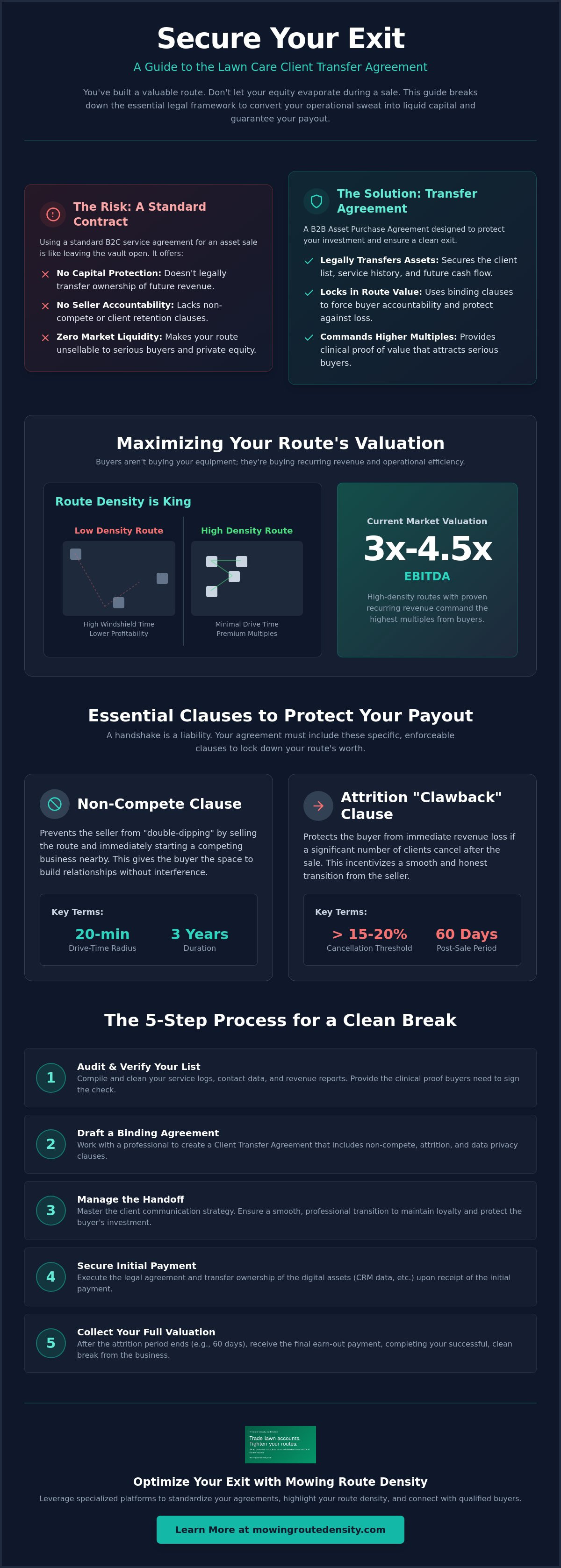
Don't let a seller "double-dip" by selling a route and then starting a new one three streets over. You need a clear non-compete clause. It must define a specific geographic radius and a reasonable duration. Too broad, and it's unenforceable. Too narrow, and it's useless. The seller shall not engage in competing lawn maintenance services within a 20-minute drive-time radius of any transferred account for a period of three years. This protection ensures the buyer has the space to build relationships without interference from the former owner.
The Attrition Clause
Client loyalty is fickle. Some customers will inevitably leave when they see a new logo on the truck. A "clawback" or attrition provision protects the buyer from immediate revenue loss. It's common to structure the deal with an initial payment followed by an earn-out. If more than 15% to 20% of the transferred accounts cancel within the first 60 days, the final purchase price should adjust downward proportionally. This keeps the seller honest. It incentivizes them to perform a "warm handoff," personally introducing the new owner to high-value accounts to ensure a seamless transition. Clean breaks are rare; structured transitions are profitable.
Finally, define the payment terms with clinical clarity. Lump-sum payments are great for the seller but risky for the buyer. Most sophisticated deals in 2026 use a hybrid model. Pay a significant portion upfront, then hold the remainder in escrow. Release the funds only after the retention milestones are met. This aligns everyone's interests and ensures the route remains a productive asset rather than a shrinking list of names.
Due Diligence: Verifying the List Before Signing
Trust is a luxury you can't afford during an acquisition. If a seller claims they have a dense, high-margin route, make them prove it. Buying a list without auditing the logs is a fast track to financial waste. You aren't just buying names. You're buying a history of performance. If that history is missing or fabricated, the value of your lawn care client transfer agreement drops to zero. You need to see the receipts before you sign the check.
Start with the service logs. GPS stamps and CRM timestamps are the gold standard here. They provide clinical proof that the work was actually performed on the days and times claimed. If a seller can't produce these, walk away. Beyond the logs, you must perform a "Quality of Earnings" analysis. This means matching the client list to actual bank deposits. A list of 100 names is worthless if only 80 of them are paying on time. Revenue verification isn't just about the total number. It's about the consistency and reliability of the cash flow.
Logistical Audit
Profit lives in the gaps between stops. A logistical audit ensures the new accounts don't balloon your overhead. You must review the route density to confirm the accounts fit your existing operational footprint. Outlier accounts are profit killers. One client located 15 minutes away from the rest of the route will drain your fuel and labor margins. You need to identify these outliers early. Use this audit to drive lawn care profit margin optimization by pruning any account that doesn't meet your density standards. If the accounts require specialized equipment you don't own, such as 36-inch mowers for narrow gates, calculate that capital expenditure into your offer.
Financial Transparency
A "clean" list is non-negotiable. Your lawn care client transfer agreement should include warrants that the financial data provided is accurate and complete. This means no delinquent accounts and no "troublemakers" who demand extra services for free. Verify the average billable hour per stop. If the seller is undercharging, you'll face immediate attrition when you try to correct the pricing. You are looking for sustainable margins, not a list of customers who are only there because the previous owner was the cheapest in town. Demand transparency. It's the only way to ensure the route is an asset, not a liability.
The 5-Step Process for a Successful Account Handoff
Once the due diligence is complete, you move from theory to execution. This isn't a slow transition. It's a surgical strike. Every day of delay increases the risk of client leakage. The goal is simple: transfer the accounts, keep the revenue, and get paid. If you fumble the handoff, you'll see your hard-earned equity vanish in a wave of cancellations. Follow a methodical process to ensure the value you built stays on the books.
- Finalize the inventory: Lock in the exact list of accounts and the agreed-upon valuation. Don't leave room for "maybe" accounts.
- Execute the agreement: Sign the lawn care client transfer agreement and secure the initial payment. Money must move before the data does.
- Send the warm handoff: Deploy a coordinated communication to all affected clients. The seller must explicitly endorse the buyer.
- Execute the shadow period: The seller should spend time on the route with the buyer. Introduce them to key accounts and explain property quirks.
- Final audit: After the retention period, verify the active account list and release the remaining escrow funds.
The Warm Handoff Strategy
Clients hate change. They especially hate surprises that involve their property. If you just stop showing up, they'll find someone else. The seller has to draft a letter that does more than just announce a change. It must position the buyer as a vetted professional who will maintain the same standards. Address price consistency and scheduling immediately to minimize anxiety. If you want to maximize your payout, you need to understand how to sell lawn mowing accounts without triggering a mass exodus. A solid endorsement from the previous owner is the best insurance against attrition.
Transitioning the Data
Profitability is in the details. You're transferring more than names; you're transferring property intelligence. Gate codes, aggressive dogs, and specific mowing height preferences must move to the new CRM. Losing this data creates friction. Friction leads to missed billable hours. Ensure your CRM export is clean and that all historical service data is preserved. The buyer shouldn't have to guess where the hidden valve box is or which neighbor complains about noise. Providing a complete data package makes the lawn care client transfer agreement much more attractive to sophisticated buyers who value operational efficiency.
A successful handoff is the final step in securing your exit. Don't let sloppy logistics ruin years of route building. If you're ready to trade your accounts for capital, list your route on an account trading platform that specializes in high-density transfers.
Optimizing Your Exit with Mowing Route Density
Route density is your primary leverage. In the 2026 market, buyers don't just want accounts; they want efficiency. A dense route minimizes windshield time and maximizes billable hours. This operational reality translates directly into higher valuation multiples. Mid-sized companies with high recurring revenue and tight routes are currently commanding 3x to 4.5x EBITDA. If your route is scattered, your multiple will suffer. You must optimize your geography before you ever draft a lawn care client transfer agreement.
Using a professional marketplace simplifies this entire transition. It moves the process away from informal handshakes and toward standardized, legally binding frameworks. This reduces legal friction between contractors and ensures that both parties are protected by a professional lawn care client transfer agreement. A marketplace also provides access to a wider pool of verified buyers who understand the value of route density. They aren't looking for a bargain; they're looking for a turn-key asset they can plug into their existing operations.
Trading vs. Selling
Sometimes a cash exit isn't the most profitable move. If you're looking to scale rather than retire, consider trading accounts. Swapping your outlier stops for accounts that fit your core density can drastically reduce your fuel and labor costs. Using a lawn account trading platform allows you to find verified B2B partners for these swaps. It's a tactical way to optimize your route without the tax implications of a full sale. You gain efficiency without losing total revenue.
Preparing Your Business for Sale
Liquidity requires preparation. You can't expect a premium price for a messy business. Clean up your books. Tighten your routes. Prune the delinquent accounts that drain your resources. A buyer wants to see a lean, profitable machine, not a fixer-upper. Developing a clear lawn care business exit strategy at least 12 months before you plan to sell is the only way to ensure maximum route liquidity. When the books are clean and the routes are tight, the sale becomes a simple transaction of value.
Don't let your equity sit idle. If your routes are dense and your revenue is recurring, you have a liquid asset. List your accounts or find your next high-density route today to turn your operational efficiency into real capital.
Secure Your Equity and Exit on Your Terms
Your route is either a burden or a bankable asset. The difference is the paperwork and the strategy behind it. A handshake is a liability. Route density is the ultimate multiplier. Executing a precise lawn care client transfer agreement is the final step in turning years of field labor into a liquid asset. This process protects your capital. It ensures the buyer gets the recurring revenue they paid for. It allows you to walk away with a clean break and cash in hand.
Stop letting outlier accounts drain your profitability. Whether you're looking to exit or just tighten your footprint, you need a professional framework. You can optimize your route density and trade accounts on our secure platform to access a national network of professional contractors. Our secure B2B trading environment provides the asset-light scaling solutions you need to grow without the overhead. Take control of your route today. Your business is too valuable to leave to chance. Build for liquidity, trade for density, and win on efficiency.
Frequently Asked Questions
Is a lawn care client transfer agreement legally binding?
Yes, a lawn care client transfer agreement is a legally binding B2B contract once signed by both parties. It serves as the official record of the asset sale. If a seller tries to restart their route in the same neighborhood or a buyer refuses to pay, this document is what a judge uses to enforce the terms and award damages. It protects your equity from informal handshakes that fall apart under pressure.
How do I value a lawn care client list for a transfer?
Valuation is driven by your Seller's Discretionary Earnings (SDE) and route density. Most transactions for mid-sized companies fall between 2.5x and 5x SDE. If your route has over 60% recurring revenue and tight geographic clusters, you'll command the higher end of that multiple. Buyers pay for predictable cash flow and operational efficiency; they don't pay for a scattered list of one-off jobs.
Do I need a lawyer to draft a client transfer agreement?
You aren't legally required to use a lawyer, but you're taking a massive risk if you don't have one review the final document. A template can't account for specific state laws regarding non-competes or data privacy. Spend the money on a professional review to ensure your exit payout is actually protected. It's a small insurance premium to pay for total financial security during a business exit.
What happens to the transfer agreement if a client refuses to move to the new company?
Most professional agreements include a clawback provision to handle clients who refuse the transition. If a customer cancels within the first 60 to 90 days, the purchase price is adjusted downward proportionally. This protects the buyer from paying for "ghost" revenue. It also forces the seller to participate in a legitimate, warm handoff to ensure the highest possible client retention rate.
Can I sell my lawn care accounts if I don’t have written contracts with my clients?
You can sell accounts without written contracts, but you should expect a lower purchase price. Without contracts, the buyer takes on significantly more risk. They are essentially buying your data and your reputation rather than a guaranteed term of service. if you want a higher multiple, start getting your high-value accounts on paper at least one season before you plan to list the route.
What is a typical non-compete radius in a lawn care route sale?
A standard non-compete radius covers a 10 to 20-mile area or a 20-minute drive-time from the transferred accounts. The restriction typically lasts 3 to 5 years. This prevents the seller from selling a route on Monday and then undercutting the buyer on Tuesday in the same zip code. Without this clause, the buyer has no protection against the seller immediately poaching the neighborhood.
How long does the transition period usually last after signing the agreement?
The transition period typically lasts 30 to 60 days. This time is used for the "shadow period" where the seller introduces the buyer to key accounts and explains specific property quirks. It allows the buyer to learn the route while the seller is still available to troubleshoot issues. Once this period ends and retention is verified, the final escrow payment is released.
Is the buyer responsible for the seller’s past liabilities?
No, the buyer is generally not responsible for the seller's past liabilities in an asset sale. You are purchasing the client list and data, not the company's legal baggage or debts. Your lawn care client transfer agreement must clearly state that all prior debts, taxes, and legal claims remain the sole responsibility of the seller. Don't inherit someone else's financial mess or legal history.


