
Every mile your truck travels between jobs is a leak in your bank account. If you're still chasing scattered clients because you're afraid to let go of the gross revenue, you aren't growing. You're just busy. You need a tactical plan to sell lawn mowing accounts that don't fit your core service area. It is the only way to stop the logistical rot of a fragmented route.
You already know that burning fuel on the highway doesn't pay the bills. It's frustrating to manage high-maintenance clients who demand premium attention while offering thin margins. We'll show you how to flip that script. You'll learn the exact framework for valuing your routes using 2026 market multiples, which currently range from 2.5x to 4.0x SDE for owner-operated setups. We'll also cover how to leverage the 20% QBI deduction under the OBBBA to keep more of your sale proceeds.
This guide explains how to prepare your books, find the right buyer, and execute a clean exit. By the end, you'll know how to turn your least efficient accounts into a cash injection for equipment upgrades while tightening your remaining operations for maximum density. Let's get to work.
Key Takeaways
- Stop viewing routes as permanent obligations; treat them as liquid assets that can be traded to eliminate the logistical rot of scattered accounts.
- Learn why high route density in a single zip code creates more value and a higher exit multiple than a massive list of geographically distant clients.
- Identify the specific nightmare clients you must fire before you sell lawn mowing accounts to ensure your list is profitable and transferable.
- Compare the trade-offs between high-fee business brokers and higher-margin peer-to-peer transactions to choose the right marketplace for your exit.
- Discover how to use a dedicated lawn account trading platform and locator tool to find qualified buyers and execute a secure, professional transfer.
The Strategic Logic of Selling Lawn Mowing Accounts
Distance kills margins. If your crews spend 20 minutes driving between jobs, you're not a lawn care operator; you're a logistics company with a failing fleet. Every account outside your core cluster is a liability disguised as revenue. When you decide to sell lawn mowing accounts that don't fit your density, you aren't shrinking your company. You are converting an inefficient service-based asset into a liquidity event. This is the difference between working for your business and making your business work for you.
The landscape maintenance industry has shifted. In 2026, volume is cheap. Density is expensive. Buyers no longer care about your total top-line revenue if it requires four trucks to service three zip codes. They want tight, defensible routes. Selling specific accounts allows you to prune the dead wood without losing the entire tree. It's a tactical optimization, not a retreat. You are trading operational headaches for cold, hard cash.
Trimming the Fat: Selling as an Optimization Tool
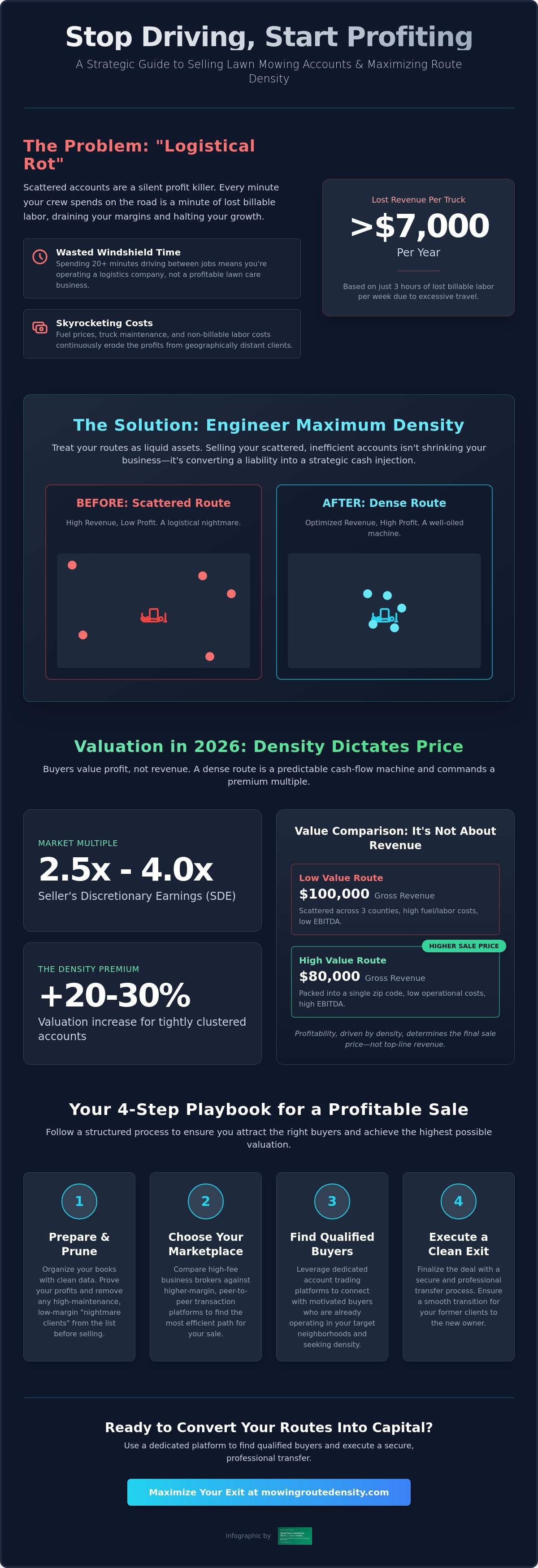
Scattered accounts are a net negative. Period. The math is simple. Every minute of windshield time is a minute of lost billable labor. Fuel prices aren't dropping. Truck maintenance isn't getting cheaper. If you have a crew driving 15 miles for a single $50 cut, you're losing money. You keep accounts 20 miles away. You lose three hours of billable labor a week. That's over $7,000 a year in lost revenue per truck. Stop the bleeding.
Selling these outliers turns a liability into capital. This isn't just about getting rid of a headache; it's about strategic reinvestment. Use that cash to dominate your core area. Buy better equipment. Hire a more skilled lead. Optimization isn't about doing more. It's about doing better in a smaller footprint. Turn your "logistical rot" into a cash injection for your high-density zones.
Market Demand for Recurring Revenue in 2026
Buyers want recurring revenue and predictability. In 2026, the market is flooded with operators who have volume but no density. This creates a massive opportunity for you. If your accounts are organized and contracted, they are high-demand assets. Private equity and local competitors are looking for asset-light acquisitions. They don't necessarily want your beat-up trucks. They want your customers.
A clean lawn care business exit strategy starts with organization. Buyers are looking for established cash flow without the operational baggage. When you sell lawn mowing accounts to someone who already services that neighborhood, you create a win-win. They get instant density. You get a higher multiple because the value to the buyer is greater than the value to you. Stop holding onto gross revenue that rots your bottom line and start treating your routes like the tradeable assets they are.
Valuation Beyond Revenue: Why Route Density Dictates Price
Revenue is a vanity metric. If you want to sell lawn mowing accounts for a maximum return, stop focusing on gross billing. A $100,000 route scattered across three counties is a logistical disaster. A $80,000 route packed into a single zip code is a profit machine. Buyers in 2026 have wised up. They've moved past the outdated rule of thumb that values a business at a few weeks of revenue. Modern valuation is driven by EBITDA. EBITDA is driven by density.
Density is the math of profit. When you eliminate 15 minutes of travel between jobs, you're clawing back an hour of billable time every four stops. Over a season, that's thousands of dollars in pure margin. This is why buyers pay a "Density Premium." Accounts clustered within a 5-mile radius frequently command 20% to 30% more than fragmented lists. If you're including equipment, condition matters. While the OBBBA allows for 100% bonus depreciation on new gear, your used fleet must show a rigorous maintenance log to avoid dragging down your multiple.
The Density Multiple: A New Standard
The industry now uses a "Clustering Metric" to judge route quality. This measures the average distance and travel time between stops. Route density is the primary driver of EBITDA in 2026. Buyers are looking for accounts that allow a crew to stay on one street or in one neighborhood all day. This reduces fuel consumption and labor waste. It turns a standard 2.5x SDE business into a 4.0x SDE asset.
Data Integrity: Proving Your Profits
Handshake deals are liabilities. If your customer list exists only in your head or a paper notebook, you're going to take a haircut on the price. Buyers need proof. They want to see digital service logs and GPS verification. This data proves the crew was on site and the billing is accurate. Auto-pay and paperless billing are equally critical. They ensure the revenue is automated and the transition is seamless. When you prepare to sell lawn mowing accounts, your digital footprint is your most valuable asset. It proves your profit is real and repeatable. Before listing, you should analyze your route density to pinpoint your most profitable clusters.
Preparing Your Accounts for a High-Multiple Sale
Buyers don't buy accounts. They buy systems. If your route data is stored in your head or on a pile of coffee-stained invoices, you're leaving money on the table. To sell lawn mowing accounts for a premium multiple, you must present a turn-key operation. This starts with a ruthless audit of your current list. Fire your nightmare clients now. If a customer pays late, complains about every trim, or has a yard full of debris, they are a liability. Firing them before the sale increases the average profit per stop and protects your reputation with the buyer. A clean, high-margin list is far more valuable than a long list of headaches.
Standardize your service agreements. A buyer needs to know that the revenue is transferable and the terms are clear. Handshake deals are worthless in a professional exit. You need documented stop times, gate codes, and specific turf requirements for every property. This level of detail eliminates the "Trial Period" myth. You don't need to let a buyer shadow you for a month. If your data is precise, the handoff is a clerical task, not a guessing game. Structure a safe handoff with a 30-day support window instead of an open-ended trial that puts your revenue at risk.
The "Due Diligence" Folder for Sellers
Organization is your best negotiation tool. Build a digital folder that includes your trailing 12-month revenue and a detailed margin analysis. Use your lawn care profit margin optimization data to prove the upside of your routes. Buyers want to see that you've already trimmed the fat and maximized the billable hours. Include a signed non-compete agreement in this folder. This shows the buyer you are serious about protecting their new investment and won't be poaching these clients next season. It builds the trust necessary to close the deal quickly.
Communication Strategy: Telling the Clients
Timing is everything. Don't tell your customers you are selling until the deal is inked. Early announcements create uncertainty and trigger churn. Once the sale is closed, send a formal "Welcome Letter" introducing the new provider. Focus on continuity. Explain that the service schedule and quality standards will remain unchanged. To minimize churn in the first 30 days, offer to join the new owner for the first round of service. This face-to-face handoff builds trust. It ensures the buyer sees the same efficiency you did when you decided to sell lawn mowing accounts to optimize your own operations.
Marketplace vs. Private Sale: Navigating the Trade
Choosing where to list your accounts is as important as the valuation itself. You have three main paths: brokers, private sales, or dedicated trading platforms. Brokers provide a high-touch service, but their commissions are steep. For businesses under $1 million, you're looking at 10% to 12% of the final sale price. If your list is worth $250,000, giving away $30,000 to a middleman who doesn't understand your route density is a hard pill to swallow. Brokers are for multi-million dollar exits. For specific route sales, they're often an unnecessary drain on your equity.
Private peer-to-peer sales offer the highest margins because you cut out the intermediary. However, they carry the highest risk of default. You aren't just selling a list; you're betting on the buyer's ability to actually service the accounts. If they fail, your reputation in that neighborhood dies with them. This is why the trading platform model has become the 2026 standard. It provides the security of a professional marketplace with the industry-specific tools needed to sell lawn mowing accounts based on density rather than just raw volume.
Evaluating Your Selling Channels
General business-for-sale sites are a waste of time for route-based businesses. You'll get "financial buyers" who want passive income but have no idea how to manage a crew. You want "strategic buyers." These are local competitors who already service your area. They see your accounts as a way to lower their own windshield time. They'll pay a premium because your accounts integrate into their existing routes. Before you sign anything, vet their operational capacity. Do they have the trucks? Do they have the labor? Don't hand your legacy to someone who isn't equipped to carry it.
Negotiating the Deal: Cash vs. Earn-Outs
Cash is king, but 100% cash at closing is rare for account-only sales. A typical 2026 deal structure involves a 70/30 split. You get 70% upfront. The remaining 30% is held in escrow as a retention-based payment. If 20% of the clients churn in the first 90 days, the buyer triggers a "clawback" clause to adjust the price. This protects the buyer and keeps the seller honest during the transition.
If your buyer is a smaller operator looking to scale, they might struggle with equipment. Suggesting professional lawn equipment rental can help them meet your route requirements without a massive capital outlay. This makes your accounts more accessible to a wider pool of buyers. Ready to find the right match? You can list your accounts on our trading platform to connect with vetted, strategic buyers in your area.
Executing the Exit with Mowing Route Density
Execution is where most owners fail. They hesitate. They overcomplicate the handoff. They let emotions cloud the math. Our lawn account trading platform removes this friction. It's built to help you sell lawn mowing accounts with surgical precision. We don't just list numbers; we verify route density. We match you with buyers who have the proven capacity to take over. This isn't a generic marketplace. It's a tool for professional optimization.
Consider the "Route Swap" advantage. This is the ultimate play for operational efficiency. You might have three accounts in the north while a competitor has three in the south. You trade. No cash changes hands. You both gain instant density and slash your windshield time. If you prefer a cash exit, our lawn mowing service provider locator identifies strategic buyers already operating in your target zip codes. These buyers value your density because it mirrors their own. They aren't just buying revenue; they're buying a more profitable day for their crews.
The Mowing Route Density Advantage
We eliminate the middleman. You don't need a broker taking a 10% to 12% cut of your hard-earned equity. Our marketplace connects you directly to a national network of professional contractors. We verify route data to build trust between parties. This transparency ensures that the buyer knows exactly what they're getting. By standardizing the transfer process, we lower transaction costs and speed up the closing. It's a lean approach to a complex problem. We prioritize your bottom-line profitability over corporate fluff.
Trust is built on data. Our platform requires verified service logs and GPS history. This proves the value of your routes. It justifies your exit multiple. When a buyer sees a tight cluster of accounts with a clean payment history, the negotiation ends. The value is obvious. We provide the framework to make that value undeniable. You get a clean break. The buyer gets a dense route. The industry gets more efficient.
Next Steps for Your Business
Stop tolerating logistical rot. Your trucks are traveling too far for too little. Audit your current routes for density leaks today. Identify every account that falls outside your five-mile core. These are your prime candidates for liquidation. Once you've cleaned your list, follow this checklist for a professional exit:
- Finalize your digital service logs and gate codes.
- Verify buyer equipment capacity via our locator tool.
- Sign the non-compete and account transfer agreements.
- Execute the 70/30 payment split to protect your equity.
- Send the joint welcome letter to your clients immediately after closing.
Don't wait for a crisis to fix your routes. List your scattered accounts on the Mowing Route Density platform now. If you're unsure how to price your list, contact our team for a tactical consultation. We'll help you sell lawn mowing accounts that are draining your resources so you can focus on the ones that actually pay the bills. It's time to work smarter.
Stop Driving and Start Scaling
Windshield time is a cancer in your business. You've seen the math. Route density isn't a luxury; it is the only way to protect your margins in a competitive market. When you choose to sell lawn mowing accounts that fall outside your core clusters, you aren't losing ground. You are gaining focus. You are turning logistical rot into immediate cash flow for your operation.
The 2026 market values systems over sweat. Clean your data. Fire your low-margin clients. Present a turn-key operation that strategic buyers can't ignore. Whether you are swapping routes for better density or executing a partial exit, the goal remains the same: maximum efficiency. Don't let scattered accounts drain your fuel tank and your morale. Take control of your territory today.
Start your route optimization journey on the Mowing Route Density marketplace. Our secure B2B trading platform connects you with a national network of verified contractors. Leverage our industry-leading route density analytics to prove your value and close the deal. Your most profitable season starts with a tighter map. You've done the hard work of building the list; now make it work for you.
Frequently Asked Questions
How much are lawn care accounts worth in 2026?
Lawn care businesses typically sell for a multiple of 2.5x to 4.0x Seller’s Discretionary Earnings (SDE) for owner-operated residential setups. If you have commercial contracts, that multiple can climb to 5.0x EBITDA. The exact price depends on your density and recurring revenue percentage. Buyers pay a premium for routes that require less windshield time and offer predictable cash flow.
Can I sell individual lawn mowing accounts or do I have to sell the whole route?
You can sell individual accounts or partial routes to optimize your footprint. Selling outliers that sit 15 miles away is a strategic move to eliminate logistical rot. It allows you to tighten your remaining schedule while getting a cash injection. You don't need to exit the entire business to sell lawn mowing accounts that are draining your profit margins.
What is a typical retention period for a lawn care account sale?
Most deals include a 30 to 90-day retention period where a portion of the sale price is held in escrow. This ensures the buyer doesn't lose the revenue they just purchased due to poor handoff. If clients churn during this window, the final payout is adjusted based on a "clawback" clause. It protects the buyer and keeps the seller engaged during the transition.
Do I need a lawyer to sell my lawn mowing client list?
A lawyer is highly recommended to draft non-compete agreements and purchase contracts. You need to protect your remaining business and ensure the buyer is legally bound to the payment terms. While digital trading platforms provide standardized frameworks, having a legal professional review your specific deal prevents future disputes. Don't skip the paperwork to save a few dollars now.
What happens if a client cancels right after I sell the account?
If you use a standard 70/30 payment split, the 30% held in escrow covers client cancellations. This is a common industry safeguard. If the cancellation is due to the buyer's poor service, the seller is usually protected. If it's due to the client's dissatisfaction with the change, the seller loses that portion of the retention payment.
How do I prove my route density to a potential buyer?
Provide digital service logs and GPS verification data from your routing software. Show the "Clustering Metric" by highlighting the average travel time between stops. Buyers want to see that your crew spends more time mowing and less time driving. If you can prove that your stops are within a 5-mile radius, you've just justified a higher exit multiple.
Is it better to sell accounts to a competitor or a new business owner?
Strategic competitors almost always pay more than new business owners. A competitor already has the equipment and labor in the area; your accounts just add pure margin to their existing route. A new owner has high startup costs and sees more risk. To sell lawn mowing accounts for the highest price, target operators who already service those neighborhoods.
Can I sell my accounts but keep my equipment?
Yes, account-only sales are standard for operators looking to downsize or pivot. Many buyers prefer this because they already have their own fleet and don't want to manage your older gear. Selling the list without the equipment allows for a cleaner transaction and a faster handoff. It's a pure asset transfer of recurring revenue.


