
Your business is bloated. If you're spending more on windshield time than billable hours, you aren't running a company; you're running a logistics nightmare. Most owners believe that selling the entire entity is the only path to a payday. Waiting for a buyer to swallow your whole operation is a slow, painful exit. When you analyze selling lawn care business vs routes, the reality is clear. Selling the whole business is a marathon. Selling routes is a surgical strike for profit.
You're likely tired of fuel costs eating your margins and brokers offering pennies on the dollar for your hard work. It's time to stop settling for "mow-and-blow" valuations that ignore your route density. This guide explains how to liquidate specific accounts to maximize your immediate payout and tighten your operations. You will learn the difference between 2026 valuation multiples for full entities versus the high liquidity of route trading. We provide a tactical roadmap to reduce your overhead and secure a clean exit strategy without the wait.
Key Takeaways
- Distinguish between transferring a whole legal entity and liquidating a client list to stop paying for overhead you don't need.
- Master the valuation mechanics of selling lawn care business vs routes so you know whether to chase EBITDA multiples or gross revenue cash.
- Bypass the six-month closing window of traditional business sales by using cash transfers for individual routes.
- Use a lawn account trading platform to surgically remove outlier accounts that drain fuel and labor.
- Learn how to maximize your liquidity by focusing on recurring revenue value rather than used equipment.
Selling Lawn Care Business vs. Routes: Defining the Tactical Choice
You've built an operation with real value. Now you want to see the cash. Most owners assume their only option is to put the whole company on the market and wait for a miracle. This is a mistake. When you analyze selling lawn care business vs routes, you're looking at two entirely different financial instruments. One is a slow, legal marathon. The other is a surgical strike that puts cash in your pocket while your crews are still out mowing.
Selling a business means transferring the entire legal shell. You're handing over the entity, the tax ID, the equipment, and the employee contracts. It's a total exit. Selling routes is different. It focuses exclusively on the client list and the recurring revenue those clients represent. You aren't selling your brand; you're selling the right to service a specific zip code. One requires a mountain of paperwork and bank approvals. The other requires a simple contract and a wire transfer. To manage the administrative burden of these transitions, you can check out Postal Methods for automated document printing and mailing. If you want speed, you sell the route. If you want to retire, you sell the business.
The Full Business Exit: Selling the Entity
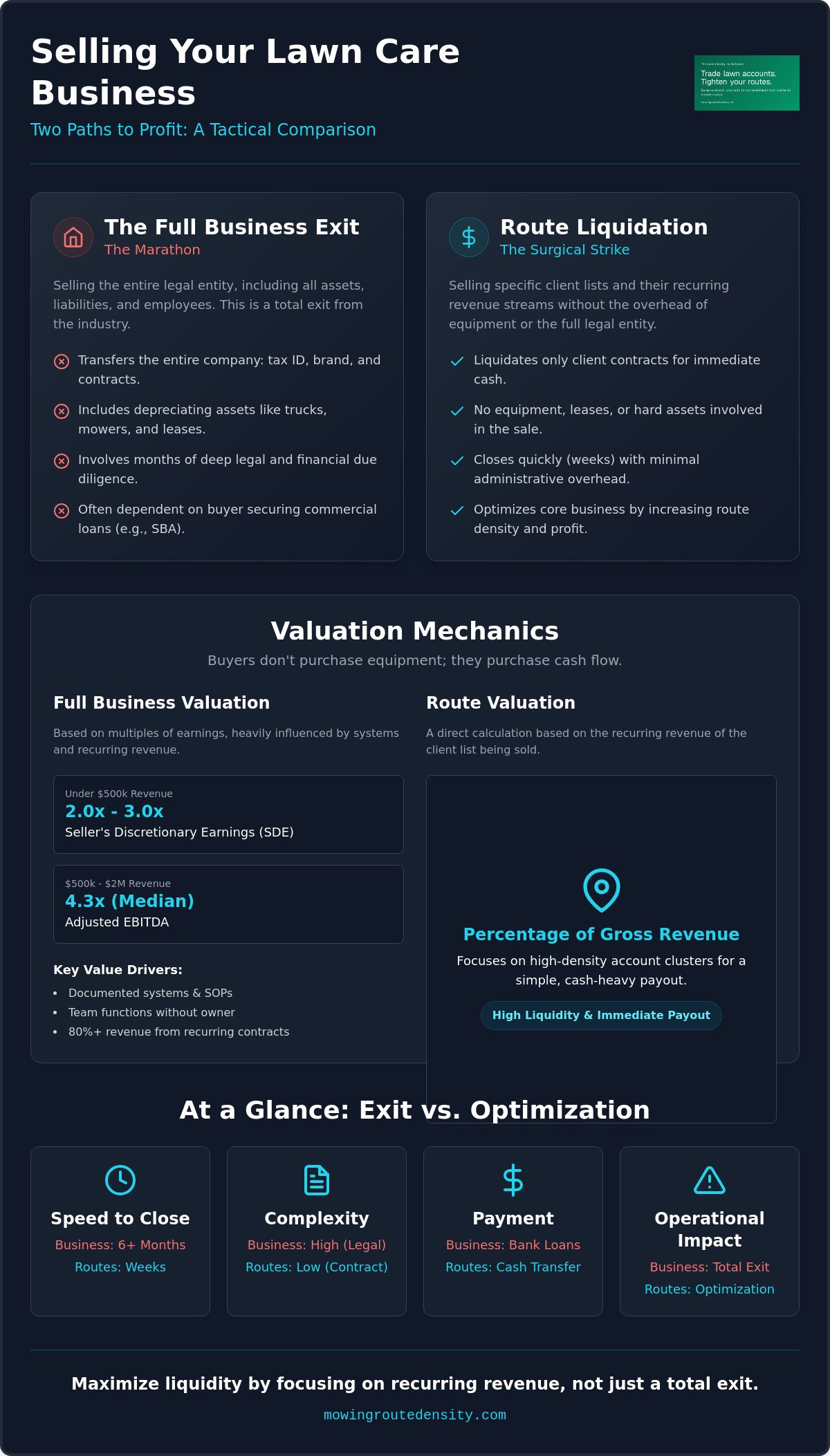
A full business sale is a heavy lift. You're offloading hard assets like trucks, trailers, and zero-turn mowers. These are depreciating liabilities that complicate the deal. Buyers don't just look at your grass; they look at your shop leases and your labor burden. This process demands deep due diligence into your tax records and potential liabilities. Buyers will often use professional business valuation methodologies to pick apart your profit and loss statements. It's a slow slog that often depends on SBA financing. This path is strictly for owners looking for a total lifestyle change or a complete exit from the industry.
- Includes all physical equipment and property leases.
- Requires months of legal and financial scrutiny.
- Dependent on the buyer's ability to secure commercial loans.
The Route Liquidation: Selling the Accounts
Route liquidation is the tactical sale of recurring revenue contracts without equipment. It's the ultimate tool for tightening your operations. Instead of waiting six months for a broker to find a buyer, you can sell off your "fat" in weeks. You identify the outlier accounts that kill your density and sell them to a competitor who's already in that neighborhood. This eliminates wasted fuel and useless windshield time. There's no legal red tape or equipment inspections. You get a cash-heavy payout and a leaner, more profitable core business. It's the fastest way to turn your client list into immediate liquidity without losing your identity. When comparing selling lawn care business vs routes, remember that routes sell for cash, not promises.
- Focuses on high-density account clusters.
- Closes quickly with minimal administrative overhead.
- Optimizes your remaining routes for maximum billable hours.
Valuation Mechanics: How Buyers View Your Assets
Stop looking at your equipment list. It's distracting you from the real money. When you're weighing selling lawn care business vs routes, remember that buyers aren't buying your trucks; they're buying your cash flow. Most operators fall into the "Iron Trap." They believe a fleet of mowers makes the business worth more. In reality, used equipment is a liability that complicates the deal. A lean lawn care business exit strategy focuses on liquidating the contracts and ditching the depreciating assets. You want liquidity, not a graveyard of rusted trailers.
Buyers use different math depending on what's on the table. When calculating a business valuation, professional investors look for stability and recurring revenue. For a full entity, they use EBITDA multiples. For a route, they often use a percentage of gross revenue. The goal is predictable profit, not just top-line noise. If your revenue isn't recurring, your valuation will tank. Buyers in 2026 pay a premium for businesses that derive 80% or more of their revenue from recurring contracts.
Multiples, EBITDA, and Intangibles
Small landscaping firms with under $500,000 in revenue typically sell for 2.0x to 3.0x Seller's Discretionary Earnings (SDE). Once you hit the $500,000 to $2 million range, the median multiple jumps to 4.3x adjusted EBITDA. What drives you to the higher end of that range? Documented systems. Standard operating procedures. A team that functions without the owner's constant supervision. This is "Goodwill." It's the proof that your profit isn't a fluke. If the business dies when you take a vacation, it isn't worth much to a buyer.
Route Density: The Hidden Value Multiplier
Density is the only metric that truly matters for route value. A cluster of 10 houses on one block is worth 20% more than 10 scattered stops. Density reduces fuel and labor waste, directly increasing account value. Every mile of "windshield time" between jobs is a leak in your profit bucket. Buyers will pay a premium for a route they can finish in half the time. If you have scattered accounts dragging down your averages, you can offload them on a lawn account trading platform to instantly boost your remaining margins. Stop selling the whole business when you can surgically sell the "fat" and keep the profit.
Comparing Speed and Liquidity: Exit vs. Optimization
Time is money; drive time is lost money. When you analyze selling lawn care business vs routes, the biggest differentiator is the clock. A full business sale is a slow, grinding process. It's an anchor on your operational mobility. Route sales are different. They offer immediate liquidity. You can sell lawn mowing accounts to fund a new crew, upgrade your fleet, or simply exit a territory that's bleeding you dry. One is a permanent exit; the other is a tactical optimization.
The tax man also views these exits through different lenses. Asset sales allow buyers to step up the basis of your equipment, which makes your company more attractive to them. Stock sales might offer you better capital gains exposure but are significantly harder to close with small-to-midsize buyers. If you're selling routes, you're typically conducting an asset sale of customer contracts. It's clean. It's fast. It's cash-heavy. You bypass the complex legal structures that keep owners trapped in businesses they no longer want to run.
The Broker Timeline: Selling the Whole Shop
Selling a whole entity usually takes six months or more. You have to find a buyer with enough capital or a high enough credit score for an SBA loan. Most small operations are too dependent on the owner. If you're the one answering every call and fixing every mower, your business is a liability to a buyer. You'll end up paying landscaping business brokers a commission of 8% to 12% of the total transaction value. For businesses between $1 million and $5 million, these fees often follow a "Double Lehman" formula. That's a massive hit to your final payout just to find a buyer who wants to work as hard as you do.
Marketplace Speed: Trading Routes for Cash
Specialized trading platforms change the game. You don't need a broker to sell 20 accounts in a specific zip code. You just need a local competitor who wants to increase their density. This allows you to avoid the "all-or-nothing" trap of traditional exits. You can sell your outlier routes and reinvest that cash into landscaping business consolidation. Focus on your most profitable territory. Cut the waste. Get paid today, not in six months. This marketplace approach turns your client list into a liquid asset that you can trade, sell, or hold as your strategy dictates.
The rise of specialized marketplaces is a global trend; just as individuals turn to Bride2Bride to sell high-value items like wedding dresses, savvy contractors use dedicated platforms to liquidate routes and reclaim their capital.
When to Call Landscaping Business Brokers vs. Listing Online
Brokers aren't your friends; they're transaction managers. If you're weighing selling lawn care business vs routes, you need to know where your money is going. Hiring a broker for a small route sale is like hiring an architect to mow a lawn. It's overkill. It's expensive. It's a drain on your equity. Brokers typically charge a flat 8% to 12% commission for businesses under $1 million. If your business is under $250,000, that fee can spike to 15% with minimums as high as $25,000. Do the math. If you're just trying to offload a few outlier accounts, a broker will eat your entire profit margin before the ink is dry.
Marketplaces and trading platforms are for the tactical operator. They allow for surgical route adjustments without the middleman. When you list online, you're dealing peer-to-peer with other contractors who understand the value of density. You don't need a formal audit to trade a zip code. You do, however, need a solid lawn care client transfer agreement to protect your interests. This document ensures the revenue stays put and the transition is seamless. Managing the sale yourself keeps the commission in your pocket and puts cash in your bank account faster.
High-Value Mergers and Acquisitions (M&A)
Brokers earn their keep when the deal is complex. If your business has multiple crews, a middle-management layer, and significant real estate, you're in M&A territory. These buyers aren't just looking for grass; they're looking for an investment vehicle. You'll need three years of clean, audited P&L statements. Expect rigorous scrutiny of your labor burden and equipment longevity. These deals almost always require ironclad non-compete agreements to protect the buyer's new asset. If you're exiting a multi-million dollar enterprise, the broker's 10% fee is the price of navigating the legal minefield.
Tactical Route Swaps and Account Trading
Most owners don't need a total exit. They need a tighter route. Tactical route swaps allow you to trade your outlier accounts for accounts that fit your core density. This is how you increase profit margins without adding a single new customer. Peer-to-peer trading via a lawn account trading platform is the fastest way to eliminate windshield time. It cuts out the broker and the wait time. You find a local contractor, agree on a price, and execute the transfer. It's lean. It's efficient. It's the only way to stay profitable in a high-fuel, high-labor market.
Maximizing Exit Value with Mowing Route Density
You don't need a total exit to get paid. You need a better strategy. Most owners stay trapped in a cycle of low margins because they think their only choice is a total liquidation. When you evaluate selling lawn care business vs routes, the most profitable path is often surgical. Mowing Route Density provides the marketplace for surgical account trading. It allows you to stop selling the whole business when you only need to sell the "fat." You keep your high-margin core. You sell the outlier accounts that waste your fuel and kill your labor efficiency.
This isn't about finding a needle in a haystack. Our platform connects you with a national network of contractors ready to buy or swap. These are professionals who understand that your outlier account might be their next-door neighbor. We provide the infrastructure to turn your scattered client list into a liquid asset. By leveraging our locator tools, you can find the perfect buyer for your dense clusters or trade your way into a tighter, more profitable route. It's about working smarter, not harder. It's about maximizing the value of every billable hour.
Leveraging the Account Trading Platform
Listing your routes on a professional lawn account trading platform gives you immediate visibility to local competitors. This is a B2B network designed for speed and security. You aren't dealing with tire-kickers on a public classified site. You're dealing with peers who value density as much as you do. The process is simple. You list your service areas. You connect with buyers. You trade or sell. Swapping accounts with neighboring contractors is the fastest way to reduce drive time without losing revenue. It turns a logistical nightmare into a streamlined profit center.
- Access a specialized network of professional landscaping buyers.
- Use locator tools to identify high-density clusters in your area.
- Execute trades that eliminate "windshield time" and boost margins.
Preparing for a High-Liquidity Handover
A fast sale requires clean data. If your route information is stuck in your head, it's worthless to a buyer. Clean up your digital route data before you list. Document your service frequencies, pricing, and specific property notes. This ensures a seamless transfer and builds trust with the buyer. High liquidity depends on client retention during the transition period. If the customers stay, you get paid. If they leave, the deal sours. Be transparent. Be organized. Be tactical. When you're ready to stop bleeding fuel and start capturing equity, the tools are ready for you. Optimize your route density or list your accounts for sale today.
Secure Your Tactical Exit Today
Stop letting inefficient logistics dictate your paycheck. You now understand that a total business sale isn't your only exit strategy. It's often the slowest one. By focusing on route density, you can liquidate the "fat" and keep the profit. You don't need a broker to tell you that drive time is killing your margins. You need a way to trade those outlier accounts for cash or better locations. Every mile of windshield time you eliminate is a direct deposit into your pocket.
The choice between selling lawn care business vs routes comes down to speed and liquidity. You can wait six months for an SBA loan to clear; or you can trade your way to a tighter operation in weeks. Our secure B2B account trading platform connects you with a national network of professional contractors ready to deal. We provide the specialized tools for route density optimization that turn a scattered list into a high-performance engine. It's time to stop working for your routes and make your routes work for you.
List your lawn care routes or browse accounts for sale on our marketplace. Build a leaner, more profitable future today.
Frequently Asked Questions
Is it better to sell my whole lawn care business or just the routes?
The choice depends on your endgame. Selling the whole business is a total exit strategy for those looking to retire or change industries. Selling routes is a tactical move to improve operational efficiency. If you're tired of wasting fuel on scattered accounts, sell the outlier routes to a competitor. Keep your high-density core to maximize your profit margins and reduce labor waste.
How do landscaping business brokers value a small mowing company?
Brokers typically use Seller's Discretionary Earnings (SDE) multiples for small operators. For businesses with under $500,000 in revenue, valuations usually fall between 2.0x and 3.0x SDE. They scrutinize your recurring revenue and how much the business depends on your personal labor. If the company can't function without you answering every call, the valuation multiple will drop significantly. Documentation is the key to a higher price.
Can I sell my lawn care routes and keep my equipment?
Yes, and for many owners, this is the smartest move. Selling routes is an asset sale of your customer contracts, not your physical gear. You can liquidate your client list to generate immediate cash and keep your mowers for a new, denser service area. Many buyers already have their own fleets and don't want to pay for your used, depreciating equipment anyway.
What is a typical multiple for selling a lawn care client list?
Individual routes don't follow the same EBITDA multiples as full companies. Instead, they are often valued as a percentage of gross annual revenue. The price depends heavily on recurring revenue stability and geographic density. Clustered accounts in a single zip code command a premium. When analyzing selling lawn care business vs routes, remember that routes are cash-heavy transactions that bypass complex bank financing.
How long does it take to sell a landscaping business versus a route?
A full business sale usually grinds on for six months or more. You have to deal with SBA loan approvals, deep due diligence, and legal red tape. Route sales are surgical and fast. You can often close a route transfer in a few weeks through a simple cash transaction. If you need liquidity today to fund an expansion, selling accounts is the faster path.
Do I need a broker to sell my lawn mowing accounts?
No, you don't. Brokers take a massive bite out of your equity, often charging 10% to 15% in commissions. For tactical account transfers, a specialized lawn account trading platform is more efficient. You deal directly with local contractors who already know your market. This cuts out the middleman and keeps the full sale price in your bank account where it belongs.
What documents are required to sell a landscaping route?
You need a clean, digital client list and a solid client transfer agreement. Buyers want to see service frequencies, pricing history, and property-specific notes. Transparency is the only way to ensure the recurring revenue stays put after the handover. If your data is disorganized, the buyer will perceive a higher risk and offer you a lower price for the accounts.
How does route density affect the sale price of my business?
Density is your biggest value multiplier. A route with 10 houses on one block is worth much more than 10 houses spread across three zip codes. Density eliminates "windshield time" and reduces fuel consumption, which directly inflates your net profit margin. Buyers aren't just paying for the revenue; they're paying for the efficiency you've built into the schedule. Clustered routes always sell first.


