

What if the mowing route with the most accounts is the one that costs you the most? A long customer list can hide scattered stops, incomplete records, and customers who may not continue after a sale. When you’re figuring out how to buy mowing routes, the headline account count matters less than what you can verify and service efficiently.
A route purchase can add work, but unclear account details or a rushed handoff can waste crew hours and damage customer trust before the first full service cycle is complete. A disciplined review before you commit can help you spot those risks.
This guide walks you through a practical process: assess whether a route fits your crew and operating area, check account records and recurring work, evaluate route density and retention risks, and plan a controlled customer handoff. You’ll also learn how route trading can help you find acquisition opportunities. The goal is to buy a verifiable handoff and a tighter route, not just an attractive account count.
Key Takeaways
- Learn how to buy mowing routes by checking account details against schedules, invoices, service notes, and customer status records.
- Use route density, workload, crew capacity, and equipment fit to judge whether the accounts make operational sense.
- Look beyond stated revenue to assess service continuity and the practical work required to retain customers.
- Build a transition checklist that assigns responsibilities, dates, schedules, and unresolved service issues.
- Once your readiness checks are complete, consider a dedicated lawn account trading platform to buy, sell, or swap routes.
How to Buy Mowing Routes Without Buying a List of Problems
A route purchase is more than taking over a customer count. You’re acquiring service accounts and the operating context behind them: what each property needs, when it’s serviced, where it sits in the route, and what the customer expects. Revenue matters, but it doesn’t show whether the accounts can transfer smoothly or fit your operation.
A transferable mowing route is a set of service accounts, relevant records, and operating details that a buyer can take over under the transaction’s agreed terms. It does not guarantee customers will remain. A seller can hand over account information, but retention depends on the circumstances and the service that follows.
Before committing, compare the route with your crews, schedules, equipment, and available capacity. Can your team absorb the work without pushing existing stops late? Do the service requirements match your equipment? A route that looks profitable on paper can still create overtime, extra trips, or a scheduling bottleneck.
What does buying a mowing route actually involve?
Start by identifying what the deal covers. It may include customer accounts, service expectations, schedules, route geography, and records that explain how each account is handled. The specific assets and records depend on the transaction, so don’t assume every seller is transferring the same things. An operating route also differs from new leads: accounts have service histories and expectations, while leads still need to become customers.
Due diligence means examining the details before you commit. A useful starting point is this overview of What is Due Diligence? For a route buyer, the practical question is whether the account information supports a workable, clearly understood handoff.
Why account count alone is a weak buying signal
Consider two hypothetical routes with the same number of accounts. One groups nearby stops; the other sends a crew across a wide area between jobs. The second route may leave less time for billable mowing, add fuel use, and limit how many properties a crew can service in a day. Assess the travel between stops, not just the stop count.
Route density helps show whether accounts can be serviced efficiently as a group. Proximity alone isn’t enough, though: service requirements, schedules, and access can affect whether nearby accounts belong on the same crew’s day. The lawn care route density guide explains why tighter geography can support better operating efficiency.
- Map the stops: Look for gaps and avoidable backtracking.
- Check the schedule: Compare service days and timing with current crew capacity.
- Match the work to equipment: Identify requirements that may change how a crew handles the route.
- Test the combined route: Consider how acquired accounts connect to existing work, not just how they look on a map.
These checks turn “more accounts” into an operational question: can your team deliver the promised service without wasting labor hours or disrupting existing customers? If the answer is unclear, treat that uncertainty as a diligence issue. Clarify the account scope and operating details before deciding whether the route fits.
How to Verify Mowing Route Accounts Before You Commit
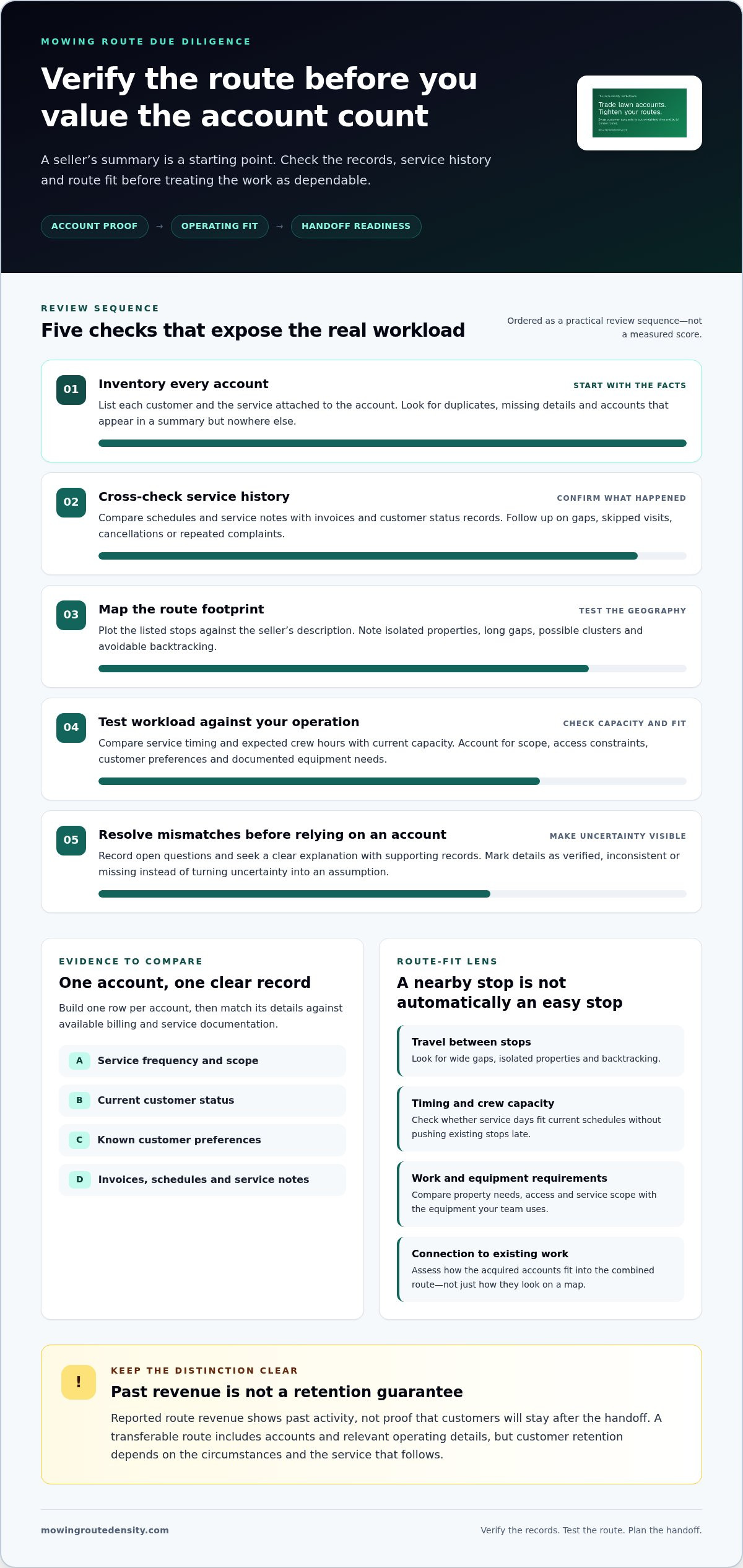
A seller’s summary is a starting point, not verification. Build an account-level picture and compare it with records showing what customers receive, when service happens, and whether the work is current. That’s how to buy mowing routes with fewer blind spots: check each claim against available evidence before treating it as dependable work.
Reported route revenue shows past activity, not proof that accounts will stay after the handoff. Customer status can change, and incomplete records make that risk harder to judge.
Use this sequence to structure your review:
- Inventory the accounts. List each customer and the service associated with the account. Check for duplicate entries, missing details, or accounts that appear on a summary but nowhere else.
- Review service history. Compare schedules and service notes with invoices and customer status records. Look for gaps, skipped visits, cancellations, or repeated complaints.
- Map the route. Plot the listed stops and compare the map with the seller’s description. Note isolated properties, long gaps, and possible clusters.
- Document operating requirements. Capture service frequency, scope, access constraints, customer preferences, and documented equipment needs.
- List unresolved questions. Record every mismatch or missing detail, then seek a clear explanation and supporting records before using the account in your assessment.
Build an account-level record, not a seller summary
Create one row per account with its service frequency, scope, current status, and known customer preferences. Then match each row against available billing and service documentation. A scheduled visit without a corresponding service note, or an invoice tied to an account marked inactive, needs follow-up. Mark details as verified, inconsistent, or missing so uncertain information doesn’t quietly become an assumption.
Audit the route footprint and service workload
Map the stops and review service timing alongside expected crew hours. The goal is to see whether the work fits your operating schedule, not just whether the addresses appear close together. Note documented access constraints, property-specific requirements, and equipment needs. A short distance on a map won’t save time if the service scope or timing creates a bottleneck for the crew.
Pay particular attention to records that don’t line up. A customer marked active despite recent cancellation notes, repeated skipped service, or an unusual requirement missing from the schedule can change the workload and retention picture. Don’t treat every inconsistency as proof of a problem; treat it as an open item. Ask for relevant documentation, record the answer, and keep unresolved items visible as you evaluate the deal.
Finish with a simple status for each account: supported by records, needs clarification, or excluded from your working assumptions until resolved. That gives you a cleaner basis for judging fit with your crews and planning the transfer. When you’re ready to compare route opportunities, Mowing Route Density’s lawn account trading platform lets contractors buy, sell, or swap routes.
How to Judge Whether a Mowing Route Fits Your Operation
A route can be well documented and still be a poor fit for your business. To judge whether it strengthens your operation, compare its expected billable work with travel, labor, maintenance, and schedule constraints using your own records. That’s a practical part of how to buy mowing routes without adding work your crews can’t absorb efficiently.
Compare route density with real crew capacity
Use the route’s actual locations and schedule to estimate service hours and travel between stops. Then compare that workload with crew schedules and completion times for similar work in your operation. Don’t assume nearby stops belong together: service scope, timing, and access can make a close account hard to pair with an existing route.
| Fit factor | What to compare | Question to answer |
|---|---|---|
| Route density | Stop locations and travel between them | Does the route reduce deadhead time or add detours? |
| Customer stability | Recurring documented work and current account status | Which accounts belong in your dependable workload estimate? |
| Workload | Service scope, estimated hours, and timing | Can the work fit without pushing other stops late? |
| Crew capacity | Available hours and existing schedule commitments | Who can take the work, and when? |
| Equipment fit | Documented property requirements and equipment on hand | Can your current setup handle the service mix? |
Build the estimate from your own operating data. Add expected mowing and related service hours to travel time, then compare the total with available crew hours in the relevant schedule windows. Include maintenance time and account for existing commitments. If the route only fits by assuming faster work or ignoring travel, it doesn’t fit yet. Identify the capacity gap and test whether a schedule adjustment or additional equipment would address it.
Assess account stability and operating compatibility
Separate recurring, documented service from uncertain or recently inactive accounts. Use the first group to estimate committed workload; treat unclear accounts as unproven until your review supports including them. This keeps a seller’s full account count from inflating your capacity estimate.
Next, compare the route’s service mix with your crews’ skills and equipment. A stop may be geographically close but still demand a different setup, timing, or service approach. Account for those differences before planning to fold it into an existing day. If the route requires equipment your team doesn’t have, Mowing Route Density offers professional lawn mower and equipment rental for contractors.
- Use actuals: Compare estimates with completed jobs and crew schedules.
- Protect current service: Check that new work won’t disrupt existing customers.
- Resolve gaps: Flag schedule conflicts, equipment needs, and uncertain accounts before deciding.
A strong fit is one your team can service reliably with a workable schedule and realistic travel time. If the math depends on best-case assumptions, revise the plan before moving forward.
How to Plan the Mowing Route Purchase and Customer Handoff
A route can be well reviewed and still lose value through a messy handoff. Schedules arrive late. Crews lack property notes. Customers don’t know who is coming or when. Build the transition plan before service changes, then use it as the working record for both sides of the handoff.
Create a written transition plan before service changes
Start with the accounts and responsibilities included in the agreed transaction. For each one, record the service schedule, assigned crew or responsible person, customer information, access instructions, preferences, outstanding work, and next scheduled visit. Note how and when records will move between parties. If a detail is unresolved, identify who will address it and by what date.
Keep the plan in a shared checklist that the people handling the transfer can update. A useful entry has an account identifier, a responsible person, a due date, and a status. This makes open questions visible instead of burying them in calls or scattered messages. Keep transaction-specific legal and tax questions separate from the operating checklist and direct them to qualified professionals.
Protect continuity during the first service cycle
Before crews take over, give them the current schedules, property notes, service requirements, and a clear escalation contact. Communicate service changes to customers in a timely, consistent way that matches the agreed transition. Keep the message practical: explain who will handle service and what customers need to know about the schedule. Don’t promise details the operating plan can’t support.
Then track each scheduled visit against the handoff list. Record whether service was completed, whether a visit was missed or duplicated, and whether the account notes matched conditions at the property. Assign someone to review exceptions promptly and update the shared record. A missed visit can quickly become a customer concern; a fast, documented response helps your team address the issue and prevent it from recurring.
Use a simple transition checklist to keep the sequence clear:
- Before the change: Finalize account details, schedules, responsibilities, and customer communication.
- At handoff: Share current records and confirm crews have the notes they need.
- During the first service cycle: Track visits, flag discrepancies, and assign follow-up.
- After review: Close resolved items and carry forward anything still open.
Keep the checklist factual. If an account’s access note is incomplete or a scheduled visit doesn’t match the service record, log the discrepancy and assign a follow-up instead of letting the crew guess. This gives the buyer and seller a shared operational reference without blurring agreed responsibilities.
A written handoff turns the purchase into a sequence your team can manage, not a pile of informal promises. If you’re ready to explore route opportunities, browse lawn accounts to buy, sell, or swap.
Where to Find Mowing Routes and Take the Next Step
Once you’ve tested account records, route density, operating fit, and the transition plan, you’re ready to look for opportunities. Keep the order straight: define what your business can absorb, then search. A listing can help you discover a route, but it can’t replace account-level diligence or prove the work will transfer smoothly.
Prepare your acquisition criteria before browsing
Write down your target service types, workable geography, schedule needs, and available crew capacity before reviewing listings. Decide what records you’ll need to evaluate an opportunity, such as an account inventory, service history, route map, operating requirements, and customer status information. Use the same checklist for every route. Consistent criteria make it easier to compare opportunities and harder to justify an impulse purchase.
Turn those criteria into a simple decision sheet. For each route, record whether the account information is supported, whether the stops fit your operating footprint, and whether the workload fits your schedule and equipment. Mark items as ready, unresolved, or outside your criteria. An unresolved detail isn’t automatically a deal-breaker, but it should stay visible until you can assess its effect on the route.
Use a route marketplace as one part of the process
A dedicated lawn account trading platform gives contractors a channel to buy, sell, or swap service routes. Mowing Route Density operates a platform for route trading, giving you a place to discover opportunities. Treat each opportunity as a lead for evaluation, not as a ready-made fit. Compare it against your defined criteria and diligence checklist before making a decision.
For each potential route, work through the same sequence:
- Screen for fit: Does the service mix, geography, and schedule align with your operation?
- Review the evidence: Do available records support the account details and current workload?
- Test capacity: Can your crews handle the work without undermining existing commitments?
- Plan the transfer: Can you document responsibilities, schedules, and open service issues before the handoff?
If an opportunity misses a core requirement, move on or leave it on hold while you resolve the gap. Don’t let an attractive account count push you past your operating limits. The point of learning how to buy mowing routes is to add manageable work, not create a service backlog your team has to unwind.
When you’re ready to explore route opportunities, browse routes on the lawn account trading platform. Bring your criteria with you, and apply the same standards from first look through final handoff.
Put Your Acquisition Criteria to Work
Your next move is to turn your route requirements into a filter you can use consistently. Define what your crew can handle, what service mix fits your operation, and which account details you need before considering a purchase. That gives you a practical standard for evaluating new opportunities instead of chasing the most attractive listing.
Learning how to buy mowing routes is only useful if the process leads to a route your business can operate well. Keep your evaluation disciplined, and treat each opportunity as a decision about capacity, not just growth. Mowing Route Density also offers a provider locator to help users find lawn mowing companies.
Ready to put your criteria to work? Explore the lawn account trading platform to find routes to evaluate against your operating needs.
Frequently Asked Questions
How do you buy a mowing route?
To buy a mowing route, first set clear operating criteria, then compare opportunities against them before agreeing to a purchase. A practical how to buy mowing routes process includes reviewing the seller’s account information, estimating the work your crews can absorb, and documenting exactly which accounts and records are part of the deal. Clarify open questions before the handoff. A route purchase can add existing work, but it doesn’t guarantee customers will stay.
What should I check before buying a lawn mowing route?
Check that the account information is current and consistent across the seller’s records. For a closer test, select a sample of accounts and compare recorded service dates with billing and service notes. Check whether customer preferences or access instructions have changed, and whether the stated service scope matches the work being performed. Ask for explanations where records conflict. Keep unresolved gaps separate from verified details while you evaluate the opportunity.
How do I know if a mowing route is profitable?
Estimate what the route contributes after operating expenses, using your own records rather than an industry-wide benchmark. Start with the revenue you can reasonably support from active accounts, then subtract crew labor, travel, fuel, equipment maintenance, and any additional operating costs. Use actual job times from comparable work to avoid optimistic estimates. Compare the result with the return your business requires for that crew time and capacity.
Can customers cancel after a mowing route is sold?
Yes. A route sale doesn’t guarantee that customers will continue service with the new operator. A customer may cancel, change service needs, or choose another provider. Treat each account as a potential transfer, not a certainty. The seller’s service history can help you understand the relationship, but it can’t promise future retention. Make your purchase decision with room for accounts that don’t continue after the ownership change.
How do I transfer lawn care customers to a new owner?
Coordinate the change around each customer’s next scheduled service. Where the transition plan allows, have the outgoing and incoming operators provide a consistent introduction so customers know who will handle their service. Keep the message specific: identify the new contact, explain any schedule change, and give customers a clear way to raise concerns. Record replies and update account notes so crews aren’t working from outdated preferences or contact details.
Is buying a mowing route better than building one from scratch?
Neither option is automatically better. Buying may give you access to established accounts and service patterns, but those customers may not remain, and the route still has to fit your operation. Building from scratch gives you more control over which customers and locations you pursue, but requires time and effort to develop accounts. Weigh your available crew capacity, sales bandwidth, and need for a specific route footprint before choosing.
Where can I find mowing routes for sale?
Contractors can look for opportunities through a dedicated lawn account trading platform, where service routes can be bought, sold, or swapped. Mowing Route Density operates a platform for that purpose. Use it as a discovery channel, then assess each opportunity using its records and operating fit. A listing can help you find a route to review; it doesn’t replace verifying account details or planning a practical handoff.


