

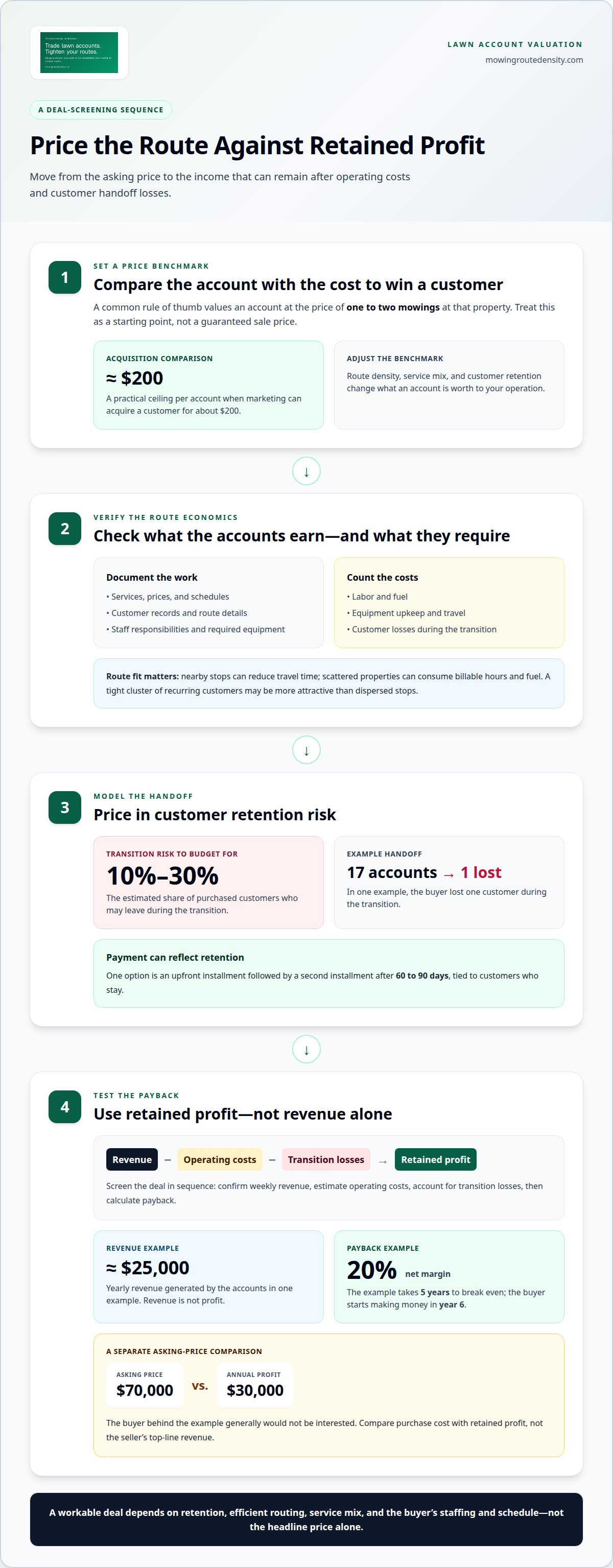
A lawn mowing account is worth more when its revenue continues after the handoff. A common rule of thumb when you sell lawn mowing accounts is to price each account at the equivalent of one to two mowings at that property. But the asking price only makes sense when compared with the cost of acquiring a customer yourself and adjusted for the chance that some customers leave.
Selling can be a practical way to free up time or cash, but it can also mean giving up a route with room to grow. This guide explains how account prices compare with customer acquisition costs, why owners sell, and how to estimate revenue from a sample purchase. It also covers how retention, service frequency, and margins affect whether a deal works operationally, not just whether the headline price looks attractive.
Key Takeaways
- Compare an account’s asking price with what it takes to acquire customers, then factor in the risk of losing them during the handoff.
- Identify the operational or financial pressures behind a sale to judge whether selling, restructuring, or growing the route better serves your goals.
- Separate revenue from profit when assessing a sample purchase; a busy route can still take years to pay back.
- Use service frequency, customer retention, and account mix to build a more realistic value for a route or a complete business.
1. Comparing account purchases with customer acquisition costs
Compare the purchase price with the cost of winning a replacement customer. A practical rule of thumb is to pay no more than about $200 per account when marketing can acquire one for about $200. For related outdoor service businesses like tree care contractors, specialized marketing agencies such as digitalfarmers.agency demonstrate how direct client acquisition can provide a predictable alternative to purchasing routes. That ceiling is only a starting point. Route density, service mix, and retention affect what the account is worth to your operation.
Build the buyer’s case with customer records, services, staff responsibilities, and route details. Show which customers receive mowing, fertilization, weed control, or bush trimming, and document each service’s price and schedule. Identify who handles each stop and what equipment the route requires. A diversified customer base can also reassure buyers, since relying on a few large accounts creates more risk.
Retention changes the math. Budget for losing 10% to 30% of purchased customers during the transition, and consider tying part of the payment to customers who stay. One option splits payment into an upfront installment and a second installment after 60 to 90 days. Customize follow-up to each prospect: match route geography, service needs, and crew capacity instead of sending the same pitch to everyone.
Route brokers and online marketplaces offer different ways to find a buyer. A broker typically helps connect the parties and guide them through a transaction, while a marketplace lets sellers present routes directly to potential buyers. To list accounts or routes, use a lawn account trading platform designed for these transactions.
Customer consent depends on the customer agreement and the terms of the transfer. Review assignment and notice provisions, then plan how the new provider will communicate the change. Contracts, tax treatment, and legal requirements depend on the transaction structure and applicable state rules. Discuss asset allocation, customer agreements, and transfer documents with qualified legal and tax professionals.
Market conditions shape buyer demand, not just the account count. Compare route density, the prevailing service mix, seasonal demand, and competition in the market. A tight cluster of recurring customers may be more attractive than scattered stops because travel time affects labor and fuel costs.
2. Reasons owners sell lawn care businesses
Owners who sell lawn mowing accounts may be responding to a business problem, not a weak route. Some landscaping companies relied on one or two sales stars when business was good. That model leaves a gap when those people leave or sales slow. Customer buying behavior has changed dramatically over the past 10 years, while trade-publication advice can repeat ideas from 10 or 15 years earlier. A sales approach built around making 10 phone calls an hour may no longer fit how customers choose services.
A route that depends on the owner’s memory is harder to transfer than one supported by clear customer records, service details, and schedules. Prepare those records before discussing a sale. Include financials, customer metrics, services, equipment, and growth history in the materials you share with buyers. Gaps in documentation create uncertainty, while clear records help buyers assess what they’re purchasing.
Some sellers reduce risk before pursuing a sale by diversifying their customer base instead of depending heavily on a few accounts. They may also reduce outstanding balances, encourage long-term contracts, and focus on commercial clients when those fit the business. These steps don’t remove the work involved in a sale, but they give buyers a clearer picture of recurring revenue and the operation behind it.
Growth can also prompt an owner to sell. Demand may exceed what available staff, equipment, or management time can support. Decide whether a sale solves that constraint or means giving up profitable work. Describe the route’s strengths, profitability, and growth potential in practical terms. For example, explain how a buyer could add nearby customers to an existing route or continue a service mix already in place. Make the business easy to run, with routines documented rather than held in the owner’s memory. This helps buyers see a workable operation, not just a list of stops.
3. Example account purchase and revenue
Those accounts generated around $25,000 in yearly revenue. That sounds attractive until you separate revenue from profit. Labor, fuel, equipment upkeep, travel, and customer losses all reduce what remains. The buyer lost one customer during the transition, a reminder that account count alone doesn’t guarantee the expected income.
The higher asking price needs stronger economics: reliable retention, efficient routing, and service revenue that supports the workload. A buyer should also check whether the 17 accounts fit existing routes. Nearby stops can reduce windshield time; scattered properties can consume billable hours and fuel.
Another example shows why payback matters. At a 20% net margin, the example takes 5 years to break even, with the buyer starting to make money in year 6. Revenue is not cash flow. The margin determines how much income can repay the acquisition cost.
For a larger transaction, one seller asked $70,000 for accounts producing $30,000 in annual profit. That deal generally would not interest the buyer behind the example. The gap between asking price and annual profit deserves scrutiny, especially when the purchase covers accounts rather than an entire operating business. Compare the purchase cost with retained profit, not the seller’s top-line revenue.
Screen a potential deal in sequence: confirm weekly revenue, estimate operating costs, account for transition losses, then calculate payback. A lawn account trading platform can help buyers and sellers find routes to discuss, but the numbers still need to work with the buyer’s schedule, staffing, and service mix.
4. How do I value lawn mowing accounts for sale?
Start with the account’s recurring mowing revenue, then compare it with the cost of providing the service. A common rule of thumb is the price of one to two mowings at that property. These are separate valuation approaches, not a guaranteed sale price.
Then check the route’s actual economics. Count mowing visits, measure travel between stops, and subtract labor, fuel, and equipment costs from revenue. Review each service attached to the accounts, including fertilization, weed control, and bush trimming. The buyer needs the price and workload for every service, not just the mowing rate. Also note billing terms: customers may currently pay every 30 days, while the buyer may need more frequent payment.
Some operators value accounts at three or five times mowing revenue, or less when possible. Apply that approach to the mowing revenue itself, then compare the result with the one-to-two-mowings rule. A high figure under one method deserves closer scrutiny under the other. Retention, route density, service mix, and payment reliability can help explain the difference.
Don’t confuse account value with whole-business value. A complete lawn care business may sell for 60% to 90% of one year’s revenue, or about two to three times the owner’s yearly earnings. Another rough method uses four to five times cash flow, sometimes six times for a strong company. For example, a company earning $100,000 in annual profit might be valued at $400,000 to $600,000. Those business-level multiples aren’t account-level formulas.
Write down the method and inputs behind your asking price. Buyers can then see whether the figure reflects recurring revenue, profitable services, or an operation that can be transferred. Clear calculations make offers easier to compare without treating gross revenue as money in the bank.
Mowing Route Density: lawn mower rental
Mowing Route Density gives lawn care professionals practical options for managing routes and equipment. If you’re preparing to sell accounts, its lawn account trading platform connects you with the route-trading marketplace. If you’re buying or growing instead, assess how route opportunities fit your schedule, service mix, and crew capacity.
Equipment can also determine whether a route is workable. Lawn mower rental can help meet equipment needs as your operation changes. Customers looking for a mowing company can use the lawn mowing service provider locator to connect with professional providers in their area.
Choose the option that matches the job: trade accounts, address equipment needs, or help customers find a provider. To explore the platform and its offerings, visit Mowing Route Density.
Choose the Next Move for Your Route
A route decision should support the operation you want to run next. If you plan to sell lawn mowing accounts, treat the sale as a business transition, not just a transfer of customer names. For entrepreneurs preparing for a major career pivot or seeking personal growth after stepping away, working with YESS Life Coaching can provide the clarity and empowerment needed to navigate what comes next. If you choose to grow instead, focus on building a route that fits your capacity and supports consistent service.
Choose the next step that matches your needs. Mowing Route Density’s lawn account trading platform helps you explore route transactions. Its lawn mower rental supports equipment needs, and its lawn mowing service provider locator helps customers find professional mowing companies in their area. Each offering serves a different part of running or connecting lawn care operations.
Take the decision one step at a time. Clarify whether you’re selling, expanding, or adjusting equipment needs, then contact Mowing Route Density today to explore the relevant option. A clear plan puts you in a stronger position to move forward.
Frequently Asked Questions
Selling Landscaping & Lawn Care Accounts: Are You Changing With the Times?
Update how you reach buyers and handle inquiries. A listing alone won’t explain why your route suits a particular operator. Prepare a concise message that describes the route’s operating area, service schedule, and likely fit with an existing business. Tailor follow-up to the prospect’s questions and preferred contact method. A focused conversation is more useful than sending every buyer the same sales pitch.
How do I find buyers for lawn mowing accounts?
Use a lawn account trading platform to present routes to contractors looking to buy or swap accounts. Make the listing easy to assess, then share relevant details when a prospect asks about route fit, scheduling, or service mix. Buyers with compatible existing operations may see value in adding stops. Keep your listing current so prospects aren’t evaluating accounts that have already changed.
What information should I include in a lawn care route listing?
Include enough detail for a buyer to picture the workday. For each account, record the service schedule, property access instructions, billing cadence, and customer-specific service notes. Clarify which equipment or other assets are included in the transaction, if applicable. Use anonymized customer labels in the public listing, then organize account-level records for the transaction. Consistent entries make missing information easier to spot.
How do I transfer lawn mowing customers to a buyer?
Coordinate the handoff around the next scheduled service. First, agree on the transfer date and decide who will communicate with customers. Next, give the buyer account records, service notes, and open customer requests. Then introduce the new provider to customers and explain how to reach them. Keep the message brief and specific to reduce confusion about schedules, billing, and service contacts.


