

A broker can help sell a small lawn care business, but hiring one isn’t the whole exit plan. If you’re preparing a lawn care business for sale in 5 years, start building a business buyers can understand and assess. A broker can help set the price, negotiate the sale, and handle paperwork.
It makes sense to focus on the sale itself. But a buyer’s interest also depends on clear records, understandable earnings, and a business that’s marketed to the right audience. This guide covers how to assess broker options, assemble buyer diligence documents, compare valuation methods, and market your business for sale. The goal is practical: make the operation easier to evaluate, make its value easier to explain, and make the sale process less dependent on guesswork.
Key Takeaways
- Decide whether a broker’s help with pricing, negotiations, and sale paperwork fits your business and exit plan.
- Organize financial records and customer information so buyers can assess the operation without unnecessary delays.
- Compare earnings, assets, and market comparisons to understand what drives a credible valuation.
- Build a sale message around the strengths buyers can evaluate, including routes, equipment, and reliable operations.
1. Can I sell a small lawn care business through a broker?
A business broker can help price a small lawn care company, negotiate with buyers, and manage sale paperwork. Look for experience with similar businesses and involve a broker or valuation professional before listing, so their review can inform your records, pricing, and preparation.
Start with customer retention. Review renewal rates over the last two seasons and note whether customers stayed after price increases. Separate recurring accounts from one-time jobs, and record renewal dates, cancellations, and reasons customers left. Tracking retention gives buyers a clearer view of recurring revenue than relying on memory.
Then examine concentration and route density. If a few commercial accounts drive much of the revenue, explain their renewal history and service arrangements. Map routes to show where nearby accounts reduce travel between jobs. Build a consistent brand across estimates, invoices, uniforms, and customer reviews. Ask satisfied customers for honest reviews, and track referrals alongside new customer sources. For context, a customer spending $50 monthly for 36 months generates $1,800 in revenue over that lifetime. Strong service quality and referrals help make customer growth easier to explain.
Reduce dependence on yourself by documenting scheduling, estimating, quality checks, and customer communication. Assign routine decisions to employees and record how exceptions are handled. Seasonality and local competition can affect buyer interest and perceived value. Present monthly revenue by service period, and explain how the route and workload change across seasons. This gives buyers a clearer view than a single annual total.
Asset sales and seller financing are possible deal structures, but their tax effects and terms differ. For an asset sale that meets the stated conditions, both buyer and seller report the sale on IRS Form 8594. Ask a tax professional about the sale’s tax consequences before accepting a price. A seller considering financing should define repayment terms with qualified legal and financial advice, rather than treating the offer price as cash received at closing.
2. Documents to assemble for buyer diligence
If you are preparing a lawn care business for sale in 5 years, make clean records part of routine operations now. Assemble three years of financial statements, business tax returns, and updated accounts receivable and payable records. Reconcile statements with the accounting ledger, and label unusual transactions. For example, separate one-time equipment repairs from recurring maintenance so buyers can understand the expense pattern.
Give receivables their own schedule. List each customer, invoice date, balance, and collection status. Highlight customer receivables older than 60 days, a buyer diligence measure for assessing whether commercial customers pay on time. Keep payable records equally clear, including the vendor, amount owed, due date, and recurring nature of the expense. This makes working capital easier to assess.
Organize customer records by seasonality, year-round status, residential or commercial type, and whether each customer is new. Include service frequency, account history, and current service terms where available. Separate active accounts from former ones. A buyer should be able to distinguish a year-round commercial account from a new seasonal customer without relying on your memory.
Keep an operations folder with equipment records, employee information, and written procedures for estimating, scheduling, and quality checks. Gather insurance policies and claims records. Licensing and environmental requirements depend on the work and applicable jurisdiction, so organize relevant permits, approvals, and chemical-handling records. Note issuing authorities and renewal dates where applicable.
For owners preparing a lawn care business for sale in 5 years, a consistent folder system saves time when buyer questions arrive. Maintain an index that names each file, its date, and the topic it supports. Keep customer-sensitive information separate from the initial sale overview, then share detailed records through a controlled diligence process. Organized documentation makes it easier to explain how the business operates and what transfers to a buyer.
3. Earnings, asset-based, and market-comparison valuation methods
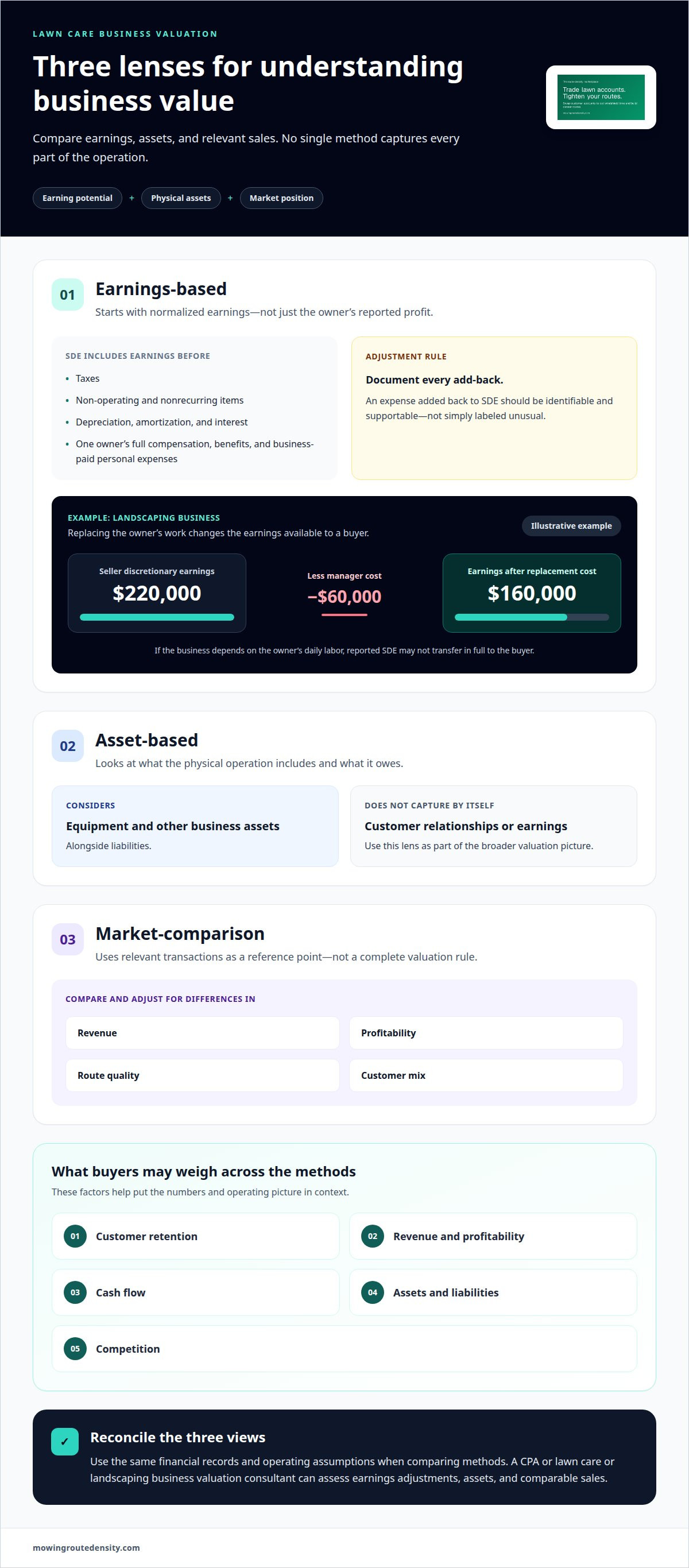
A lawn care business can be valued based on earnings, assets, or comparisons with similar sales. No single method captures every part of the operation. Buyers may weigh customer retention, revenue, profitability, cash flow, assets, liabilities, and competition. Compare approaches to see whether the asking price reflects the business’s earning potential, physical assets, and market position.
An earnings-based approach starts with normalized earnings, not just the owner’s reported profit. The International Business Brokers Association defines seller discretionary earnings (SDE) as earnings before taxes, non-operating and nonrecurring items, depreciation, amortization, interest, and one owner’s full compensation, benefits, and business-paid personal expenses. Document every adjustment. For example, an expense added back to SDE should be identifiable and supportable, not simply labeled unusual.
Then test what earnings a buyer can actually keep. In one example, a landscaping business has $220,000 in SDE, but replacing the owner’s work with a general manager costs $60,000. The buyer’s earnings after that cost are $160,000. That difference matters: a business dependent on the owner’s daily labor may not transfer the full reported SDE to its buyer.
An asset-based approach considers equipment and other business assets alongside liabilities. It shows what the physical operation includes, but does not by itself capture customer relationships or earnings. A market comparison examines relevant transactions and adjusts for differences in revenue, profitability, route quality, and customer mix. Treat it as a reference point, not a complete valuation rule.
For a defensible estimate, reconcile the methods using the same financial records and operating assumptions. A CPA or lawn care or landscaping business valuation consultant can assess earnings adjustments, assets, and comparable sales. Show how each method supports the conclusion, and explain material differences rather than choosing whichever result gives the highest figure.
4. Marketing a business for sale
Marketing starts with a buyer-ready description, not a vague “business for sale” notice. Describe the service area, customer mix, recurring work, route layout, crew structure, and included equipment. Support each claim with an example from your records. For instance, show how nearby accounts form efficient routes or explain how demand changes across seasons. Buyers need to picture the operation they would take over.
Prepare a short, confidential overview before sharing detailed records. Summarize the business model, services, operating strengths, and reason for selling. Leave customer names and sensitive financial details out of the initial version. Share them later with serious prospects through an organized due diligence process. Keep the overview consistent with your financial records. A mismatch between advertised earnings and documented results can weaken buyer confidence.
Target likely buyers instead of sending the same message everywhere. An existing lawn care operator may value route density, while a new entrant may focus on equipment and established customer relationships. List practical questions buyers may ask, then answer them with evidence: service area maps, account categories, equipment lists, and sample operating procedures. Use customer reviews to illustrate service quality, but do not treat isolated praise as a substitute for retention or financial records.
A small company with minimal equipment may be able to manage the sale itself. This can avoid broker commissions, but the owner must handle inquiries, buyer screening, negotiations, document requests, and closing coordination. Set a process before advertising: use one contact channel, record each prospect’s questions, and keep a dated log of shared materials. A broker can help with pricing, negotiations, or sale paperwork. The right approach depends on the operation’s complexity and the owner’s capacity to manage the process.
Make the listing precise. State what transfers, what remains with the seller, and how the buyer can understand the routes and customer base. Avoid unsupported claims about growth or future earnings. To frame the local service landscape, explore lawn care providers by region as you shape your market overview.
Mowing Route Density
Mowing Route Density supports lawn care professionals with tools for equipment access, customer visibility, and account routes. As you prepare for a future sale, these tools can help organize parts of the operation buyers will assess. The lawn account trading platform lets contractors buy, sell, or swap service routes. Lawn mower rental supports equipment needs, and the lawn mowing service provider locator connects customers with professional mowing companies in their regions.
Consider these offerings when route management, equipment access, or customer discovery is relevant to your operating plan. They do not replace organized financial records, a valuation, or a buyer-ready sales process, but can support the day-to-day business you are preparing to transfer. Contact Mowing Route Density to discuss how its offerings fit your lawn care business.
Build a Business That Can Run Without You
If you’re preparing a lawn care business for sale in 5 years, make transferability part of everyday decisions now. Build routines that don’t depend on your memory, keep key responsibilities clear, and make the operation understandable to someone who hasn’t run it before. The goal isn’t to strip away what makes the business work. It’s to make those strengths visible and repeatable.
Choose one operational improvement to start, then make it part of the way the business runs. Once that practice is established, address the next bottleneck. Steady progress is more useful than a last-minute push to make the company look ready. A future buyer will assess the business you have built, not just the story you tell about it.
When you’re ready to discuss how Mowing Route Density can support your lawn care business, contact Mowing Route Density. Keep building with purpose. Each stronger routine gives you more options for what comes next.
Frequently Asked Questions
Can I sell a small lawn care business through a broker?
A broker can represent a small lawn care business, but the owner still makes key decisions about timing, deal structure, and acceptable terms. A broker’s experience with similar service businesses can help when buyers ask about route quality or customer retention. Before hiring one, clarify which parts of the sale process they will manage and which decisions remain yours.
Do recurring contracts raise what a buyer will pay?
Contracts can strengthen a buyer’s case for future revenue, especially when customers renew and service terms are clear. A contract alone does not prove that accounts will stay. Buyers may consider renewal history, cancellations, customer concentration, and the work required to fulfill each agreement. Record renewal outcomes and service obligations so recurring accounts are supported by evidence, not just a sales claim.
What is a landscaping business worth?
There is no single value that applies to every landscaping business. Buyers and valuation professionals weigh earnings, cash flow, customer mix, assets, liabilities, route efficiency, and how much the owner handles personally. For example, two businesses with similar revenue may differ in value if one has more dependable repeat work or needs less owner involvement. A valuation should show how its assumptions connect to the operation’s records.
How do buyers value a lawn care business, and what are typical valuation multiples?
Buyers may assess earnings, business assets, and comparable sales, then adjust for differences in route quality, customer mix, profitability, and owner dependence. A lawn care route example uses 1-2 times annual revenue as a possible pricing range. That’s an example, not a universal multiple for a whole company. A route’s revenue alone doesn’t show its operating costs or the earnings a buyer can retain.
What financial records should a lawn care business maintain to prepare for sale?
Keep financial statements, tax returns, and current accounts receivable and payable records, with three years of financial statements available. Add monthly revenue and expense reports that separate service lines, along with notes explaining unusual transactions. For example, label equipment repairs separately from routine maintenance. Consistent categorization helps buyers trace reported earnings and understand whether costs reflect normal operations or a one-time event.
How can a lawn care owner increase recurring revenue and customer retention before selling?
Use a monthly communication cadence to keep customers informed about service schedules, seasonal changes, and completed work. Track renewals, cancellations, complaints, and referral sources in the same customer record. For example, when a client cancels after a missed visit, record the reason and response. That history helps identify service problems early and shows whether repeat revenue comes from reliable delivery, rather than assumptions.


