

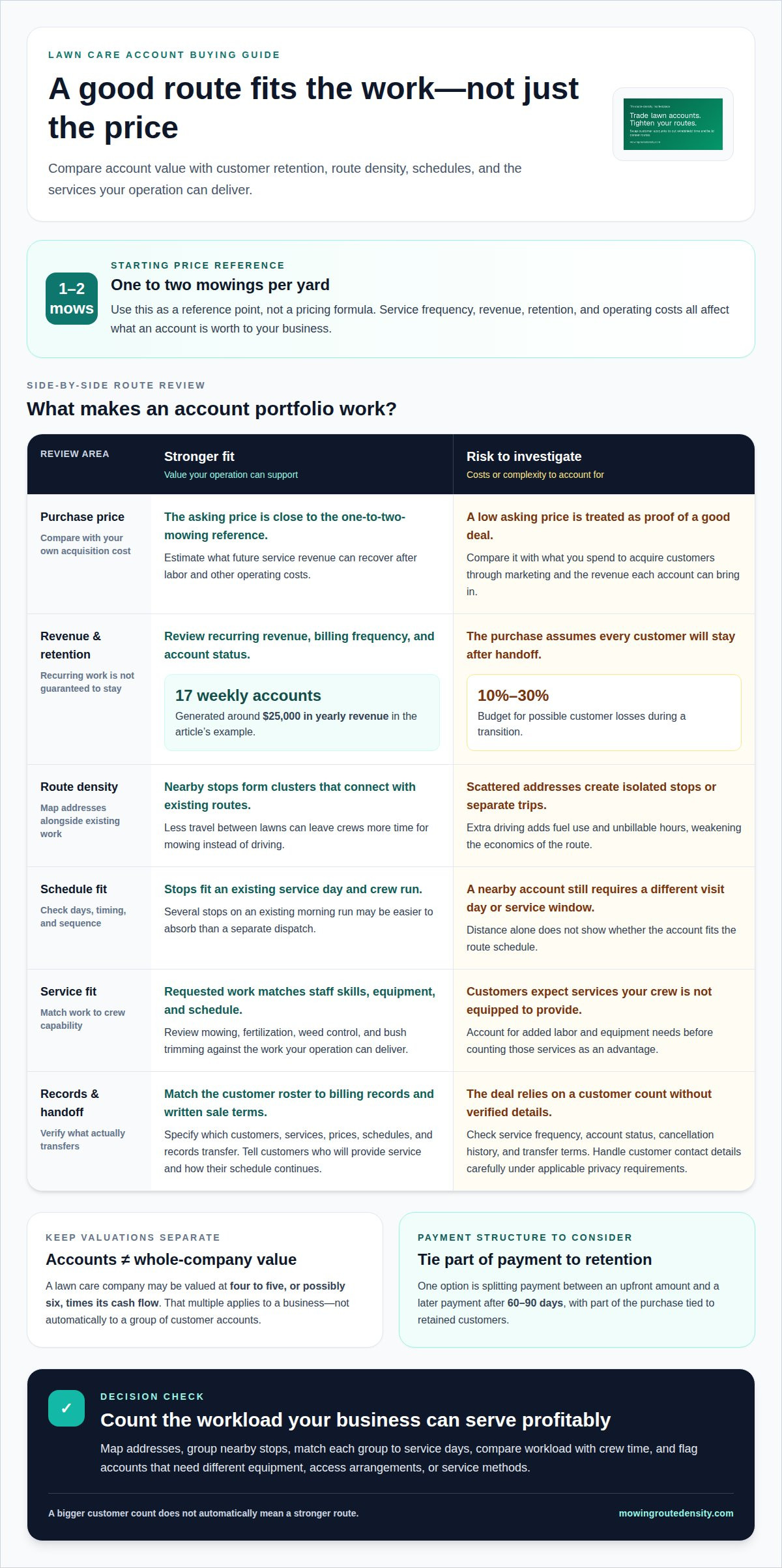
Buying lawn care accounts can make sense when the price is roughly equal to one or two mowings per yard. But a low asking price alone does not make a route a good buy. Compare the price with your customer acquisition costs, and make sure the accounts fit how your business operates.
Buying accounts can grow your customer base faster than building a route one lawn at a time. It can also leave you with scattered stops, mismatched services, or customers who leave after the handoff. Compare the asking price with what you spend to acquire customers through marketing, clarify why you want to buy, and assess route density and service fit. The aim is growth that strengthens your operation, not simply a bigger customer count.
Key Takeaways
- Use the cost of acquiring customers through marketing as a benchmark, then weigh the asking price against the revenue each account can bring in.
- Buy accounts to solve a clear growth or route-planning need, not just to increase your customer count.
- Assess whether nearby stops and compatible services can make the route more efficient to operate.
- Compare customer routes with whole-business listings, since they represent different kinds of purchases and operational commitments.
1. Comparing purchase prices with customer acquisition costs
A practical starting point is to value a mowing account at one to two mowings per yard. Treat this as a reference point, not a pricing formula. Service frequency, revenue, retention, and operating costs all affect what an account is worth to your business.
Compare the asking price with your own customer acquisition cost. The difference is what you will need to recover through future service revenue, after labor and other operating costs.
How are lawn care accounts valued based on recurring revenue, customers, and retention? Start with recurring revenue from each customer, then account for how often service is billed and how many customers are likely to stay after the transition. For example, 17 weekly mowing accounts generated around $25,000 in yearly revenue, but buyers should budget for losing 10% to 30% of customers during a transition.
How do you evaluate account quality and profitability before buying? Compare service prices, including mowing, fertilization, weed control, and bush trimming, with the labor and operating costs required to deliver them. Then assess billing patterns and retention: some customers are billed every 30 days, and a missed visit the following week can cost you an account. To buy lawn care accounts, consider splitting payment between an upfront amount and a payment after 60-90 days, tying part of the purchase to retained customers.
Keep account pricing separate from whole-company valuation. A lawn care company may be valued at four to five, or possibly six, times its cash flow. That multiple applies to a business, not automatically to a group of customer accounts.
2. Reasons to buy lawn care accounts
Buying accounts makes sense when customer growth solves a specific operating problem. A business with 20 lawns might reach 40 in a single week through a purchase, rather than waiting for marketing to build the route gradually. That increase only helps if crews, equipment, and schedules can absorb the added work.
How do customer contracts, consent, and privacy laws affect transferring lawn care accounts? Review the service agreement for transfer terms and handle customer contact details carefully under applicable privacy requirements. Tell customers who will provide service and how their existing schedule will continue.
What is included when buying a lawn care customer route or account portfolio? A purchase may cover customer relationships and recurring service work, with the sale agreement specifying the exact assets. Define which customers, services, prices, schedules, and records transfer instead of relying on a customer count alone.
What due diligence should I perform before purchasing lawn care accounts? Match the customer roster against billing records, then review service frequency, account status, and cancellation history. Compare each service price with the labor and travel it requires. A full route is not valuable if the work loses money.
What are the steps to buy and transition lawn care accounts successfully? Put the transferred accounts and terms in writing, prepare crews and schedules, and communicate the handoff before the next service visit. Keep service details consistent so customers know who is arriving and what work to expect.
What financing options are available for buying a lawn care route or accounts? Buyers can consider cash, business financing, or a negotiated payment arrangement with the seller. Compare repayment obligations with expected account cash flow before committing. A larger route does not automatically mean more available cash.
Risks include cancellations, inaccurate service records, underpriced work, and routes that add excessive drive time. Buyers may also inherit customer expectations that differ from their current operating model. Focus on accounts your business can serve profitably, not just a headline customer total.
How can I find lawn care routes for sale? Search route listings in the areas you want to serve, prioritizing locations that connect with existing stops. Nearby accounts can reduce driving time, while scattered customers can weaken the economics of an otherwise attractive purchase.
3. Route density and service fit
Route density determines how much time crews spend mowing instead of driving. Nearby lawns can reduce travel between stops; scattered addresses add driving time, fuel use, and unbillable hours. Plot each account alongside your existing work. Before judging the route by customer count, mark clusters, isolated stops, and stretches that require a separate trip.
Compare the proposed schedule with your current service days. Even a nearby account can disrupt a route if it requires a different visit day or service window. For example, several stops that fit an existing morning run may be easier to absorb than one nearby lawn requiring a separate crew dispatch. Match the timing and sequence, not just the distance.
Review each account’s location pattern alongside its service details. A route with recurring customers may look attractive, but addresses spread across a broad area can reduce the value of those visits. Group stops by neighborhood or road corridor, then identify gaps. A route map can show whether the accounts form a workable run or several disconnected trips.
Service fit matters, too. A mowing crew may not be equipped for fertilization, weed control, or bush trimming. Compare the requested work with your staff’s skills, equipment, and schedule. If customers expect services your operation does not currently provide, account for the added labor and equipment needs before counting those services as an advantage.
Use a practical review sequence: map addresses, group nearby stops, match each group to service days, and compare the workload with available crew time. Then flag accounts that need different equipment, access arrangements, or service methods. A tight cluster that suits your operation can make routing more efficient. Scattered accounts with mismatched work can complicate dispatch and pull crews away from established customers.
4. Where can I buy lawn care accounts or customer routes in the United States?
Look for customer routes through account-trading marketplaces and business-sale listings. These sources present different opportunities: a route listing may focus on recurring customers, while a whole-business listing may cover a broader operation. Search for listings that match the areas your crews can serve, then compare each route’s locations with your existing schedule. A large customer count means little if the stops are difficult to combine.
Listings can advertise very different portfolio sizes. For example, one lawn care business listing promotes 150 established accounts, while a residential lawn business listing promotes 296 recurring monthly customers. These figures describe different portfolios, not a like-for-like comparison. Service frequency, customer mix, and how the accounts fit together all affect whether either opportunity suits your operation.
Start with the areas your crews can realistically cover. Search listings by the service area you want to expand into, then distinguish account-only routes from whole-business sales. For each opportunity, note the advertised customer count, recurring work, and general location pattern. Compare the route with existing stops. A listing outside your practical operating footprint can add travel without strengthening your schedule.
Use listing details to identify prospects, not to judge route quality on their own. Compare the customer total with service schedules and the work expected at each property. For example, a smaller group of recurring accounts may fit your crew’s existing schedule better than a larger portfolio with scattered visits. Listings help surface opportunities; operational fit determines whether a purchase supports your business.
For a focused search, browse lawn account opportunities and narrow your attention to routes that match your target area and service model. Keep your criteria consistent: compatible services, workable locations, and recurring customers you can integrate into your schedule.
Mowing Route Density: lawn mower rental
Mowing Route Density helps lawn care operators act on route decisions through its lawn account trading platform. Use the platform to buy, sell, or swap service routes in line with your operating plan. A route that adds scattered stops may create more driving than useful work.
Equipment needs can change as a route grows. Lawn mower rental can help when your operation needs mowing equipment. If you are looking for a professional mowing company, the lawn mowing service provider locator connects you with providers by region.
Choose the offering that fits the task: route trading for account growth, mower rental for equipment needs, or the locator to find a provider. Contact Mowing Route Density to discuss the option that suits your situation.
Put Your Next Route Decision to Work
The next step is to turn a route opportunity into an operating decision. Before you buy lawn care accounts, decide what your business needs most: a closer group of stops, a way to trade accounts, equipment for added work, or help locating a mowing provider in a specific area. That choice keeps expansion tied to how your crews actually work.
Mowing Route Density supports these needs with its lawn account trading platform, lawn mower rental, and lawn mowing service provider locator. Choose the option that matches your next move instead of adding services or equipment without a clear operational reason.
For help taking that next step, contact Mowing Route Density. Build deliberately, keep the route workable, and make your next decision count.
Frequently Asked Questions
Is Buying Another Lawn Care Business a Good Idea?
Buying another lawn care business can make sense when it addresses a clear operating need. For example, acquiring a business with an established crew may help an owner take on work the current team cannot cover. The fit depends on whether its customers, equipment, staffing, and service model complement your operation. If the purchase adds management demands without useful capacity or customers, growth can become a costly distraction.
Why Is the Previous Owner Selling This Mowing Business?
An owner may be selling because of retirement, a change in priorities, or a desire to leave daily operations. The reason alone does not show whether the business is a good purchase. Review what the seller plans to transfer and how the handoff will work. A clear explanation and organized customer and service records give you a more useful picture than a sales pitch alone.
Why Should You Buy a Landscaping Business?
Buying a landscaping business can provide an operating foundation beyond a customer route, depending on the sale terms. It may suit an owner who wants to take over an existing operation rather than build each part from scratch. Compare that broader commitment with buying accounts alone. Consider whether you are prepared to manage the business’s existing services, team, equipment, and customer expectations.
How much do lawn care accounts and routes typically cost?
Purchase prices vary with the assets being sold and the strength of the recurring work. An account portfolio differs from a complete operating business, which may include equipment, staff, and other assets. Customer retention, service mix, documented revenue, and transition terms also shape value. Compare the purchase with the operation you will take over, rather than relying on customer count alone.


