

A seller may help you buy a route, then leave you facing a balloon payment before the route has paid for itself. Seller financing for a lawn route purchase means the seller finances part of the purchase price, which you repay in agreed installments. It can fill a funding gap, but the terms determine whether it supports the purchase or strains your cash flow.
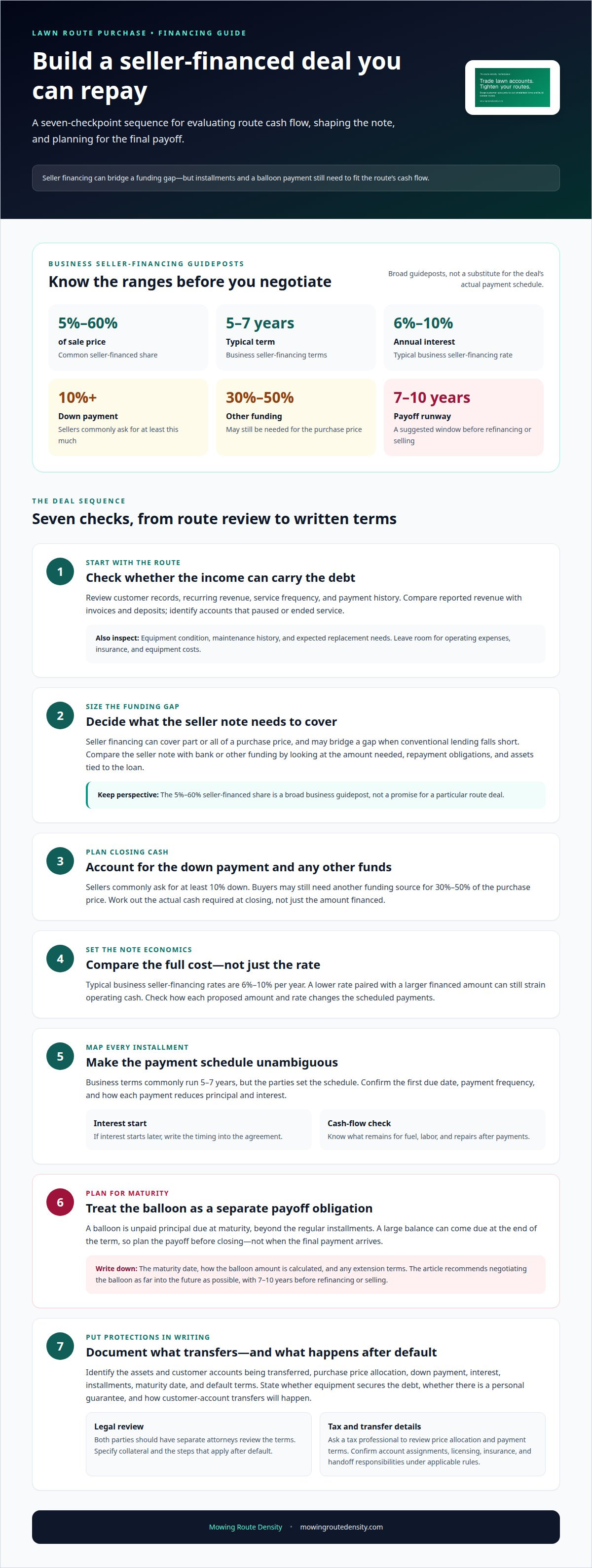
It’s reasonable to compare this option with a bank loan or other funding. Business seller financing commonly covers 5% to 60% of the sale price, with typical terms of 5 to 7 years and interest rates of 6% to 10% per year. Those are broad guideposts, not a substitute for working through the deal’s actual payment schedule.
This article explains how seller financing works for a lawn route, which terms and costs to review closely, and how a balloon payment changes the risk. It also compares seller financing with other funding options, so you can assess the effect of each arrangement on your cash flow and the route you’re buying.
Key Takeaways
- Weigh the easier access to funding against the seller’s right to assess your ability to repay and the payment burden the deal creates.
- Model the balloon payment alongside regular installments so you can see whether the route’s cash flow can support the debt and a future payoff plan.
- Put the repayment terms, collateral, and any personal guarantee in a written agreement reviewed by an attorney for each side.
- Compare a seller note with bank or other lending options by looking at the funding gap, repayment obligations, and assets tied to the loan.
What is owner financing?
Seller financing is a private arrangement in which the seller finances part or all of a business’s purchase price. The buyer repays the balance in agreed installments, usually documented in a promissory note.
Buyer and Seller Tradeoffs
For buyers, seller financing can bridge a funding gap and make a route purchase possible when conventional lending falls short. The seller can review credit and repayment ability, then decline if the risk looks too high. Buyers commonly need a 680+ FICO score, and a seller may also require a personal guarantee. That guarantee can put personal assets at risk if payments stop.
Sellers may receive installment payments and interest instead of the full purchase price at closing, but they take on collection work and the risk of missed payments. For buyers, the benefit is negotiated access to funding; the drawback is debt that reduces operating cash. A balloon payment can add pressure if the balance comes due before route income can cover it. Leave room in the budget for insurance and equipment costs, too.
Tax Implications
Tax treatment depends on how the sale price is allocated among customer accounts, equipment, and other assets, as well as how interest and installments are documented. Have a tax professional review the allocation and payment terms before signing. The promissory note should distinguish principal from interest so the payment structure is clear.
Route Transfer Checks
State and local rules may affect licensing, insurance coverage, and customer or account transfers. Requirements depend on the jurisdiction, services performed, and existing customer contracts. Put transfer conditions and responsibility for coverage in the purchase agreement. Confirm that route accounts can be assigned, and clarify who will communicate with customers during the handoff.
Valuing Customers, Revenue, and Equipment
Assess the route by reviewing customer records, recurring revenue, service frequency, and payment history. Compare reported revenue with invoices and deposits, and identify accounts that have paused or ended service. For equipment, record each item’s condition, maintenance history, and expected replacement needs. These checks help show whether route cash flow can cover installments after operating expenses.
Loan terms and balloon payments
The financing agreement sets the down payment, interest rate, payment schedule, and maturity date. There’s no standard lawn-route price per customer or annual revenue: value depends on recurring revenue, customer retention, service frequency, geography, and included equipment.
Payment Schedules and Interest Accrual
A payment schedule states when installments are due and how each payment reduces principal and interest. Business seller-financing terms commonly run 5 to 7 years, but the parties set the schedule directly. A real-estate example allows interest to begin accruing after 3 months on vacant property. For a route purchase, any delayed interest start must be written into the agreement. Spell out the first due date, payment frequency, and how the balance changes. Otherwise, buyers can misjudge how much cash remains for fuel, labor, and repairs.
Down Payments and Interest Rates
Down payment and interest negotiations determine how much cash the buyer needs at closing and what the remaining debt costs. Seller financing for a business typically covers 5% to 60% of the sale price, while sellers commonly ask for at least 10% down. Buyers may still need another funding source for 30% to 50% of the purchase price. Typical business seller-financing interest rates are 6% to 10% per year. Compare the full payment schedule, not just the rate: a lower rate paired with a larger financed amount can still strain operating cash.
Balloon Payments and Maturity Dates
A balloon payment is the unpaid principal due at the loan’s maturity, beyond the regular installments. Business financing terms commonly run 5 to 7 years, while a balloon can leave a large balance due at the end. Negotiating the balloon as far into the future as possible, with 7 to 10 years before refinancing or selling, gives the buyer more time to build repayment capacity. Put the maturity date, balloon amount calculation, and any extension terms in the financing agreement. Plan for the payoff before closing, not when the final payment comes due.
Legal advice for owner-financing agreements
Seller financing creates direct payment obligations between buyer and seller, so the agreement must define the deal clearly. Unlike a real estate land contract, a lawn route purchase usually involves customer accounts, equipment, and business assets, not title to land.
A seller-financed lawn route purchase agreement should identify the assets and accounts being transferred, purchase price allocation, down payment, interest, installment schedule, maturity date, and default terms. It should also state whether equipment secures the debt, whether the buyer provides a personal guarantee, and how customer-account transfers will happen. Clear terms reduce disputes about what the buyer receives and what happens after missed payments.
Seller-financing arrangements may leave buyers and sellers with fewer protections than conventional loans, particularly if payments are missed. A seller may secure the loan with a UCC-1 lien on business assets such as machinery or vehicles. The agreement should describe the collateral and the steps that apply after default. Both parties should have separate attorneys review the terms before signing.
Lease-purchase and rent-to-own structures need clear conditions, too. A lease-option agreement may set an option fee, a deadline for exercising the option, and rules for rent credits. Those are real estate concepts, and they do not automatically define ownership of lawn accounts or equipment. If a route deal involves a staged transfer or temporary operating rights, document when control changes and how payments apply to the purchase.
Specify insurance responsibilities in the agreement. State who maintains coverage for equipment and operations during the transition, and how proof of coverage is handled. State and local licensing and customer-transfer rules can vary, so the contract should identify which party handles each transfer or filing. Clear responsibilities help ensure the buyer can operate the accounts and assets as planned.
Seller financing compared with other financing options
For a lawn route purchase, compare seller financing with a bank, credit union, or online lender. The right structure depends on the funding gap, repayment capacity, and assets securing the debt. Seller financing can cover part of the gap, while another lender may fund the rest. Compare the full obligations, not just the amount available at closing.
With a conventional business loan, a financial institution sits between buyer and seller. The lender sets underwriting criteria and repayment terms, and the seller receives the agreed sale proceeds through the transaction. With seller financing, the parties negotiate directly, but the seller takes on payment collection and default risk. Buyers may combine a seller note with a lender loan to cover the portion not funded by their down payment or seller financing.
A blended deal can spread the funding burden, but it adds complexity. A bank loan and seller note, for instance, may have different payment dates, maturity dates, and collateral. One missed payment could affect more than one agreement. Ask an attorney to review how the contracts interact, which assets secure each loan, and what happens if customer accounts or route revenue decline.
Seller financing may carry higher interest than traditional financing, and a balloon can leave a large balance due at maturity. A lender loan may avoid a seller-held balance, but qualification and repayment terms come from that lender. Foreclosure is a real-estate remedy, not a simple synonym for recovering business assets; default rights depend on the contract and collateral. Choose based on total payments, available cash, and realistic repayment sources. Explore route acquisition options as you weigh the funding structure against the accounts and assets being transferred.
Mowing Route Density
Mowing Route Density helps lawn care professionals connect route transactions with practical operating needs. If you’re considering a seller-financed purchase, its lawn account trading platform lets you buy, sell, or swap service routes, so you can explore route opportunities alongside financing terms. If the purchase also leaves an equipment gap, lawn mower rental can help meet that need without relying on financing alone.
Use these tools when you’re assessing a route opportunity or planning how to operate after the transfer. Financing terms still belong in a clear agreement between buyer and seller, but the right route and equipment resources can help shape a workable purchase plan. Contact Mowing Route Density to discuss your route needs.
Set up the route to work before the debt comes due
A financing plan only works if the route fits your operations. Before committing, map the service area, weekly schedule, travel time, staffing, and equipment needs against your current workload. A route that looks manageable on paper can become a drain if customers are spread out or service days conflict with existing jobs.
Use that operating plan to decide what you can take on without compromising maintenance, payroll, or customer service. Seller financing for a lawn route purchase should support a business you can run consistently, not force you into a schedule with no room to address problems. Align the agreement with the route’s actual demands, and make your next move with a clear view of both workload and debt.
Contact Mowing Route Density to discuss your lawn care business needs. Build a route plan you can operate with confidence.
Frequently Asked Questions
What is seller financing?
Seller financing is an arrangement in which the seller finances some or all of the funds needed to buy a business. Rather than receiving the full amount at closing, the seller receives repayments under agreed terms. For example, the seller may finance the balance after the buyer’s down payment. The buyer then owes the seller, not only a bank or another lender.
How does seller financing work for buying a lawn care route?
The buyer and seller agree on which customer accounts, equipment, and other assets transfer, then set the financed amount and repayment terms in writing. For a seller-financed lawn route purchase, the buyer might use a down payment and a seller note to cover part of the agreed price. The transfer schedule should clarify when customer accounts move and who handles service during the handoff.
What down payment and interest rate are common for seller-financed lawn route purchases?
For business seller financing generally, buyers commonly put at least 10% down, and typical interest rates run 6% to 10% per year. Seller financing often covers 5% to 60% of a business sale price. These are broad business-financing guideposts, not a lawn-route-specific quote. The buyer’s credit, seller’s risk, down payment, and repayment period can affect the negotiated terms.
What loan terms and repayment schedules are typical for a seller-financed route?
Business seller-financing terms commonly run 5 to 7 years, but the buyer and seller can negotiate another schedule. The agreement should state payment frequency, due dates, how payments apply to principal and interest, and the final maturity date. If payments are calculated over a longer amortization period, a balloon may leave principal due at maturity. Build that payoff into cash-flow planning.
How do seller financing and SBA or bank loans compare for buying a lawn route?
A bank or SBA-backed loan involves a lender’s application and underwriting process; seller financing is negotiated directly with the seller. A buyer may combine funding sources if one loan does not cover the full purchase. Compare total repayment obligations, collateral, approval conditions, and timing. A direct seller agreement allows for negotiation, while lender approval determines whether conventional financing fits the transaction.
What risks should buyers and sellers consider with seller financing for a lawn route?
Buyers risk payment strain if customers leave, revenue falls, or a balloon payment comes due without a payoff source. Sellers risk late or missed payments and may need to collect what they’re owed. Both sides should consider how the contract handles default, collateral, customer-account transfers, and equipment. A handoff that fails to preserve recurring accounts can undermine the buyer’s ability to repay.


