

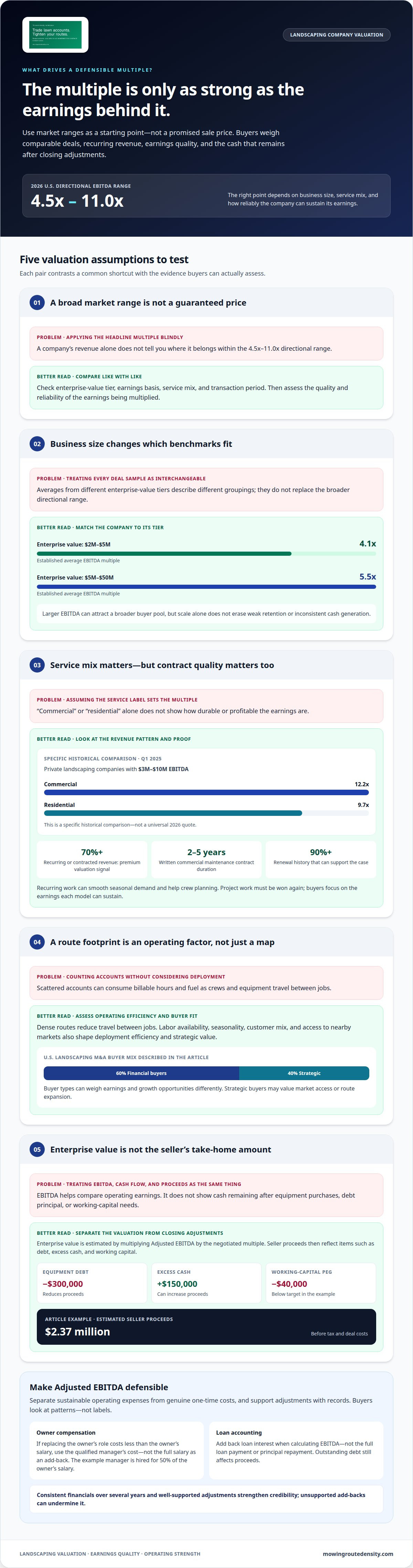
A useful starting point for understanding EBITDA multiples for landscaping companies in 2026 is the U.S. directional range: 4.5x-11.0x, depending on business size and service mix. Apply a multiple to Adjusted EBITDA to estimate enterprise value, but don’t treat the range as a guaranteed price. The right point depends on what the business earns and how reliably it can keep earning it.
That’s why an industry average can mislead. Recurring maintenance, customer concentration, route density, crew retention, and reliable cash flow all influence how buyers assess a landscaping company. Strong revenue means less if profits depend on one-off projects or the owner’s continued involvement.
This article explains how to choose a realistic multiple, how recurring work and service mix affect value, and why enterprise value differs from a seller’s proceeds. You’ll learn to relate a market range to your earnings and identify operating strengths that may support a stronger valuation.
Key Takeaways
- Build a defensible EBITDA figure by separating true one-time costs from expenses the business will keep carrying.
- Translate enterprise value into likely seller proceeds by accounting for debt, excess cash, and working capital.
- Show how predictable maintenance revenue and a balanced service mix can strengthen the case for a higher multiple.
- Use sale benchmarks that match your business’s size and earnings basis, rather than applying a headline multiple blindly.
What drives premium multiples for landscaping platforms?
Landscaping valuation depends on more than revenue: earnings quality, service mix, business size, and buyer demand all shape the multiple. The 2026 U.S. directional range is 4.5x-11.0x EBITDA, but it isn’t a one-size-fits-all benchmark.
EBITDA in Valuation Models
EBITDA adds interest, income taxes, depreciation, and amortization back to net profit. In valuation modeling, it gives buyers a way to compare operating earnings before those items; enterprise value is then estimated by multiplying Adjusted EBITDA by the negotiated multiple.
Accounting discipline matters. Separate sustainable operating expenses from genuine one-time costs, and support every adjustment with records. To prepare for a sale, owners can manage labor and equipment costs, document defensible adjustments, and present consistent financials over several years. Unsupported adjustments can undermine credibility rather than strengthen valuation.
Geographic Valuation Differences
Geographic valuation differences reflect local operating conditions and the strategic value of a company’s footprint. Route density, labor availability, seasonality, customer mix, and access to nearby markets affect how efficiently crews and equipment can be deployed. Dense routes reduce travel between jobs; scattered accounts can consume billable hours and fuel.
Interest rates can affect buyer financing costs and the returns buyers expect, while strategic buyers may value market access or route expansion differently from financial buyers. The U.S. landscaping M&A market is described as 60/40 financial and strategic buyers, respectively; each buyer type weighs earnings and growth opportunities differently.
Business Size and Enterprise-Value Tiers
Business size and EBITDA influence which valuation comparisons are relevant. For businesses with enterprise value from $2 million to $5 million, the established average EBITDA multiple is 4.1x; for enterprise value from $5 million to $50 million, it is 5.5x.
These averages don’t conflict with the broader 4.5x-11.0x directional range: they describe different groupings and deal samples. Compare like with like by checking enterprise-value tier, earnings basis, service mix, and transaction period. Larger EBITDA can attract a broader buyer pool, but scale alone doesn’t erase weak retention or inconsistent cash generation.
Residential and Commercial Multiples
Residential and commercial landscaping companies can receive different multiples because their revenue patterns, contracts, and service demands differ. In Q1 2025, private commercial landscaping companies with EBITDA of $3-10 million averaged 12.2x, compared with 9.7x for private residential landscaping companies in the same EBITDA range.
Those figures are a specific historical comparison, not a universal 2026 quote. Recurring maintenance, written contracts, customer retention, and limited customer concentration can strengthen a commercial operation’s profile. A residential design-build company may rely more heavily on project flow. Buyers assess the earnings each model can sustain, not just the label on the service mix.
Is EBITDA the same thing as cash flow?
No. EBITDA measures operating earnings before interest, income taxes, depreciation, and amortization. Cash flow tracks money moving into and out of the business. EBITDA helps buyers compare operations, but it does not show cash remaining after equipment purchases, debt principal, or working-capital needs.
That difference matters at closing. Enterprise value is not the seller’s take-home amount. In one landscaping example, the business had $300,000 in equipment debt, $150,000 in excess cash, and a working-capital peg $40,000 below target. After those adjustments, estimated seller proceeds before tax and deal costs were about $2.37 million. Debt reduces proceeds; excess cash can increase them; a working-capital shortfall can reduce them.
Adjusted EBITDA starts with EBITDA and then accounts for expenses that do not reflect ongoing operations. Each adjustment needs a clear business rationale and supporting records. An expense called one-time for five years may be difficult to justify as an add-back the next year. Buyers look at patterns, not labels. Unsupported adjustments can weaken the seller’s case.
Owner compensation is another adjustment to examine. If the owner’s salary exceeds the cost of replacing their role, Adjusted EBITDA may reflect the qualified manager’s cost instead. For example, the stated scenario uses a manager hired for 50% of the owner’s salary. The business still needs someone capable of handling those responsibilities, so removing the entire salary would overstate earnings.
Loan accounting also matters: add back loan interest when calculating EBITDA, not the full loan payment or principal repayment. That distinction keeps operating earnings separate from capital structure, while cash proceeds still account for outstanding debt. For owners considering account changes alongside financial preparation, a lawn account trading platform can support buying, selling, or swapping service routes.
Recurring versus construction-based landscaping operations
Recurring maintenance and project-based construction have different revenue patterns, operating demands, and buyer risk profiles. The mix matters because buyers assess predictable earnings differently from revenue that must be won again with each project.
Revenue Mix and Contract Duration
Revenue mix describes how much income comes from ongoing maintenance contracts versus one-time design-build or construction work. A business with 70%+ recurring or contracted revenue has a premium valuation signal, while written commercial maintenance contracts lasting 2-5 years with a 90%+ renewal history can further support the case.
Those figures matter only if operations deliver the work profitably. Recurring revenue can smooth seasonal demand and help with crew planning, but contract duration alone does not prove strong margins. Compare contract revenue with actual labor, equipment, and service costs. A construction-heavy company may generate substantial revenue, yet its profit depends on repeatedly winning and completing projects.
Client Concentration and Operating Risks
Client concentration measures how heavily revenue depends on a few customers. A landscaping company with no customer representing more than 5% of revenue has a premium valuation signal. Losing one major account can sharply reduce earnings, disrupt crew schedules, and leave equipment underused. Customer retention, contract renewals, and a diversified account base help buyers assess that risk.
Financial, operational, and customer risks can all lower valuation. Weak margins, inconsistent cost accounting, crew turnover, equipment downtime, scattered routes, and lost contracts can undermine adjusted EBITDA. Route density affects travel time and productive crew hours, so tightly grouped maintenance accounts can make recurring work more efficient. Buyers may also challenge unsupported add-backs. An expense described as non-recurring for five years may be hard to exclude from ongoing costs.
Premium U.S. multi-region landscaping operators with 70%+ recurring revenue and $7M+ EBITDA are described as reaching 8.0x-11.0x EBITDA. That benchmark reflects scale and revenue quality together, not recurring revenue alone. A clear contract history, reliable service execution, and credible cost records help show whether recurring operations can sustain profit.
Landscaping and yard-services sale multiples
Landscaping sale multiples vary with earnings basis, company size, service mix, and deal quality. For U.S. landscaping and yard-services businesses, reported 2025 closed sales averaged 2.56x SDE and 0.76x revenue. These measures answer different questions, so owners should compare each business against the right earnings basis.
For owners focused on understanding EBITDA multiples for landscaping companies 2026, the directional range is 4.5x-11.0x EBITDA. The directional SDE range is 3.0x-4.5x. SDE comparisons may fit smaller owner-operated businesses; EBITDA is more relevant for larger operations with established management. Match the benchmark to company size, earnings, and service mix before estimating enterprise value.
Deal samples need context. BizBuySell reported 211 closed landscaping and yard-services sales in 2025. Its 2.56x average SDE multiple summarizes those transactions, but doesn’t capture every company’s growth, profit consistency, or customer concentration. A business with documented earnings and diversified accounts has a different risk profile from one dependent on its owner or a few customers.
Quality of Earnings reviews can help buyers assess the earnings behind a proposed valuation. In an analysis of 360 transactions since Q3 2024, sellers who commissioned a review averaged 7.4x, compared with 7.0x for sellers who did not. That comparison doesn’t establish a guaranteed uplift. It underscores the value of clear accounting and credible earnings support.
Understanding EBITDA multiples for landscaping companies 2026 also means resisting direct comparisons with lawn care, tree care, or snow removal. Their operating demands and revenue patterns differ, so compare similar earnings bases, service mixes, company sizes, and customer concentration rather than assuming one shared multiple.
For owners assessing lawn-care operations, a lawn mowing service provider locator can connect customers with providers in their geographic region.
There is no single EBITDA multiple that applies across landscaping, lawn care, tree care, and snow removal. Their operating demands and revenue patterns differ, so comparisons should account for the earnings measure, service mix, company size, and customer concentration.
Mowing Route Density
Mowing Route Density gives lawn care professionals practical tools for operational decisions that can shape earnings and business readiness. Its lawn account trading platform supports buying, selling, or swapping service routes. Lawn mower rentals and a lawn mowing service provider locator help with equipment access and connections to professional mowing companies.
These offerings do not determine a valuation multiple. They can be part of broader operational planning: route changes may affect account mix, while equipment access can influence how a business manages its work. Choose the next step based on the operational issue you need to address, not on an assumed sale-price increase.
If you’re considering how these tools fit your business plans, contact Mowing Route Density.
Turn valuation goals into operating decisions
A practical understanding of EBITDA multiples for landscaping companies in 2026 is most useful when it changes how you run the business. Start by identifying the operational weakness that makes earnings harder to repeat, whether that’s inefficient routing, equipment capacity, or dependence on a narrow customer base. Then focus on improvements that make the company’s day-to-day performance clearer and more consistent. That work can strengthen operations even if a sale isn’t immediate.
Mowing Route Density supports lawn care professionals with tools for equipment access, lawn account trading, and finding mowing providers. These tools address operational needs, not valuation advice or a promised sale outcome. Choose the next step based on the bottleneck you need to solve, and keep financial records aligned with any changes.
For a practical conversation about your lawn care business needs, contact Mowing Route Density. Keep tightening the operation, one sound decision at a time.
Frequently Asked Questions
What multiple should I use to value my business?
Use a benchmark that matches your earnings measure, company size, and service mix rather than relying on one industry-wide figure. For a small owner-operated company, SDE comparisons may fit better; larger operations are commonly assessed using Adjusted EBITDA. Then test the multiple against recurring work, customer concentration, management depth, and documented earnings. The result estimates enterprise value, not necessarily the seller’s final proceeds.
Why Is It Important to Calculate EBITDA?
Calculating EBITDA helps owners and buyers assess operating performance without financing choices and certain accounting expenses distorting the comparison. It also provides a consistent starting point for valuation models. For example, a landscaping business can separate operating results from interest and depreciation, then assess whether its earnings are sustainable. EBITDA does not show available cash by itself, so equipment purchases, debt principal, and working-capital needs still matter.
How has the landscaping M&A market changed recently?
Recent activity includes an expanding platform-buyer presence and competitive sale processes for larger companies. The U.S. market has more than 40 active PE-backed landscaping platforms, and an advisor-run process for a company with $2M+ EBITDA may approach 40-80 buyers. Those figures indicate potential buyer interest, not a guaranteed bidding outcome. Owners should distinguish broad market activity from the demand for their specific earnings profile.
How is EBITDA Used in Financial Modeling?
In financial modeling, EBITDA helps estimate enterprise value by applying a selected multiple to adjusted earnings. A model can compare scenarios by changing the earnings base or multiple and showing how those assumptions affect estimated value. Owners can also use projections to test whether planned changes to labor, equipment, or routes support repeatable profit. The model is only as useful as its accounting inputs and assumptions.
What Determines an EBITDA Multiple?
An EBITDA multiple reflects the risk and growth potential buyers see in a company’s future earnings. They assess company size, recurring maintenance revenue, contract renewals, customer concentration, crew stability, route efficiency, and the reliability of financial records. Buyer type matters too: a strategic buyer may value market access differently from a financial buyer focused on returns. Weak earnings quality can offset otherwise attractive growth prospects.
What are typical EBITDA multiples for U.S. landscaping companies in 2026?
The directional 2026 range is 4.5x-11.0x EBITDA, depending on size and service mix. Smaller owner-operated businesses may be evaluated using SDE instead, with a directional range of 3.0x-4.5x SDE. For context, small commercial maintenance operators with $1M-$3M EBITDA are described at 4.5x-6.5x EBITDA. Treat each range as a comparison point, not a fixed offer.


