

Fast funding isn’t always the right funding. Securing a loan to buy a lawn care business can take longer than financing a mower: the timeline depends on the loan type, your financial records, and the deal’s complexity. Alternative lenders may fund zero-turn mower financing within 24 to 48 hours, while equipment financing typically takes about one week.
It’s reasonable to focus on how quickly the money can arrive. But speed matters little if the loan won’t cover the purchase and leave enough cash for crews, equipment, and daily operations. This guide explains what financing can cover, why operating history and seasonal cash flow may affect approval, and how rates, loan amounts, and repayment terms shape your options. You’ll also learn how to distinguish acquisition financing from equipment or working-capital funding, so you can match the loan to the need rather than choosing on speed alone.
Key Takeaways
- Match the loan to the purchase: buying a business, financing equipment, and covering operating costs can call for different funding structures.
- Prepare for startup approval challenges by showing how the business will manage seasonal cash flow and meet payments.
- Compare rates, fees, repayment periods, and down payment requirements, not just the amount offered.
- Choose financing that supports the business after the purchase, including equipment needs and route operations.
What can you use a landscaping loan for?
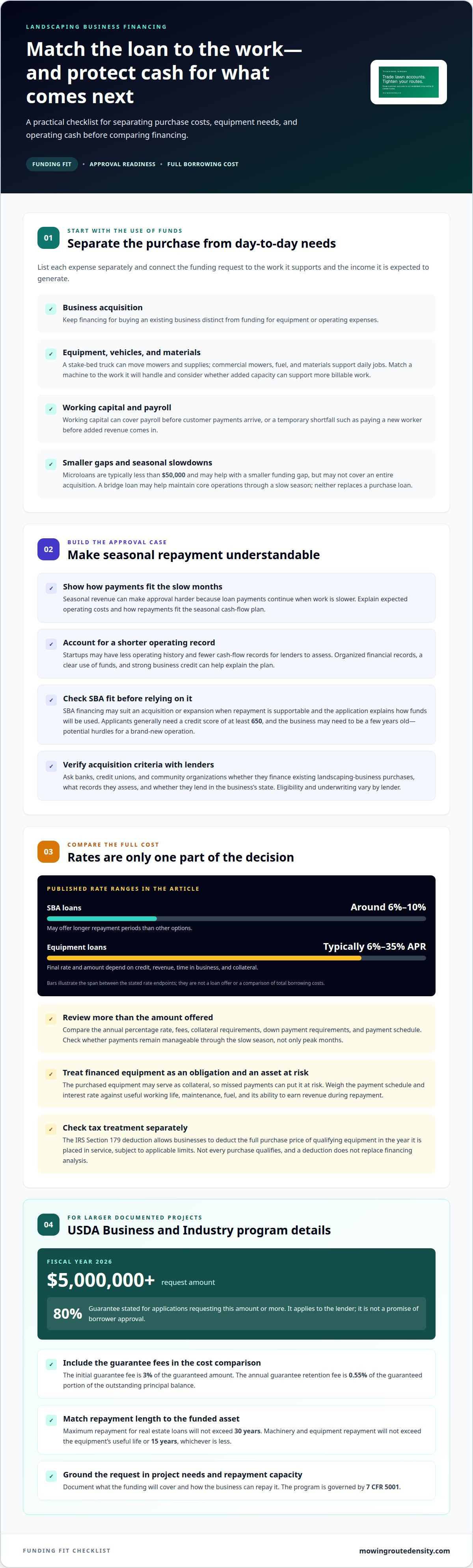
Landscaping financing can cover equipment, vehicles, materials, and labor needed to deliver work. A stake-bed truck can move mowers and supplies between job sites. Commercial mowers, fuel, and materials support daily operations, while working capital can cover payroll before customer payments arrive. List each expense separately to connect the funding request with specific work and expected income.
Equipment financing can preserve cash for hiring, marketing, and business growth. Some commercial mower manufacturers arrange industry-specific financing through local dealers when you buy equipment. Before financing, match the machine to the jobs it will handle, then estimate how added capacity could increase billable work. An idle mower adds payments without earning revenue; one that helps crews complete more scheduled jobs may support growth.
Equipment financing also carries risk. The purchased equipment may serve as collateral, so missed payments can put the asset at risk. Compare the payment schedule and interest rate with the equipment’s useful working life. For vehicles and machinery, account for maintenance, fuel, and whether the asset can earn revenue throughout the repayment period. These costs affect the cash available for loan payments.
Tax treatment matters, too. The IRS Section 179 deduction allows businesses to deduct the full purchase price of qualifying equipment in the year it is placed in service, subject to applicable limits. That rule does not mean every purchase qualifies or that a deduction replaces financing analysis. Account for the timing of equipment use and the business’s tax position before relying on a deduction in cash-flow projections.
For larger projects, the USDA Business and Industry program may also be relevant. USDA Rural Development says applications requesting $5,000,000 or more receive an 80 percent guarantee in Fiscal Year 2026. That guarantee applies to the lender, not as a promise of approval for the borrower. The Office of the Federal Register identifies 7 CFR 5001 as governing the USDA Business and Industry Guaranteed Loan program. Match the funding request to documented project needs and repayment capacity.
Challenges getting startup business loans
U.S. buyers may consider SBA loans, personal loans, small-business credit cards, microloans, and working-capital financing. Startups can face a tougher approval process because lenders have less operating history and fewer cash-flow records to assess. Seasonal landscaping revenue adds another challenge: payments continue during slow months.
SBA Loans for Expansion or Acquisition
SBA financing may suit an acquisition or expansion when the business can support repayment and the application explains how the funds will be used. Applicants generally need a credit score of at least 650, and the business may need to be a few years old. Those hurdles can make an SBA loan a difficult fit for a brand-new operation. Buyers should separate the acquisition’s projected revenue from assumptions about future growth.
If you’re starting a business, build a clear funding case. Explain what the money will pay for, outline expected operating costs, and show how repayments fit seasonal cash flow. Strong business credit and organized financial records can help lenders assess your plan.
Finding Acquisition Lenders by State
To find lenders that serve your state, consider banks, credit unions, and community organizations that finance small businesses, then review their acquisition criteria. Ask whether they finance purchases of existing landscaping businesses, what records they use to assess repayment, and whether they lend in the business’s state. Eligibility and underwriting can vary by lender.
Community organizations may also offer microloans, which are typically less than $50,000. That amount may help cover a smaller funding gap, but it may not cover an entire acquisition. Compare the loan purpose and repayment schedule with the amount you need to borrow.
Seasonal cash gaps may call for a different type of financing. A bridge loan can help maintain core operations through a slow season, while a working-capital loan can cover a temporary shortfall, such as payroll for a new worker before the added revenue arrives. Neither replaces a purchase loan. Keep acquisition funding and operating capital distinct in your plan.
If an acquisition depends on understanding a local service footprint, a lawn mowing service provider locator can help identify professional companies by geographic region.
Loan rates, amounts, and repayment terms
Compare the full cost of borrowing, not just the amount offered. Interest, fees, collateral requirements, and seasonal cash flow all affect whether payments will remain manageable.
SBA Eligibility and Terms
SBA loans may offer rates around 6% to 10%, with longer repayment periods than other options. Applicants generally need at least a 650 credit score, and the business may need to be a few years old. Those conditions can make an SBA loan difficult for a new buyer. An application should connect the acquisition plan to the business’s ability to repay.
Interest Rates and Loan Amounts
Equipment-loan rates for lawn care businesses typically range from 6% to 35% APR. The final rate and amount depend on credit, revenue, time in business, and collateral. A lender may review whether mower payments fit cash flow through the slow season, not only peak months. Compare the annual percentage rate and payment schedule before choosing a loan.
Fees and Repayment Terms
USDA Rural Development says the initial USDA Business and Industry loan guarantee fee is 3 percent of the guaranteed amount. USDA Rural Development sets the guarantee retention fee currently at 0.55 percent of the guaranteed portion of the outstanding principal balance, paid annually.
USDA Rural Development states that maximum repayment for real estate loans will not exceed 30 years; machinery and equipment repayment will not exceed the useful life of the machinery and equipment or 15 years, whichever is less; and working capital repayment will not exceed 7 years. Match the term to the asset and its earning life.
Acquisition Down Payment
Some lenders may require a 10% to 20% down payment from startups or borrowers with credit challenges. That range is not a universal acquisition requirement. The required contribution depends on the lender’s assessment of credit, collateral, business performance, and the buyer’s available capital. A larger down payment can reduce scheduled payments, but it also leaves less cash for payroll and operating costs after closing. Keep both needs in view.
Choosing a loan for a lawn care business
A lender’s valuation can affect your options for securing a loan to buy a lawn care business. Lenders assess earnings, assets, and customer accounts, then compare available cash flow with scheduled debt payments to calculate the debt service coverage ratio.
Business Valuation
For an acquisition, support the asking price with evidence of business performance. Lenders may review financial records, equipment condition, outstanding debt, and the stability of customer accounts. Consistent revenue gives you a stronger basis for explaining future cash flow than optimistic projections alone. Separate current earnings from revenue that depends on new routes or planned investment.
Traditional lenders may suit lawn and landscape businesses operating for more than two years and generating at least $100,000 in annual revenue. That profile helps show whether the purchase and repayment fit the company’s established operations.
Debt Service Coverage Ratio
The debt service coverage ratio, or DSCR, compares available operating cash flow with scheduled debt payments. Lenders use it to assess whether income can cover principal and interest after operating expenses. Include the acquired business’s existing obligations alongside the proposed loan, rather than treating the purchase payment as its only debt.
Test repayment against seasonal revenue. A projection that works only during peak mowing months can hide a shortfall in slower periods. Include working capital, payroll, fuel, and equipment upkeep when estimating funds available for debt service. This analysis helps you assess whether securing a loan to buy a lawn care business fits its actual cash flow.
Match the financing structure to the business’s operating history and funding needs. Some landscaping financing products are available after six months of operating history. Online lenders may suit businesses with a credit score below 680, while a business line of credit can help manage uneven expenses. Interest applies only to the amount drawn, not the full approved credit limit.
Invoice financing may help owners waiting on customer payments, while equipment financing targets a specific asset. Choose based on the use of funds, repayment schedule, and how reliably the business can generate cash. For market context, use a lawn mowing service provider locator to explore professional companies by geographic region.
Mowing Route Density
Mowing Route Density can support your operating plans after an acquisition. A loan may fund the purchase, but route organization, equipment access, and customer connections still shape day-to-day operations.
Use the lawn account trading platform to buy, sell, or swap service routes as you optimize operations. Lawn mower rentals can help meet equipment needs without including every machine purchase in the acquisition financing plan. The lawn mowing service provider locator connects people with professional lawn mowing companies in their geographic regions.
These tools don’t replace acquisition financing or determine loan approval. They can help you address operational needs around routes, equipment, and customer connections as you plan for the business after closing. Contact Mowing Route Density to discuss which resources fit your lawn care business plans.
Turn the Financing Plan Into an Operating Plan
Securing a loan to buy a lawn care business involves both financing and operating decisions. Before proceeding, turn the purchase plan into a practical initial operating plan. Identify the customer accounts, routes, staffing, and equipment priorities to manage after the ownership change. Base those priorities on the business’s actual workload, not optimistic growth assumptions.
That discipline keeps the transition focused. A financing plan explains how you’ll pay for the purchase; an operating plan shows how you’ll protect the work that supports repayment. Set clear priorities, track the assumptions behind them, and adjust your plan as you learn how the business runs day to day.
Mowing Route Density can support lawn care professionals with tools related to routes, equipment, and local service connections. Contact Mowing Route Density today to discuss a practical next step for your business plans. Build deliberately, keep operations focused, and move forward with a plan you can put to work.
Frequently Asked Questions
What Collateral Is Required?
Collateral requirements depend on the loan type and what the lender is financing. With equipment financing, the mower or other purchased equipment can secure the loan. For USDA Business and Industry loans, the discounted value of collateral must be at least equal to the loan amount. USDA collateral must also carry hazard insurance equal to the loan amount or depreciated replacement value, whichever is greater. These requirements determine which assets support the borrowing.
What are the applicable fees?
Fees depend on the financing program and loan structure. USDA Rural Development sets the initial Business and Industry loan guarantee fee at 3 percent of the guaranteed amount. Its guarantee retention fee is currently 0.55 percent of the guaranteed portion of the outstanding principal balance, paid annually. Ask for a written breakdown that separates lender charges from program fees, then factor each cost into total repayment.
What are the borrowing restrictions?
Borrowing restrictions can relate to location, borrower eligibility, collateral, and the intended use of funds. A USDA Business and Industry project is generally eligible in a rural area outside a city or town with a population over 50,000 inhabitants. Individual borrowers must be U.S. citizens or legally admitted permanent residents residing in the United States. The program also requires adequate collateral and a qualifying business purpose.
What are the interest rates?
Rates depend on the lender, loan type, credit profile, collateral, and repayment structure. Equipment-loan rates for lawn care businesses typically range from 6% to 35% APR, while SBA loan rates are around 6% to 10%. Compare APR, not just the stated interest rate, and account for whether a variable rate could change payments. For a seasonal business, test affordability against slower-month cash flow.
What are the loan terms?
Loan terms vary by funding purpose and lender. USDA Rural Development sets maximum repayment at 30 years for real estate; for machinery and equipment, the useful life or 15 years, whichever is less; and 7 years for working capital. A shorter term can mean higher scheduled payments, while a longer term can increase total interest. Match repayment to the asset’s useful life and the business’s cash flow.
What are the underwriting requirements?
Underwriting examines whether the borrower and business can repay the debt and support the requested loan. USDA Business and Industry underwriting analyzes character, capacity, capital, collateral, and conditions. Prepare accurate financial statements, debt details, an acquisition plan, and evidence for projected revenue. For a seasonal lawn care operation, show how the business will cover payments during slower periods, not just peak months.


