

Scattered stops turn paid labor into windshield time. Lawn care route consolidation groups nearby accounts into tighter service areas, giving crews less time on the road and more time for billable work. The goal is a denser route, not simply a fuller schedule.
Labor is a major operating pressure, and adding accounts won’t fix a route that wastes hours on the road. Ask whether each cluster of work can be serviced efficiently with your current crews, equipment, and schedule. Better density can reduce unproductive travel and help labor hours go further, though results depend on the location and mix of accounts.
This article explains how consolidation works, what makes routes inefficient, and how grouping or trading service accounts can support healthier margins as a landscaping business grows. Learn where scale benefits come from, which trade-offs to weigh, and how to tell whether a route change solves a real operational problem or merely shifts it elsewhere.
Key Takeaways
- Separate productive service time from travel and other non-billable work to see where labor pressure is building.
- Understand how tighter operating areas can help crews and equipment serve more accounts with less wasted movement.
- Use customer locations, service needs, and scheduling patterns to spot route overlaps and gaps.
- Learn what route-planning software can help organize, and when account trading may offer a practical way to reshape a service area.
Labor costs and margin pressure
Route density affects how much crew time goes to paid service rather than travel. Compare each stop’s service time with the drive to the next account to see where a route loses productive hours.
U.S. hourly wages and other landscaping service costs have been rising rapidly at a rate similar to the national average. When scattered stops add travel between jobs, payroll hours increase without adding billable work. Lawn care route consolidation targets that gap by grouping nearby accounts, not by simply packing more stops into a day.
Service needs also affect how long a route takes. Drought may leave established lawns dormant in summer, while irrigation, disease, leaf cleanup, or a change in mowing height can alter the work. A soil test may also prompt a different service plan. Account for seasonal differences, or a route that looks efficient on paper may put crews under pressure during a busy period.
When assessing an acquired route or customer list, base its value on transferable recurring revenue, customer retention, service frequency, and the labor and travel required for each account. Include equipment needs and seasonal work. Customer count alone can mislead: a smaller group of nearby, established accounts may take less time to serve than a larger, scattered list.
Route Optimization Software
Route optimization software organizes customer stops and service details to help plan workable routes. Its practical value is making travel gaps and overloaded days easier to spot before they drain crew hours. Enter accurate locations, service durations, and scheduling needs. A route plan only helps when it reflects the work crews actually perform.
Route Rules, Churn, and Capacity Risks
Local zoning, licensing, traffic, and labor rules can affect which routes are workable in the United States. Requirements vary by jurisdiction, so account for applicable restrictions when defining service areas and scheduling crews. Customer churn is another risk: a route purchase loses value when accounts do not stay. Capacity matters, too. Adding stops without enough crew time or suitable equipment can delay service and strain existing accounts. Review retention, workload, and crew capacity before absorbing a route, or the added work may undermine the margin consolidation was meant to protect.
Scale benefits for landscaping service providers
Scale comes from serving more nearby accounts with repeatable schedules, services, and equipment needs. Consolidation works best when the added work fits existing crew capacity.
Customer Clustering by Location and Service Day
Customer clustering groups nearby properties with compatible service needs on the same route day. This reduces backtracking and makes daily workloads easier to plan. Group recurring mowing accounts, then account for properties needing mulching, seeding, or seasonal treatments. Weather can shift schedules, so leave room to adjust without scattering crews across the service area. A lawn mowing service provider locator can connect customers with companies in their area as a territory develops.
Costs and Benefits of Route Deals
Buying or merging routes adds accounts, but also creates transition work and operating demands. Assess customer retention, location, service frequency, equipment requirements, and crew capacity before valuing a deal. A compact route with compatible jobs may fit existing operations; scattered accounts or mismatched service expectations can erase the density benefit. Include the time needed to transfer schedules and communicate service changes. Account count alone doesn’t make a deal sound.
Consolidation Without Service Disruption
Consolidation without disruption means changing route assignments while keeping agreed services on schedule. First, align account locations, service days, and job requirements. Then assign crews and equipment to routes they can complete within available work hours. Clearly communicate schedule changes and monitor missed visits and customer feedback during the transition. Similar mowing needs can simplify planning, while insect treatments, fertilizers, and seasonal tasks need separate scheduling.
Standardized work can support scale without treating every lawn alike. Rutgers Cooperative Extension recommends mowing at 2½ to 3½ inches, particularly during summer, and says once a week is generally adequate at those heights. Use service records to distinguish healthy established turf from lawns needing attention for crabgrass, insect damage, or stressed plants. Organic care, mulching, and seeding also affect labor and equipment planning. These service differences indicate where crews need different tools or time. Group compatible work, not just nearby addresses, to keep growth manageable.
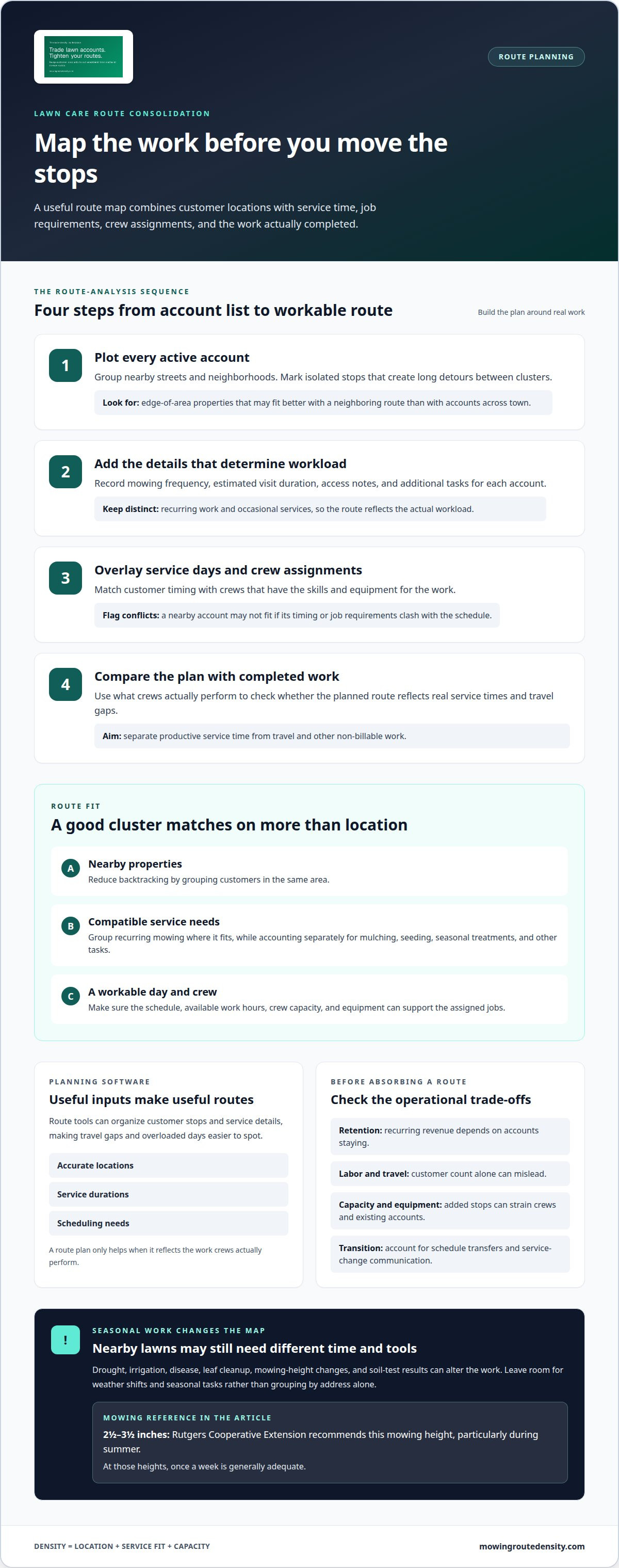
How do you map and analyze lawn care customer routes?
Start with a map of every active account, then add the work details that determine how each stop fits into the day. An address alone won’t tell you whether a route is efficient.
- Plot each customer location. Put every account on one map and group nearby streets or neighborhoods. Look for isolated stops that require a long detour between clusters. A property on the edge of a service area may fit better with a neighboring route than with accounts across town.
- Add service information. Record each account’s mowing frequency, estimated visit duration, access notes, and additional tasks. For example, a lawn needing mowing and seasonal cleanup may take longer than a routine mowing stop. Keep recurring work distinct from occasional services so the route reflects the actual workload.
- Overlay service days and crew assignments. Mark which days customers expect service and which crews have the skills or equipment for each job. A nearby account may not belong on a route if its timing or work requirements conflict with the schedule. Flag those conflicts before moving stops.
- Compare planned routes with completed work. Review crew records for travel gaps, late arrivals, return visits, and jobs that regularly run longer than expected. If stops on one side of a neighborhood finish early while another crew crosses the same area later, test a reassignment that reduces duplicated travel.
Evaluate each proposed route as a full workday, not just a cluster of map pins. Check whether travel, service duration, breaks, and schedule commitments fit available crew hours. Even a dense route can fail if it overloads a crew or leaves no room for weather delays.
Keep the map current as accounts change. Mark new customers, paused service, and completed acquisitions, then review how each change affects nearby routes. This makes route planning an operating record rather than a one-time exercise. Use the updated map to test assignments before changing customer schedules, then compare the next completed route with the original plan.
What software helps optimize lawn care routes?
Route-planning software helps organize customer addresses, service schedules, and stop sequences. For a lawn care business, a useful tool turns account details into a workable daily plan. A map shows where customers are; scheduling and route tools connect those locations to crew capacity and service commitments.
Look for functions that support the decisions your operation makes:
- Mapping: display customer addresses together, so isolated stops and overlapping service areas stand out.
- Scheduling: group recurring visits by service day and flag accounts with different timing needs.
- Route sequencing: arrange stops to reduce unnecessary backtracking between neighborhoods.
- Job records: keep service notes, estimated durations, and special access instructions with each account.
Accurate inputs matter more than a polished screen. If an account address is outdated or its service duration is consistently underestimated, the proposed route can mislead. Keep customer records current, distinguish routine mowing from seasonal work, and update time estimates when completed jobs regularly differ from the plan. This gives the software a useful picture of operations instead of making bad data look precise.
Use the tool to compare route options, not to accept every suggested sequence automatically. A route that minimizes driving, for example, may still fail if it schedules a time-sensitive visit outside the customer’s preferred window. Review crew assignments, equipment needs, service commitments, and realistic work hours before applying a change. Then compare planned stops with completed work and adjust where delays or unnecessary crossings appear.
Software can organize routes, but it can’t fix an account mix that spreads customers across distant areas or exceeds crew capacity. If analysis points to a need to reshape the territory, explore options for improving route density. Use the software to maintain the revised schedule and identify when new accounts create useful clusters rather than fresh detours.
Mowing Route Density
Mowing Route Density helps lawn care professionals address route gaps through its lawn account trading platform, mower rentals, and provider locator. If mapping reveals scattered accounts, use the platform to buy, sell, or swap service routes and reshape an operating area. When equipment capacity is the constraint, lawn mower rental offers another practical option. The provider locator connects customers with lawn mowing companies in their geographic regions.
These offerings address different needs. Route trading can help when the account mix needs adjustment. Equipment rental can help when a business needs access to mowers. The locator serves customers looking for a local mowing provider, rather than contractors consolidating accounts. Choose the next step based on the bottleneck your route analysis identified.
Contact Mowing Route Density to discuss the route challenge you’re working to solve.
Make Route Density a Deliberate Growth Decision
Review route design whenever your business changes shape. A new territory, a shift in crew capacity, or a change in customer mix can alter what makes a service area workable. Treat each change as a decision point, not an administrative update. This keeps growth aligned with the operation’s ability to serve accounts consistently.
Treat lawn care route consolidation as a business decision, not a goal in itself. The right move fits your service commitments, crew workload, and plans for the next stage of growth. A tighter route is useful only if the work remains manageable.
If you’re ready to explore a practical next step for your operation, contact Mowing Route Density. Build from what your routes are telling you, then keep moving forward with a plan that fits your business.
Frequently Asked Questions
What is lawn care route consolidation?
Lawn care route consolidation reorganizes customer accounts so crews can serve a more coherent territory with less unnecessary travel. For example, a contractor might transfer nearby recurring accounts from a route that regularly crosses the service area to a crew already working nearby. The aim is to match daily assignments to actual locations and workloads, not simply increase the number of stops.
How much can lawn care route consolidation reduce fuel and labor costs?
The reduction depends on how much avoidable travel a business removes and how crews use the time saved. Compare completed routes before and after a change over the same period, tracking fuel use, travel time, paid hours, and completed jobs. Traffic, property size, service duration, and schedule changes also affect results. A tighter route creates an opportunity for savings, not a fixed percentage.


