

A long-term aerator rental for professionals may require a refundable deposit, with the amount set by the rental terms. The deposit is separate from the rental charge, and delivery and pickup can add to the total. To estimate the full cost, look beyond the weekly or monthly rate.
That’s where crews can get caught out: a lower rental rate doesn’t always mean a lower job cost. This guide explains how rental duration, aerator size, deposit terms, and delivery distance shape the bill, so you can budget before equipment ties up cash or crew time. Rental pricing depends on the case and is provided after a quote request; the rental period, machine type, and delivery needs determine the total. You’ll also see how to compare walk-behind, tow-behind, and ride-on options against the work on your route. The goal is straightforward: choose a rental window and machine that fit the workload, avoid paying for capacity you won’t use, and keep the job’s equipment costs in line with the work it brings in.
Key Takeaways
- Compare weekly and monthly terms with the daily rate to see whether a longer rental period fits your workload.
- Match the aerator’s working width and machine type to the properties on your route; extra capacity can add cost without saving time on smaller sites.
- Build the full rental budget around more than the base rate: deposits, delivery, pickup, and rental duration all affect the total.
- Plan around seasonal demand and job timing so equipment is available when your route needs it.
- Use lawn mower rental, route trading, or the service provider locator to address other equipment and workload needs in your lawn care business.
Aerator working widths and tank capacity
Working width determines how much ground an aerator covers with each pass. A commercial stand-on plug aerator has a 30-inch aerating width. That broader path can reduce overlapping passes across open lawns, but it won’t remove the need for careful turns around obstacles.
Measure the route before choosing a machine. Note narrow gates, tree rings, landscape beds, and hardscape edges. A 30-inch deck may cover open turf efficiently, while tighter spaces demand more maneuvering. Responsive controls and a tight turning radius help operators work around those features with less turf damage.
Width alone does not determine an aerator’s performance. Tine design, soil condition, and machine weight also affect penetration. A true core plug system removes soil cores to help relieve compaction. In dry, compacted soil, a high-torque commercial-grade engine is designed to help maintain tine penetration.
Operator layout matters over a full route. A stand-on platform is designed to improve visibility and maneuverability while reducing fatigue during long workdays. Better sightlines can help operators navigate landscape beds and tree rings, reducing corrections and wasted time.
Consider tank capacity separately from working width. On a model with a ballast tank, capacity determines how much ballast it can carry. Added weight can affect tine penetration, particularly in firm soil. Compare usable tank capacity with operating weight instead of assuming a larger tank will deliver better results. Tank capacity is not aerating width and does not indicate how much turf each pass covers.
Use this sequence when comparing machines for a route:
- Measure the narrowest access point and compare it with the machine’s overall width.
- Estimate open turf separately from tight areas that need slower, careful passes.
- Match the aerating width to the property layout, not just its total area.
- Review tank capacity and operating weight when ballast affects the model’s setup.
- Consider soil conditions, including dry, compacted ground.
For long-term aerator rental for professionals, these details help prevent a costly mismatch. A wide machine can reduce passes on open ground but slow work where access is tight. A narrower working width may suit complex properties, while adequate weight and tine penetration remain essential. Compare access, soil, controls, and capacity together before choosing a model for repeated route work.
Daily, weekly, and monthly aerator rental rates
Rental duration changes the cost per working day.
Machine type shifts the daily rate.
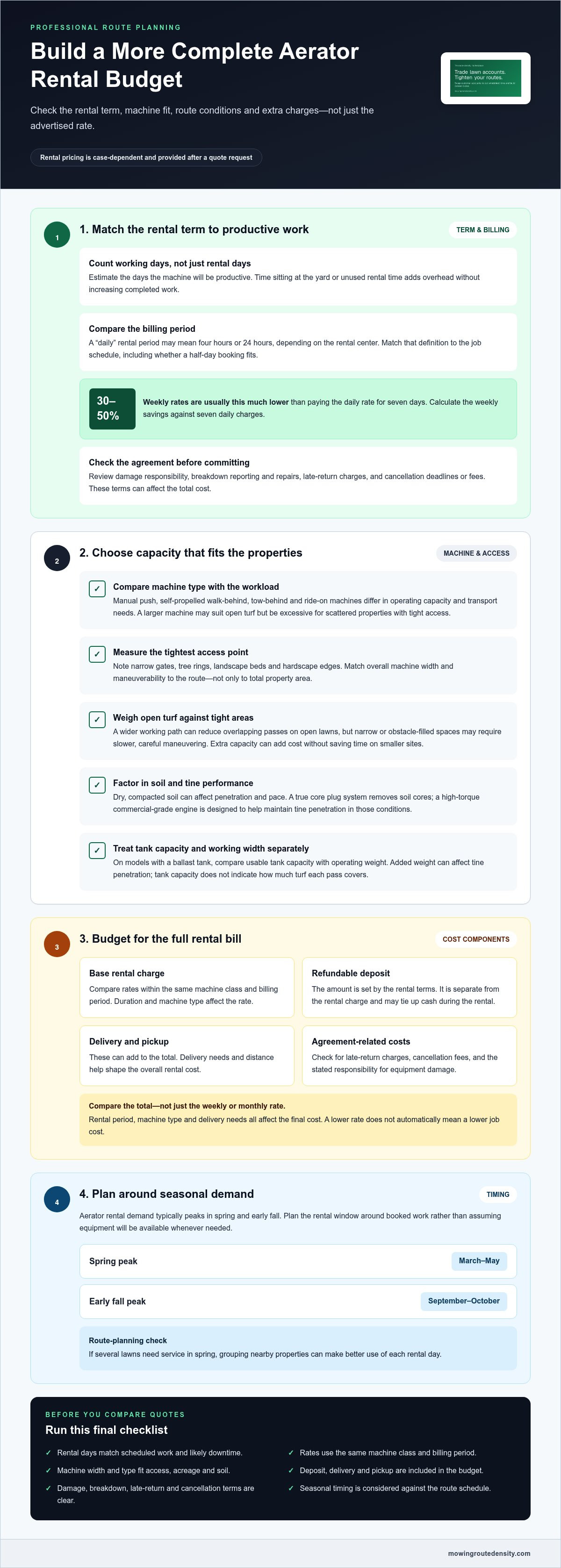
Weekly agreements can suit a crew working across several sites. Weekly rates are usually 30 to 50 percent lower than paying the daily rate for seven days.
Monthly rental terms can suit sustained route demand, but compare machine classes before comparing total costs.
Before choosing a term, calculate the days the machine will be productive, not simply the days it sits at your yard. Spring and early fall demand typically peaks, so rental timing can shape the options available. Also compare the agreement’s billing unit: rental centers may define a daily period as four hours or 24 hours. That difference can change the effective cost of a short job.
The rental agreement should explain responsibility for equipment damage, how to report a breakdown, and what happens during repairs. It should also specify late-return charges and cancellation terms, including any deadlines or fees. These details affect the total cost as much as the listed rate.
- Match the rental period to scheduled work and likely downtime.
- Compare rates within the same machine class and billing period.
- Calculate weekly savings against seven daily charges.
- Read damage, breakdown, late-return, and cancellation terms before signing.
If your route also needs mowing equipment, lawn mower rental can help you plan that equipment need alongside aeration work.
Factors that affect rental costs
Rental duration is one of the first cost factors to assess. A short job may fit a half-day booking, while multiple properties may require a full day. Compare the billing period with your route schedule. Paying for unused rental time adds overhead without increasing completed work.
Machine type also affects the rate. Manual push, self-propelled walk-behind, tow-behind, and ride-on aerators differ in operating capacity and transport needs. A larger machine may cover open turf efficiently but be excessive for scattered properties with tight access. Consider access, acreage, and soil conditions together. The cheapest category is not necessarily the lowest-cost choice if it slows the crew.
Season affects demand and rental planning. Demand for aerator rentals typically peaks in spring, from March to May, and early fall, from September to October. Those busy periods matter when crews have fixed job schedules. Plan the rental period around booked work instead of assuming equipment will be available whenever needed. If several lawns need service in spring, group nearby properties to make better use of each rental day.
Job conditions matter, too. Dry, compacted soil can affect tine penetration and working pace; a high-torque commercial-grade engine is designed to help maintain penetration in those conditions. Dense, compacted soil may call for a true core plug system that removes soil cores. A machine suited to the soil can help avoid unproductive passes. Property layout matters as well: narrow access, landscape beds, and hardscape features can slow a wide machine.
Before estimating the total, list the factors that affect your specific route:
- Rental period: Match the half-day or 24-hour booking to scheduled work.
- Machine class: Compare manual, self-propelled, tow-behind, and ride-on options.
- Season: Plan around spring and early-fall demand peaks.
- Site conditions: Account for soil compaction, access, and obstacles.
- Utilization: Group jobs so the rented machine spends more time working.
Estimate productive hours, not just calendar time. A crew serving several nearby lawns can reduce travel between jobs and keep the machine working. A route spread across distant properties may leave more rental time idle. That can change which rental period makes sense, even when the machine and daily rate are the same.
For long-term aerator rental for professionals, weigh these factors together. The model sets the basic rate, while duration, seasonal demand, and job conditions determine how efficiently that rate translates into completed work.
Choosing an aerator size
Start with the turf area, then account for access and obstacles. For a yard under half an acre, a standard walk-behind plug aerator is the recommended choice. It suits smaller properties without bringing a larger machine onto tight lawns. For routes with mixed property sizes, assess each site instead of choosing a machine based only on the largest lawn.
Open acreage changes the calculation. A commercial stand-on plug aerator has a 30-inch aerating width, which can cover open turf with fewer passes than a narrower machine. That width can become a disadvantage around narrow gates, landscape beds, tree rings, and hardscape. Measure access points and walk the planned path before selecting equipment. The route’s tightest areas can set the size limit.
Match the machine to how the crew will move between sites. A walk-behind model suits smaller lawns and close maneuvering. A tow-behind model may fit jobs where the crew has compatible towing equipment and room to turn. Larger tow-behind or ride-on aerators suit broader work areas but need practical access and maneuvering space. A machine that cannot reach the turf wastes rental time.
Soil condition should also guide the choice. A true core plug system removes soil cores and helps relieve compaction in dense, compacted soil. Dry, compacted soil can challenge tine penetration, so a high-torque commercial-grade engine is designed to help maintain it. Choose based on the ground the crew will actually aerate, not just the machine’s stated width.
Use this short site review before choosing a size:
- Map the turf: Separate open sections from narrow or obstructed areas.
- Check access: Compare gates and paths with the machine’s overall dimensions.
- Consider the soil: Note compaction and whether a core plug system suits the work.
- Plan the route: Identify turning space around trees, beds, and hardscape.
- Match the machine: Choose walk-behind, tow-behind, or ride-on equipment for the site mix.
For example, a property under half an acre with narrow access points points toward a standard walk-behind plug aerator. A route dominated by open lawns may justify comparing wider equipment, including a 30-inch stand-on model. If only a few properties have tight turns, plan those separately rather than forcing one oversized machine through every site.
For long-term aerator rental for professionals, the right size completes the scheduled work without creating access problems. Compare acreage, ground conditions, and route layout together. This helps reduce wasted passes and keeps the equipment suited to the job.
Deposits and delivery fees
These charges are separate from the rental rate, so include them when estimating the cash needed to put equipment on a job.
Budget the deposit separately from the rental expense. The deposit is generally returned, while delivery and pickup fees are additional costs. For example, when arranging delivery to a distant job site, account for both transportation charges and the temporary deposit. Do not treat the deposit as part of the rental rate or assume it reduces the final bill.
Distance affects delivery and pickup fees. A rental location closer to your work area may have a different transport charge than a distant site. For routes covering several properties, consider where the aerator will be delivered and collected. If the machine moves between locations, plan the sequence to avoid unnecessary transport arrangements.
Before signing, read the agreement for the deposit amount, return process, and delivery terms. Check how the equipment’s condition is recorded at handoff and return. Note existing wear, and keep the rental paperwork with the job records. These steps help distinguish the deposit from other charges and clarify the agreement’s terms on equipment condition.
Use this cost review before scheduling delivery:
- List the rental rate: Keep it separate from the deposit and transport charges.
- Map the route: Set the delivery point around the scheduled work locations.
- Record condition: Document the aerator’s condition at handoff and return.
For a long rental, include these items in one working estimate. Show the deposit separately as a temporary cash requirement, then add delivery and pickup to the rental expense. This gives the crew a clearer picture of the amount tied up temporarily and the costs that remain after the equipment is returned.
For example, compare delivery plans by considering distance, job sequence, and pickup logistics. The lower transport charge may not be the better fit if it disrupts the work route. Coordinating delivery with the first scheduled property and pickup near the final job may simplify equipment handling. The location and route determine which plan is practical.
With long-term aerator rental for professionals, deposits and delivery costs can be easy to overlook beside the recurring rental rate. Track each separately, factor distance into transport costs, and keep the agreement’s return terms with your job records. This makes the full equipment commitment easier to plan.
Mowing Route Density: lawn mower rental
Mowing Route Density helps lawn care professionals manage related equipment and route needs. If your aeration schedule also creates a gap in mowing equipment, its lawn mower rental offering may suit that need. The lawn account trading platform lets contractors buy, sell, or swap service routes, while the lawn mowing service provider locator connects people with professional mowing companies.
Turn to these tools when equipment needs or route planning affect your workload beyond aeration. They address adjacent business needs, not aerator rental itself. For details on Mowing Route Density’s offerings, visit Mowing Route Density.
Put Your Equipment Plan to Work
A long-term aerator rental for professionals works best as part of a broader operating plan. Use your schedule to identify overlapping equipment demand, opportunities to reduce wasted travel through route changes, and the work that deserves priority. This keeps the focus on productive hours rather than equipment sitting idle.
For your other lawn care operations, Mowing Route Density offers lawn mower rental, a lawn account trading platform for buying, selling, or swapping service routes, and a lawn mowing service provider locator. Choose the tools that address your operational needs, whether equipment or route planning, and match them to the work you plan to complete.
Contact Mowing Route Density to explore the available tools for your lawn care business. A clear plan puts your next workday on firmer ground.
Frequently Asked Questions
Do I need to pay a deposit when renting an aerator?
Usually, yes. Treat the deposit as cash temporarily tied up, not as part of the rental rate. Include it alongside the equipment charge when budgeting a job. Keep the rental agreement and return records together to track the deposit through equipment return and any refund process.
What Affects Your Aerator Rental Cost?
The rental period, aerator type, seasonal demand, and delivery distance all affect the total. Your route matters, too: a machine sitting idle between distant properties uses paid rental time without producing work. When practical, schedule nearby lawns together and align the rental period with that route. Include the deposit and delivery or pickup charges in your cash plan instead of comparing the base rate alone.
What are the weekly and monthly rental prices for commercial lawn aerators?
Rates vary by machine type. Compare similar machine types and rental periods to maximize your long-term aerator rental for professionals investment.
Do rental companies offer discounted long-term rates or seasonal contracts for aerators?
Weekly rates are usually 30 to 50 percent lower than paying the daily rate for seven days. That gives crews a useful basis for comparing a weeklong booking with separate daily rentals. Seasonal contracts aren’t covered by a single standard rate in these figures. For a planned season, calculate expected working days and downtime first, then compare the total rental period with weekly terms.
What aerator size and type is best for a landscaping business based on acreage, soil, and workload?
For a yard under half an acre, a standard walk-behind plug aerator is the recommended choice. For larger open lawns, compare broader equipment, such as a commercial stand-on plug aerator with a 30-inch working width. Soil matters: heavy, compacted regional clay soils benefit from a true core plug system that removes soil cores. Also account for gates, turns, and the mix of properties on your route, especially when managing Mowing Route Density.
What deposit, insurance, and business-account requirements apply to long-term aerator rentals?
Most rental providers require a security deposit, proof of general liability insurance naming the rental yard as additionally insured, and an established commercial business account with verified credit or a major credit card on file.
Are delivery, pickup, maintenance, and replacement equipment included in long-term aerator rental agreements?
The agreement should explain responsibility for damage, how to report a breakdown, and what happens during repairs. Delivery and pickup fees may be waived or discounted for extended rental terms, while routine wear-and-tear maintenance is typically covered unless negligence is found.
How do long-term aerator rental costs compare with buying or leasing a commercial aerator?
Renting long-term avoids high upfront purchase costs, depreciation, and off-season storage expenses. While purchasing makes financial sense for year-round heavy usage, extended rentals and commercial leases offer greater flexibility for scaling fleet size during peak aeration seasons without long-term capital commitments.


